Blog
Irrigation Junction Box for Agricultural Field Wiring
An irrigation box usually fails for reasons upstream of the enclosure: entry count, 24 VAC volt drop on the common, valve boxes that drain by design, and condensation.
Read More
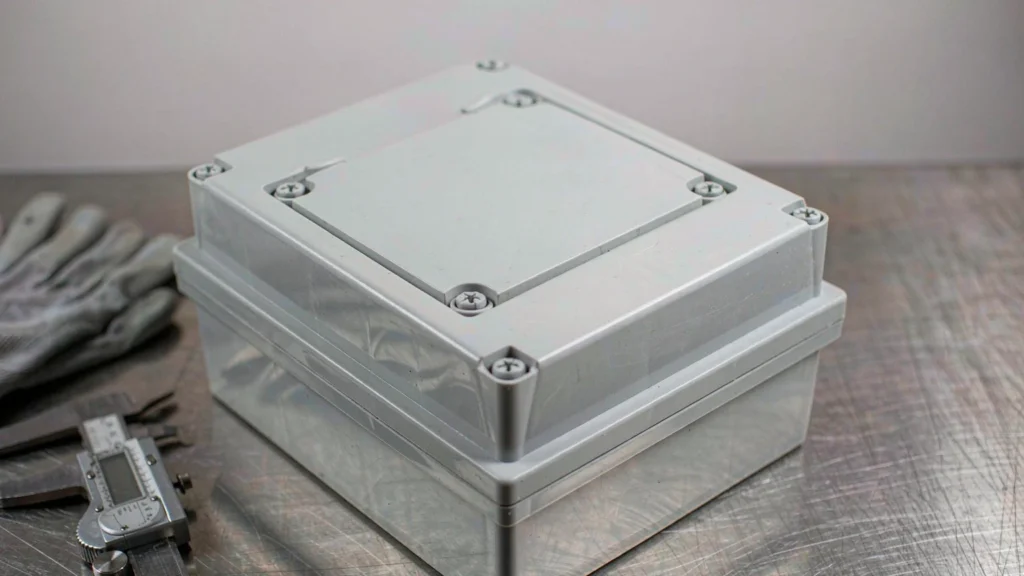
An IEC 60670 test report is the only document that tells you a junction box was assessed as a box rather than as a moulded part. It covers construction, marking, shock protection, degree of protection, mechanical strength, heat and fire resistance — and the space available for the conductors inside.
It is also the standard most often misquoted in a quotation. Suppliers print “IEC 60670 compliant” on a datasheet without naming the part, the edition or the tests run. This article reads the two parts that matter and separates what a report proves from what a certificate claims. Our waterproof junction box range is the example.
IEC 60670 is a family, not a document. Part 1 holds the general requirements and is never used alone; the other parts add requirements for one kind of box. A connecting box is Part 1 plus Part 22, and quoting only the family name tells a laboratory nothing.
| Part | Applies to | Relevant when |
|---|---|---|
| 60670-1 | General requirements | Always, as the base document |
| 60670-22 | Connecting boxes and enclosures | The box joins or taps cables with terminals |
| 60670-24 | Enclosures for protective devices | Up to 400 V, incoming current to 125 A |
The scope sentence deserves a literal reading. Part 22 applies to boxes and enclosures for electrical accessories rated up to 1,000 V AC or 1,500 V DC, for household or similar fixed installations, indoors or outdoors, and it covers junction connecting boxes and tapping connecting boxes. Declared ambient is +40 °C maximum, a 24-hour average no higher than +35 °C, and −5 °C minimum.
Two consequences follow. A box installed where ambient sits outside that window needs a different classification. And a box housing protective devices belongs to Part 24 — which is why some enclosures arrive marked 60670 with no thermal data at all.
Part 1 classifies a box across nine dimensions: material, installation type, inlet type, clamping means, minimum temperature, protection against solid objects, protection against water, internal protection of hollow-wall parts, and provision for fixing accessories. A report lists the classifications the sample achieved; your order should list the same ones.
| Classification | What to write on the order | Why it changes the test |
|---|---|---|
| Material | Insulating, metallic or composite | Different impact and insulation test set |
| Installation type | Surface, flush, or hollow wall class Ha or Hb | Hollow-wall boxes carry extra tests and must be marked Ha or Hb |
| Inlets | The inlet type, or “without inlets, made on site” | An opening drilled later is outside the tested configuration |
| Minimum temperature | −5 °C, −15 °C or −25 °C | The low-temperature impact test is run at that figure |
Write classifications, not the family name. A line such as “insulating, surface mounting, inlet 7.3.5 for threaded entries, minimum temperature −15 °C, IP66” gives a laboratory something to test and a supplier no room to substitute. Add the edition too: 60670-1:2024 and 60670-22:2024 are current, so a report to the 2015 or 2003 edition describes an older requirement set.
Clause 8 of Part 1 requires the manufacturer’s name or mark, the type reference, and the IP numerals wherever declared protection is higher than IP4X or IPX2. Hollow-wall boxes must carry the symbol Ha or Hb.
Two requirements catch people out. Hollow-wall boxes must show minimum internal volume in cm³ on the inside, readable after installation but before devices go in. And the marking must survive a fifteen-second water wipe followed by a fifteen-second solvent wipe, then stay legible — a screen print that rubs off in the back of a van fails the clause even when every other test passes.
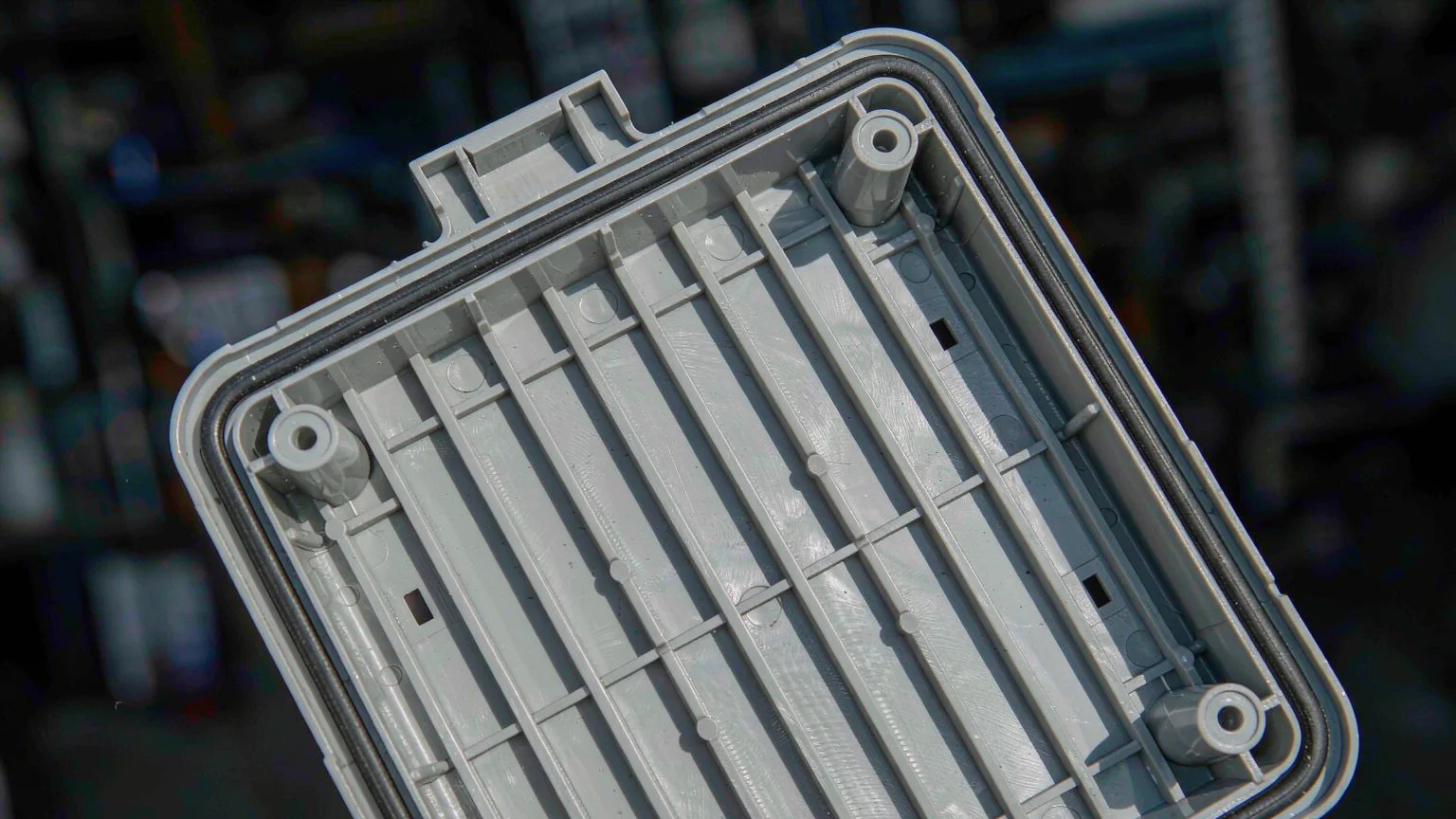
Part 22 is mostly about how terminals are held and whether the box has room for the conductors. Terminals may be integrated with a compression unit, integrated as part of the connecting device, provided for separately, or left floating. Where the cover fixing also secures the connecting device, that device has to stay in place with the cover removed.
The space requirement is checked the hard way: the laboratory fits the maximum number of conductors at the largest cross-section the box claims, or the worst combination, and confirms the connection still works to IEC 60998. This sits behind our guide to how many cables a junction box takes, and explains why a generous-looking box can fail on a four-core splice. Entries are classified separately, as covered in knockouts versus threaded glands.
Part 22’s second edition was published in December 2024, replacing the 2003 edition and its 2015 amendment. Three changes matter before you accept an old report.
Annex CC is the commercially useful one: it gives an outdoor box a defined sunlight test to be measured against instead of the words “UV stabilised”. Part 1 gained a normative annex for IK code testing in the same revision.
A full report runs the clauses below; partial reports are normal, but know which are missing.

| Test | Requirement |
|---|---|
| Protection against electric shock | Test probe 11 of IEC 61032, 20 N for one minute, no penetration |
| Earthing continuity | 25 A test current, resistance 0.05 Ω or less to each exposed conductive part |
| Degree of protection | Per IEC 60529; drain holes of 5 mm or 20 mm² where IPX1 to IPX6 applies |
| Insulation resistance and electric strength | 5 MΩ minimum, then 1.25 to 3.5 kV according to rated insulation voltage |
| Ball pressure and glow wire | Indentation 2 mm or less at 125 °C; IEC 60695-2-11 on insulating material |
| Ageing | 70 °C for 168 h, then 96 h at room temperature with no damage |
The IP side of that table is covered level by level in our IP rating comparison for boxes.
It is not a CE certificate. For a box rated 50 to 1,000 V AC, the legal instrument is the manufacturer’s declaration of conformity; a test report supports the technical file but does not replace it. The document set is a separate exercise, covered in our guide to CE and RoHS documents for EU buyers.
It is not the standard for what you install inside, either — switchgear assemblies follow IEC 61439 once devices are fitted. And it is not the cable gland standard, which is IEC 62444. A box tested to 60670 with an untested gland through its wall is a tested box with an untested seal.
Ask for the report rather than the claim, and read four things.
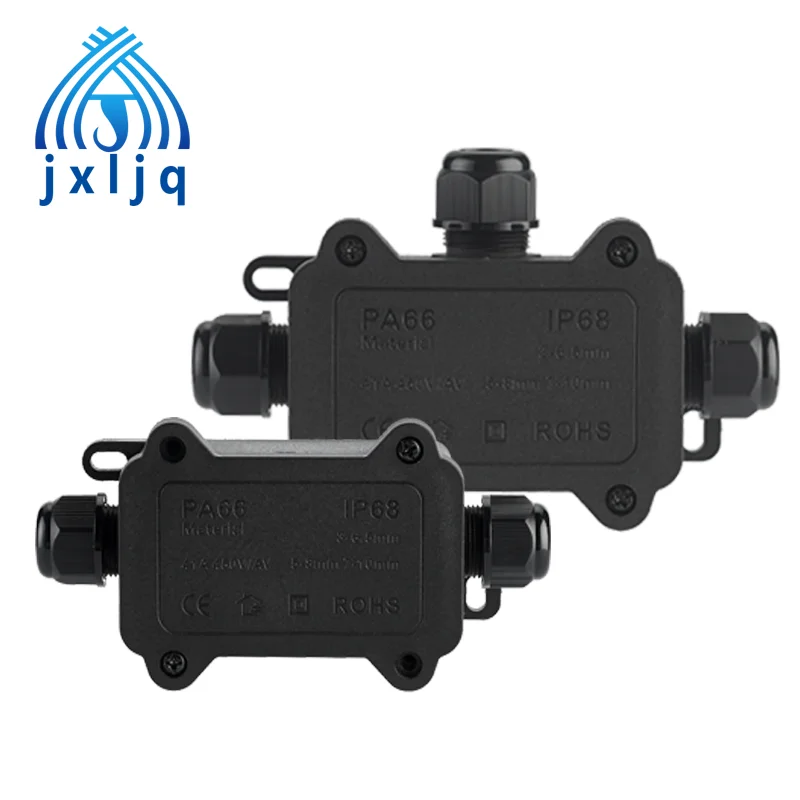
Where our own range is concerned, be direct: JX-AG is published as IP67 with IK08 and RoHS, JX-RA as IP55/IP65 with CE and RoHS, and F1 as IP68 with a flame-retardant PA66 housing and UL94 V-0. None of the three carries a published 60670 report today. If your project needs one, ask before you order and we will tell you what exists and what can be arranged. Material choice interacts with all of it — see our junction box material comparison.
IEC 60670 answers one question: was this box assessed as a box? Construction, marking, terminals, conductor space and behaviour under impact, heat and water all sit inside the test set, and Part 22 governs a connecting box. Request the report, check the edition, and put the classifications on the order instead of the standard’s number.
No. There is no certificate to obtain. Declaring conformity is the manufacturer’s own act, supported by a technical file that may include a 60670 report as evidence.
Part 22, with Part 1. It is written for junction and tapping connecting boxes, and adds the terminal fixing and conductor space requirements a plain enclosure does not face.
It describes a real test, but the 2024 editions added cable joints, Annex CC sunlight exposure and Annex DD encapsulation. If outdoor durability is the point you are being asked about, an older report may not address it.
No. It applies the IEC 60529 tests at whatever IP level the box declares, and tests the box as assembled. A gland, an unused entry or a field-drilled opening changes the assembly, and therefore the protection, without changing the report.
The classification list on the first pages — material, installation type, inlet classes, minimum temperature and IP level. It is the only basis for comparing the sample to your installation.
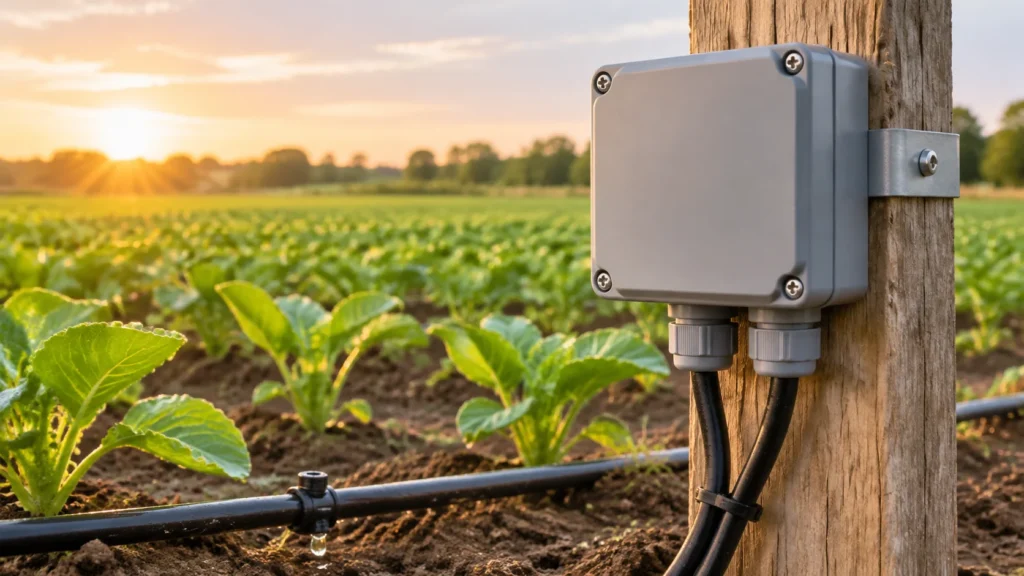
An irrigation box usually fails for reasons upstream of the enclosure: entry count, 24 VAC volt drop on the common, valve boxes that drain by design, and condensation.
Read More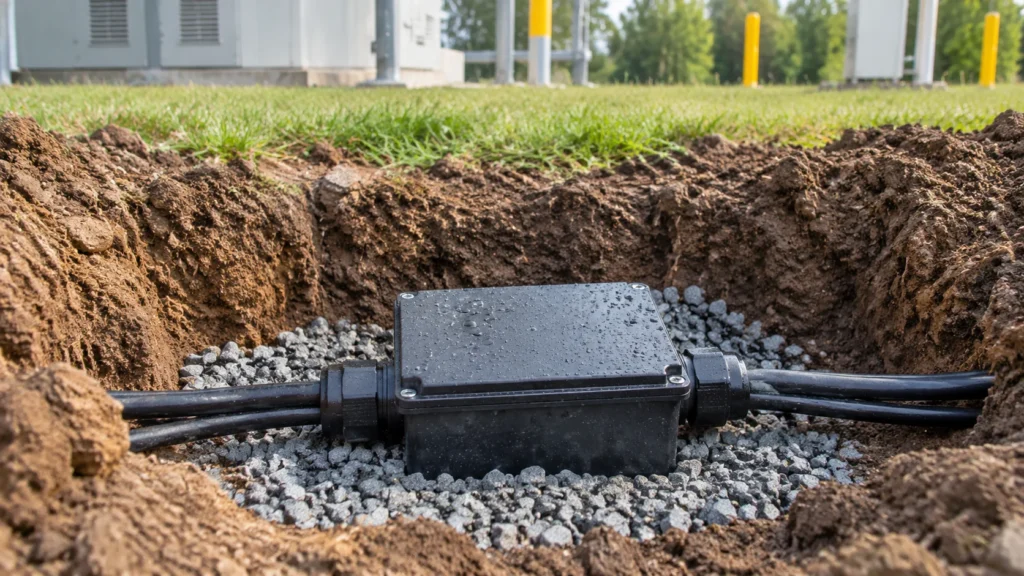
NEC 314.29, the gravel-pit exception, cable depth rules and the conduit convection loop that fills a buried IP68 box with water. What to build instead of burying a splice.
Read More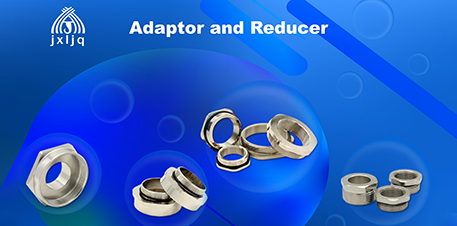
When to use a cable gland adaptor, reducer or enlarger: the difference between them, common thread combinations, and how to keep the IP rating when threads do not match.
Read More