Blog
Application of the Cable Glands on CCTV Systems
How cable glands protect CCTV cameras, junction boxes and NVR cabinets: IP68 sealing, nylon vs brass, multi-hole entries, and hazardous area options.
Read More
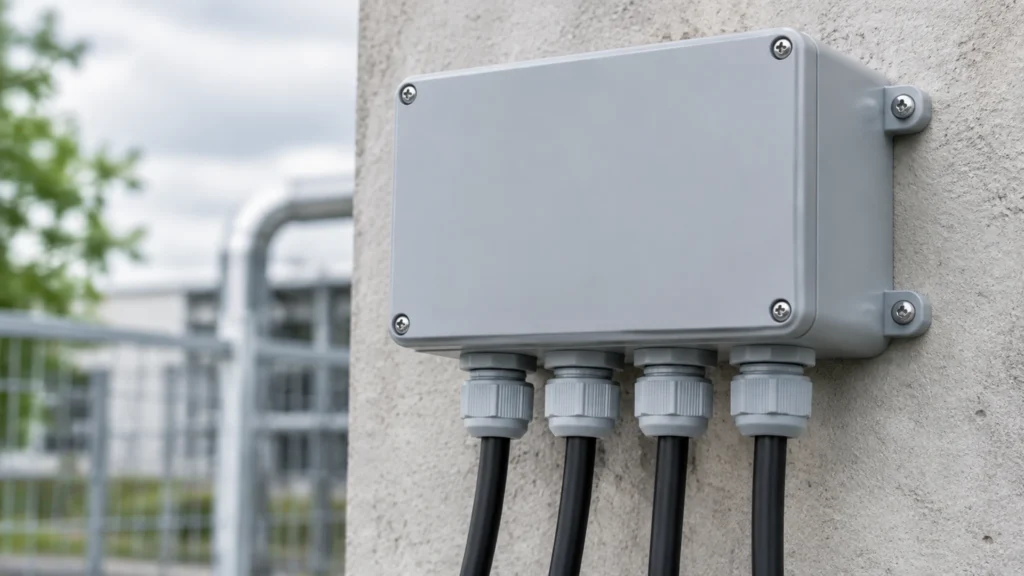
Most answers to how many cables in a junction box you can fit cite a wire-count table and stop. That table is real, but it answers a different question: how many conductors a box holds under the US National Electrical Code. It says nothing about how many cable entries the housing has, how many terminals sit inside, or whether a gland can seal two cables at once. This article separates those three limits and gives you the arithmetic to size a box correctly.
A cable count is the lowest of three numbers:
In practice, on a compact IP-rated box the entry count binds first. On a large adaptable box used as a pull point, volume binds first.
A cable gland seals on the cable’s outer sheath. That seal is a single annular compression around one circular profile, so putting two cables through one gland gives you an oval bundle that the seal cannot close on. The same applies to push-in stoppers and to moulded membrane entries unless the manufacturer explicitly rates the membrane for multiple cables.
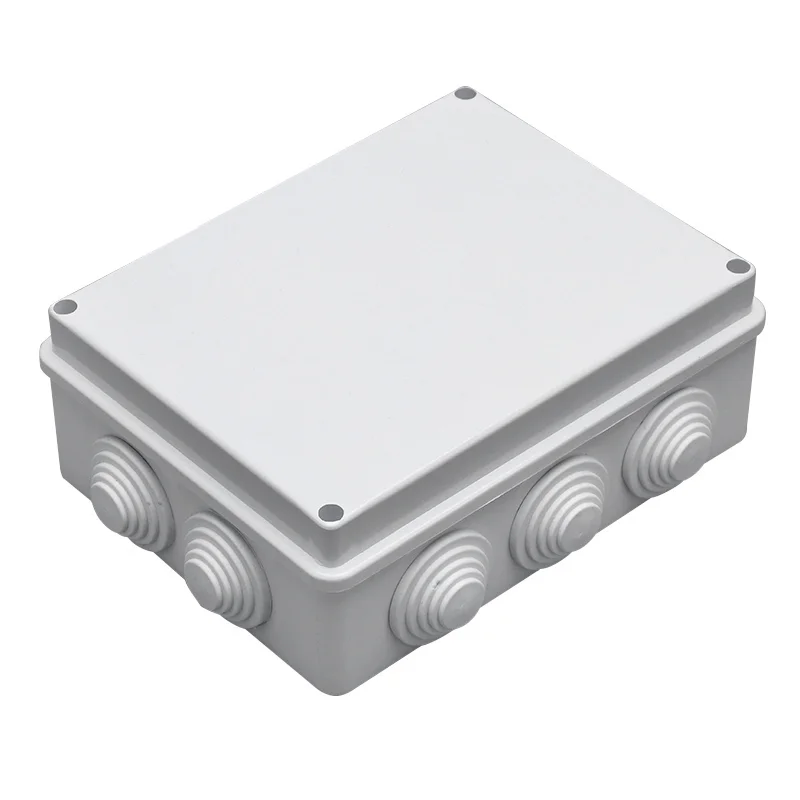
So the hard ceiling is the number of openings in the housing. Our own datasheet publishes that number per model, which makes it checkable before you buy:
| JX-RA model (mm) | Openings | Hole size | IP |
|---|---|---|---|
| 50 × 50 | 4 | 25 mm | IP55 |
| 85 × 85 × 50 | 7 | 25 mm | IP65 |
| 100 × 100 × 70 | 7 | 25 mm | IP65 |
| 150 × 110 × 70 | 10 | 25 mm | IP65 |
| 200 × 155 × 80 | 10 | 36 mm | IP65 |
| 200 × 200 × 80 | 12 | 36 mm | IP65 |
| 300 × 250 × 120 | 12 | 36 mm | IP65 |
| 400 × 350 × 120 | 16 | 36 mm | IP65 |
Two things follow. First, the smallest model with 4 openings is also the only one rated IP55 — the size with the fewest entries has the weakest seal, so “just use the small one” is a double compromise. Second, unused openings must be closed with the supplied stoppers; an open hole is not spare capacity, it is an ingress path. The cable entry comparison covers knockouts, glands and moulded entries.
The second ceiling is inside. A conductor has to land somewhere, and each terminal position takes one conductor within a stated range. The F1 mini series shows how the numbers move with configuration:
| Model | Openings | Cable OD range | Wire size | Rating |
|---|---|---|---|---|
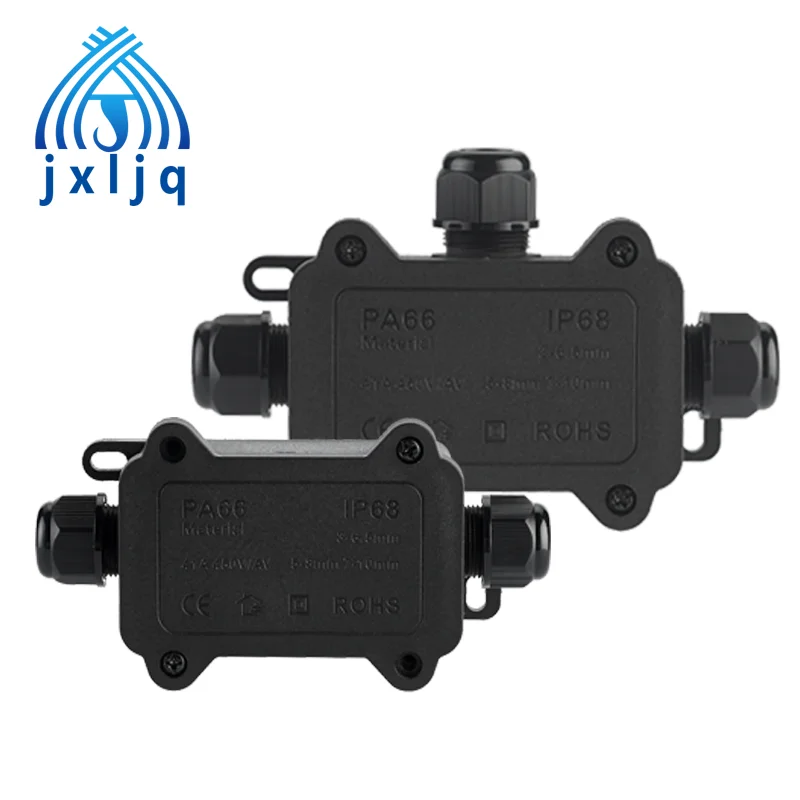
| MN-01 | 2-way | 3–6.5 mm | 0.5–4 mm² | 16 A / 450 V |
| MN-02 | 2-way | 5–8 mm | 0.5–4 mm² | 16 A / 450 V |
| MN-03 | 2-way | 7–10 mm | 0.5–4 mm² | 16 A / 450 V |
| MH-05 | 3-way | 3–6.5 mm | 0.5–2.5 mm² | 24 A / 450 V |
| MH-06 / 07 | 3-way | 5–8 / 7–10 mm | 0.5–2.5 mm² | 24 A / 450 V |
| MN-8 / MN-9 | 4-way | 3–6.5 / 5–8 mm | 0.5–2.5 mm² | 24 A / 450 V |
Read the wire size column carefully, because it reverses the usual assumption: the 2-way models accept a larger conductor (4 mm²) than the 3- and 4-way models (2.5 mm²). More ways means smaller terminals. If your circuit needs 4 mm² — a long 12 V landscape run, for instance — you are limited to two cables even though a 4-way body exists.
The datasheet also does not publish a pole count, and that is the number that actually caps your cable count. Ask before you order: if a 3-core cable enters a 2-way body, the block must offer three positions per side, not two. Suppliers who cannot answer this have not specified the terminal, only the housing. The F1-2T/3T/4T mini junction box page lists cable range, wire size and rating per order number, which is the minimum you should expect.
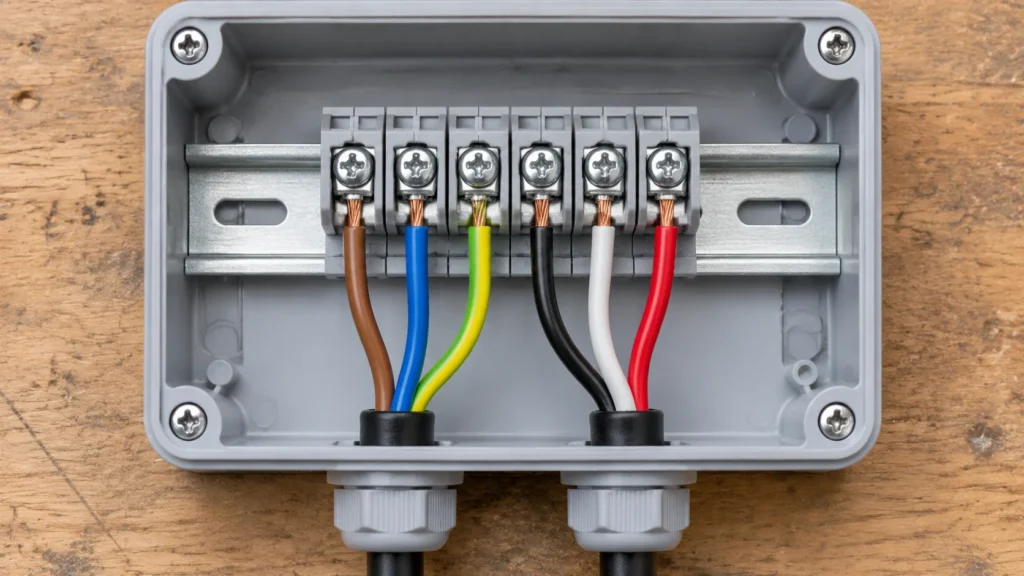
Volume is the only limit with a published arithmetic, and the NEC version is the most widely copied. Under NEC 314.16 you count volume allowances and compare them to the box’s marked cubic-inch capacity. The allowance per conductor depends on size:
| Conductor | Volume per allowance | Conductor | Volume per allowance |
|---|---|---|---|
| 18 AWG | 1.50 in³ | 12 AWG | 2.25 in³ |
| 16 AWG | 1.75 in³ | 10 AWG | 2.50 in³ |
| 14 AWG | 2.00 in³ | 8 AWG | 3.00 in³ |
| 6 AWG | 5.00 in³ | — | — |
The counting rules are where most people lose the calculation. Each conductor that enters and terminates counts once. All equipment grounding conductors together count as one allowance, however many there are. All internal cable clamps together count as one. Each device on a yoke counts as two. External connectors threaded into knockouts count as nothing.
Three 12 AWG cables, each with a hot and a neutral, plus grounds, entering a box with internal clamps. Six current-carrying conductors, one grounding allowance, one clamp allowance: eight allowances × 2.25 in³ = 18.0 in³. A 4 × 4 × 1½ inch box is rated 21.0 in³, so it passes with 3 in³ to spare.
Now add a receptacle on a yoke. That is two more allowances, so ten × 2.25 = 22.5 in³, which exceeds 21.0. The box that passed a moment ago now fails, and you step up to a 4 × 4 × 2⅛ inch box at 30.3 in³. That is the trap: three cables is fine until a device appears, and the yardstick everyone remembers — “a 4 × 4 box takes six 12 AWG conductors” — was never the answer to the question being asked.
Outside North America there is no equivalent fill table. IEC/EN 60670-22 covers connecting boxes and requires the manufacturer to declare the intended use and the conductor capacity, rather than prescribing a universal cubic-inch allowance. The practical consequence is that the metric answer to “how many cables” is a document request, not a calculation: ask for the declared conductor capacity and the terminal specification per model.
Two IEC-side limits usually govern instead: terminal current rating and conductor range, as in the table above, and voltage drop and grouping, which are circuit calculations rather than box calculations.
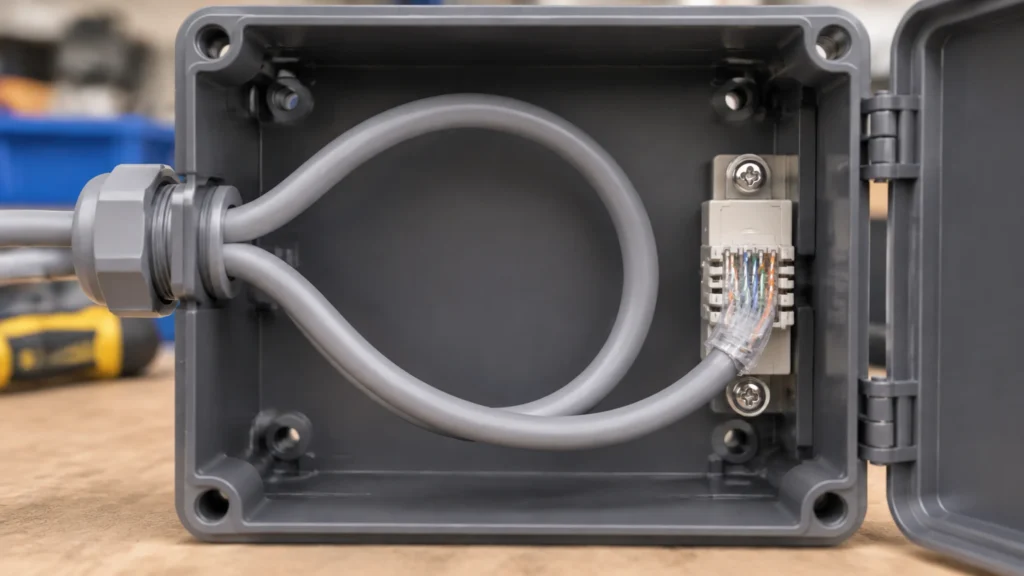
Conductors need room to fold. A neat splice with a 90° fold needs roughly twice the cable diameter in clear depth behind the terminal, and data cable is far worse: category cable is typically specified at four times the outer diameter as a minimum bend radius, so a 6 mm Cat6 needs a 24 mm radius, meaning about 48 mm of clear depth for the loop alone.
That single number rules out most shallow boxes for network work regardless of how many cubic inches they claim. If you are terminating data, size on depth first and count second — the junction box size chart tabulates dimensions against typical cable counts for exactly this reason.
If all four answers are yes, the box is correctly sized. If any is a guess, it is not. Asked plainly — how many cables in a junction box will fit — the honest answer is that it depends on all four, and the datasheet only gives you two of them.
The mini junction box guide walks the same sequence for compact enclosures, and the 2-way versus 3-way versus 4-way comparison covers how configuration changes what fits.
How many cables fit is not one number. It is the smallest of the entry count, the terminal count and the volume allowance — and on sealed boxes the entry count usually wins. Check openings and wire range, run the fill arithmetic with devices included, then confirm depth for the bend. The JX-RA plastic waterproof junction box range runs from 4 openings to 16, so if your count does not fit one size, it will fit the next.
Four, if the body has four openings and each is glanded or stoppered. The 4-way F1 models accept cable from 3–6.5 mm (MN-8) or 5–8 mm (MN-9) with conductors up to 2.5 mm², so four cables is the entry limit and 2.5 mm² is the conductor limit.
No. A gland seals one circular sheath, so two cables produce an oval bundle the seal cannot close on. Use a multi-entry gland rated for multiple cables, or add an opening. Sharing an entry is one of the most common causes of a box that tests dry and leaks in service.
Yes, but only once. All equipment grounding conductors in the box together take a single volume allowance based on the largest one. The mistake that fails inspections is forgetting them entirely, which adds about 2.25 in³ at 12 AWG.
No universal table. IEC/EN 60670-22 leaves conductor capacity to the manufacturer’s declaration, so on a metric project you request the declared capacity and terminal specification rather than calculating cubic inches.

How cable glands protect CCTV cameras, junction boxes and NVR cabinets: IP68 sealing, nylon vs brass, multi-hole entries, and hazardous area options.
Read More
Read IP68 test reports with confidence: what IEC 60529 immersion testing covers for cable glands, what a real report contains, and how to verify a supplier’s IP68 claim before you buy.
Read More
Practical EMC cable gland grounding guide: 360° shield termination steps, panel preparation, common mistakes, and continuity checks.
Read More