Blog
Application of the Cable Glands on CCTV Systems
How cable glands protect CCTV cameras, junction boxes and NVR cabinets: IP68 sealing, nylon vs brass, multi-hole entries, and hazardous area options.
Read More
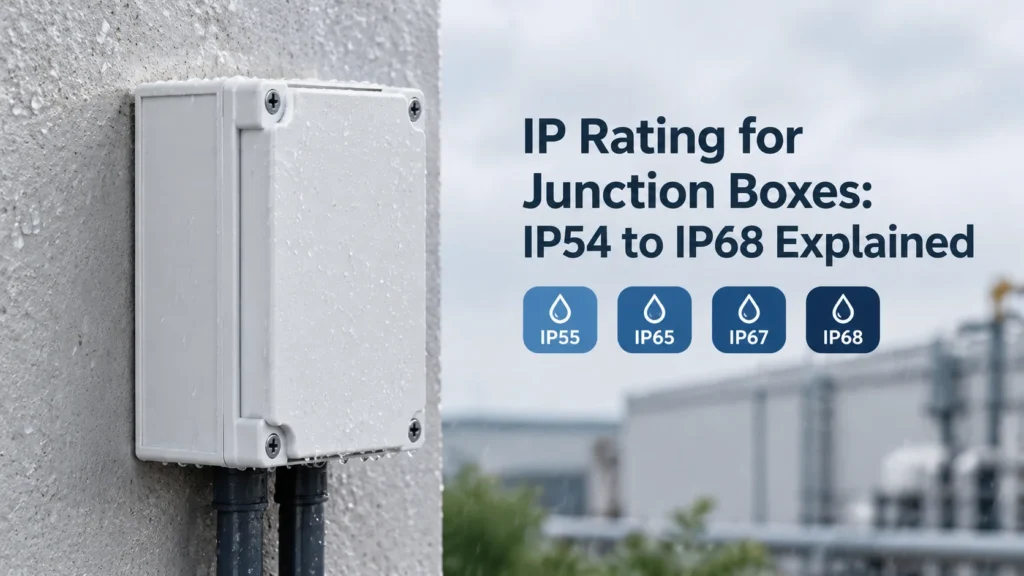
A junction box IP rating is the only line in an enclosure datasheet that tells you what happens when water arrives, and it is the most misread line on the sheet. Buyers compare IP65, IP66, IP67 and IP68 as steps on one ladder, when each is a separate test with its own nozzle, flow rate, pressure and duration. Choosing an IP rating junction box for an exposed site therefore comes down to matching a specific water event to a specific test, not to picking the biggest digit.
IEC 60529 defines two independent digits. The code says nothing about impact, corrosion, UV, temperature or condensation; it answers one question only, which is how much solid and how much water gets in under a defined laboratory test. The first digit runs from 0 to 6, and level 5 is the misleading one: written as “dust protected”, it permits a limited quantity of dust to enter as long as operation is unaffected. Almost every outdoor box is 6 there. The second digit runs from 0 to 8, plus the separate IPX9K washdown rating, and these are not increments of one test: IPX5, IPX6, IPX7 and IPX8 use different apparatus, and passing a higher number does not mean the sample was tested to a lower one.
Keep this table beside a quote sheet. The parameters are the ones in the standard, not marketing summaries.
| Rating | Test behind it | Key parameters | Where it fits |
|---|---|---|---|
| IP54 | Splash from any direction | Low-pressure spray nozzle | Indoor plant rooms, under a canopy |
| IP55 | Water jets | 6.3 mm nozzle, 12.5 L/min, 30 kPa, 3 min | Hosed walls, light washdown |
| IP65 | Water jets, dust-tight | Same jet as IP55, first digit 6 | Usual minimum for exposed mounting |
| IP66 | Powerful water jets | 12.5 mm nozzle, 100 L/min, 100 kPa, 3 min | Driving rain, coastal, vehicle spray |
| IP67 | Temporary immersion | Lowest point 1 m below the surface, 30 min | Pits and ground-level installations |
| IP68 | Continuous immersion | Depth and duration declared by the maker, and harsher than the IPX7 condition | Permanently wet locations, specified case by case |
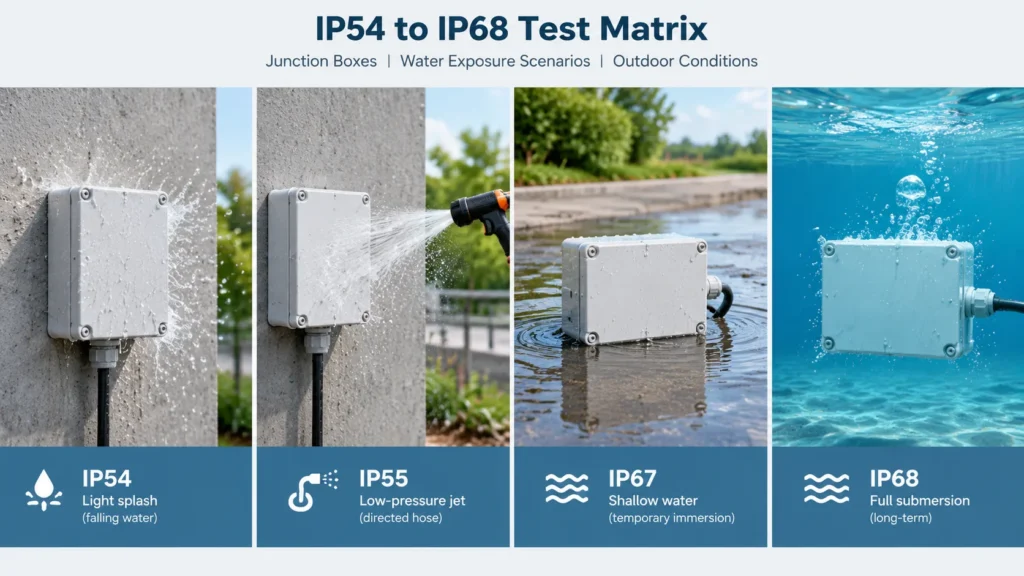
Two details cause most disputes. IPX7 is a fixed test, while IPX8 is an open condition: the manufacturer states depth and time, and the only hard rule is that it must be more severe than 1 m for 30 minutes. A sheet reading “IP68” without a bracketed depth and duration is not a checkable specification.
Both are dust-tight. The difference sits in the jet: IPX5 delivers 12.5 L/min at 30 kPa through a 6.3 mm nozzle, while IPX6 delivers 100 L/min at 100 kPa through a 12.5 mm nozzle. That is eight times the volume at more than three times the pressure, at the same surface, for the same three minutes. Against wind-driven rain, roof runoff or a pressure washer, IP66 is the honest choice; IP65 is a splash-and-hose rating being asked to do a storm’s job.
They fail differently. A jet loads the gasket line and the cable entries from outside, and the typical failure is water driven sideways past a lip seal. Immersion loads the whole enclosure with a small uniform static head, and the typical failure is a slow leak at a distortion point, a screw boss or an unused entry. Neither test predicts the other, which is why boxes for pits are specified IP67 even though they never see a jet.
IP67 is one metre for thirty minutes, measured to the lowest point of the enclosure. IP68 is whatever the manufacturer declares, provided it is harsher. Fresh water adds about 0.1 bar per metre of depth, so a 5 m claim equals roughly 0.5 bar of static head and a 10 m claim about 1 bar. Ask for depth, duration and the test report, and treat bare “IP68” as a category label rather than a number.
IEC 60529 allows more than one rating when a product has passed the tests for each, which is why datasheets read IP66/IP67 or IP66/IP68. That is a useful signal rather than a trick: the box was tested both under a jet and under immersion. What you should not accept is a slash between two numbers with only one report behind it.
Size-dependent ratings are the detail most buyers never check. The JX-RA ABS series runs from 50×50×50 mm to 400×350×120 mm, and the smallest size is rated IP55 while every other size is IP65. The reason is physical: a large lid has a longer gasket perimeter and needs more evenly spaced screws to keep compression uniform, while a small lid is stiff enough that the same wall thickness behaves differently under the same test. A supplier quoting one figure across an eight-to-one size range is telling you the figure was not tested per size.
The same logic applies across families, and the differences are structural rather than commercial:
| Series | Rating | Size span | Sealing strategy |
|---|---|---|---|
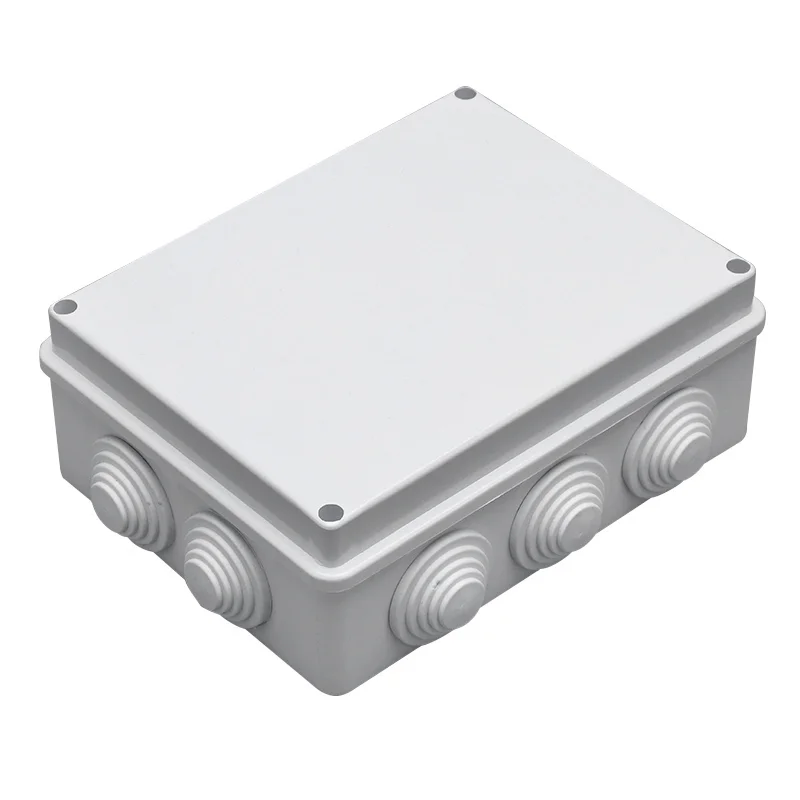
| JX-RA plastic enclosure | IP55 on the 50×50 only, IP65 on the other ten sizes | 50×50×50 to 400×350×120 mm | ABS body, PVC stoppers, gasketed lid |
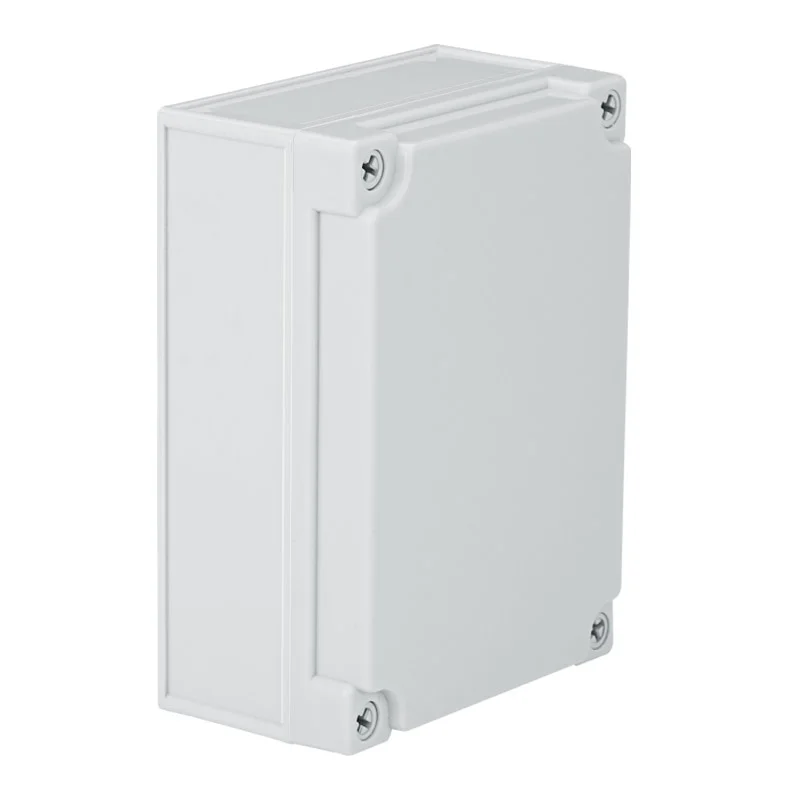
| JX-AG high-end box | IP67, immersion to 1 m, plus IK08 impact | 95×65×55 to 280×190×180 mm | Heavy-wall moulding under a gasketed lid |
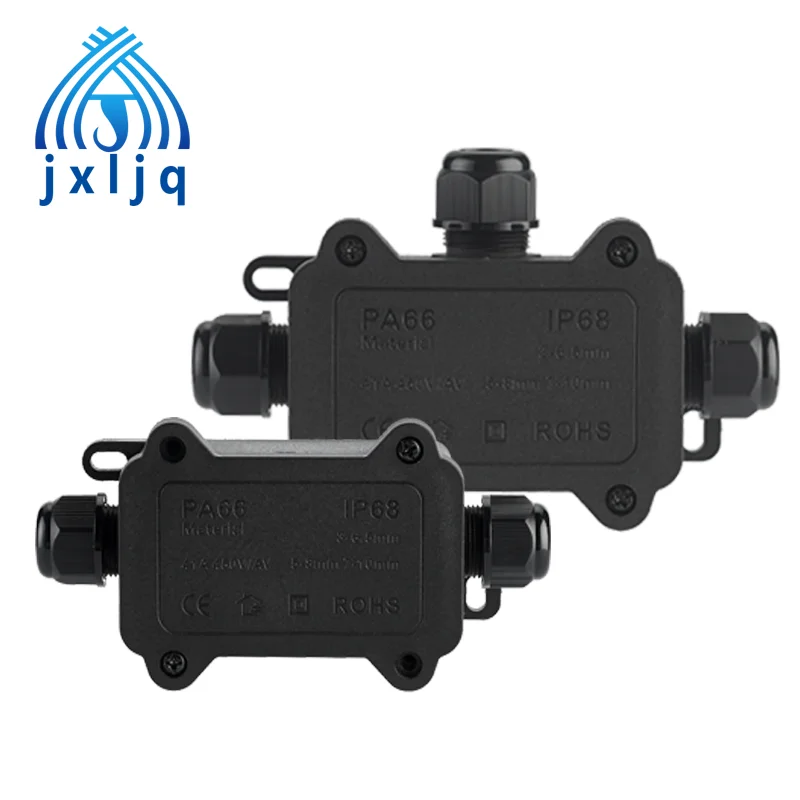
| F1 mini junction box | IP68 | Compact PA6 body, 2/3/4-way | Silicone O-ring on a small housing |
A box is certified as it leaves the factory: closed, empty, new. Everything that happens on site works against that condition.
A 25 mm entry with its membrane intact is part of the tested enclosure. Punch it and leave it open and that point has no rating at all. Every unused opening needs a blanking plug rated at least as high as the enclosure, and every gland must match the cable’s outer diameter, because a gland compressed onto an undersized cable seals on the wrong surface and passes water along the jacket.
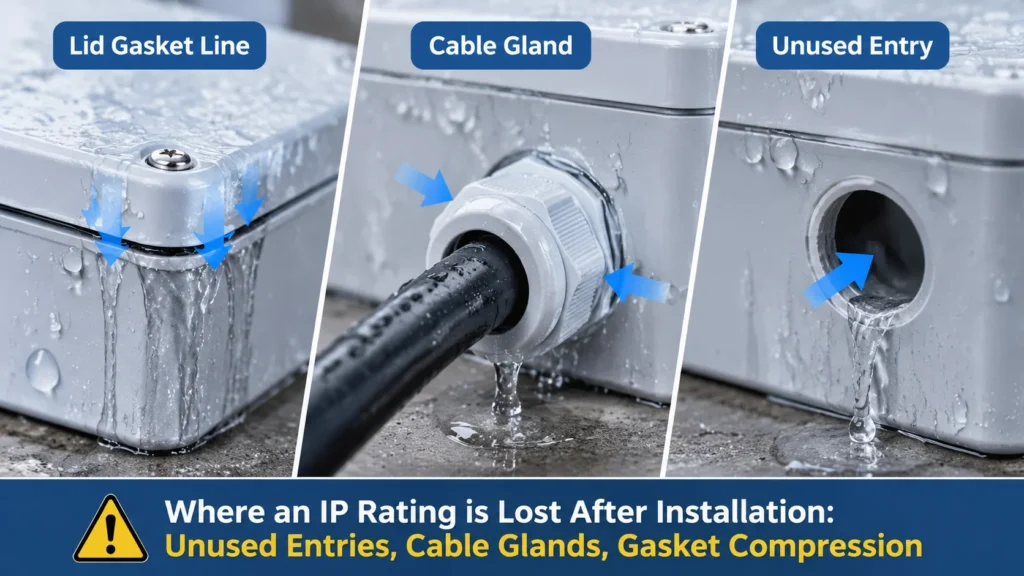
Elastomer gaskets seal by compression, not contact. Under-tightening leaves gaps; over-tightening deforms the gasket and the lid. Age matters too: a compressed gasket takes a permanent set, which is why a box that passed IP67 when new can fail after two summers of sun.
A sealed box that passes IP67 also traps the humid air inside it on the day it was closed, and each temperature cycle pumps more vapour past the seals. Water then appears in a box with no leak. IP testing is static immersion on a new sample: it does not test pressure cycling, and it does not test vapour. That is a separate problem with a separate solution, which is why exposed IP67 installations often need a pressure-equalising accessory rather than a higher rating.
How far the immersion condition changes a site decision is worked through in this field note on installing an IP67 junction box on exposed sites.
An IP rating is a test result, not a quality grade. Read the second digit as a description of a specific water event, check the rating per model rather than per series, and treat the enclosure as one component of an assembly. Tell a supplier the depth, the duration and the jet the installation will see and you get a box that works; ask for “the highest IP available” and you pay for a number the installation can lose at the first open knockout.
For the wider decision, including material, entry configuration and internal volume, see this IP68 junction box selection guide, and for body sizing the junction box size chart. If you send the site conditions and cable schedule, we will match gasket type and entries to the actual water load.
Not automatically. IP68 certifies immersion beyond the IPX7 condition at whatever depth and duration the manufacturer declares, so a poorly documented IP68 can be less demanding than a well-tested IP67.
No. Higher ratings bring tighter gaskets, fewer service openings and higher cost. For sheltered indoor mounting IP54 is sufficient and easier to maintain.
On sheltered outdoor walls, yes. Fully exposed positions and coastal sites call for IP66, because only the jet test represents driven water.
No, and a tighter box can make it worse by trapping humid air. IP testing covers liquid ingress under defined conditions; condensation is a vapour and pressure problem managed separately.
No. The enclosure is tested empty and closed. Once entries are cut and glands fitted, the assembly rating is the lowest among enclosure, gland, cable match and blanking plugs.

How cable glands protect CCTV cameras, junction boxes and NVR cabinets: IP68 sealing, nylon vs brass, multi-hole entries, and hazardous area options.
Read More
Compare metric, PG, and NPT cable gland sizes in one chart. Learn how to measure cable diameter, match sealing ranges, and avoid sizing mistakes.
Read More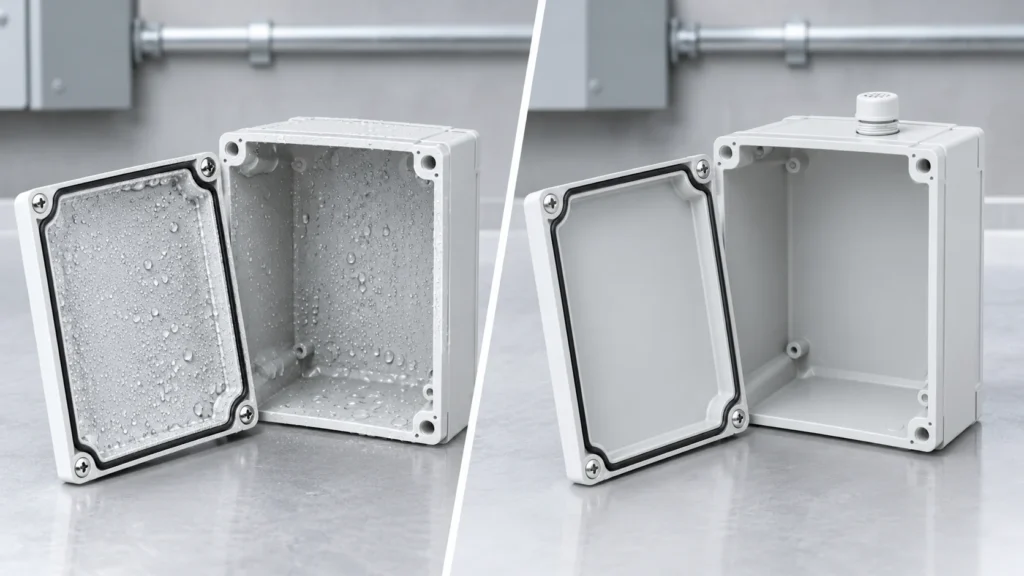
Condensation in junction boxes is a vapour and pressure problem, not a leak. The four ingress routes, the dew point arithmetic, and the vent plug fix.
Read More