Why a UV Resistant Junction Box Needs a Number, Not an Adjective
Every outdoor enclosure datasheet says it is UV resistant. Very few say what that was measured against, at what irradiance, for how long, and what was allowed to change. A UV resistant junction box is not a product category — it is a claim that must carry a test condition.
This article works through what actually fails, how much ultraviolet energy an installation receives, why two suppliers can both say “1,000 hours” and mean different lives, and what to write on an order. Our waterproof junction box range supplies the examples.
Yellowing Is Not Failure: Four Endpoints
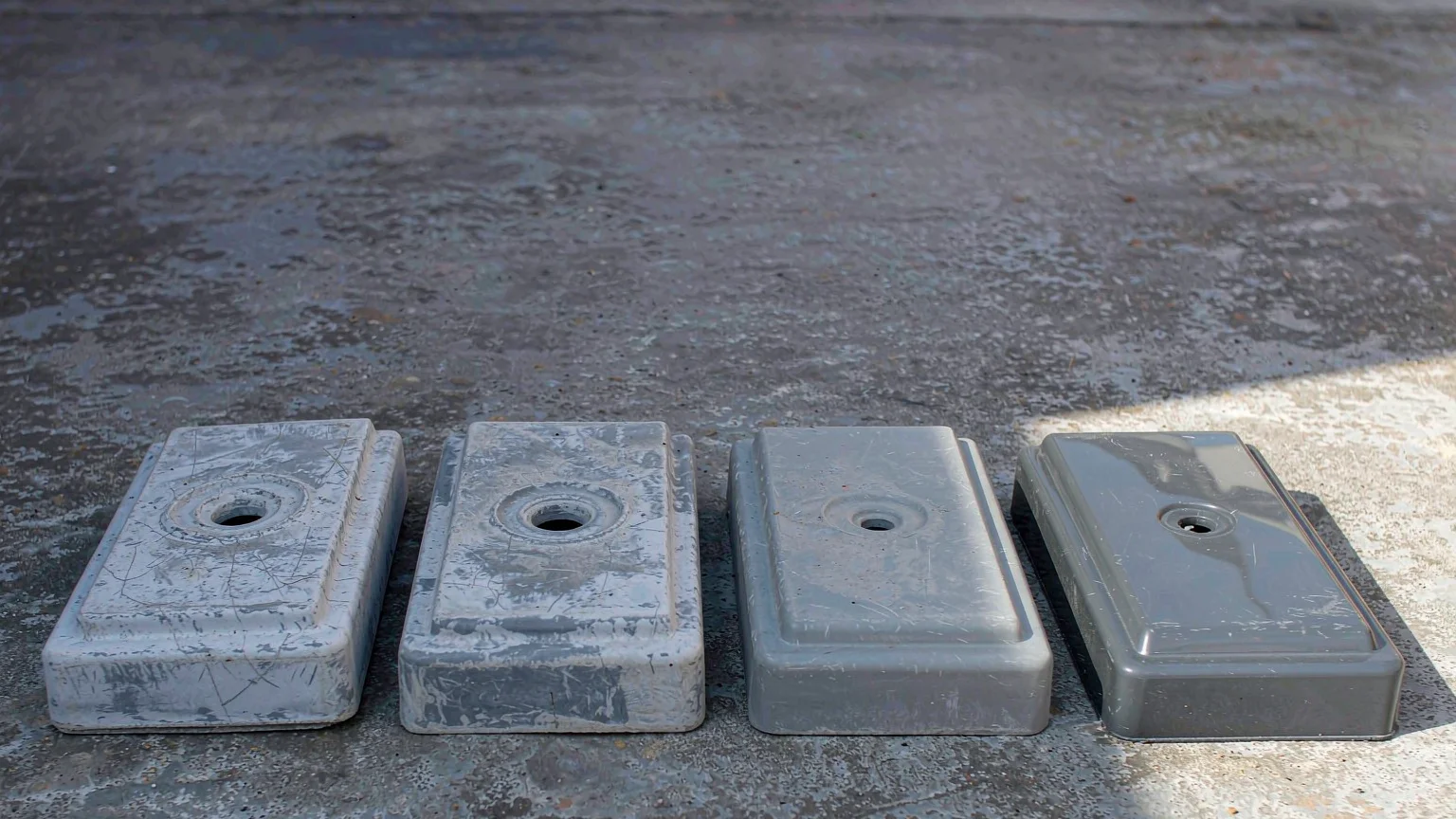
A box can go visibly yellow in three summers and still be serviceable, or stay bright white while its gasket has hardened into a brittle ring. Colour change is the easiest thing to measure and the least useful; a report should name which endpoint it used.
Endpoint
How it is measured
What it predicts
Colour shift
ΔE against an unexposed control
Appearance only, unless the customer specified a colour
Impact retention
Charpy or falling-dart, aged versus new
The IK rating after five years, not at delivery
Seal function
Gasket compression set, lid gap, IP retest
Whether the box still keeps water out at all
The UV Dose Your Box Actually Receives
Sunlight below about 385 nm carries only a few percent of total solar energy, but those photons break polymer chains, and that fraction governs outdoor life. Global horizontal irradiance at 40° latitude is roughly 1,300 kWh/m² a year, so the ultraviolet portion is around 200 to 250 MJ/m² annually.
Latitude moves that number a long way: near the equator it is closer to 350 MJ/m² a year, in northern Europe nearer 180. The same box with the same resin and gasket has roughly half the life in Malaysia that it has in Germany, so a service-life claim written for a European project should not be reused for a tropical one.
Why “1,000 Hours” Proves Almost Nothing
Two suppliers can quote 1,000 hours and mean different things. Xenon-arc testing to ISO 4892-2, at the common Method A irradiance of 0.51 W/m² at 340 nm with the 102-minute light and 18-minute spray cycle, delivers a UV dose of roughly 200 MJ/m² — about one year at mid-latitude.
Change three settings and the same 1,000 hours becomes a different experiment. Raise the irradiance and it ages faster; switch to UVB-313 lamps and the chamber emits energy below 300 nm that never reaches the ground; extend the spray cycle and hydrolysis joins in. Hence one vendor’s 1,000 hours maps to three years, another’s to six months.
Colour Is a Stabiliser
Carbon black is the cheapest and most durable UV stabiliser, because it absorbs ultraviolet energy before the polymer backbone sees it and does not get consumed. That is why so much outdoor hardware is black: the colour is doing the work.
Light colours cannot use that mechanism. They rely on hindered amine light stabilisers and UV absorbers dissolved in the resin, which are consumed over time; a 2 mm wall has a finite reservoir. A light grey box that looks identical to a black one may have a fraction of the weather resistance.
Black, Grey and White Behave Differently
Black is safest for long exposure and hardest to inspect, because yellowing is hidden. White works better than buyers expect — rutile titanium dioxide is an effective UV screen — but only the surface-treated rutile grade; anatase TiO2 is photocatalytic and accelerates polymer breakdown. Grey is the awkward middle: enough pigment to hide the warning signs, not enough carbon black to protect.
Material by Material
The resin determines the failure mechanism, and the mechanism decides whether stabilisation can help. Junction box material selection is covered in more depth separately.
Material
Outdoor behaviour
What actually helps
ABS
Butadiene phase oxidises; chalking and embrittlement
Carbon black, dark colour, or an ASA cap layer
ASA
Acrylate replaces butadiene; holds colour in light shades
Nothing extra; pay for the grade
PA66 / PA6
Amide bonds; UV plus moisture, hydrolysis above 70 °C wet
Carbon black and HALS together; keep water out
Polycarbonate
Photo-Fries yellowing, then surface microcracking
UV hard coat or coextruded cap; never bare
Polypropylene
Weakest of the five in sunlight
Carbon black is effectively mandatory
ASA: The Grade Nobody Quotes
ASA swaps the butadiene in ABS for an acrylic ester, removing the double bonds ultraviolet light attacks. It is the practical answer for a light-coloured box that must last a decade in the sun, at a higher price and with fewer grades available.
The Parts That Fail Before the Housing
In field returns, the gasket and small moulded details usually give up before the shell does. Surface embrittlement of a few tenths of a millimetre is enough to change how a seal behaves, and it is invisible from outside.
The gasket. EPDM resists UV and ozone well, silicone better, nitrile poorly. A UV-stable housing with a cheap gasket is a sealed box with a date on it; see our IP rating comparison .
PVC stoppers. Plasticiser migrates under heat and UV, the stopper hardens, and a fit that sealed at year one no longer does. Our JX-RA uses PVC stoppers; in tropical sun that is the part to inspect, not the ABS body.
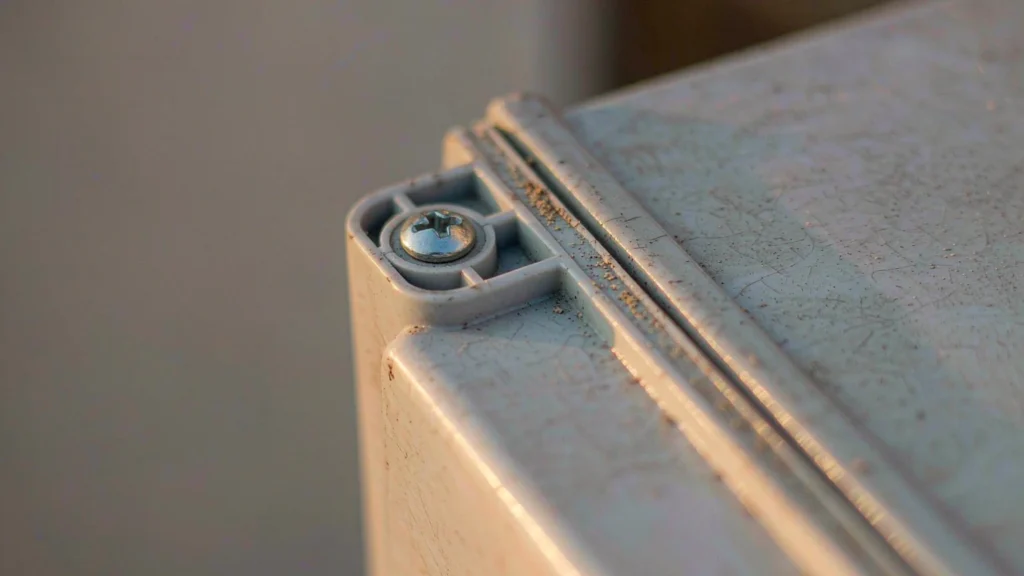
Screw bosses and lid corners. Hoop stress concentrates where the fastener pulls, and aged material cracks there first — the mechanism behind several of the returns in our field failure analysis .
Clear covers. A transparent polycarbonate lid yellows fastest of anything on the box and loses impact strength with it.
Stress and light multiply: a lid screwed down to close a moulded gap carries permanent load, and that surface crazes years before an unstressed one.
Heat on Top of Light
A dark box in full sun runs 20 to 30 K above ambient, so a 40 °C site puts the surface near 70 °C before device heat. Reaction rates roughly double every 10 K, so a black enclosure in the tropics runs a much faster clock than its datasheet assumes.
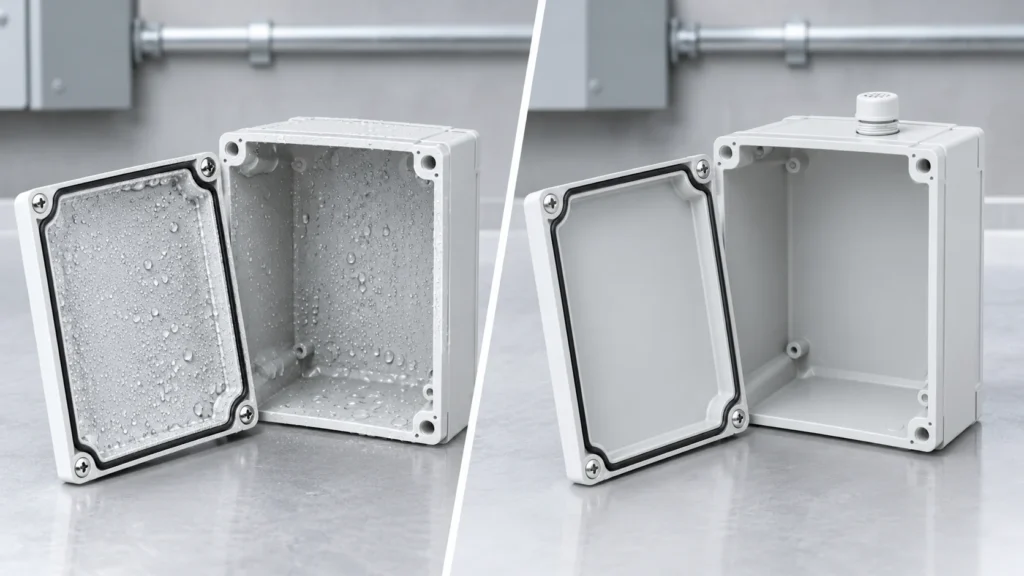
Heat also pumps air through the seals: a box warmed by sun and cooled by rain accumulates moisture inside. That is a pressure problem, covered in our article on condensation in sealed junction boxes.
Annex CC: The New Sunlight Test
Until recently, sunlight performance was a private arrangement between buyer and supplier. The 2024 edition of IEC 60670-22 added requirements and an annex for boxes exposed to direct sunlight — Annex CC — so an outdoor box now has a defined exposure test rather than an adjective.
Ask whether a report covers Annex CC, and at what exposure. Most boxes on the market, ours included, have no Annex CC data; know that before you write a fifteen-year durability clause into a tender.
What to Write on the Purchase Order
A specification that can be checked has five parts.
Resin and colour : the grade name, not “plastic”, plus the stabiliser system.
Test method : ISO 4892-2 or -3, lamp type, irradiance at 340 nm, cycle, chamber temperature, hours.
Pass criterion : ΔE limit plus a retained-impact figure, and whether the IP rating is retested afterwards.
Scope : housing, lid, gasket, stoppers and screws, because the weakest part sets the answer.
Site : latitude, mounting orientation and any part-day shading.
Where Our Range Fits
Stated plainly, so this can be used against its author’s products. JX-AG is published as IP67 with IK08 and RoHS, from 95×65×55 mm to 280×190×180 mm. JX-RA is ABS with PVC stoppers, IP55 or IP65, with CE and RoHS. F1 is flame-retardant PA66 with a silicone O-ring, IP68, rated −40 °C to +105 °C.
None of the three publishes a weathering test report. Under eaves, on a shaded wall, inside a cabinet or on a north elevation, that gap usually does not matter. In full tropical sun with a light colour and a fifteen-year expectation it does, and the answer is a stabilised grade, an ASA option or a shade. For harshest exposure, pressure cycling matters more — see our rooftop and ground-mount PV enclosures and marine and dock wiring.
Conclusion
Outdoor life is decided by ultraviolet dose, resin chemistry, colour and the small parts that seal the box. A test hour is not a unit of time until the lamp, irradiance, cycle and pass criterion are named. Specify the method and endpoint, inspect the gasket and stoppers as wear items, and treat any bare “UV resistant” claim as a question.
FAQ
How long does a plastic junction box last in direct sun?
Two to twenty years, which is not useful. An unstabilised light-coloured ABS box in a warm climate can chalk and embrittle in two or three summers; a black stabilised PA66 box with a silicone seal is a different proposition.
Is a black box always better outdoors?
For UV resistance, usually yes, because carbon black absorbs the damaging wavelengths and does not deplete. It runs hotter, though, so where devices are near their limit a light colour or a shade may serve better.
Does IP68 mean it can stay outside for years?
No. IP68 describes water ingress under defined test conditions on a new sample; it says nothing about gasket compression set after five years of thermal cycling, which is what ends an outdoor installation.
What is the cheapest way to extend outdoor life?
Shade the box. A simple cover, an eave or a change of mounting face cuts both the UV dose and the surface temperature, and it costs less than moving up a resin grade.
Introduction Even the best IP68 cable gland can fail if installed incorrectly. Installation mistakes are one of the main causes of water ingress and cable damage. Mistake 1: Incorrect Cable Diameter Selection Using a cable outside the recommended clamping range can compromise sealing performance. Mistake 2: Over-Tightening or Under-Tightening Both can damage seals or reduce […]
Discover the right cable glands for EV charging infrastructure and energy storage systems. This guide covers selection criteria, materials, IP ratings, and installation best practices.
We use cookies to enhance your browsing experience, serve personalised ads or content, and analyse our traffic. By clicking "Accept All", you consent to our use of cookies.