Blog
What Is The Difference Between BW and CW Cable Glands
BW and CW cable glands both terminate SWA armoured cable, but they are built for different environments. Learn the key differences, IP ratings, and how to choose.
Read More
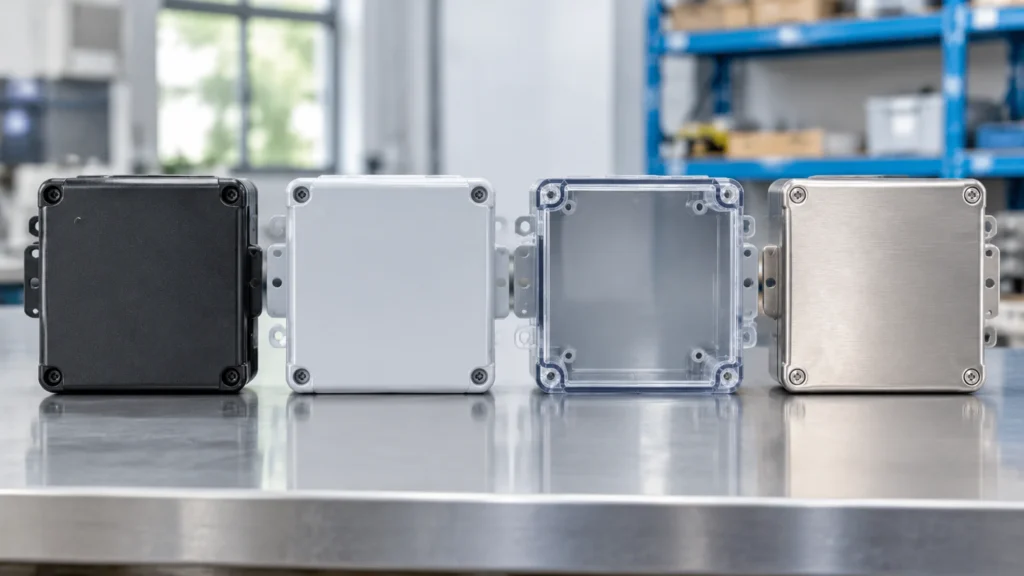
Choosing a junction box material is usually treated as a price question: plastic is cheap, metal is expensive, pick one. That framing fails three years in, when the lid gasket has taken a permanent set or the cover screws have stripped their bosses. This guide compares the four materials you will actually be quoted — PA66, ABS, polycarbonate and stainless steel — on the properties that decide field life.
A waterproof enclosure carries five loads at once, and different materials fail on different ones:
Any material can pass an IP test on a new sample. The question is which failure mode you are buying.
| Property | PA66 nylon | ABS | Polycarbonate | Stainless 304/316 |
|---|---|---|---|---|
| Moisture absorption (ISO 62) | High: 2% at 50% RH, 8%+ saturated; 0.5–0.7% linear swell | Low: under 0.5%, negligible swell | Low: 0.15–0.35% | None |
| Heat deflection, 1.82 MPa | Often only 80 °C unreinforced | 80–90 °C | 125–130 °C | Above any cable rating |
| Notched impact, room temp | Moderate; drops dry and cold | Moderate | Very high | Dents, not breaks |
| UV without stabilisers | Yellows, then embrittles | Chalks, yellows fastest | Yellows, slow cracking | Unaffected |
| Chemical weakness | Phenols, formic acid | Ketones, esters, fuels | Alkalis, ammonia, amines | Chlorides, acids |
| Honest use | Oily, abrasive splices | Indoor, sheltered, cheap | Sun-exposed, hot, impact | Chemical, marine, fire |
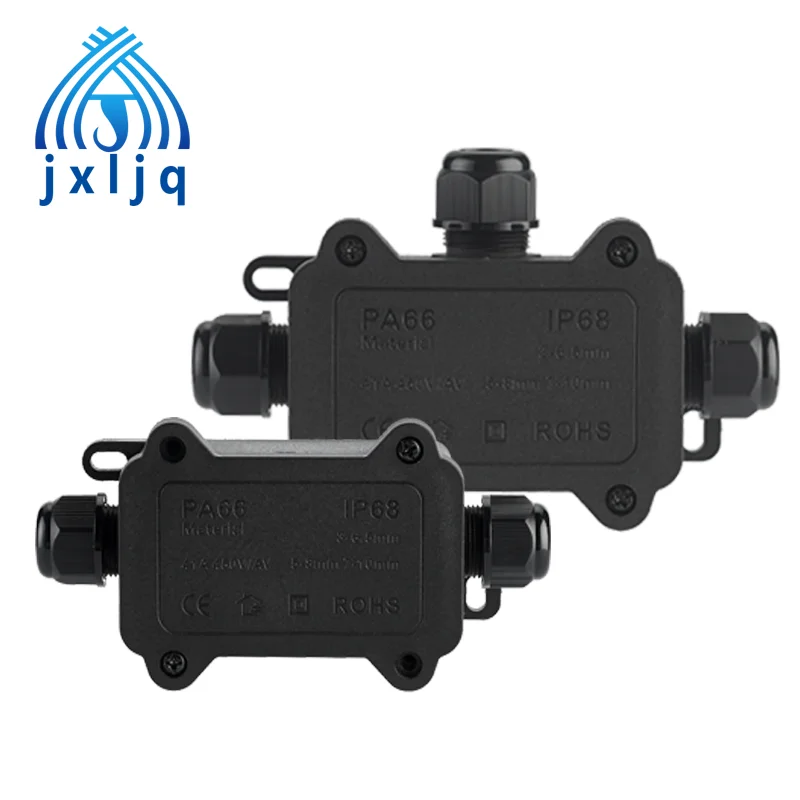
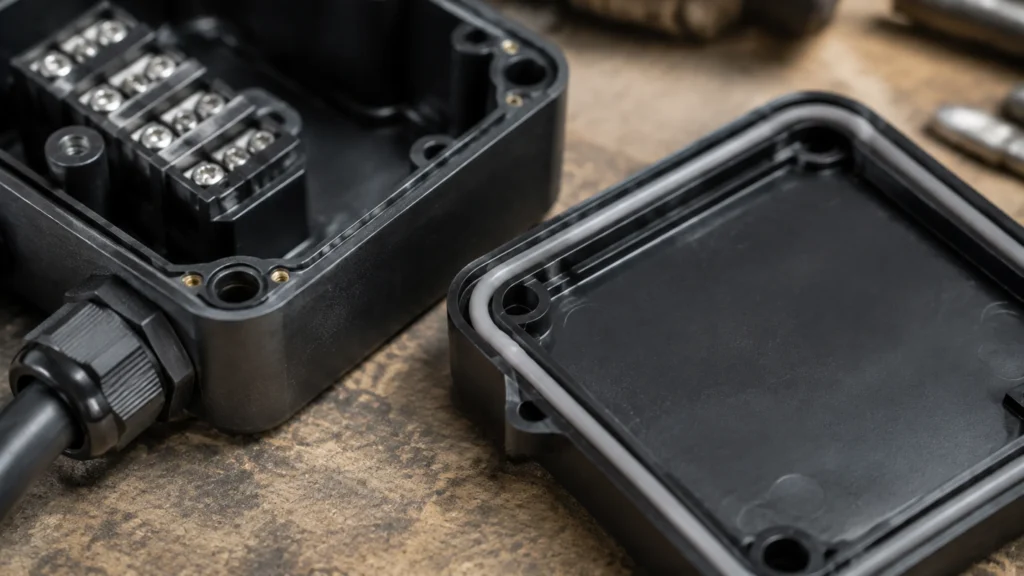
PA66 is the material most often quoted for IP68 mini junction boxes: it is tough, oil-resistant, abrasion-resistant, and takes a moulded thread and gasket groove well. The F1 series mini junction box uses a flame-retardant polyamide housing with a silicone O-ring, rated IP68 from -40 °C to +105 °C.
Polyamides are hygroscopic by design — the property that makes them tough also makes them swell. Unreinforced PA66 picks up roughly 2% moisture at 50% relative humidity and over 8% when saturated, about 0.5–0.7% linear growth: on an 85 mm box face, 0.4–0.6 mm across the width. That matters because an O-ring groove is sized to compress a 2–3 mm cord by roughly 20%. A groove that grows against a silicone cord that does not changes compression set, and repeated wet-dry cycles leave the cord seated in the wrong place.
It explains a pattern you will see in the field: a nylon box that passed its factory test can weep at the lid after three humid seasons, where an ABS box of the same design does not. If your site alternates soaked and dry, ask for conditioned dimensions, not the dry-as-moulded drawing.
Warm water attacks the amide bond. Below about 60 °C a stabilised PA66 tolerates wet service well; above 70 °C in continuous humidity, standard grades lose strength over months rather than years. A sealed box under a metal roof can reach that through solar gain alone — which is why “nylon” on its own is not a specification.
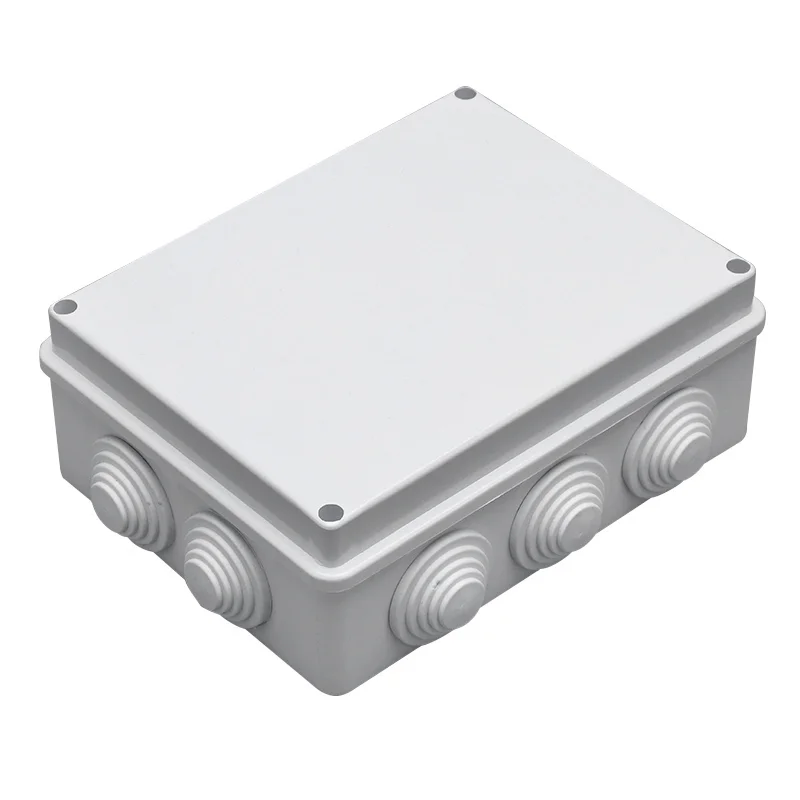
ABS is the pragmatic choice for most indoor and sheltered installations. Water absorption is under 1%, typically below 0.5% at 50% RH, so a gasket groove moulded into ABS stays where the tool put it, and it costs less than the alternatives. The JX-RA plastic waterproof junction box is exactly this: ABS body with PVC stoppers, CE and RoHS certified, internal holes for a circuit board or DIN rail, IP55 on the 50 × 50 model and IP65 on every larger size.
The weaknesses are equally specific. The butadiene phase is the impact modifier and the weak link: UV photo-oxidises it, first as chalking and yellowing, later as brittleness at the entry holes. Heat deflection is 80–90 °C under load, so a box against a hot enclosure will creep. ABS is also attacked by ketones, esters and aromatic solvents — the wrong cleaner can craze a cover in minutes. Under a roof, in a plant room, or behind a panel, ABS is usually correct and the cheapest answer; on a pole in the sun for fifteen years, it is not.
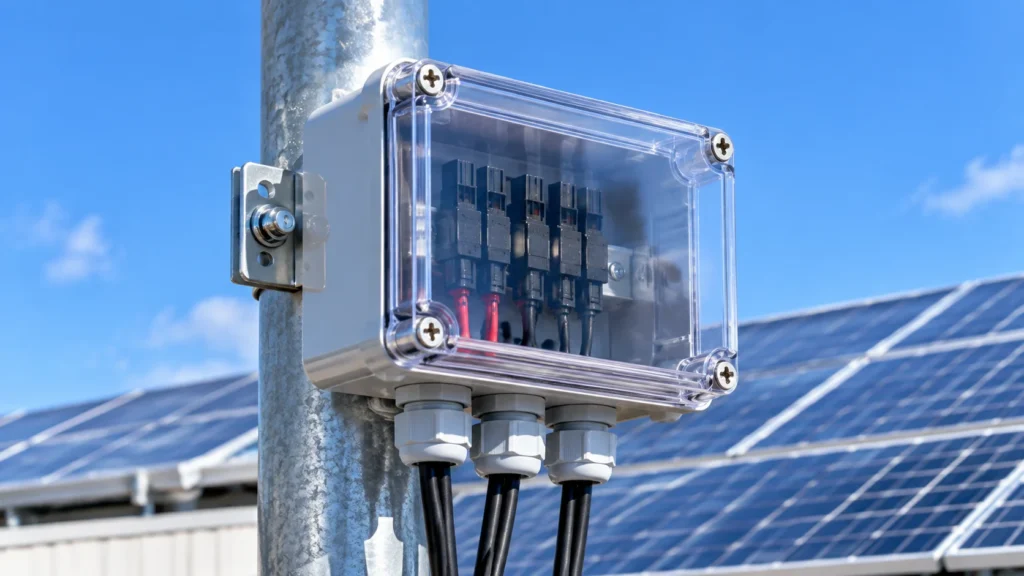
Polycarbonate is what you specify when the box must survive both sun and impact. Heat deflection under load sits at 125–130 °C, notched impact is several times that of ABS, and UV-stabilised grades are genuinely rated for outdoor service — which is why PC is the default for rooftop combiner boxes and street furniture.
Two caveats. PC impact strength is notch-sensitive: a deep scratch or badly deburred hole becomes a crack origin, so entry holes must be drilled and finished, not punched. And PC is chemically the most fragile of the three plastics — ammonia cleaners, amine curing agents and alkaline wash-down detergents cause crazing and stress cracking. In a plant that foams down with caustic, PC can fail faster than ABS.
Stainless is chosen for chemical plants, food production, water treatment, marine decks and fire zones, and because it cannot burn or embrittle. Grade 304 covers most indoor and rural outdoor work; grade 316, with 2–3% molybdenum, is correct where chlorides are present — coastal air, de-icing salt, chlorinated water. Specifying 304 near a pool or salt-spray line is a common and expensive mistake: chlorides pit 304, while 316 resists them.
First, galvanic corrosion. Stainless is cathodic to galvanised steel and aluminium, so when a stainless box couples to a galvanised conduit or mild-steel bracket, the other metal corrodes preferentially and quickly. You need insulating bushings or a stainless transition. Second, earthing: a metal enclosure must be bonded to the protective conductor, and every entry needs its own continuity check.
Stainless is also heavy — a 200 × 150 × 100 box can weigh several times its plastic equivalent, which changes bracket design, pole loading and freight.
| Site condition | Choose | Because |
|---|---|---|
| Indoor plant room, sheltered wall, cost-driven | ABS | Best stability per unit cost; solvent cleaners are the only real risk |
| Full sun, high impact, 15+ year life | UV-stabilised polycarbonate | Highest heat deflection of the three plastics plus best retained impact |
| Oily, abrasive, vibrating machinery | PA66 | Oil and abrasion resistance; specify conditioned dimensions |
| Chemical plant, wash-down, marine, fire zone | 316 stainless | No UV or moisture mechanism; bond it and isolate from dissimilar metals |
| Coastal but budget-capped | Stabilised PC, not 304 | 304 pits in chlorides; PC avoids the galvanic problem entirely |
One series, several materials, several IP ratings. Do not assume a family shares one rating. In the JX-RA range the 50 × 50 mm model is IP55 while every size from 85 × 85 mm upward is IP65 — same ABS, same sealing concept, different result because the smaller body has less gasket land and more entry-hole area relative to its face.
The flame-retardant package changes the mechanical data. A V0 rating is reached with additives that reduce toughness and sometimes heat resistance. Two boxes can both say “PA66, V0” and behave differently at -20 °C. Ask for the impact value of the compounded grade.
Vague material claims hide a real decision. Some datasheets say only “high-quality plastic” — the JX-AG high-end waterproof junction box publishes IP67 with 1 m immersion, IK08 and RoHS, and states its material that way rather than naming a grade. The grade is then not locked, so put it on the purchase order.
Material choice is a matching exercise, not a ranking. ABS wins on dimensional stability and cost, polycarbonate on sun plus impact, PA66 on oil and abrasion, stainless on chemistry — at the price of weight, bonding and galvanic care. Get the site condition right first, then let the material follow. If you are still narrowing the enclosure, the waterproof junction box selection guide covers rating, size and entry, and the nylon versus metal cable gland comparison applies the same logic to the fittings.
Not universally. PA66 wins on oil, abrasion and mechanical abuse; ABS wins on dimensional stability and cost in sheltered locations. PA66 absorbs about 2% moisture at 50% RH and swells 0.5–0.7% linearly, which moves the gasket groove.
Because the smallest size usually has less gasket land and more entry-hole area. In the JX-RA range the 50 × 50 mm model is IP55 while every size from 85 × 85 mm up is IP65. Read the rating per model, not per series.
No. IP is a result on a new, correctly closed sample and depends on seal design and entry fittings as much as on the polymer. The IP rating explained guide covers what each digit is tested against.
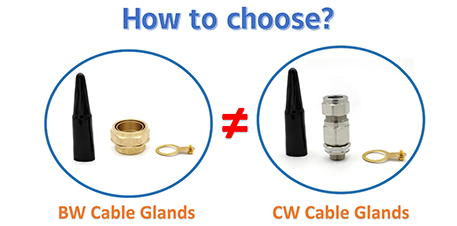
BW and CW cable glands both terminate SWA armoured cable, but they are built for different environments. Learn the key differences, IP ratings, and how to choose.
Read More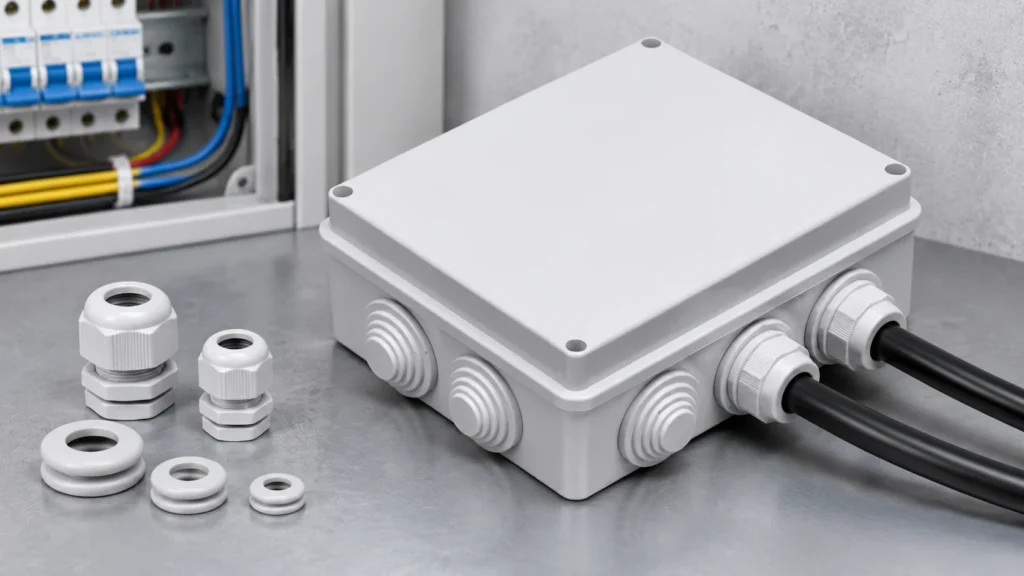
Cable entry, not the box, is usually where a waterproof enclosure fails. Compare knockouts, grommets, stoppers and gland threads, and check the hole before you order.
Read More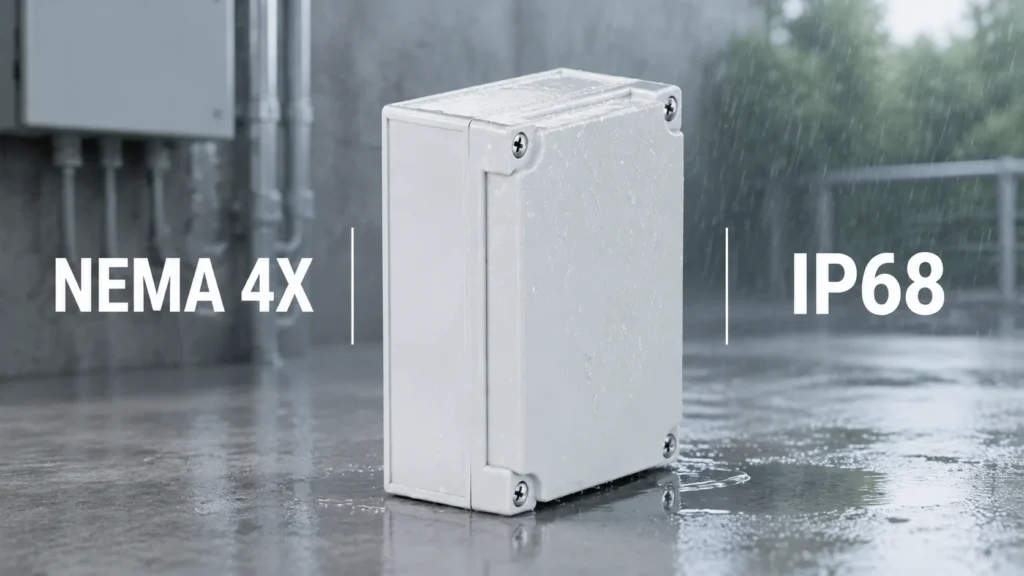
NEMA 4X stops at IP66, while IP68 is a supplier-declared immersion test. See the correct cross-reference, the test methods behind both codes, and the spec line that stops rejections.
Read More