Blog
Application of Strain Relief Cable Glands in Robotic Industry
Why robot cables fail at entry points, how strain relief cable glands protect them, where they matter in a robotic cell, and how to choose and install them.
Read More
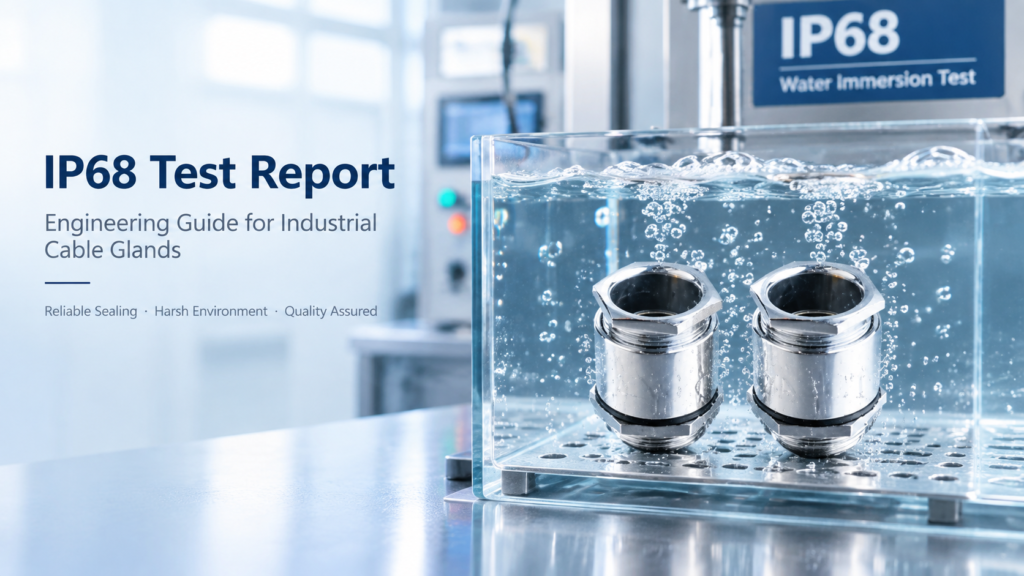
An IP68 test report is the document that turns an “IP68” label on a cable gland into something a buyer can actually verify. When you are sourcing glands for outdoor enclosures, submersible equipment, or marine installations, the two-digit code on the datasheet is not proof of waterproofing — the report behind it is. This guide explains what an IP68 immersion test really involves, what a genuine test report must contain, and how to check a supplier’s claim before you add a product to your bill of materials. If you are still comparing IP68 cable glands by price alone, the verification steps below will save you from specifying a gland that was never actually tested the way you assume.
IP68 comes from IEC 60529, the international standard for ingress protection, and it is a two-part promise. The first digit, 6, means dust-tight: the product passed the standard’s dust-chamber test with no dust entering the interior. The second digit, 8, means protection against continuous immersion in water beyond one meter.
The detail most buyers miss is that IEC 60529 does not fix the immersion depth or duration for IP68. It only requires the test to be more severe than IP67, which is fixed at 1 meter for 30 minutes. The exact conditions — for example 1.5 meters for 30 minutes, or 10 meters for 72 hours — are declared by the manufacturer and agreed with the test laboratory. Two glands can both carry IP68 while being verified under completely different conditions, which is why the rating code alone tells you very little.
For a mechanical sealing component such as a gland, the rating is earned by the complete assembly: the body, the elastomer sealing ring, the locknut, and the cable it clamps. We explain the two sealing points that make this work in our guide to how IP68 cable glands achieve a watertight seal — the same two seals are what a test report verifies.
Not every IP68 claim carries the same weight. Before you compare reports, separate the three types of evidence a supplier can show you.
| Evidence type | What it means | What to ask for |
|---|---|---|
| Third-party certified | Product samples tested by an accredited laboratory (for example TUV, SGS, Intertek, or BSI) against IEC 60529, with a numbered report and certificate issued. | The report number, the issuing laboratory, and a copy of the report. |
| Manufacturer self-declared | The factory performed its own immersion test following IEC 60529 and states the result on the datasheet. | The internal test record, including depth, duration, and sample description. |
| System certification | Certificates such as ISO 9001 prove the factory’s quality management process — not that a specific product is waterproof. | Do not treat ISO 9001 as an IP68 substitute; check the product-level report separately. |
A well-run factory will normally hold both: system certificates for its processes and product-level reports for waterproof ratings such as IP68. If a supplier answers an IP68 question by pointing at its ISO 9001 certificate alone, that is a signal the immersion report may not exist.
An IP68 verification for a cable gland follows a standard sequence. Knowing the steps helps you read any report critically, because each step has conditions that must be stated.
The pass criterion is not “bone dry” in an absolute sense — it is that no water enters in a quantity that could reach live parts or affect safe operation, and that the seals remain intact. A report that states “tested at 1.5 meters for 30 minutes with a 10 mm cable installed” tells you exactly what the product withstood; one that only prints “IP68” does not.
When you request the IP68 test report from a supplier, check that the following elements are present before you trust it:
Watch for red flags: a report with no stated depth or duration, a test performed on the gland alone without a cable, an unverifiable laboratory with no accreditation, a generic report written for an enclosure rather than for the gland assembly, or a sample description that does not match the model and seal material you intend to buy. Any one of these is a reason to ask for a better report rather than accept the badge.
Apply these checks every time a new supplier claims IP68 on a cable gland:
Remember that the report certifies the product under laboratory conditions. In the field, most failures come from assembly errors rather than the gland itself — the common mistakes when installing IP68 cable glands are a useful checklist for your installation team.
Nowhere is the IP68 report more important than in marine and offshore work, where cable entries face continuous submersion risk, salt water, and vibration. For these applications, look beyond the immersion report and ask whether supplementary corrosion evidence, such as a salt-spray test per ISO 9227, is available for the plating and body material.
A practical example is the TJ Marine Cable Gland: a chrome-plated brass gland with an NBR clamping ring, IP68 certified, backed by ISO 9001 and TUV, rated for −40 °C to +110 °C (120 °C static) and aimed at ship, instrument, and oil-field cable fixing. The chrome plating and NBR ring are chosen for corrosion and oil resistance in salt-laden environments — the material decisions that keep an IP68 seal working over years, not just during the 30-minute test. You can compare similar products in the marine cable gland range and request the immersion and material reports for the exact model before specifying it.
A test report proves one batch under one set of conditions. Factory quality control is what decides whether every gland that leaves the production line matches that tested sample. When you evaluate a supplier, look for the practices behind the paper.
Yueqing Jixiang Connector Co., Ltd., the manufacturer behind this site, operates on this basis: a factory founded in 2011 with around 5,000 square meters of production space, rated as a National High-tech Enterprise, with the QC process described above and product reports available on request. If you are qualifying an IP68 gland for a project, ask the factory for the test report tied to the batch you are buying and for samples to verify yourself — you can contact us for the TJ datasheet, IP68 report, and sample arrangements.
An IP68 rating on a cable gland is only as trustworthy as the report that supports it. Read the report for the stated depth and duration, confirm the tested assembly matches what you will install, and verify the factory’s quality controls rather than relying on the badge alone. With those checks in place, you can specify IP68 glands with confidence — and with a sample in hand, you can prove it before your project depends on it.
It documents that a specific gland assembly — with its cable, seal ring, and locknut — passed an IEC 60529 dust test and an immersion test at a stated depth and duration, with no water ingress affecting safe operation.
No. IP68 covers continuous immersion under the specific depth and duration the manufacturer declares and the report states. Check those conditions against your installation; “continuous” does not mean unlimited depth or unlimited time.
IP68 is tested for immersion beyond one meter, while IP67 is fixed at one meter for 30 minutes. Which is “better” depends on your application — the IP67 vs IP68 comparison explains when each rating fits.
They assemble the gland with a real cable at the correct torque, run an IP6X dust test for 8 hours, then submerge the assembly at the declared depth for the declared duration, and inspect for water ingress afterwards.
IEC 60529 does not fix them. IP68 must be more severe than IP67 (1 meter for 30 minutes), but the exact depth and duration are declared by each manufacturer — which is precisely what the test report must state.
ISO 9001 certifies the factory’s quality management system, not the waterproof performance of a product. If you need IP68 evidence, ask specifically for the product-level immersion test report issued against IEC 60529.

Why robot cables fail at entry points, how strain relief cable glands protect them, where they matter in a robotic cell, and how to choose and install them.
Read More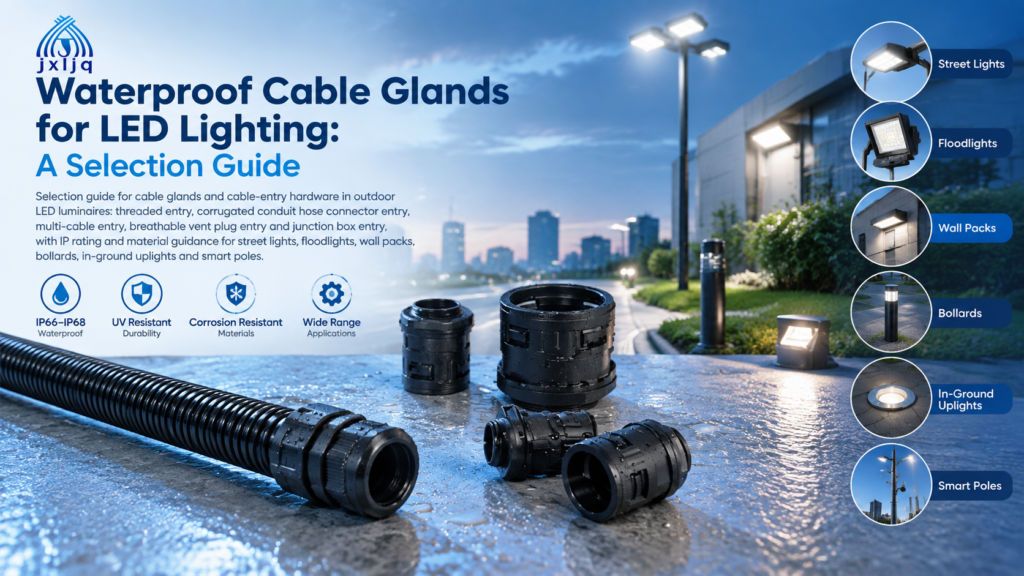
How to choose a waterproof cable gland for LED lighting: five cable-entry paths, a fixture-type selection table, IP rating rules, materials and condensation control for outdoor luminaires.
Read More
BW, CW and A2 are positions in the BS 6121 cable gland type code, not rival models. This guide decodes the letter system and shows how to specify the right armored gland type.
Read More