Blog
How to Audit a Junction Box Factory: QC Steps and Reports
A factory visit rarely explains why a box leaks. What to measure in thirty minutes, which five dimensions decide the seal, and what each test report proves.
Read More
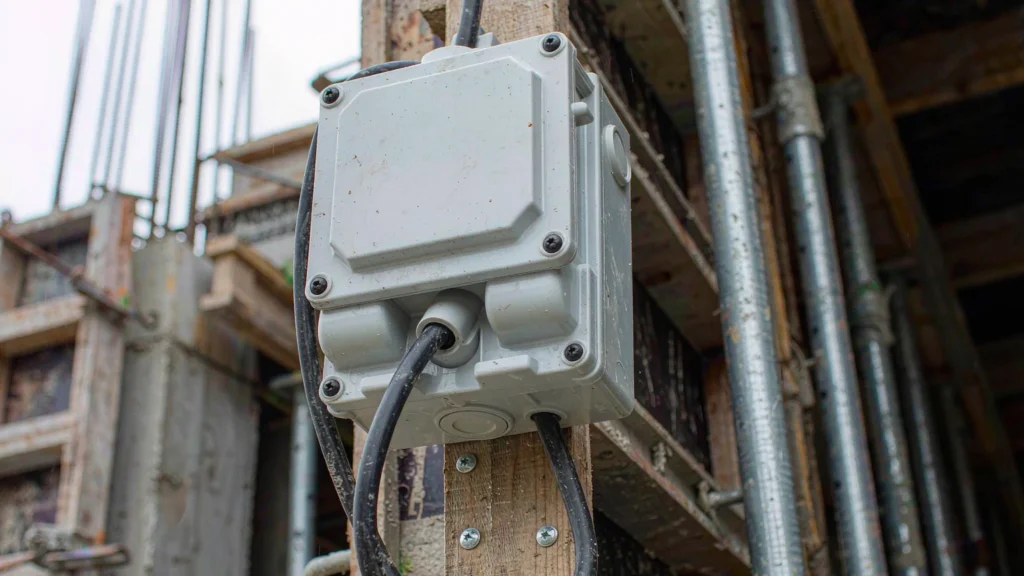
A temporary power junction box is usually bought last, fitted in a hurry, and then moved eleven times before the project ends. That sequence explains almost every failure we see on site: the enclosure was chosen as if it were a permanent installation, when the thing it must survive is not twenty years of weather but twenty lid removals, four relocations and one winter pour. This guide sets out what actually drives the specification, where a moulded plastic box belongs on a construction site, and the inspection that has to happen every time the box moves.
Permanent wiring assumes the enclosure is installed once and opened rarely. Temporary wiring assumes the opposite: the box is assembled on a bench, hung on a wall, opened when a circuit changes, taken down, thrown in a van and hung somewhere else. The electrical duty may be identical. The mechanical duty is not.
That is why a box that performs perfectly in a plant room can fail in three weeks on a site. Nothing about the housing changed. The use pattern did.
Every time the lid closes, the gasket is compressed. A silicone or NBR gasket recovers most of that compression when the lid opens — not all of it. Compression set accumulates, and it accumulates faster when the gasket is hot, cold, dirty or over-tightened.
| Lid cycles in service | What the gasket is doing | Practical consequence |
|---|---|---|
| 1 (install and forget) | Single compression, full recovery expected | Seal life set by ageing, not by cycles |
| 10–20 (typical site box) | Set accumulating, groove taking a shape | Inspect at every relocation |
| 50+ (shared tool-room box) | Gasket flattened, corners set first | Treat gasket as a consumable, keep spares |
The numbers above are order-of-magnitude guidance, not test data, but the direction is reliable: a box specified for a permanent installation should not be reused as a site box without a gasket policy. Screw torque matters here too — an over-tightened lid crushes the gasket flat in a handful of cycles, and a screwdriver is not a torque wrench.
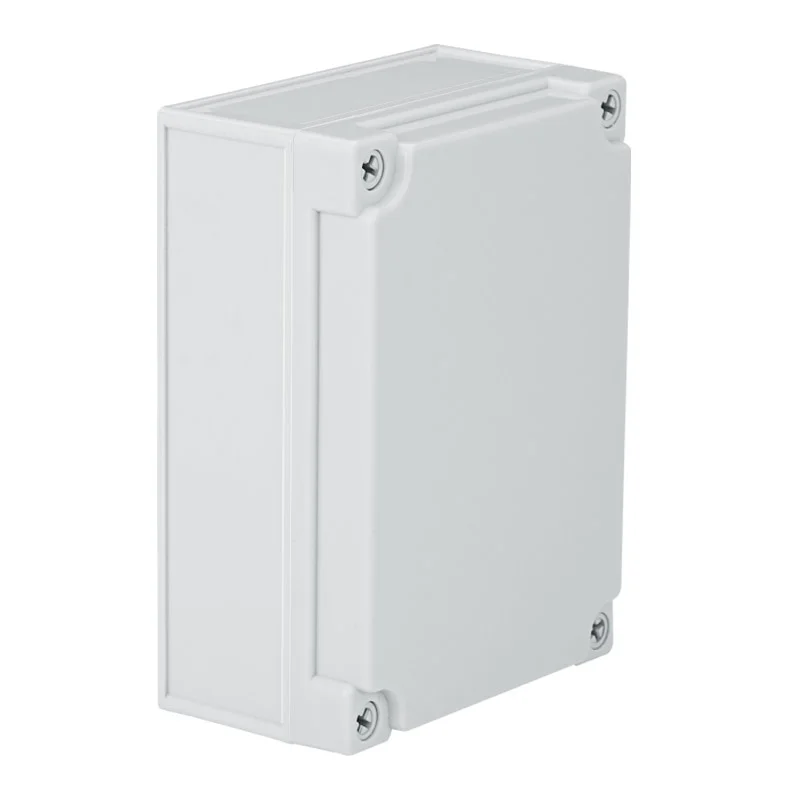
A moulded enclosure is the right answer for a fixed point on site: a tap-off for a site hut, a splice between two lengths of armoured cable, a joint in a temporary lighting run, a junction for a hoist or a pump. It is the wrong answer for anything that must be plugged in and out, isolated, locked off or protected by an RCD.
The distinction matters commercially. Buyers occasionally ask for “a temporary power box” meaning a portable distribution unit with an isolator, RCDs and CEE outlets. A sealed enclosure with terminal blocks cannot do that job at any IP rating, because the missing parts are electrical, not environmental.
Two material behaviours decide most site failures, and neither appears on a data sheet headline.
Cold brittleness. ABS loses notched impact strength sharply as temperature falls, and a box that shrugs off a dropped scaffold clip at 20 °C can crack at −5 °C. The practical rule is to avoid fitting and tightening ABS enclosures in near-freezing conditions, and to avoid dropping them at all.
UV and dirt. Site boxes sit in sun for months and are handled with muddy gloves. UV yellowing is cosmetic until the surface chalks, at which point impact strength is the number to watch — we covered the degradation sequence in UV resistant junction box service life. Grit in a gasket groove is more immediately destructive than sunlight: a single grain holds the seal open by its own thickness.
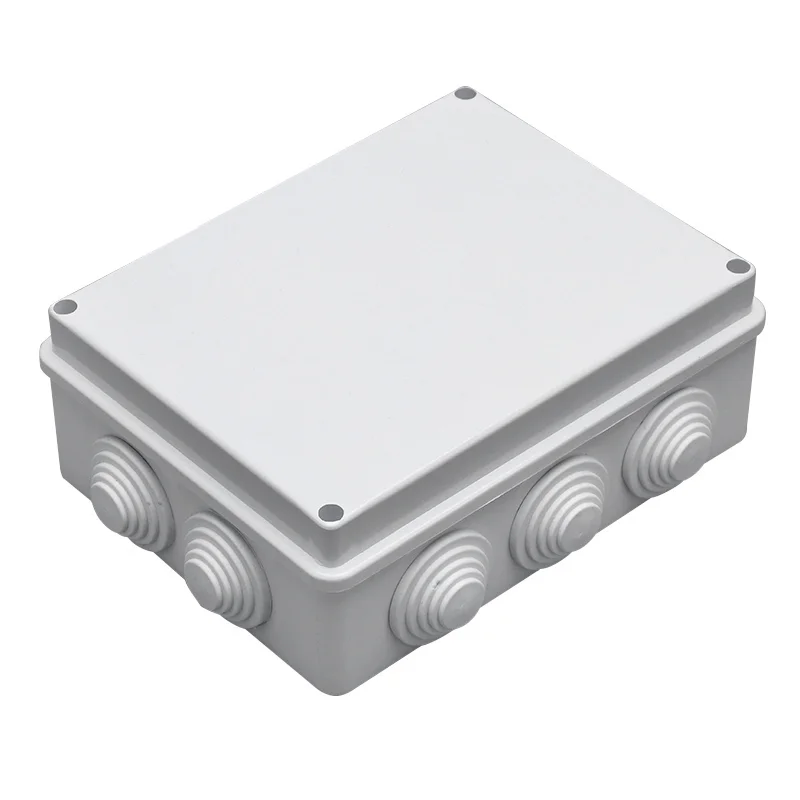
The JX-RA ABS box is IP55 or IP65 depending on size, CE and RoHS marked, and available from 50×50 mm up to 400×350×120 mm — a sensible range for site tap-offs, provided it is not asked to survive being driven over.
| Site hazard | Effect on a moulded enclosure | What to specify |
|---|---|---|
| Dropping, struck by scaffold tube | Cracks start at screw bosses | A rated impact class, or a protected location |
| Fitting below 5 °C | Brittle failure on impact, not on load | Warm the box and the site before closing |
| Mud and grit on the rim | Seal held open by a single grain | Wipe the groove at every closure |
On a site, cables are pulled, stood on and coiled wet. The entry is the part that fails, not the terminal. Three habits prevent most of it:
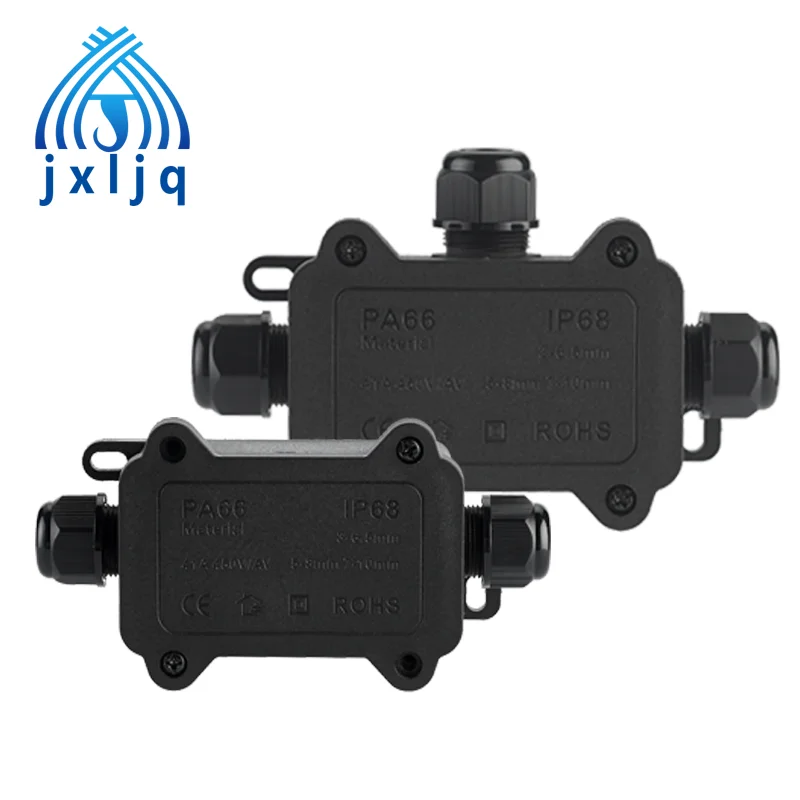
A PA66 nylon cable gland with NBR sealing is normally enough for site cable, and its IP68 claim at 10 bar is far beyond what a hose or a puddle will apply. Close every unused entry with a screw plug rather than tape: an open 25 mm hole is the most common cause of a “failed” enclosure we are asked to warranty.
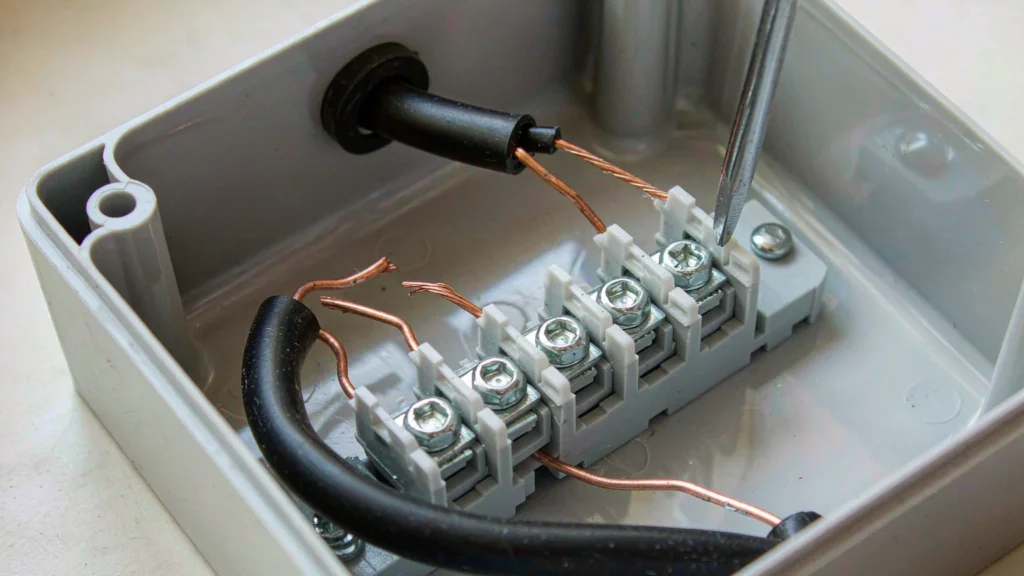
Three site requirements sit outside any enclosure’s specification, and confusing them with waterproofing causes arguments at handover.
| Requirement | Where it is met | What a junction box contributes |
|---|---|---|
| Isolation and lock-off | Distribution unit, switch-disconnector | Nothing: no switching device, no marked off position |
| Residual current protection | RCD upstream of the circuit | Nothing: fault protection is not an enclosure function |
| Portable outlets | Site plugs and sockets to their own standard | Nothing: a glanded entry is not an outlet |
Where a site runs reduced-voltage tools, the transformer and its outlets do that job. The junction box only joins cables between those points, and should be specified as such.
Sooner or later a temporary box gets buried in a slab, a footing or a wall because the services moved and nobody wanted to dig it out. Once that happens the enclosure is permanent but inaccessible, which is the worst of both worlds: no maintenance access, and no proper slab box with a flush cover.
If a temporary point is likely to be absorbed into the permanent works, decide that before the pour. Either re-route, or install a box intended for embedding with a cover that can be opened later. Sealing a site box into concrete and hoping is not a design decision.
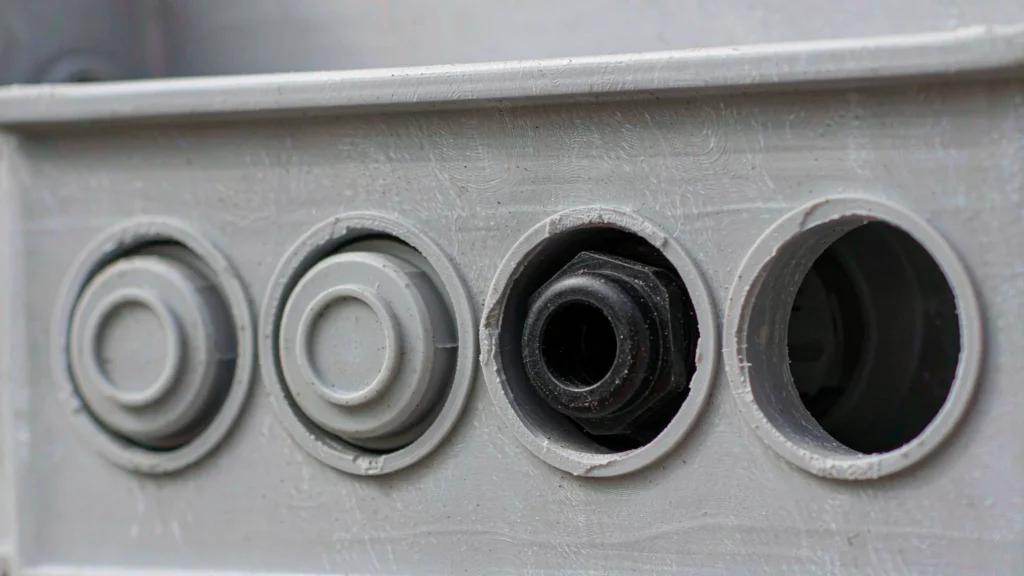
Two minutes with these six checks replaces most field failures. The full environment-based schedule, including how often to replace rather than inspect, is in our junction box maintenance schedule.
For a fixed site point, specify the family by cavity size rather than by IP number: a waterproof junction box large enough for the splice plus a service loop will be closed properly, while an undersized one will be left ajar. Where the joint is a single cable-to-cable splice on a small circuit, a compact F1 mini junction box at IP68 with screw-crimped terminals and 3–10 mm cable entries is quicker to re-terminate than a large enclosure with a DIN rail.
Order spares on the same purchase order: one gasket per box, a handful of screw plugs, and a torque screwdriver for the lid. The failure mode you are buying protection against is not water. It is the third fitter who closes the lid with a cordless drill.
A temporary power junction box earns its keep by being reopened gracefully. Choose a housing material that tolerates cold handling, put the entries underneath with a drip loop, plug every hole you are not using, and inspect the gasket every time the box moves. None of that is expensive. All of it is decided before the box is hung, which is why the specification matters more on a site than in a plant room.
IP65 with downward-facing entries covers rain, jets and standing water in practice. Higher ratings help only if the entries and gasket are maintained.
No. It has no switching device, no marked off position and no lock-off point. Isolation must come from the distribution unit.
Usually cycles and over-tightening rather than age. Every lid closure compresses the gasket permanently; a crushed gasket stops sealing long before it perishes.
For wall-mounted tap-offs and splices, yes, if it is not dropped or fitted near freezing. For anything likely to be struck or run over, specify a higher impact rating.
With a screw plug and its sealing ring, not tape. Tape lifts in sun and leaves adhesive in the thread.
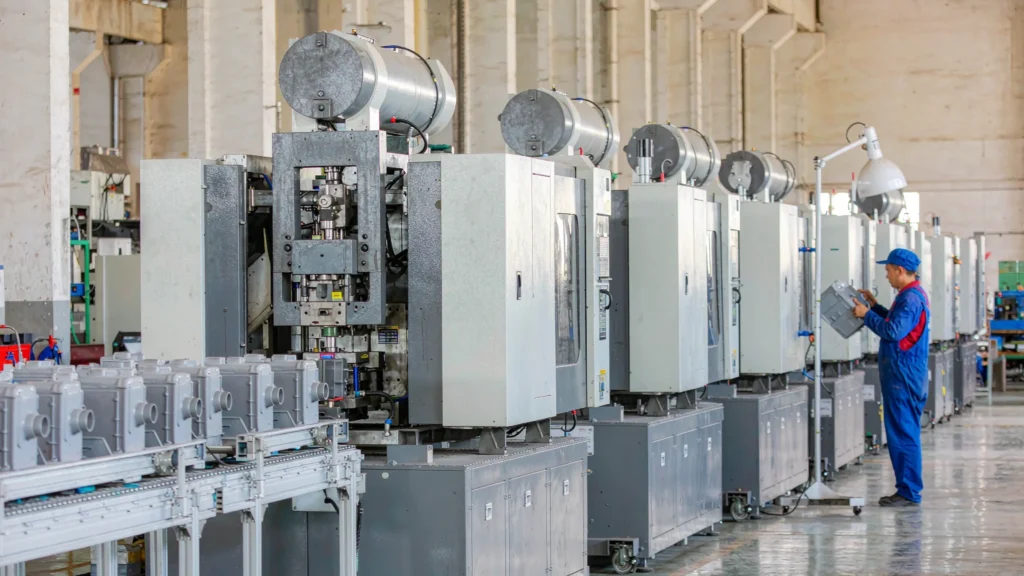
A factory visit rarely explains why a box leaks. What to measure in thirty minutes, which five dimensions decide the seal, and what each test report proves.
Read More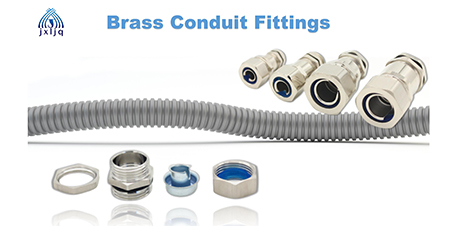
What brass conduit fittings are, why nickel-plated brass is used, the types, key specifications, applications, installation steps and how to choose the right fitting.
Read More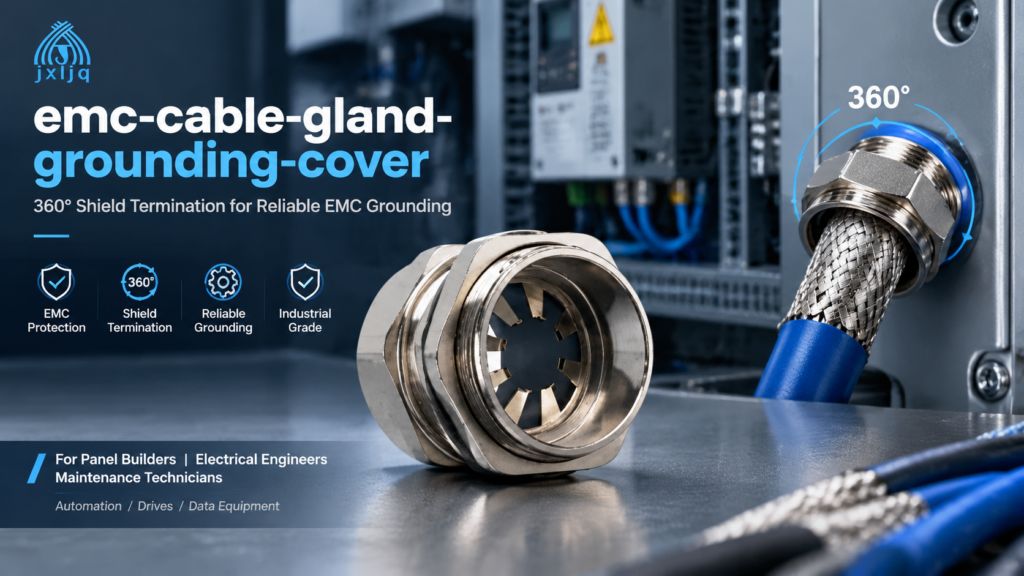
Practical EMC cable gland grounding guide: 360° shield termination steps, panel preparation, common mistakes, and continuity checks.
Read More