Blog
What is the IP Rating of Metal Cable Glands?
Learn what the IP rating on metal cable glands means under IEC 60529, how IP65 to IP69K compare, how glands are tested, and how to choose the right rating.
Read More
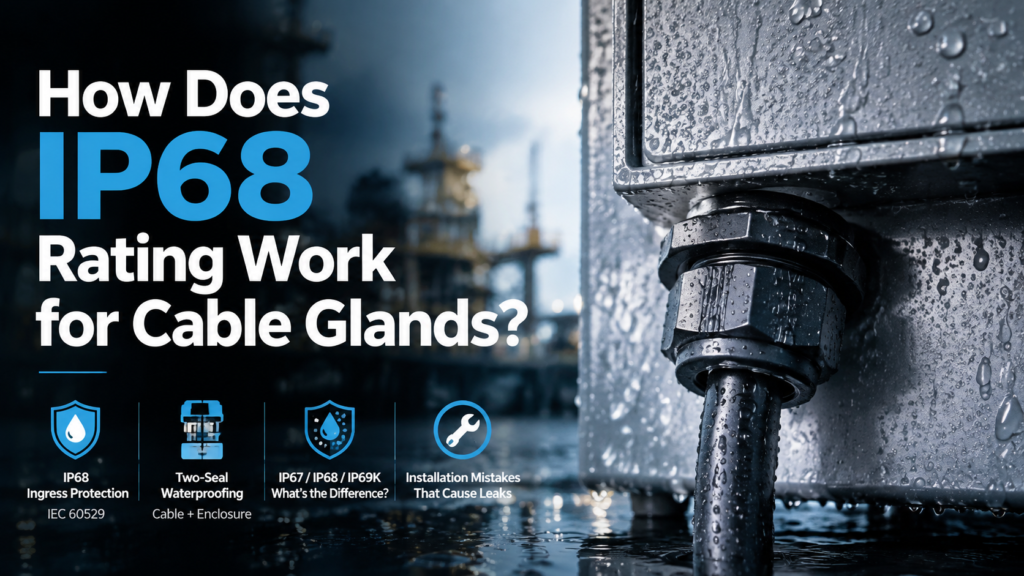
An IP68 label on a cable gland looks reassuring, but it is not a fixed promise. The “8” in IP68 means continuous immersion beyond one meter — yet the exact depth and duration are set by each manufacturer, not by the standard. Two glands can both carry an IP68 rating while one is tested at 1.5 meters for 30 minutes and the other at 10 meters for 72 hours. This guide explains what the IP68 rating on cable glands actually means, how the sealing mechanism works to achieve it, how the rating is tested, and why installation mistakes are the most common reason a rated gland still leaks.
The IP (Ingress Protection) code is defined by IEC 60529 and uses two digits. The first digit covers protection against solid objects and dust; the second digit covers protection against water. For IP68:
The critical detail is the word “manufacturer-specified.” IEC 60529 requires IP68 to be more severe than IP67 (which is fixed at 1 meter for 30 minutes), but it does not define a universal depth or time for IP68. Every manufacturer must state the exact test conditions behind its rating, and those conditions vary widely between products.
| IP Code | Dust Protection | Water Protection | Typical Test Conditions |
|---|---|---|---|
| IP66 | Dust-tight | Powerful water jets | Jet from any direction, 3-minute exposure |
| IP67 | Dust-tight | Temporary immersion | 1 meter for 30 minutes |
| IP68 | Dust-tight | Continuous immersion | Manufacturer-defined, e.g. 1.5 m / 30 min or 10 m / 72 h |
This is why the rating alone is not enough information. When comparing IP67 vs IP68 waterproof ratings, you should ask for the stated immersion depth and duration, not just the two-digit code.
A cable gland earns its IP68 rating through coordinated sealing at two separate points. If either seal fails, the whole assembly fails the immersion test.
The primary seal sits between the cable jacket and the gland body. Inside the gland, an elastomer sealing ring (usually EPDM or NBR) surrounds the cable. When the dome nut or compression nut is tightened, it drives a pressure cone forward, which compresses the sealing ring radially inward from all sides at once. This creates a 360-degree contact surface against the cable jacket, closing off the path where water could track along the cable surface.
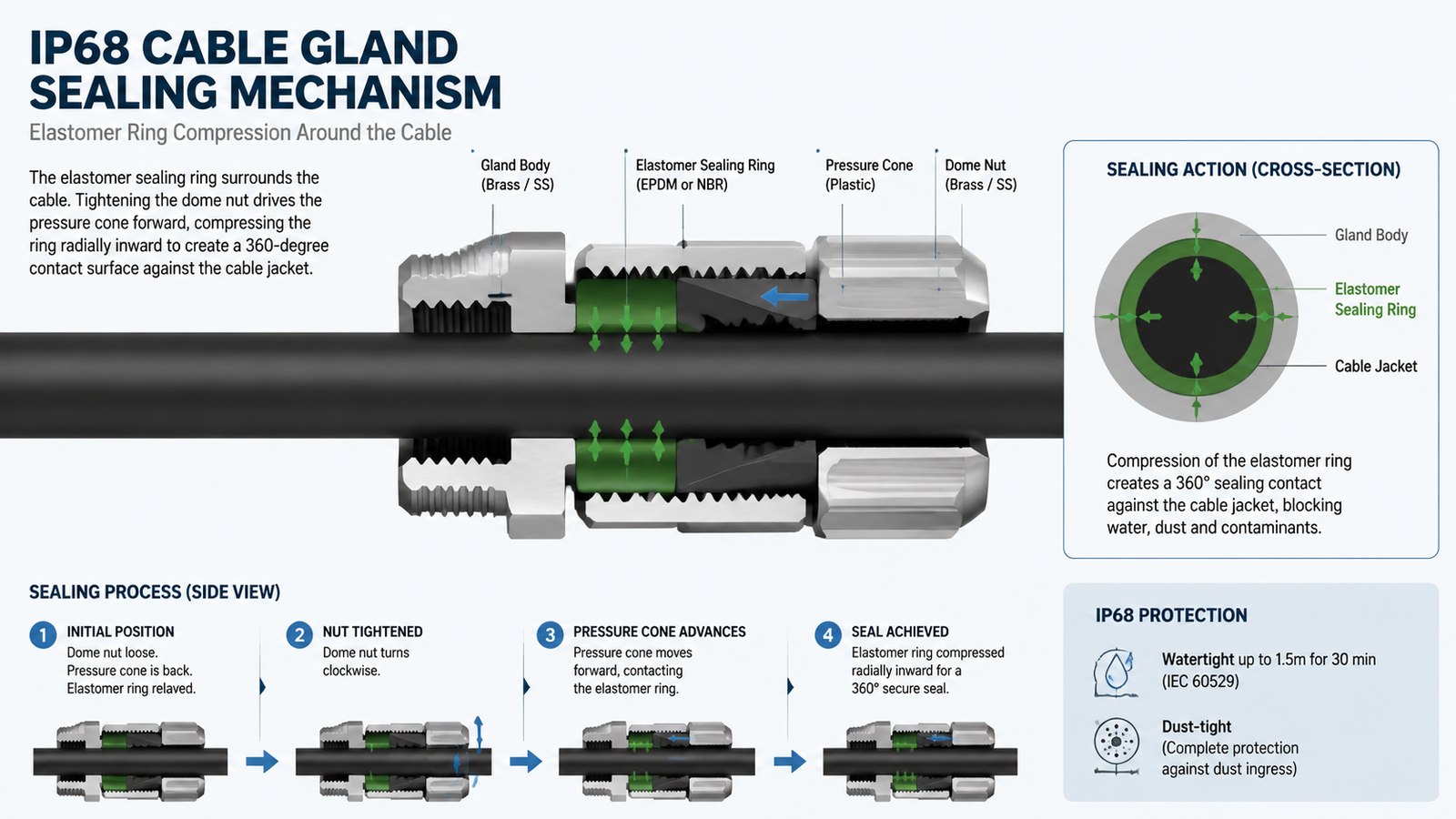
The secondary seal closes the gap between the gland body and the enclosure or panel. It is usually a flat gasket or an O-ring on the mounting thread, compressed as the gland is torqued into its threaded entry. Without this seal, water travels through the threads even on an otherwise well-made IP68 gland. A missing or pinched O-ring is one of the most common causes of a failed rating in the field.
The gland body itself is not the sealing element — the elastomer is. But the housing material has to hold its shape and clamping force under compression without creeping, cracking, or deforming over time. That is why the choice between nylon, brass, and stainless steel matters for long-term performance even when all three can reach the same IP68 rating at installation.
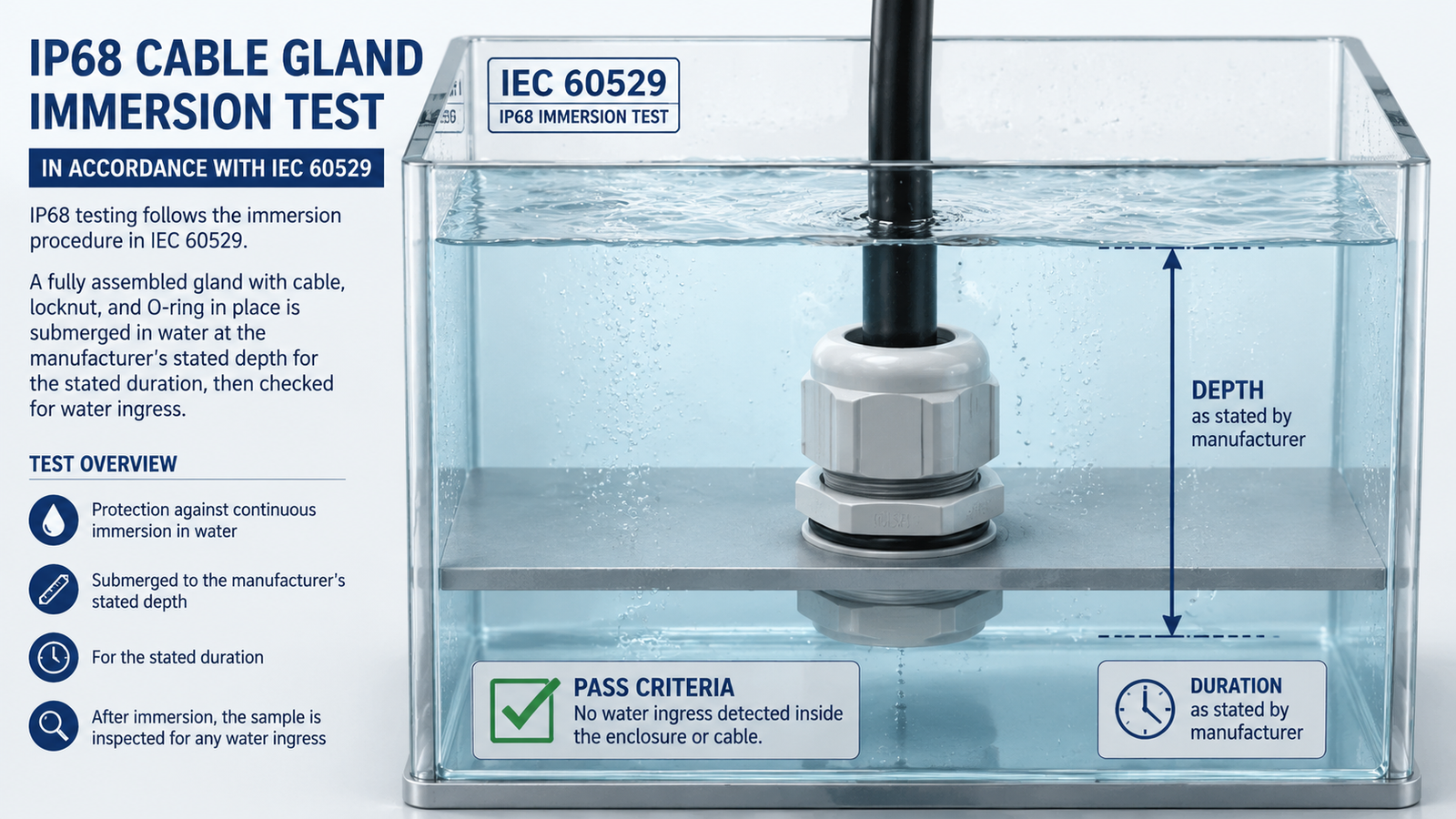
IP68 testing follows the immersion procedure in IEC 60529. A fully assembled gland — with cable, locknut, and O-ring in place, exactly as it will be installed — is submerged in water at the manufacturer’s stated depth for the stated duration. After the test, the gland must show no water ingress that would reach live parts or affect normal operation, and the seal must remain intact on inspection.
Because the test conditions are negotiated between manufacturer and customer, the same IP68 code can cover very different real-world capability. Before specifying a gland for an application with real submersion risk — submersible pumps, underground wiring, marine equipment, outdoor junction boxes — check the datasheet for the exact depth and duration, and confirm the test was performed on the full assembly rather than on the gland alone.
The most common confusion around IP68 is treating it as a linear upgrade from lower ratings. It is not. Each rating tests a different kind of water exposure, and choosing the wrong one either underprotects the installation or adds cost for protection you never use.
| Rating | Water Protection | Best Fit |
|---|---|---|
| IP66 | Powerful water jets | Outdoor panels, washdown areas with no immersion risk |
| IP67 | Temporary immersion, 1 m / 30 min | Flood-prone sites, occasional pooling |
| IP68 | Continuous immersion, manufacturer-defined | Submersible pumps, burial, marine, permanent submersion |
| IP69K | High-pressure, high-temperature jets (ISO 20653) | Food, pharma, vehicle washdown lines |
IP69K is not “better” than IP68 — it is a different test for high-pressure cleaning. A gland can pass IP68 yet fail IP69K, and vice versa. Select based on your worst realistic exposure, not the biggest number.
Most IP68 failures are installation failures, not product failures. The rating is only valid when the gland is assembled and installed the way it was tested. The three most common causes are:
When evaluating an IP68 cable gland, look beyond the label:
An IP68 rating on a cable gland means dust-tight protection plus continuous immersion beyond one meter, under conditions the manufacturer defines. The rating is achieved by two coordinated seals — one around the cable and one at the enclosure wall — and it is only as good as the test behind it and the installation in front of it. When you need a gland for real submersion duty, check the stated depth and duration, verify the material suits the environment, and install it to the manufacturer’s torque and sealing requirements. Get those right, and the IP68 rating will protect the cable entry for the life of the equipment.
No. IEC 60529 defines IP68 as continuous immersion beyond one meter, but the exact depth and duration are specified by the manufacturer. Check the datasheet for the stated test conditions — for example, 1.5 meters for 30 minutes or 10 meters for 72 hours.
Not necessarily. IP67 is fixed at 1 meter for 30 minutes, while IP68 covers continuous immersion beyond one meter. If the gland only faces rain or occasional pooling, IP67 delivers the same dust-tight sealing at lower cost. Choose IP68 when the gland may be submerged or buried for extended periods.
Nylon, brass, and stainless steel glands can all reach IP68. The material affects long-term durability — corrosion resistance, temperature range, and mechanical strength — not the rating itself at installation.
Most leaks come from installation errors: a cable outside the gland’s clamping range, incorrect torque on the compression nut, or a missing thread O-ring. The rating only applies when the gland is assembled and installed exactly as tested.
It is a different test, not a higher grade. IP69K (ISO 20653) verifies resistance to high-pressure, high-temperature water jets for washdown environments. A product can pass IP68 and fail IP69K. Choose based on the actual exposure: immersion for IP68, pressure cleaning for IP69K.
Learn what the IP rating on metal cable glands means under IEC 60529, how IP65 to IP69K compare, how glands are tested, and how to choose the right rating.
Read More
When it comes to protecting electrical cables and ensuring long-lasting performance in harsh environments, brass cable glands are a top choice. These sturdy, reliable connectors offer IP68 waterproof protection, making them suitable for a wide range of industrial, outdoor, and marine applications. Whether you’re a professional installer or a DIY enthusiast, installing brass cable glands […]
Read More
The cable gland questions buyers ask most, answered in one place: sizing, thread standards, materials, IP ratings, armoured and EMC glands, torque and ordering terms.
Read More