Every failed cable gland sealing range decision looks the same on site: a gland that is loose enough to spin by hand, or one so tight that the sealing insert extrudes around the cable. In both cases the root cause is rarely the gland itself — it is a mismatch between the cable’s actual outer diameter and the clamping range the gland was built for. This guide explains what a sealing range is, how to measure cable outer diameter correctly, and how to match the two so your installation holds its IP rating for the life of the equipment.
What Is a Cable Gland Sealing Range?
A cable gland sealing range (also called a clamping range) is the minimum and maximum cable outer diameter that one specific gland model can seal around. A gland marked M20, for example, does not seal “M20 cables” — it seals cables whose measured OD falls between two published values, such as 6 to 13 mm, depending on the exact model and insert.
The range exists because the elastomer seal inside the gland can only compress so far. Below the minimum diameter the seal cannot close around the cable; above the maximum diameter the compression nut cannot generate enough force, or the cable will not pass through the insert at all. When your cable OD sits comfortably inside the range, the gland can deliver its rated IP protection, strain relief and jacket protection. When it does not, no amount of tightening will fix it.
One point that catches out even experienced buyers: the sealing range belongs to the exact gland model, not to the thread name. Two M20 glands from the same manufacturer can have different ranges. Always work from the model’s datasheet, and if you are converting between metric, PG and NPT threads, confirm the thread system first in our thread standard conversion guide.
How to Measure Cable Diameter for a Gland
Sealing range selection starts with an accurate measurement of the finished cable, taken over the outer sheath — not the conductor, not the insulation and not the cross-section printed on the cable drum. A calibrated digital caliper is accurate enough for almost every industrial application.
Clean the cable surface. Wipe off dirt and grease so the caliper jaws seat on the sheath itself.
Measure at the widest point. Cable jackets are rarely perfectly round. Place the jaws across the widest visible cross-section, perpendicular to the cable axis.
Take at least three readings. Rotate the cable slightly and measure again along its length. Use the largest value, because manufacturing tolerance between batches can easily reach half a millimetre.
Measure over the full jacket. Include armour or screen if the cable has one, since the gland has to seal over the finished cable.
Round conservatively. Round up to the nearest 0.5 mm so you never undersize the gland you order.
For flat or oval cables, measure both axes and size the gland to the larger dimension. A standard round sealing insert may not be suitable at all — some manufacturers offer shaped inserts for these cases, and forcing a flat cable into a round seal is a common source of water ingress.
Typical Sealing Ranges by Thread Size
The table below shows typical sealing ranges for common metric gland sizes. Use it as a shortlist, then confirm the exact range against the datasheet of the specific model you plan to order.
Thread size
Typical cable OD range
Typical applications
M12 × 1.5
3 – 6.5 mm
Sensor and signal cables
M16 × 1.5
4 – 10 mm
Instrumentation and small control cables
M20 × 1.5
6 – 13 mm
General panel and control wiring
M25 × 1.5
9 – 17 mm
Multi-core power and feeder cables
M32 × 1.5
11 – 21 mm
Heavier power and motor cables
M40 × 1.5
16 – 28 mm
Large multi-core and main feeds
M50 × 1.5
27 – 38 mm
Main incoming supplies
M63 × 1.5
34 – 45 mm
Heavy industrial and armoured cables
If you work across metric, PG and NPT systems, the same logic applies to every thread standard — our cable gland size chart lists the equivalent sizes side by side so you can cross-check before ordering.
What Happens When the Cable OD Falls Outside the Range
A cable that is too small for the gland leaves an incomplete seal. The insert cannot close fully around the jacket, so dust and moisture find a path into the enclosure even when the gland “looks” tight, and strain relief suffers because the gland cannot grip a cable it was never designed to hold.
A cable that is too large causes a different set of failures. Forcing it through an undersized insert deforms the sealing rubber, cuts into the jacket and can crush the conductor insulation underneath, while over-tightening to compensate can split a nylon body or extrude the seal. Either way the gland cannot hold its rated IP68 protection — our IP67 vs IP68 comparison explains exactly what that rating does and does not guarantee.
How to Choose Between Two Candidate Sizes
Measured cable ODs often fall inside two overlapping ranges, such as a 13 mm cable fitting both an M20 (6 – 13 mm) and an M25 (9 – 17 mm) gland. In that situation, prefer the gland whose range holds your cable closer to the middle rather than sitting on an edge. A cable at the extreme edge of the range leaves the seal no margin for cable tolerance, temperature movement or jacket ageing.
Also check the conditions around the entry before committing to the size:
Temperature cycling. Sheath materials expand and contract; an edge-of-range fit will not stay tight.
Movement and vibration. Continuously flexed cables need firmer mid-range grip and adequate strain relief.
Future cabling. Panel builders sometimes choose the larger gland and use reducers to keep options open.
Sealing Inserts and Materials Matter Too
The insert that actually touches the cable is as important as the size stamped on the gland body. Most standard glands ship with an EPDM insert, which handles a wide range of cable jackets well. For cables that vary more in diameter, or installations that face wide temperature swings, a softer silicone rubber insert compresses over a wider span and follows jacket irregularities more closely. A brass cable gland with a silicone rubber insert, for example, pairs the durability and thread strength of nickel-plated brass with a more forgiving seal — a practical choice for outdoor enclosures and equipment subject to seasonal temperature change.
If the rest of your specification already uses brass, keep the whole entry consistent. A standard brass cable gland covers general industrial sealing, while a brass MG cable gland suits heavier clamping demands. Mixing materials across one panel rarely causes problems electrically, but it doubles the number of datasheets your team has to check on site.
Common Measurement Mistakes
Using the nominal datasheet value. Manufacturer tolerances vary; measure the actual cable in front of you.
Measuring a compressed or damaged section. Cable that has been clamped, kinked or stripped reads smaller or oval.
Reading AWG or cross-section instead of OD. Conductor size tells you nothing about the jacket diameter, which is what the gland seals against.
Assuming the thread defines the range. The same M20 size can carry several different sealing ranges across models and brands.
Ignoring installation torque. Even a correctly sized gland needs proper tightening — our cable gland torque guide covers the values and the two sealing points to check.
Conclusion
Getting a gland to seal is not about luck or extra force — it is about one number: the measured outer diameter of the finished cable, matched to the documented sealing range of one exact gland model. Measure with a caliper over the sheath at three points, round up, choose the model whose range holds the cable near the middle, and verify the insert material suits the environment. Do that, and the gland will hold its rated protection for the service life of the installation.
If you are specifying glands for a full panel or enclosure build, gather the cable schedule first and list every OD before ordering — or send the measurements to our team and we will confirm the right gland size, insert and material for each entry.
Frequently Asked Questions
What is the sealing range of a cable gland?
It is the minimum and maximum cable outer diameter that one specific gland model can seal around, published in the model’s datasheet. The range belongs to the exact model, not to the thread size name.
How do I measure cable diameter for a cable gland?
Measure over the outer sheath with a digital caliper at the widest point, take at least three readings along the cable, use the largest value, and round up to the nearest 0.5 mm.
What happens if my cable is too small for the gland?
The insert cannot close fully around the jacket, so the seal leaks and strain relief is weak. Use a smaller gland, or a reducer sized for the measured cable OD.
Can a cable be too big for an M20 gland?
Yes. Any cable above the model’s maximum OD will not seal properly and forcing it damages the insert, the jacket or both. Move up to M25 (or the next range that holds the cable near its middle).
Do I measure the conductor or the outer jacket?
Always the outer jacket of the finished cable, including any armour or screen. The gland seals and grips the sheath, never the conductor.
Discover the right cable glands for EV charging infrastructure and energy storage systems. This guide covers selection criteria, materials, IP ratings, and installation best practices.
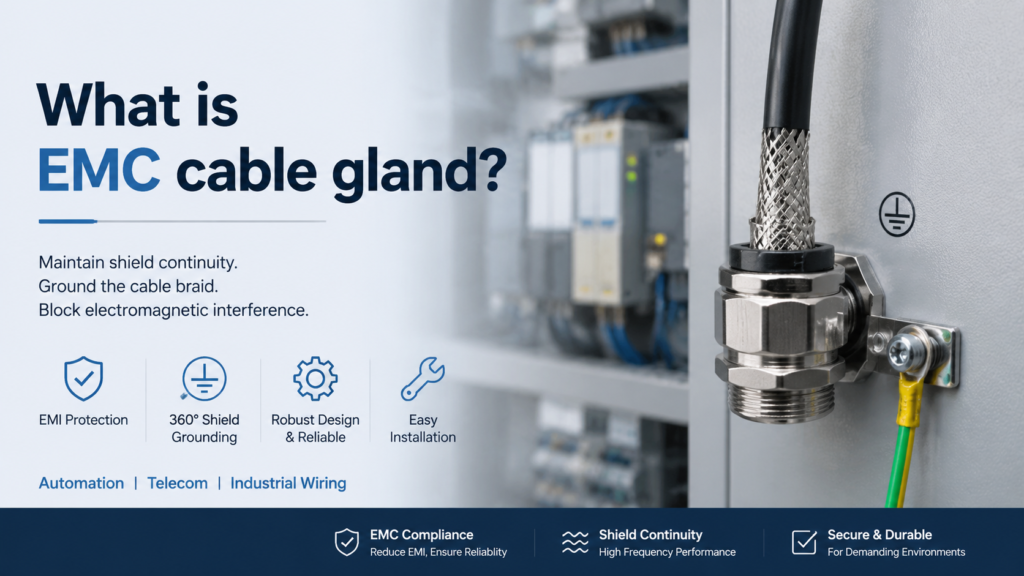
Learn what an EMC cable gland is and how it keeps a shielded cable’s braid grounded to the enclosure to block electromagnetic interference in automation, telecom, and signal systems.
We use cookies to enhance your browsing experience, serve personalised ads or content, and analyse our traffic. By clicking "Accept All", you consent to our use of cookies.