Blog
Waterproof Junction Box vs Distribution Box: Key Differences
A waterproof junction box joins wires, a distribution box protects circuits. Compare function, standards, IP ratings, sizing and cost before you specify the right enclosure.
Read More
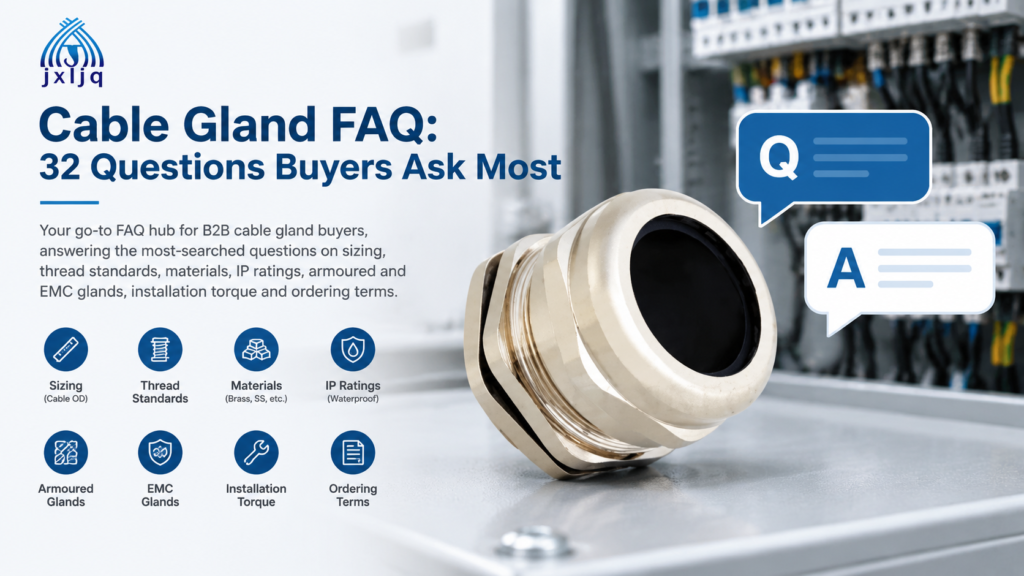
Almost every cable gland failure traces back to a decision made long before anyone picks up a wrench: a size that sits outside the clamping range, a thread that was never going to fit, a material that was wrong for the environment, or a seal that was never compressed properly in the first place. The questions on this page are the ones our sales engineers answer most often, by email, at trade shows, and on the factory floor. We have grouped these frequently asked questions by topic and answered each one directly, without the marketing padding.
This cable gland FAQ is arranged so you can find your answer quickly rather than reading the whole page. If you are new to cable glands, start with the basics and sizing sections. If you already know what you need and something is going wrong on site, jump straight to installation and torque. Each answer links to a deeper guide where the topic deserves more than a paragraph, and the questions we are asked most often are recapped in a single table at the end.
A cable gland is a mechanical fitting that anchors and seals a cable where it passes through the wall of an enclosure, panel, or machine housing. It threads into the entry point, grips the cable jacket, and compresses a seal around it. The part itself is simple; the job it does is not, because that single entry point is the weakest spot in the entire enclosure.
Four things, and all four matter:
In most of the world, yes. “Cord grip” is the common North American term, “cable connector” is used widely in Asia, and “cable gland” is standard in Europe and the UK. They describe the same family of fittings. The one distinction worth keeping is between a cable gland and a conduit fitting: a gland grips a flexible cable jacket, while a conduit fitting terminates rigid or flexible conduit. They are not interchangeable.
An open hole in an enclosure breaks its IP or NEMA rating immediately, and it also exposes the cable jacket to a sharp metal edge that will cut through it under vibration. A gland costs very little compared with the cost of a moisture-related failure. In hazardous areas it is not optional at all: the entry must be sealed with a certified fitting, and using a general-purpose gland there is both dangerous and non-compliant.
Size a gland from the cable’s outer diameter, never from the conductor size or the AWG rating. Measure the finished jacket with calipers, then pick the gland whose clamping range contains that measurement, ideally near the middle of the range. An M20 gland typically seals 6-12 mm cable, M25 covers roughly 10-14 mm, and PG11 covers 5-10 mm, but exact ranges vary by design, so always check the datasheet rather than a generic table. Our cable gland size chart lists the metric, PG, and NPT ranges we manufacture.
Choose the smaller gland when the cable fits inside its range. A gland that is slightly too large cannot compress its seal around the jacket, so it will not seal at all and will not grip. A gland that is slightly too small simply will not pass the cable, which is an obvious and safe failure. If your cable is thinner than the smallest insert in a given thread, the answer is a reducing insert or seal, not a smaller thread.
Use calipers on a straight section of the finished cable, at least 100 mm back from the end, and take three readings around the circumference. Jackets are rarely perfectly round, so use the largest reading. On flexible or braided cable, also allow for the tolerance the cable supplier publishes: a nominal 10 mm cable can measure 9.4 mm or 10.6 mm in practice, and that spread decides whether it seals. Our guide to measuring cable diameter for a gland walks through the full method.
Yes. The thread on the gland body has to match the entry it screws into, and the panel hole is sized by that thread, not by the cable. An M20 thread needs roughly a 20.2 mm clearance hole, PG11 needs about 18.6 mm, and a 1/2 in NPT entry has its own tapered dimensions. Measure the existing hole before you order a replacement, because a gland with the right cable range but the wrong thread is still the wrong gland.
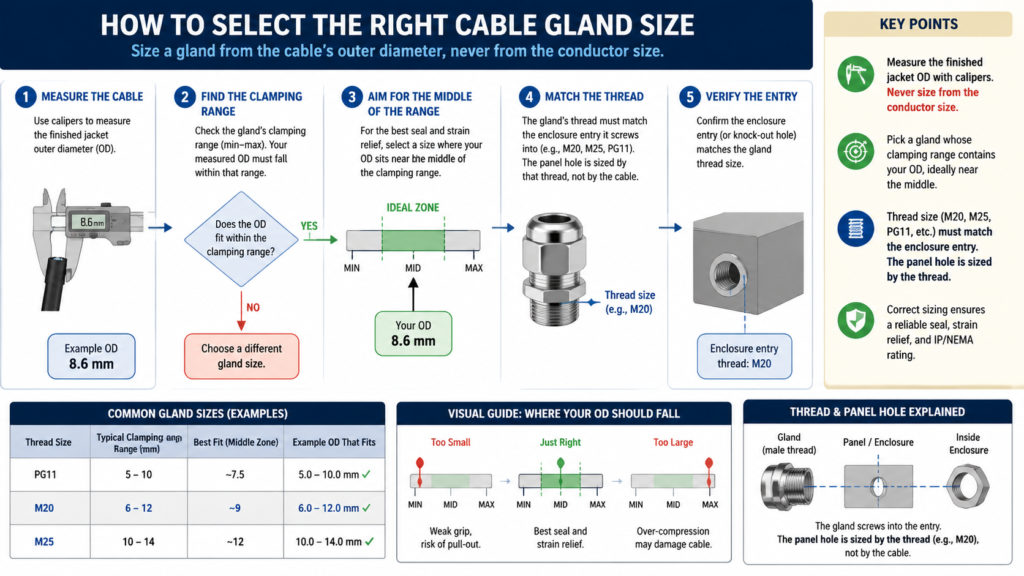
No. Metric and PG threads have different diameters and different pitches, so a PG16 gland will not screw into an M20 hole and an M20 gland will not seat in a PG16 hole. Forcing the issue strips threads and destroys the seal. If you have to mix standards on an existing panel, use a thread adapter or a reducer and enlarger pair sized for the two threads involved.
Metric threads follow ISO 965 and are written as M plus diameter plus pitch, for example M20 x 1.5. PG, short for Panzergewinde, is an older German standard with a finer pitch and a size code that does not correspond to a millimetre dimension. PG is formally withdrawn but is still common on European equipment built before the 2000s, which is why conversion charts exist. The full mapping is in our Metric, PG and NPT conversion guide.
NPT stands for National Pipe Thread, and its defining feature is that it is tapered rather than straight. The taper is what creates the seal on a pipe fitting, and it is also why NPT and metric threads can never be interchanged. If you are supplying equipment into the United States or Canada, confirm the entry thread on the enclosure before you specify a gland, because a metric panel will not accept an NPT fitting without an adapter.
Usually, yes, and it is the cheaper option. A reducer lets a smaller-thread gland fit a larger entry, while an enlarger does the opposite. Both are available in metric, PG, and NPT and in brass, stainless steel, and PA66. The one thing to keep in mind is that each adapter adds a joint, so if the enclosure has to hold IP68, the adapter has to be sealed with the same care as the gland itself.
Match the material to the environment, not to the budget line.
| Material | Best for | Avoid when |
|---|---|---|
| PA66 nylon | General panels, junction boxes, light industrial, chemical splash, non-conductive entries | High mechanical load, EMC shielding, continuous UV exposure without stabiliser |
| Nickel-plated brass | Industrial machinery, control panels, EMC-sensitive cabinets, vibration, oil and coolant exposure | Saltwater or aggressive chemical environments |
| SS304 / SS316L | Marine, offshore, food and beverage, chemical plants, washdown and hygienic areas | Weight and cost are the primary constraints |
Our nylon vs metal selection guide goes through the trade-offs in more detail, including the temperature and chemical limits of each family.
Outdoors is usually fine; near the sea is not. Nickel-plated brass resists atmospheric moisture and industrial pollution well, which is why it dominates outdoor panels and street lighting. In a marine or coastal setting, salt spray attacks the plating and then the brass underneath, so stainless steel is the correct choice. A brass gland that looks perfect at commissioning can be corroded and seized within two or three seasons on a pier or an offshore platform.
Our standard nylon and brass ranges are rated from -40 °C to +100 °C, with some brass variants allowing brief excursions to around +120 °C. Stainless steel bodies tolerate a wider spread, but the limit is usually set by the sealing elastomer, not by the metal: NBR and EPDM seals have their own temperature windows and chemical compatibility profiles. If your application runs hot, specify the seal material first and the body material second.
It is real and it is frequently overlooked. Installing a nickel-plated brass gland directly into a galvanised steel enclosure, or a stainless steel gland into an aluminium panel, creates a galvanic couple that accelerates corrosion wherever moisture sits. The practical fix is a nylon or plastic-bodied gland, or an insulating washer and a non-conductive interface between the two metals. In outdoor and damp installations this is worth designing in from the start.
IP68 means the gland is dust-tight, and that it will keep water out when continuously immersed under conditions agreed between the manufacturer and the customer. The 8 in IP68 does not define a depth or a duration by itself: IEC 60529 leaves those to the manufacturer to declare, and the only requirement is that the test is more severe than IPX7, which is 1 m for 30 minutes. When a supplier claims IP68, the honest question is “at what depth, for how long, and tested by whom”.
No, and specifying it unnecessarily adds cost. IP66 or IP67 is enough for most outdoor panels, rooftop equipment, and washdown areas where water is sprayed but never pooled. IP68 is the right call where the entry will genuinely be submerged, such as wet wells, underground pits, submersible pumps, and marine deck fittings. Match the rating to the worst realistic condition rather than defaulting to the highest number on the datasheet.
Only if your process uses high-pressure, high-temperature jet cleaning, which is typical in food and beverage plants and some pharmaceutical lines. IP69K is tested against a close-range jet at around 80 °C and high pressure, which is a different challenge from immersion. A gland that is IP68 is not automatically IP69K, and the two tests do not substitute for each other. Our IP67 vs IP68 comparison explains where the boundary sits.
Yes, and this is the most common cause of “waterproof” glands leaking. The rating assumes the cable outer diameter sits inside the published clamping range, the sealing nut is tightened to the specified torque, the panel surface is flat and free of burrs, and the O-ring or sealing washer is correctly seated. Break any one of those and the rating is void regardless of what the badge on the bag says. Glands also age: elastomer seals harden and take a set, so a seal that passed a pressure test at year one may not at year five.
Armoured cable needs a double-compression gland. One stage grips and seals the outer jacket, and a second stage clamps the steel wire armour or aluminium armour for mechanical retention and earth continuity. A single-compression gland designed for unarmoured flex will not bond the armour, so the earth path is lost. If the cable is armoured, always confirm the over-bedding diameter as well as the overall diameter, because the armour has to land inside its own specified range.
These are the traditional British gland designations. BW is the indoor, single-seal armoured gland. CW is the outdoor version with an additional seal and a shroud, so it holds up to weather and water. A2 is an unarmoured gland for general industrial use, not for armoured cable at all. Modern equivalents exist in most ranges, but the naming persists in specifications, so it is worth knowing which one a tender document is asking for. We compare them side by side in our BW vs CW vs A2 guide.
The shield has to be bonded to the enclosure around its full circumference, at 360 degrees, and as close to the point of entry as possible. A drain wire or pigtail is the wrong answer: its inductance rises with frequency, so it stops behaving as a shield exactly where you need shielding most. EMC glands use a contact spring or clamping cone that presses the braid against the gland body around the whole circumference. Our guide to EMC grounding and 360 degree shielding covers single-ended versus double-ended bonding and painted panel problems.
Whenever the installation sits in a classified hazardous area, and the required protection concept has to come from the area classification, not from the gland catalogue. Ex d flameproof glands contain an internal ignition so it cannot spread, and Ex e increased-safety glands maintain a higher level of sealing and mechanical integrity. The gland, the enclosure, and the cable all have to be certified to the same concept and the same gas or dust group. Outside a hazardous area, a standard industrial gland is the correct and cheaper answer.
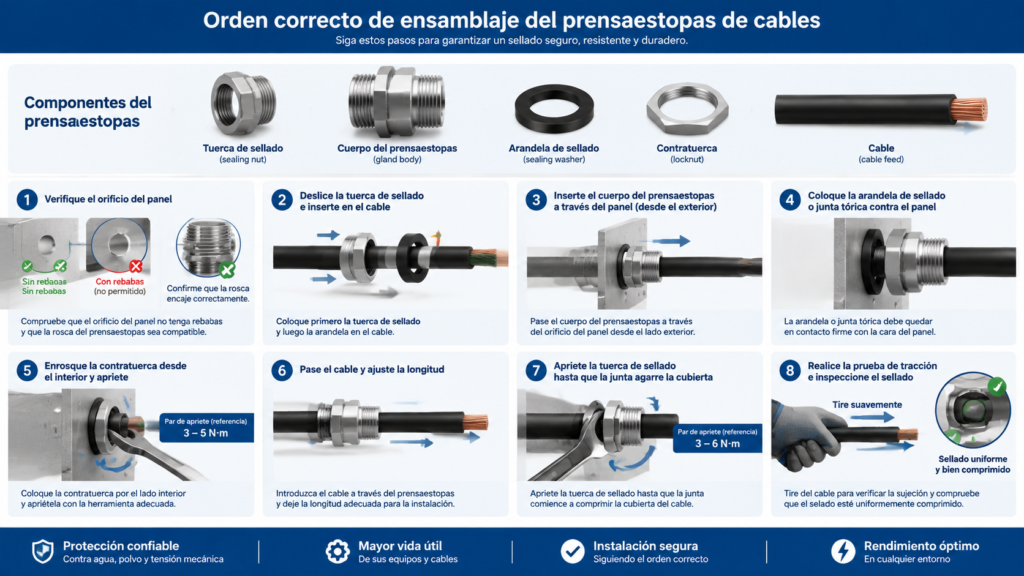
Tight enough to compress the seal, and no tighter. The locknut or body should be snug against the panel, and the sealing nut should be tightened until the seal grips the jacket firmly without deforming it. Over-tightening is the more damaging error: it crushes the sealing insert, can crack a plastic body, and on a plastic enclosure can warp the panel so the O-ring no longer seats. Use a torque wrench where a specification exists. Our torque and sealing point guide explains which joint to tighten and in what order.
Not through a standard gland. A standard sealing insert is designed around one round cable, and pushing two cables through leaves an unavoidable gap between them, which voids the IP rating and destroys the strain relief because the gland cannot grip either cable properly. If you need multiple cables at one entry point, use a multi-hole or multiple-cable gland with a separate opening for each cable, or a dedicated cable entry system.
In rough order of how often we see them: the wrong cable diameter for the gland, a missing locknut on a plain clearance hole, a missing sealing washer so the panel face is the only seal, over-tightening the sealing nut, sharp panel edges cutting the jacket, mixing brass into a galvanised or aluminium enclosure without isolation, and running multiple cables through a single-hole insert. Every one of these is a five-minute fix at installation and an expensive repair after commissioning.
Ask for the certificate for the specific product family and the specific claim you are relying on, not a general company certificate. For a standard industrial gland, that means the CE declaration, RoHS and REACH statements, and an IP test report if a rating is claimed. For hazardous areas, it means the Ex certificate with the certificate number, the protection concept, and the gas or dust group visible. A supplier who can only show an ISO 9001 certificate is telling you about their management system, not about the product.
MOQ depends on the product and the thread size, because some items are stocked and others are made to order, so tell us the part and quantity and we will confirm in writing. Samples are available, and we are happy to send them before a first order so you can check the thread, the clamping range, and the finish against your cable. For buyers who want to evaluate several sizes at once, sending a cable sample along with the enquiry gets you a much faster and more accurate recommendation.
Stocked items ship quickly, and custom or made-to-order quantities depend on the thread sizes and the finishing required. We reply to enquiries within 12 hours on business days with price, lead time, and technical feedback, so the fastest path is to send your drawing or specification and let us come back with a firm schedule. If a project has a hard delivery date, say so in the first message rather than the third.
Yes. We support custom thread types, cable ranges, body materials, seal compounds, laser marking and branding, and special packaging requirements, from drawing through to mass production. The main constraint is tooling and minimum quantity, which is why custom work is quoted per project rather than from a price list. Yueqing Jixiang Connector has been manufacturing cable glands and wire fittings since 2011, operates a factory of nearly 5,000 square metres with a monthly output above 10 million pieces, and holds ISO 9001, IATF 16949 and ISO 14001 certification along with TUV, CE, RoHS, REACH and IP68 reports.
The pattern behind almost every question on this page is the same: get the four core inputs right before you order. Measure the cable outer diameter with calipers. Confirm the enclosure thread standard and the hole size. Decide the material from the environment, not the price. Decide the IP rating from the worst realistic condition, not the highest number available. Once those four are fixed, the gland almost chooses itself, and the installation questions become straightforward.
This cable gland FAQ covers the questions we hear most, but no single page covers every project. If your situation is not here, the fastest route is to send us the cable specification, the enclosure entry details, and the environment. We will come back with a selection and a quotation rather than a catalogue page. Contact our technical team with your drawing or specification and we will respond within 12 hours on business days.
| Question | Short answer |
|---|---|
| What is a cable gland? | A fitting that anchors, seals and earths a cable where it enters an enclosure. |
| How do I size a cable gland? | Measure the cable outer diameter with calipers and pick the clamping range that contains it, near mid-range. |
| Are metric, PG and NPT threads interchangeable? | No. Diameters and pitches differ, so use the matching thread or a proper adapter. |
| Nylon, brass or stainless steel? | Nylon for general panels, brass for industrial and EMC work, stainless steel for marine and corrosive sites. |
| What does IP68 mean? | Dust-tight and protected against continuous immersion, with depth and duration declared by the manufacturer. |
| Which gland for armoured cable? | A double-compression gland that clamps the armour separately for earth continuity. |
| Can two cables share one gland? | Not a standard gland. Use a multi-hole or multiple-cable gland instead. |
| How tight should it be? | Snug enough to compress the seal without deforming the jacket or cracking the body. |
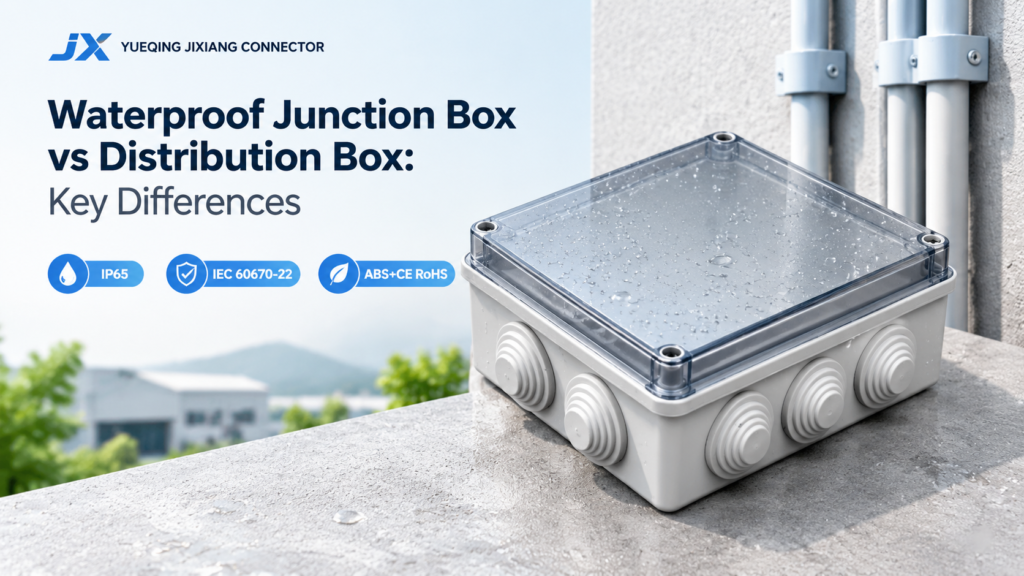
A waterproof junction box joins wires, a distribution box protects circuits. Compare function, standards, IP ratings, sizing and cost before you specify the right enclosure.
Read More
Introduction Even the best IP68 cable gland can fail if installed incorrectly. Installation mistakes are one of the main causes of water ingress and cable damage. Mistake 1: Incorrect Cable Diameter Selection Using a cable outside the recommended clamping range can compromise sealing performance. Mistake 2: Over-Tightening or Under-Tightening Both can damage seals or reduce […]
Read More
Introduction Choosing between an IP68 nylon cable gland and a brass cable gland is one of the most common decisions in industrial and outdoor electrical installations.Both options provide waterproof protection, but they differ in strength, cost, and application suitability. This guide compares the two to help engineers and purchasing managers make the right choice. Material […]
Read More