Blog
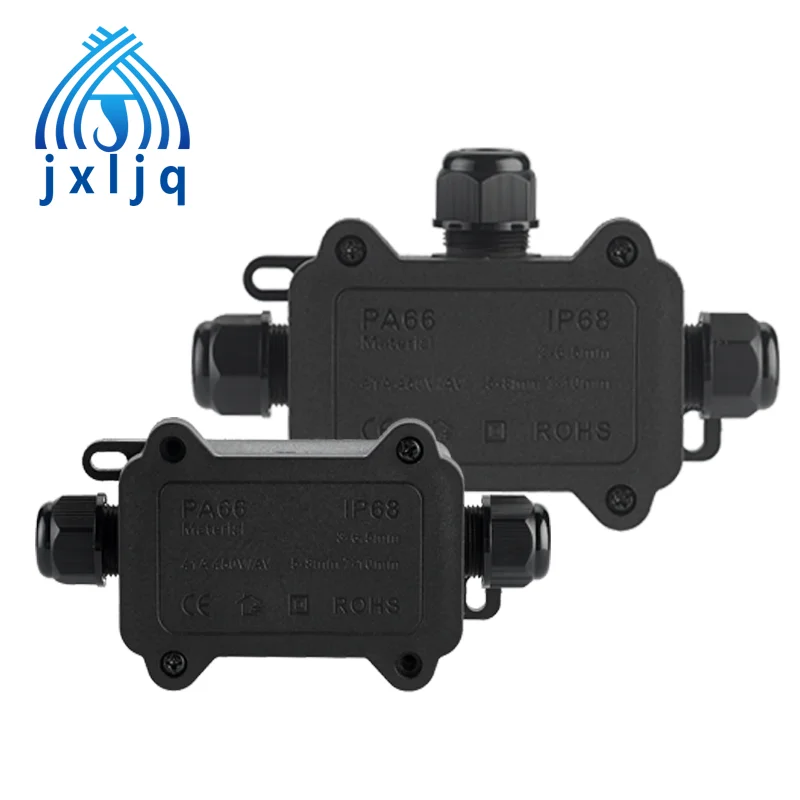
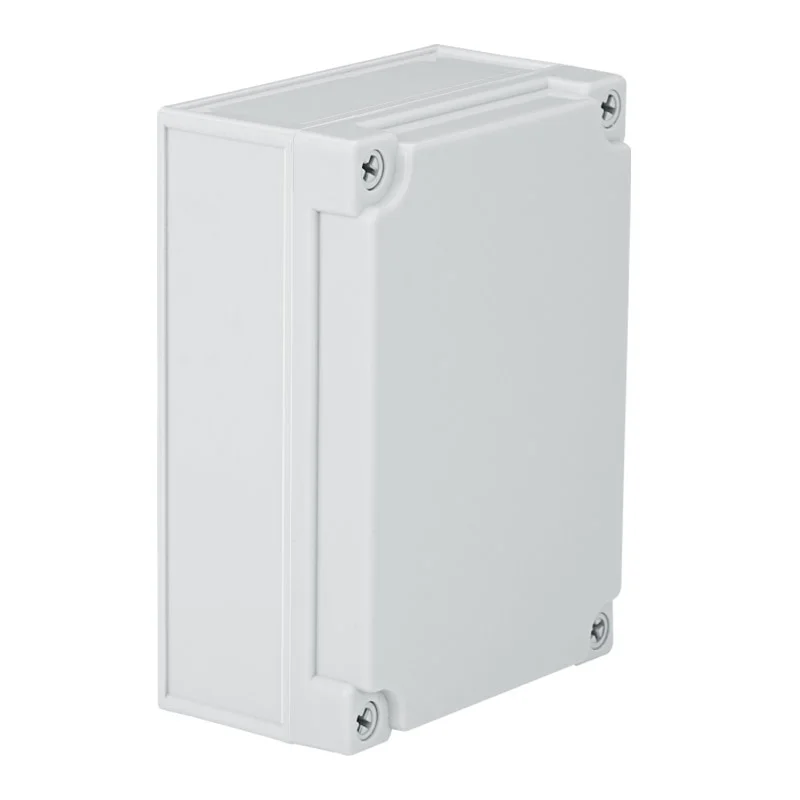
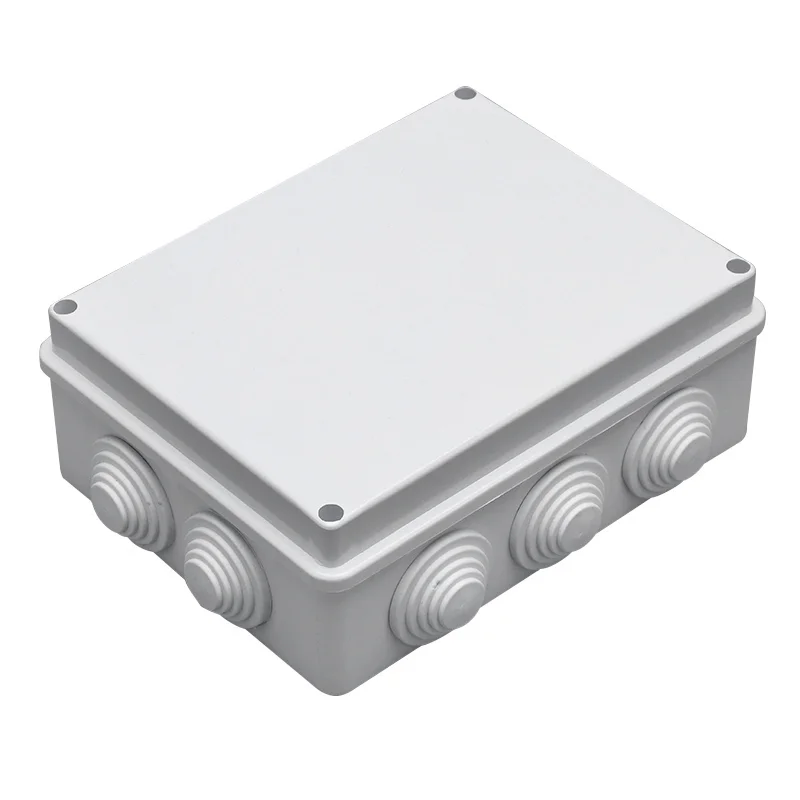
Waterproof Junction Box vs Distribution Box: Key Differences
A waterproof junction box joins wires, a distribution box protects circuits. Compare function, standards, IP ratings, sizing and cost before you specify the right enclosure.
Read More

BW, CW and A2 sit next to each other in the same column of almost every gland catalogue, so most buyers assume they are three competing models of armored cable gland types and pick the one that looks strongest. That is the wrong starting point. BW, CW and A2 are not products at all — they are positions inside the British Standard BS 6121 type code, and each letter position answers a different question about the cable, not about the gland.
Once you can read the code, the comparison stops being a guess. You will know why a BW gland is the cheapest correct choice for a switchroom panel and the most expensive mistake in a wet plant room, why a CW gland is the workhorse of outdoor steel wire armoured (SWA) terminations, and why A2 — the letter most often misread as “the third armored gland” — is actually defined for cable with no armour at all. This guide decodes the whole designation system from BS 6121:Part 1:1989, places BW, CW and A2 on the same map, and finishes with a four-step method you can apply to a real bill of materials.
If you only need the headline, this is it:
| Designation | What the code means | Cable it is built for | Where it belongs |
|---|---|---|---|
| BW | Armour clamp, no seal on the outer sheath | SWA / AWA armoured cable | Dry indoor enclosures — panels, switchgear, distribution boards |
| CW | Armour clamp plus a single outer seal | SWA / AWA armoured cable | Indoor and outdoor — plant rooms, pumps, motors, buried runs |
| A2 | Outer seal on an elastomeric or plastic sheath, rated IP66 | Unarmoured cable | Indoor and outdoor, wherever there is no armour wire to terminate |
The single most useful takeaway: BW and CW are a pair, separated only by how many sealing points they carry. A2 belongs to a different family entirely, and mixing it into the armored comparison is what produces most of the wrong specifications you see on site.
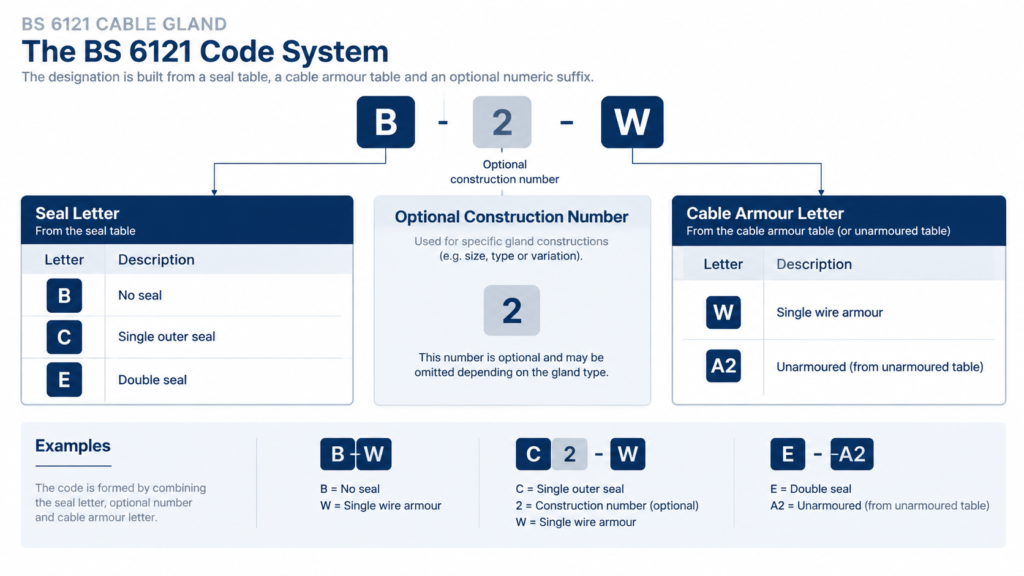
BS 6121:Part 1:1989 fixed a short-hand that the cable gland industry still uses four decades later, and both British manufacturers and their overseas competitors quote it directly in catalogues. The designation is built from three separate tables, and this is the part most datasheets never explain.
The first table defines the A-series, which applies to unarmoured cable:
| Type | BS 6121 definition |
|---|---|
| A1 | For unarmoured cable with an elastomeric or plastic outer sheath, sealing between the cable sheath and the sealing ring of the gland |
| A2 | As type A1, but with seal protection degree IP66 |
| A3 | As type A1, but with an electrical bond for the metallic inner screen |
The second table defines the seal code, and this is where BW and CW get their first letter. It describes how many sealing points the gland provides:
| Code | Sealing provided |
|---|---|
| B | No seal |
| C | Single outer seal |
| D | Single inner seal |
| E | Double seal — inner and outer |
A numeric suffix sits after the seal letter: 1 means normal construction, 2 means the gland is intended for lead-sheathed cable.
The third table defines the cable armour, and it supplies the second letter:
| Code | Armour type |
|---|---|
| T | Pliable wire armour |
| W | Single wire armour (SWA) |
| X | Braid |
| Y | Strip armour |
| Z | Tape armour |
Combine the tables and the well-known codes fall out automatically. Take E1W, the double-seal armoured gland used in hazardous and corrosive areas:
Run the same logic on the three codes from the title:
That last point deserves to be stated plainly, because it contradicts what a lot of catalogue pages imply.
A BW cable gland is built to BS 6121 for terminating SWA cable in dry, indoor locations. Inside the body, a tapered cone and clamping ring grip the exposed armour wires. That grip does two jobs at once: it anchors the cable so it cannot be pulled out of the enclosure, and it creates the electrical path that bonds the armour to earth through the gland body.
What the BW design deliberately does not do is seal against the outer sheath of the cable. The sheath passes through with no compression seal, which leaves water and dust a clear route along the armour wires. This is not a defect, it is the definition of the code letter — B means no seal.
Because there is no outer seal, any ingress protection figure quoted for a BW gland comes from the enclosure it is bolted to, not from the gland itself. Some catalogues print IP54 for the type; others decline to quote a weatherproof rating at all, which is the more honest position. In practice a BW gland belongs in switchgear cabinets, control panels, motor control centres and distribution boards, where the termination is already protected by the enclosure.
A useful detail for procurement: the BW body is normally brass, with or without nickel plating, and is available in metric, NPT, BSP and PG threads. If your project uses a thread standard other than metric, the code letters do not change — only the entry thread does, which is why metric, PG and NPT threads should be confirmed separately before the inquiry goes out.
A CW cable gland is the same armoured gland family, one code letter further along. It still clamps the armour and still provides earth continuity, but it adds a compression seal on the outer sheath of the cable — the C in the code. That single extra sealing point closes the gap water would otherwise use to travel along the armour wires.
The practical consequences are large. A CW gland is specified for indoor and outdoor use, typically achieves IP66 or IP67, and usually holds a working temperature range in the order of -20 °C to +80 °C on standard seals. Those numbers are what make it the default choice for plant rooms, pump stations, motor terminations, outdoor distribution equipment, underground runs and any location exposed to rain, condensation or wash-down.
Note the wording carefully: CW is a single seal gland. It seals the outer sheath only. It does not seal the inner bedding, and it is not the same specification as E1W, which adds the inner seal as well. Suppliers sometimes describe CW as a “double compression” gland because the assembly has two tightening actions, but under the standard the seal count is one. When a specification calls for double sealing, check which definition the author is using — this ambiguity causes more rejected submittals than any other part of the code.
Here is where the market diverges from the standard. Under BS 6121, A2 is defined for unarmoured cable: a gland that seals the outer sheath of an elastomeric or plastic-sheathed cable and reaches IP66. There is no armour clamp, because there is no armour. A2 is the weatherproof member of the A-series, sitting above A1 (the base version) and below A3 (which adds a bond for a metallic inner screen).
In commercial catalogues, however, it is extremely common to see “A1/A2 type” glands listed as armoured, and to see the real distinction described as single compression versus double compression. That usage is widespread, particularly among brass gland manufacturers selling into multiple markets, but it is not what BS 6121 says. The result is a predictable failure mode: a buyer searches for the third option next to BW and CW, finds A2, and orders an unarmoured gland for an SWA cable.
The safe rule is to treat the code letters as a description of the cable, not of the gland. If the cable has steel wire armour, you are choosing between B, C and E seal codes with a W armour code — in practice BW, CW or E1W. If the cable has no armour, you are in the A-series, and a standard brass cable gland or a nylon equivalent is the right family.
And if the “cable” is not a cable at all but flexible conduit or corrugated tubing, none of these codes apply. Tubing is terminated with a different connector family altogether — for example a watertight fitting gland, which is rated IP68 and sized by tubing outside diameter rather than by armour and sheath dimensions. Reaching for a BW or CW code on a conduit run is the fastest way to order something that will not fit.
| Feature | BW | CW | A2 |
|---|---|---|---|
| BS 6121 code source | Seal table (B) + armour table (W) | Seal table (C) + armour table (W) | Unarmoured table (A-series) |
| Cable type | SWA / AWA armoured | SWA / AWA armoured | Unarmoured, elastomeric or plastic sheath |
| Armour clamping and earth continuity | Yes | Yes | No armour to clamp |
| Outer sheath seal | None | Single compression seal | Single pull-resistant seal |
| Typical protection | Depends on the enclosure; no weatherproof rating from the gland | IP66 / IP67 | IP66 (per the standard definition) |
| Environment | Dry indoor only | Indoor and outdoor | Indoor and outdoor |
| Material and finish | Brass, optional nickel plating | Brass, optional nickel plating | Brass or nylon, depending on the range |
| Thread options | Metric, NPT, BSP, PG | Metric, NPT, BSP, PG | Metric, NPT, BSP, PG |
| Relative cost | Lowest | Higher than BW | Comparable to CW in brass |
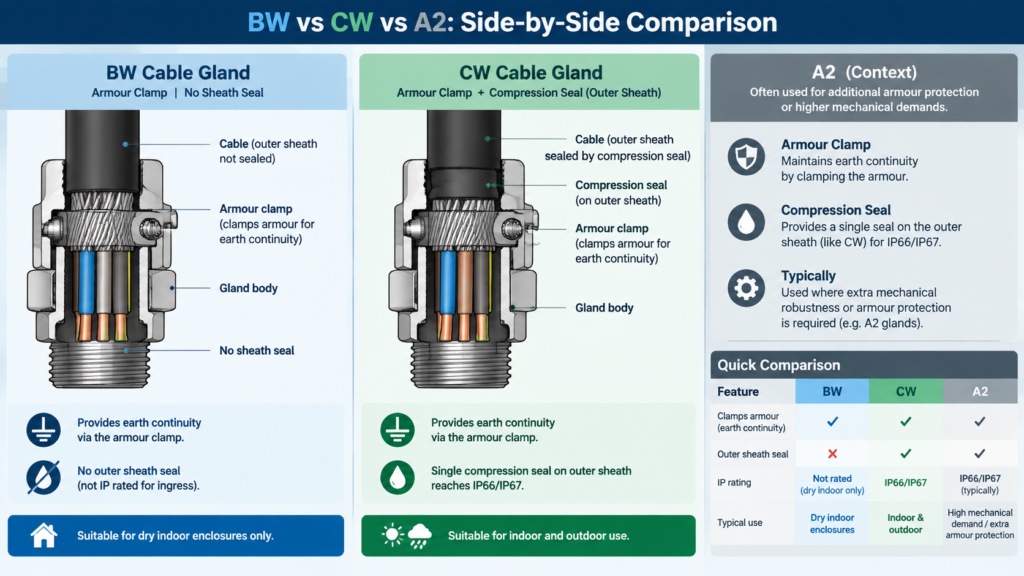
The table makes the commercial argument on its own. BW is cheaper, but it only works where the enclosure is doing the weatherproofing. CW costs a little more and removes that dependency entirely. On a mixed site, standardising on CW avoids the whole class of error that comes from someone grabbing a BW gland for an outdoor junction box.
The code system does not stop at three entries, and knowing the rest saves a phone call when a client’s specification quotes one of them:
Two of these matter for everyday buying decisions. First, CX and E1X exist because braided cable is not the same as wire armoured cable, and a W-code gland will not clamp a braid correctly. Second, E1W is often the correct answer when a specification demands IP68 — single-seal CW glands typically reach IP66/IP67, and the extra inner seal is what lifts the assembly further.
Work through the code from the cable outwards, not from the catalogue inwards. The order matters, because each step eliminates whole families before you look at a single price.
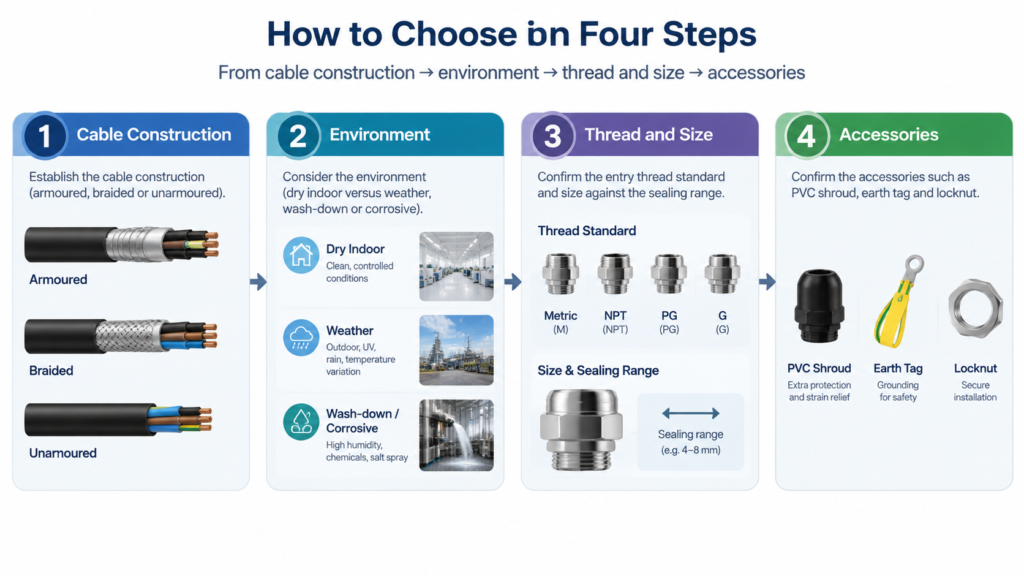
Once the correct code is chosen, the mechanical work is straightforward — our walkthrough on how to install an armoured cable gland covers the sequence from stripping the sheath to seating the armour under the cone.
No, and this is the limitation built into BS 6121 from the start. As British gland manufacturers have long pointed out, the type designation identifies the cable gland family; it does not determine the precise method of sealing the manufacturer adopts inside that family. Two glands can both be legitimately labelled CW and still differ in seal geometry, seal material and the cable diameter range over which the quoted protection holds.
For a buyer, that turns into three practical habits. Ask for the certified IP figure and the test basis rather than accepting the code letter as a promise. Ask for the sealing range in millimetres, because a gland only delivers its rating across the range it was tested over. And where the environment is genuinely demanding, ask whether the assembly including shroud and locknut was tested, or the bare gland alone. A code letter is a starting point for a specification, never the whole of it.
BW, CW and A2 are not three rival products fighting for the same job. They are three positions in the BS 6121 type code, and each one answers a different question: BW clamps armour with no sheath seal and belongs in a dry enclosure; CW adds a single outer seal and works indoors and out; A2 is not an armoured gland at all, but the IP66 unarmoured type with which it is so often confused. Read the code from the cable outwards — construction first, then environment, then thread, size and accessories — and the specification writes itself.
If you are working through a bill of materials and want the BW, CW and E1W ranges checked against your cable schedule, send over the cable sizes and thread requirements and our team will confirm the matching code, sealing range and accessory kit.
BW comes from the BS 6121 code: B means the gland provides no seal, and W means it is for single wire armoured (SWA) cable. A BW gland clamps the armour and gives earth continuity, but has no seal on the outer sheath, so it is intended for dry indoor installations inside a protective enclosure.
The CW gland meaning comes straight from the BS 6121 code: C means a single outer seal and W means single wire armoured cable. A CW gland therefore clamps the armour, provides earth continuity, and adds a compression seal on the cable’s outer sheath, which is what allows it to be used outdoors and reach IP66/IP67. It seals the outer sheath only, not the inner bedding.
They are not alternatives, because they suit different cables. A BW gland is for steel wire armoured cable, clamps the armour and gives earth continuity, but has no seal on the outer sheath. An A2 gland is for unarmoured cable, has no armour clamp, and seals the outer sheath to IP66. Choose BW if there is armour wire to terminate; choose A2 if there is not.
No. In BS 6121, A2 is defined for unarmoured cable with an elastomeric or plastic outer sheath, with a seal rated IP66. It has no armour clamp because there is no armour to grip. Some catalogues group A1/A2 glands alongside armoured types, which is the main source of confusion around this code.
CW. Because a BW gland has no outer sheath seal, water can travel along the armour wires into the cable, causing insulation faults and corrosion. Any termination exposed to rain, condensation or wash-down should use a CW gland or a higher-rated double-seal type such as E1W.
Both are armoured glands for SWA cable. CW provides a single outer seal and typically achieves IP66/IP67. E1W provides a double seal — inner and outer — and is specified where the cable bedding also needs protection, such as hazardous areas, chemical plants and wash-down environments where IP68 may be required.
No. A CW gland is designed to clamp armour wire, so on unarmoured cable there is nothing for the cone and clamping ring to grip and the earth continuity function is lost. Unarmoured cable should be terminated with an A-series gland such as A2, or an equivalent metric or PG gland matched to the cable’s outer diameter.
A waterproof junction box joins wires, a distribution box protects circuits. Compare function, standards, IP ratings, sizing and cost before you specify the right enclosure.
Read More
Cable gland accessories explained: locknuts, earth tags, sealing washers, reducers, blanking and vent plugs — and when each one is required.
Read More
What a cable gland factory tour should show you: the 7-stage production chain, injection molding discipline, capacity verification and a 12-point audit checklist.
Read More