Blog
Jixiang Connector: Yueqing Cable Gland Manufacturer Profile
The official profile of Jixiang Connector (Yueqing Jixiang Connector Co., Ltd.): products, certifications, MOQ, lead times and how to verify the factory before ordering.
Read More
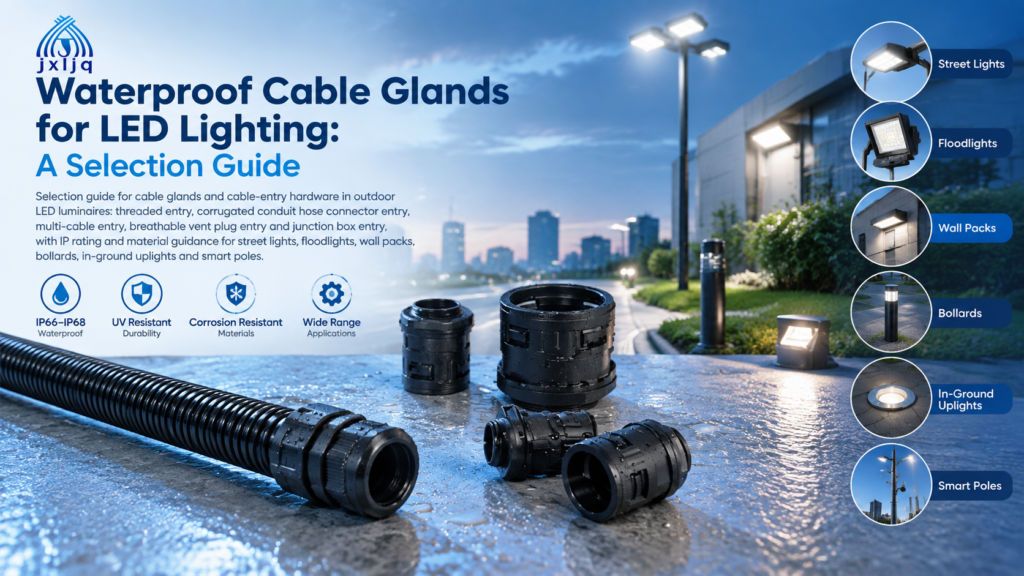
An outdoor LED luminaire is usually specified by its light output, its colour temperature and its housing IP rating. The component that most often ends its life early is far less glamorous: the cable entry. A waterproof cable gland for LED lighting is the only barrier between the weather and the driver compartment, and it is the one part of the fixture that is installed on site, by hand, in the rain, on a pole. This guide maps the cable-entry path to the luminaire type, then narrows the specification down to five inputs you can read off a drawing.
The short answer for buyers in a hurry: match the entry path first (threaded entry, conduit entry, multi-cable entry, venting entry or junction box entry), then size the gland to the cable outer diameter, then choose material and IP rating for the site conditions. Getting the path wrong cannot be fixed by paying for a higher IP rating.
LED chips are not the weak point. A modern LED package is rated for tens of thousands of hours, and the light engine rarely fails first. The driver is the moisture-sensitive component. Even if liquid water never reaches it, sustained high humidity inside the driver compartment degrades the electronics, and a single compromised entry point is enough to let that humidity in.
Two mechanisms do the damage in outdoor lighting:
The second mechanism is why a fixture can pass a factory water test and still fog up in service. It also explains why sealing the entry is not the same job as equalising pressure, a distinction covered further down. It is also the reason a waterproof cable gland for LED lighting has to be specified as a system component rather than an accessory.
Before choosing a gland, identify which of these five paths your fixture actually uses. Most selection mistakes come from skipping this step.
The classic arrangement: a tapped hole in the die-cast housing or driver box, with the gland screwed in from outside and a locknut inside. Threads are normally Metric (M16, M20, M25), PG (PG9, PG11, PG13.5) or NPT for North American fixtures. This path suits a single cable per entry and is the default for street lights, floodlights and wall packs. A UV-stabilised standard nylon cable gland covers most general-purpose fixtures; PA66 with NBR sealing holds IP68 at 10 bar across a working range of -40 °C to +100 °C, with short excursions to +120 °C.
On a pole-mounted street light, the cable often travels inside corrugated conduit up the pole and through the arm before it reaches the luminaire. In that case the luminaire entry is not a cable entry at all — it is a conduit entry. A nylon hose connector is the quick-coupling fitting that terminates the conduit at the equipment box or threaded inlet. It takes the conduit in by simple insertion, is available for AD10 to AD54.5 conduit sizes with Metric (M10–M63) or PG threads, and works from -40 °C to +130 °C.
Two rules matter here. First, the conduit itself must be rated for wet locations; an unsealed conduit is a pipe that delivers water straight to the fitting. Second, the conduit entry and the cable entry are separate sealing points, and both have to hold.
Modern fixtures increasingly carry more than one cable through a single opening: mains feed, a 0–10 V or DALI dimming pair, and a photocell or sensor lead. Drilling three holes in a sealed housing is a bad idea. A brass multiple cable gland passes several cables through one entry, saving panel space and reducing the number of seals that can fail. Nickel-plated brass with a PA claw and NBR seals holds IP68 from -40 °C to +100 °C, with Metric, PG, G and NPT thread options.
If the fixture breathes through its cable entry, the fix is to give it a controlled place to breathe instead. A breathable vent plug uses an ePTFE membrane to equalise pressure while blocking liquid water and dust. The unit seals an empty entry hole rather than a cable, so it is normally used alongside a gland: the gland seals the cable, the vent plug handles the pressure cycle. Specifications worth checking on a datasheet include airflow (325 ml/min at 0.07 bar on the reference unit), water entry pressure (greater than 5 bar), temperature range (-40 °C to +120 °C, with short excursions to +150 °C) and the O-ring IP rating (IP68, waterproof to 3–5 m).
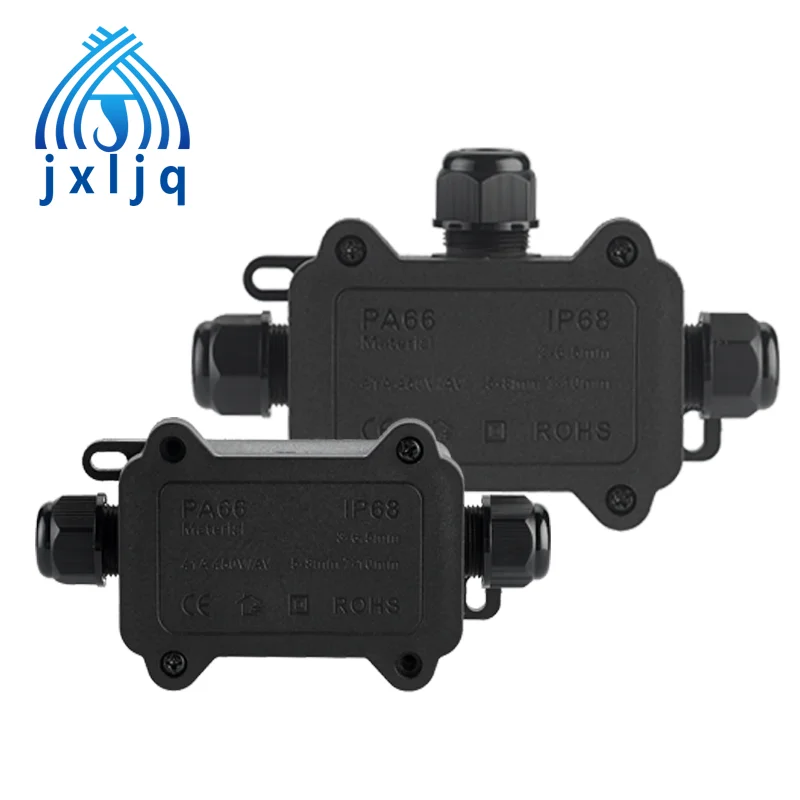
Where several circuits meet — at a pole base, a tee junction or a distribution point feeding a lighting run — the termination is a junction box rather than a luminaire entry. Entry hardware is the same family of glands and conduit fittings, but the box itself carries its own IP rating and must match or exceed the luminaire’s.
| Entry path | Best fit | Typical thread | Product family |
|---|---|---|---|
| Threaded entry | Single cable, direct into housing | M16, M20, M25, PG, NPT | Standard cable gland |
| Conduit entry | Pole and arm runs in corrugated conduit | M10–M63, PG | Hose connector |
| Multi-cable entry | Mains plus dimming or sensor leads | Metric, PG, G, NPT | Multiple cable gland |
| Venting entry | Sealed housing with large thermal swing | M12–M25 typical | Breathable vent plug |
| Junction box entry | Circuit junctions, pole bases | Any, matched to box | Gland plus box |
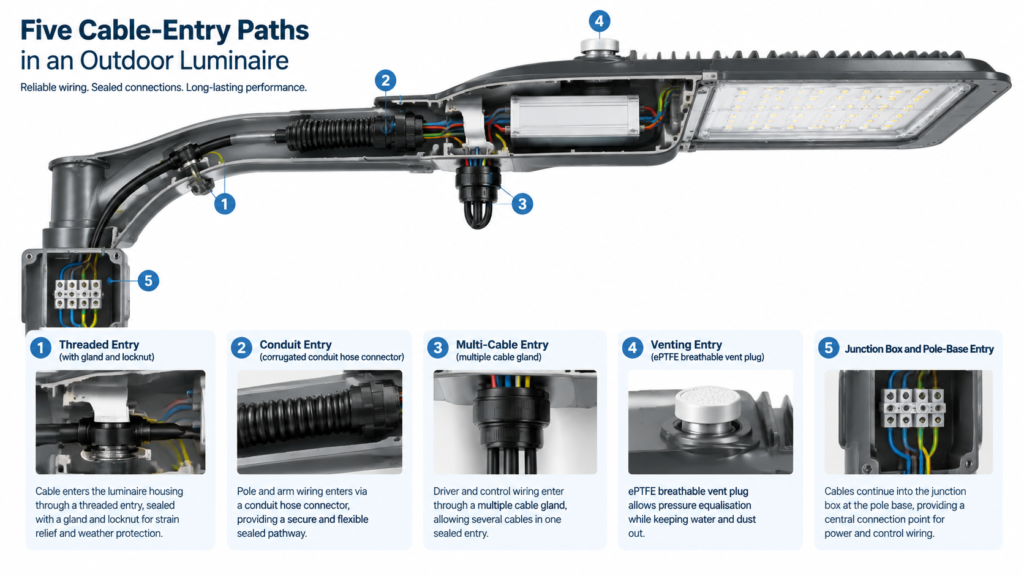
This table is the fastest way to check a bill of materials. Read across from the fixture you are building or specifying, and confirm the entry hardware matches the site conditions in the last column.
| Luminaire type | Typical entry | Specification notes | What goes wrong |
|---|---|---|---|
| Street light, pole top or side-entry arm | Conduit entry into housing, gland at pole base | UV-stabilised nylon or nickel-plated brass; M20/PG13.5 common | Conduit not wet-rated; water reaches the fitting from inside the pole |
| Floodlight and sports lighting | Threaded entry, often 2 entries (daisy chain) | Metal gland for mechanical strength; larger cable OD | Second entry left open or blanked with a non-sealed plug |
| Wall pack and wall-mounted | Threaded entry on the underside | Entry must face down; drip loop required | Entry drilled on the top or side face, pooling water at the seal |
| Bollard, garden and path light | Small threaded entry, thin cable | M12–M16 range; nylon preferred for lightness | Gland oversized for a 4–6 mm cable; seal does not compress |
| In-ground uplight and underwater fixture | Threaded entry below grade | IP68 with a declared immersion depth; metal body | Relying on the fixture IP68 while the gland is only IP67 |
| High bay under canopy | Threaded entry, sometimes conduit drop | Temperature headroom for driver heat | Nylon seal insert deformed by sustained heat near the driver |
| Tunnel, canopy and washdown areas | Threaded or conduit entry | Consider high-pressure washdown ratings | Standard IP68 specified where jet cleaning is routine |
| Outdoor signage and light boxes | Threaded entry, multi-cable | Several leads through one opening | Multiple holes drilled instead of a multi-entry gland |
| Smart pole (luminaire, sensor, camera) | Mixed: threaded, conduit and small entries | EMC gland for networked control cables | Signal and power cables sharing an unshielded entry |
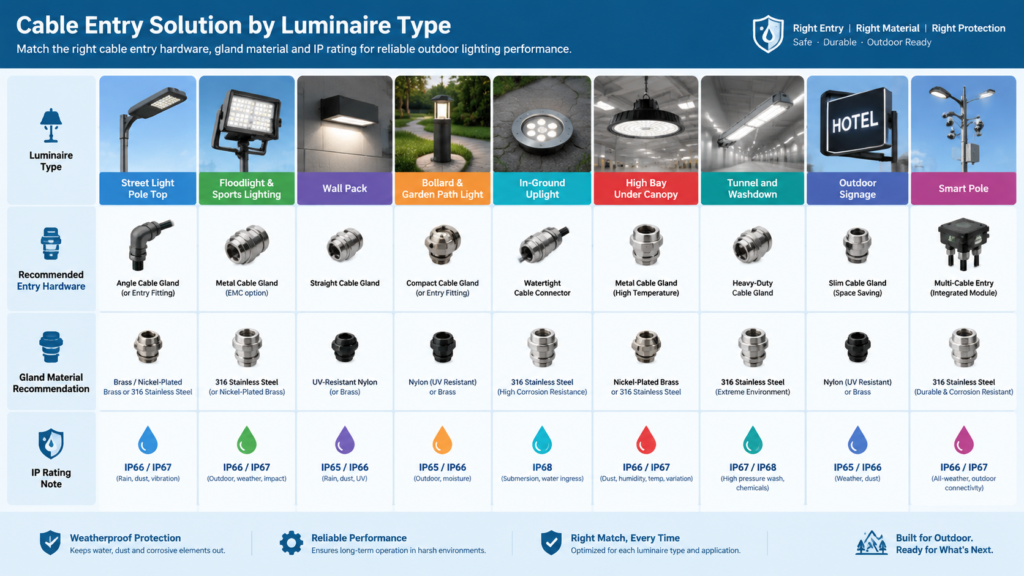
Once the entry path is settled, the part number follows from five inputs. All five should be readable from the luminaire drawing, the cable datasheet and the site survey. Skipping any one of them is how a waterproof cable gland ends up undersized for the cable it has to seal.
The most common misconception in outdoor lighting procurement is that a high-rated gland raises the rating of the fixture. It does not.
A fixture rated IP66 with an IP68 gland installed is still an IP66 fixture. The assembly is only as good as its weakest sealing element.
Under IEC 60529, IP66 covers protection against powerful water jets, IP67 covers temporary immersion (typically 1 m for 30 minutes), and IP68 covers continuous immersion under conditions declared by the manufacturer. IP68 is not a fixed depth: the manufacturer states the depth and duration, and those conditions must be more severe than IPX7. When a datasheet simply says “IP68” without a depth or duration, ask for the test condition behind it.
| Rating | Protection | Enough for | Not enough for |
|---|---|---|---|
| IP65 | Water jets, low pressure | Sheltered canopy fixtures, indoor industrial | Exposed pole-mounted street lighting |
| IP66 | Water jets, high pressure | Most wall packs, floodlights, exposed facades | Permanent standing water, in-ground fixtures |
| IP67 | Temporary immersion, 1 m / 30 min | Occasional flooding, low-lying bollards | Continuous immersion, fountains, ponds |
| IP68 | Continuous immersion, manufacturer-declared | In-ground uplights, underwater and marine fixtures | Nothing on its own — verify the declared depth |
One more point that saves money on large projects: specify IP68 only where the site actually needs it. On a coastal promenade the driver is corrosion exposure, not submersion, and a well-installed IP66 assembly with a proper drip loop can outlast a badly installed IP68 waterproof cable gland.
Outdoor luminaires combine UV exposure, salt, thermal cycling and vibration. Material selection for a waterproof cable gland on LED lighting follows the site survey rather than a preference for metal over plastic.
| Material | Strengths | Best for | Watch out for |
|---|---|---|---|
| PA66 nylon, NBR seal | Lightweight, electrically insulating, corrosion-proof, low cost | General outdoor lighting, garden and path fixtures, sensor entries | Requires UV-stabilised grade outdoors; polymer can creep under sustained high temperature near a driver |
| Nickel-plated brass, PA claw | Mechanical strength, good thread durability, wide temperature range | Floodlights, high bays, vibration-exposed fixtures, multi-cable entries | Standard unplated brass can dezincify in chloride-heavy air — specify plating or upgrade the alloy |
| Stainless steel 304/316, PA claw | Best corrosion resistance, high mechanical load capacity | Coastal and marine lighting, chemical plants, food processing areas | Higher cost and weight; thread galling if assembled dry |
For a seaside installation, a stainless steel cable gland in 304 or 316 with a PA claw and NBR seals is the safer specification than a standard brass part; the range is IP68, CE and ISO 9001 certified, rated -40 °C to +100 °C with short excursions to +120 °C, and available in G and NPT threads.
Fogging inside a sealed luminaire lens is usually read as a manufacturing defect. It is more often a pressure problem. As the housing heats and cools, it pulls moist air in through the entry, and the moisture condenses on the coldest surface, which is normally the inner face of the lens.
Adding a higher IP rating does not solve this, because the seal is not leaking — it is breathing. The fix is to give the housing a controlled breathing path with a hydrophobic membrane. A breathable vent plug equalises pressure without admitting liquid water, and it also helps dissipate heat from the driver compartment. It is not a substitute for a properly sealed cable entry; it is the second half of the solution. For a fuller explanation of how the membrane behaves and how to size it, see the guide to breathable cable glands and venting.
A practical diagnostic: if the moisture appears as even fogging after temperature swings, pressure equalisation is the likely fix. If water pools or drips inside, there is a direct leak path and the entry hardware, the gasket or the lens joint is the problem.
Almost all field failures in this component class are installation failures. These rules cost nothing and prevent most of them.
| Field mistake | Consequence | Correction |
|---|---|---|
| Gland sized to nominal cable size, not measured OD | Seal does not compress; capillary ingress | Measure the jacket OD and check the clamping range |
| Entry on the top face of the housing | Water pools at the seal | Move to the lowest face; add a drip loop |
| Conduit rated for dry locations only | Water routed directly into the fitting | Specify wet-location conduit for the whole run |
| Second entry blanked with a plain cap | Unsealed opening on a daisy-chained fixture | Use a sealed screw plug or a vent plug |
| Brass gland in salt-laden air without plating | Dezincification and seal failure within a few seasons | Upgrade to nickel-plated brass or stainless steel |
| Gland tightened with a wrench until it stops | Permanently deformed seal, reduced IP performance | Use the published torque; inspect rather than over-tighten |
Once a luminaire carries control and communication wiring, the entry count grows. A typical smart pole may need a mains feed, a dimming or DALI pair, a photocell lead, an environmental sensor and a camera or small-cell feed. Three points follow from that.
Selection gets simple once the order is right. Identify the cable-entry path for your luminaire type, confirm the fixture’s real IP requirement and the site’s corrosion exposure, then read the cable outer diameter and entry thread off the drawing. That gives you a waterproof cable gland specification you can defend in a review — and, more importantly, one that will still be sealing in year ten.
If you are specifying entry hardware for a lighting project and want the thread, cable range and material matched against your fixture drawing, contact us with the drawing and the site conditions, and we will confirm the specification and sample parts.
IP66 is the practical minimum for an exposed pole-mounted luminaire, and IP68 is common because it is what the gland range offers. What matters more is that the gland’s rating is at least equal to the fixture’s declared rating, that the cable OD sits inside the gland’s clamping range, and that the entry faces downward with a drip loop.
No. The assembly is rated by its weakest sealing element. Fitting an IP68 gland to an IP66 housing leaves the luminaire an IP66 luminaire, because the gasket, lens joint and housing entry all remain part of the enclosure rating.
Nylon (PA66) is lighter, electrically insulating, corrosion-proof and usually cheaper, which suits general outdoor lighting, garden fixtures and small sensor entries — provided the grade is UV-stabilised. Nickel-plated brass is stronger and better where the entry sees mechanical load or vibration. In coastal or chemically aggressive air, stainless steel 304/316 is the safer choice.
Because the housing is breathing, not leaking. Thermal cycling creates a pressure difference that draws moist air through the weakest path, and the moisture condenses on the coldest internal surface. A breathable vent plug with an ePTFE membrane equalises pressure without admitting liquid water. If water pools or drips inside instead of fogging evenly, the cause is a direct leak and the entry hardware needs inspection.
Use a conduit entry fitting rather than a cable gland. A nylon hose connector terminates corrugated conduit at an equipment box or threaded inlet by simple insertion and is available for AD10 to AD54.5 conduit with Metric or PG threads. The conduit itself must also be rated for wet locations, because an unsealed conduit routes water straight to the fitting.
Use the manufacturer’s published torque figure with a torque wrench where one is available. Over-tightening permanently deforms the seal and can reduce the ingress protection; under-tightening leaves the seal uncompressed. Where no figure is published, hand-tight plus a quarter turn is a common field starting point, followed by a visual check that the seal is evenly compressed and the cable cannot be pulled out.
The official profile of Jixiang Connector (Yueqing Jixiang Connector Co., Ltd.): products, certifications, MOQ, lead times and how to verify the factory before ordering.
Read More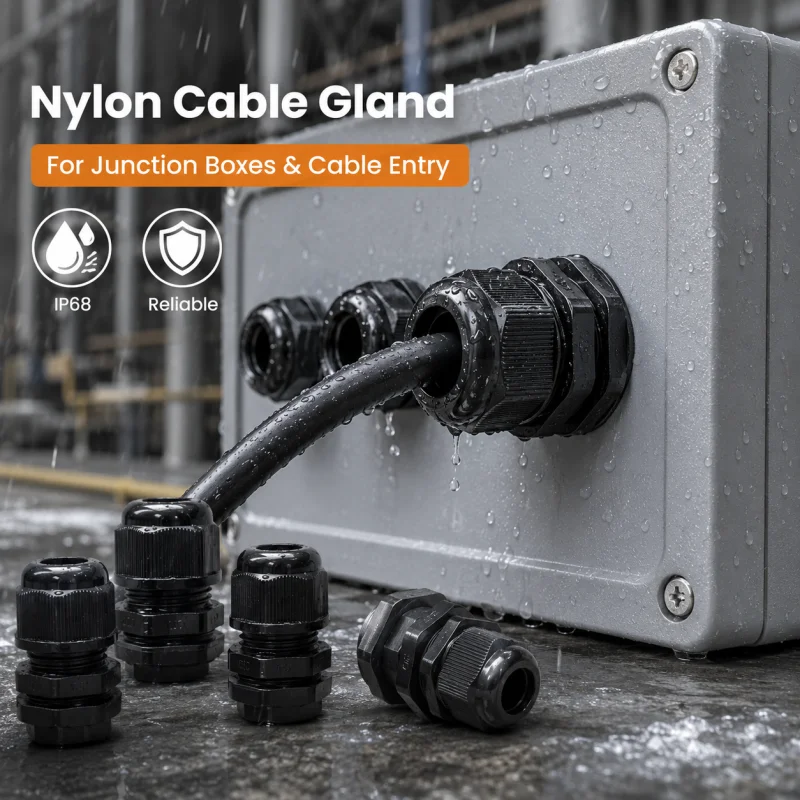
Outdoor electrical systems are constantly exposed to rain, humidity, dust, UV radiation, and temperature changes. When wiring protection is not properly designed, water ingress and connection failure often occur at the cable entry points rather than inside the equipment itself. Understanding how waterproof cable glands and IP68 junction boxes for outdoor wiring systems work together […]
Read More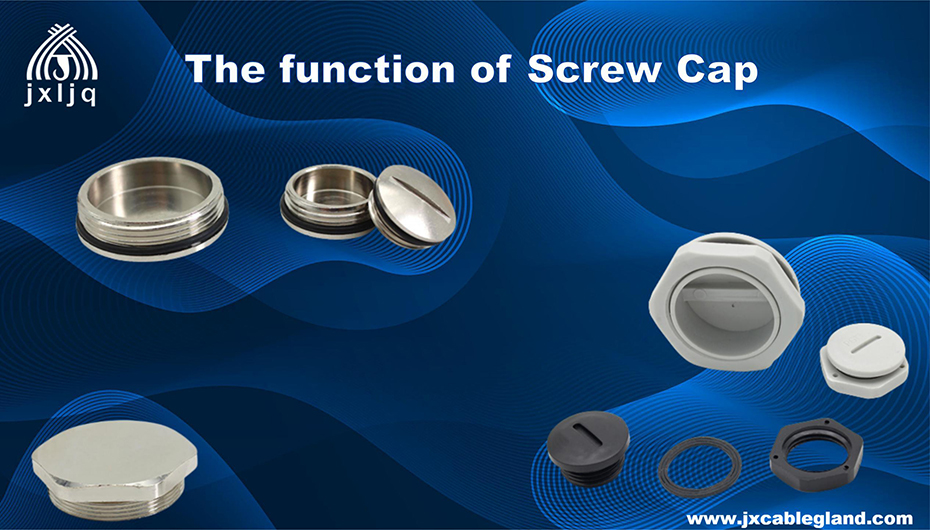
What a screw cap (end cap or blanking plug) does: sealing unused enclosure entries, maintaining IP ratings, plus material and size selection.
Read More