Blog
IP Rating for Junction Boxes: IP54 to IP68 Explained
An IP rating is a test result, not a quality grade. What IP54 to IP68 actually test, where IP65 to IP68 differ, and why one junction box series can carry two ratings.
Read More
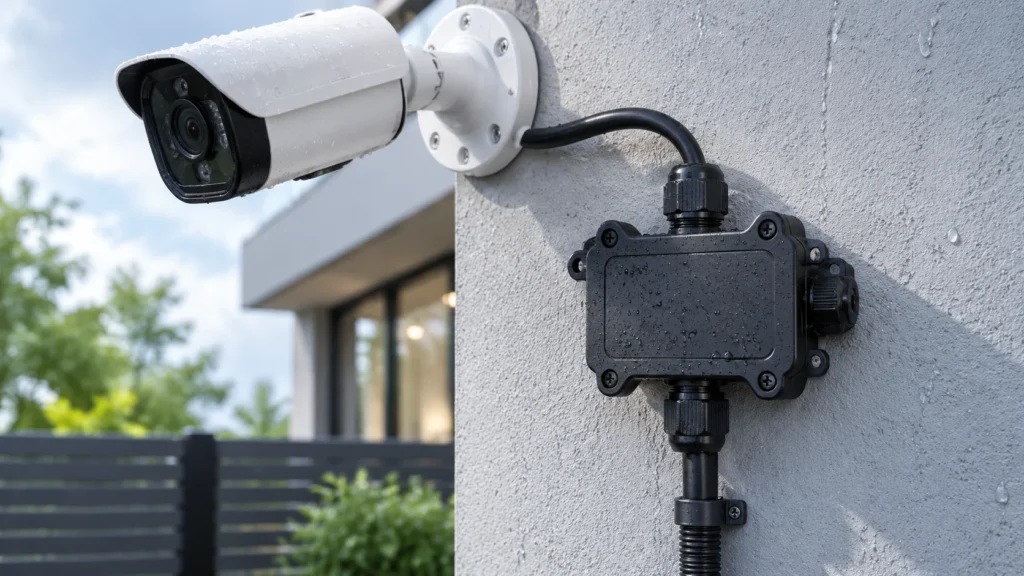
Most outdoor cameras do not fail because of rain. They fail because someone joined a camera cable in a box that was too small for the connector, or sealed an entry that had a plug jammed through it. Choosing a junction box for security camera wiring is a sizing problem before it is a waterproofing problem: the enclosure has to swallow a connector stack and a bend radius, and only then hold a seal.
This guide covers the camera cabling patterns, the arithmetic that decides whether a connector fits, and the four places water actually enters a camera installation — one of which is not the box at all.
Camera systems need different entries because they carry different cables. Match the box to the pattern before you look at IP ratings.
| System | Cables at the box | Typical jacket O.D. | Entries needed | Sensible enclosure |
|---|---|---|---|---|
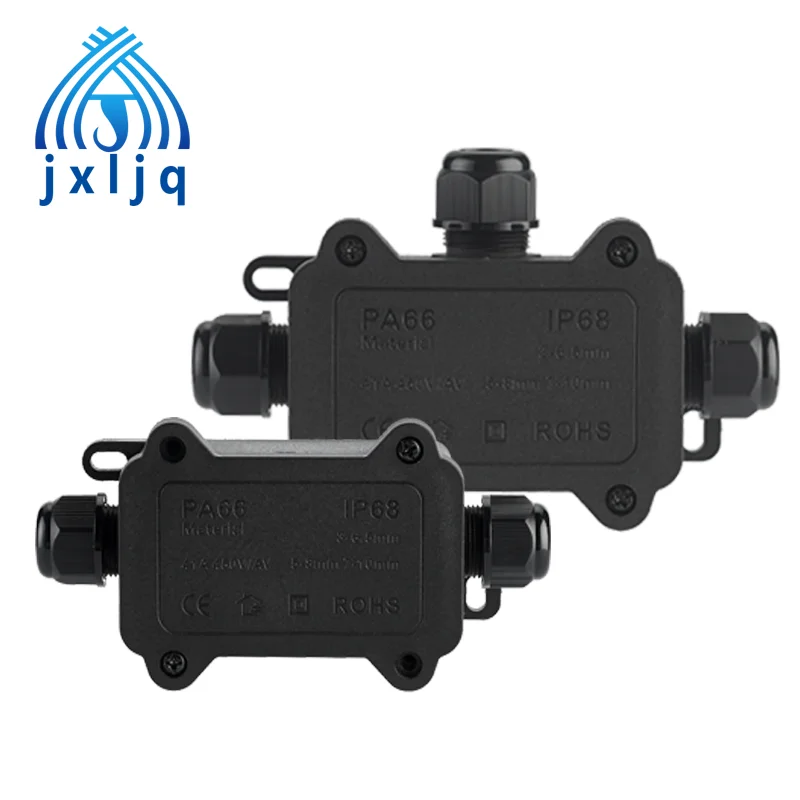
| Analogue HD (AHD/TVI/CVI) | Coax plus 2-core power | Coax 6.1 mm; power 2 × 0.75–1.5 mm² | 2 | Mini 2-way, IP68 |
| IP camera on PoE | One Cat5e/Cat6 | 5.0–7.5 mm | 1, but the plug will not pass | Standard box with gland |
| IP camera, local 12/24 V | Cat cable plus 2-core power, or a splitter inside | As above plus 6 mm | 2–3, plus splitter space | Standard box, 100 mm+ deep |
| Wi-Fi camera, power only | 2-core flex | 6–8 mm | 1 | Mini 2-way, IP68 |
Figures are typical values — measure the jacket on the drum you were supplied. A coax-and-power analogue drop or a power-only Wi-Fi camera fits a compact sealed enclosure with no compromise; anything with a factory-fitted RJ45 needs space and a plan.
An RJ45 plug body is about 11.7 mm wide and cannot be reduced. The most common compact box we sell, the F1 series mini junction box, seals cable ranges of 3–6.5, 5–8 and 7–10 mm across eight order codes — perfect for a 6 mm Cat5e jacket, and impossible for the plug moulded onto the end of it. A PG9 gland has the same limit: it clamps 4–8 mm of jacket and nothing wider will pass.
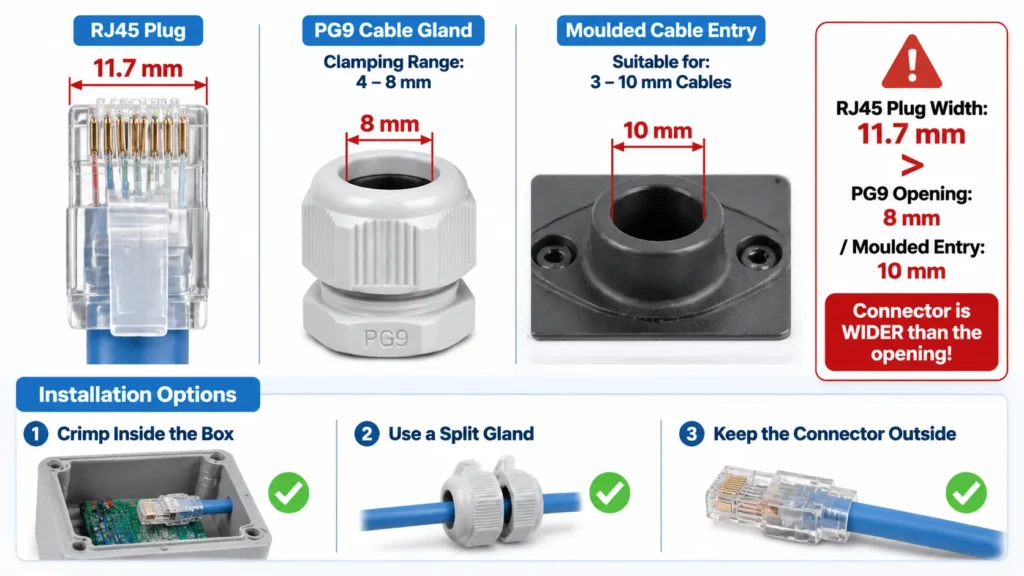
There are only three honest answers:
What does not work: drilling the entry out and wrapping the plug in self-amalgamating tape. The tape becomes the only element holding the rating, and it has no rating.
Interior volume is decided by three things, and only the first is obvious:
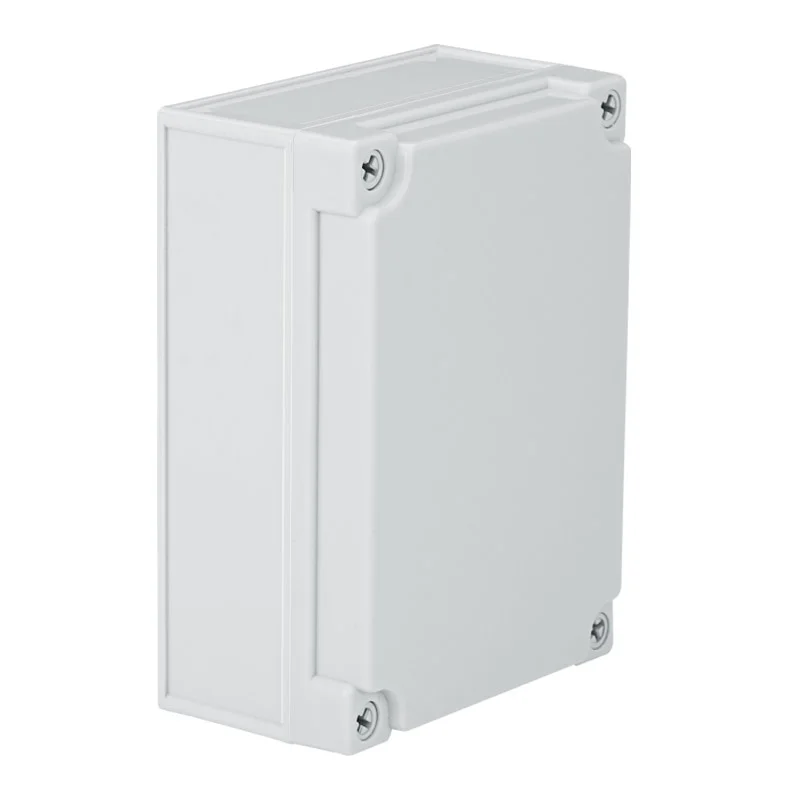
Our JX-AG high-end waterproof junction box runs from 95 × 65 × 55 mm to 280 × 190 × 180 mm with IP67 (1 m immersion) and IK08 impact resistance. The smallest size gives about 0.34 litres gross — call it 0.24–0.27 litres usable once walls, bosses and lid are accounted for. That is enough for a splice and a loop, not enough for a splitter and a coil of surplus cable. Treat usable volume as 70–80% of the published exterior dimensions and the choice usually makes itself.
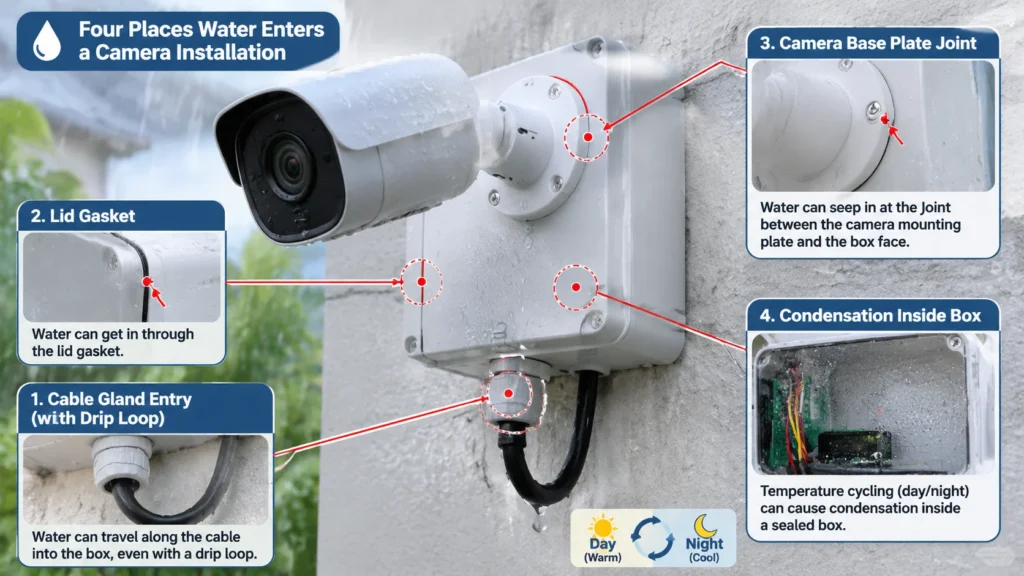
Camera mounting plates are usually round and often wider than a compact box. Measure the plate diameter first: a 100 mm plate on a 95 × 65 mm box leaves the gasket edge hanging over air, and silicone will not seal an unsupported gasket. Step up to a size that supports the full ring, or mount the camera on its own bracket and use the box as a cable chamber behind it. Flatness matters as much as width — moulded ribs, part lines and screw bosses all create a path under the gasket, so a plain flat lid face is worth more than an extra millimetre of wall.
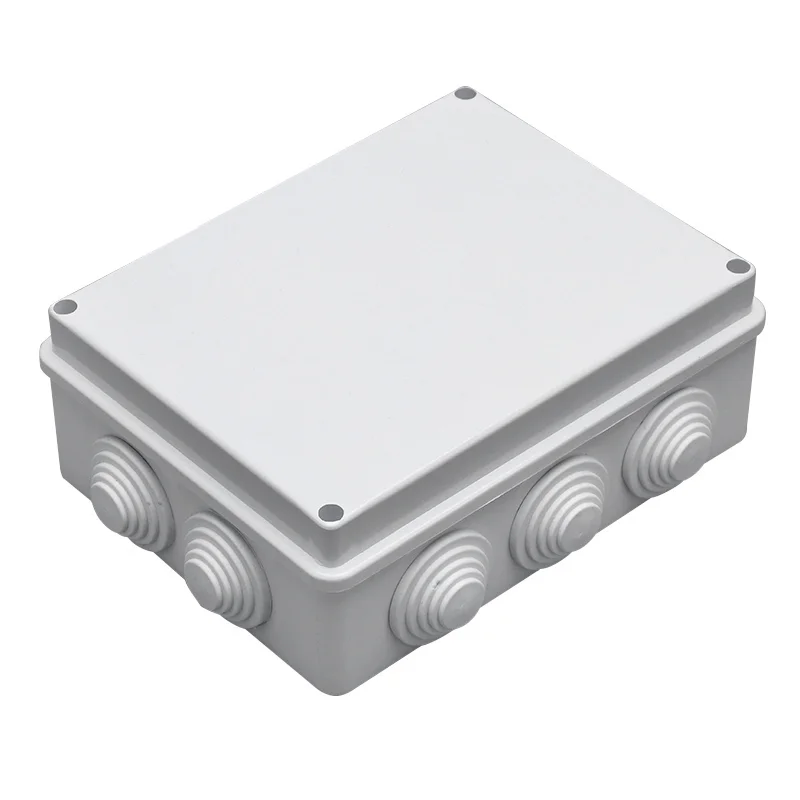
Plastic is the default for a reason: no corrosion, no earth bond to maintain, no paint to chip, and the box does not become the tallest thing on the mast. ABS covers most wall-mounted work; the JX-RA plastic waterproof junction box adds CE and RoHS documentation, internal PCB or DIN rail mounting points, and pre-moulded 25 mm or 36 mm holes across eleven sizes. Metal earns its place in two cases: where impact risk exceeds IK08, and where the installation demands a metallic earth path. In the second, the gland must be an EMC type with the shield bonded at the box.
Select on jacket diameter, then check the hole. From our standard nylon cable gland range: PG7 clamps 3.5–6.5 mm (needs a 12.6–13.0 mm hole), PG9 clamps 4–8 mm (15.3–15.5 mm), PG11 clamps 5–10 mm (18.7–19.0 mm), PG13.5 clamps 6–12 mm (20.5–21.0 mm). A 6 mm Cat5e sits in a PG9; a 7.5 mm Cat6 needs PG11. For the analogue side in more depth, see our article on cable glands on CCTV systems.
Size the junction box for security camera work in four steps: count the cables, measure the largest jacket, decide whether a plug has to pass, then allow for the bend radius and connector stack. Only then does the IP rating decide — and the assembly is only as sealed as its worst joint. A camera on an IP67 box with a 2 mm gap under its base plate is a wet camera.
Send us the camera model, the cable type and the mounting surface, and we will come back with the enclosure size, the entry list and the gland sizes — contact our team.
IP65 minimum for a sheltered wall, IP66 for direct rain, IP67 where the box can stand in water or take a pressure wash. The camera, the entries and the base joint each carry their own rating.
Only if the box has depth. A mated RJ45 pair with boots is about 45 mm long and the cable still needs a bend radius near 4 × its diameter. Below about 70 mm internal depth you will pinch the cable against the lid.
The pigtail gets you a short lead, not a sealed joint. If the connection is outdoors, the joint still needs an enclosure — otherwise the coupler sits in rain and oxidises within a season.
Equalise pressure instead of trying to make the box airtight. A breathable vent plug moves about 325 ml/min at 0.07 bar while holding IP68 through its O-ring, so moisture leaves with the air instead of condensing on the camera body.
An IP rating is a test result, not a quality grade. What IP54 to IP68 actually test, where IP65 to IP68 differ, and why one junction box series can carry two ratings.
Read More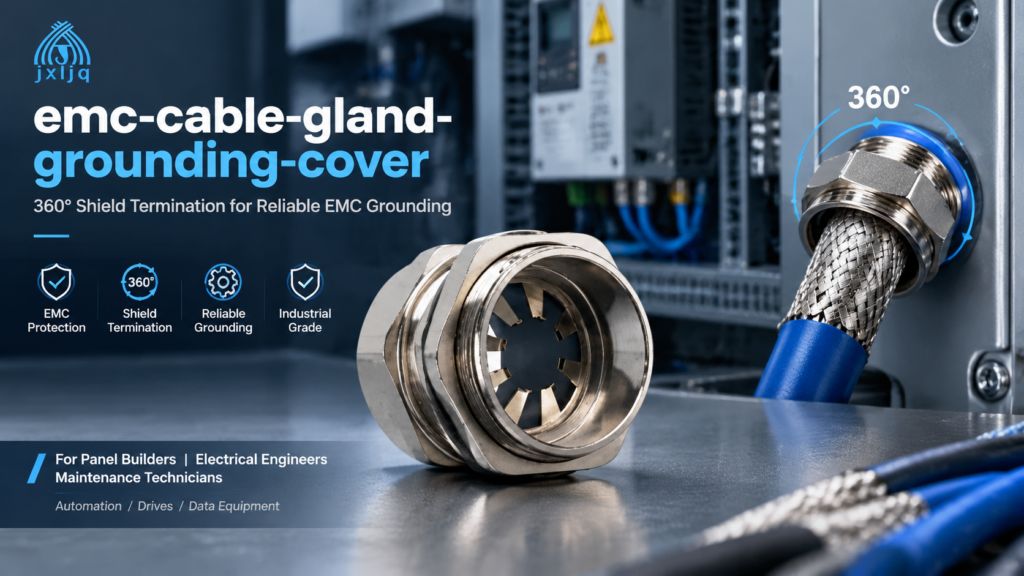
Practical EMC cable gland grounding guide: 360° shield termination steps, panel preparation, common mistakes, and continuity checks.
Read More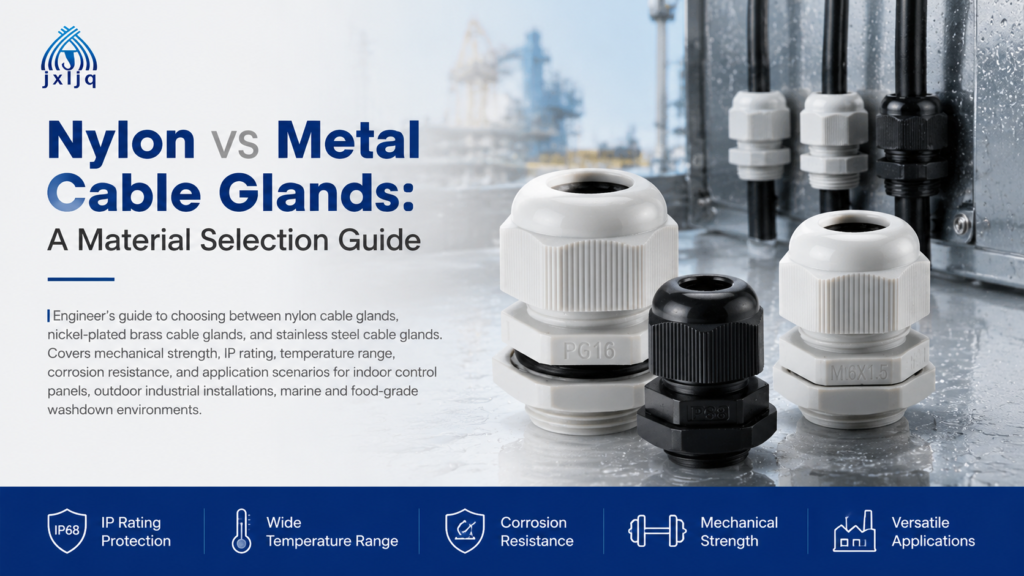
Engineering guide to choosing between nylon, brass, and stainless steel cable glands — environment-driven material selection, side-by-side specs, and a quick selection matrix.
Read More