Blog
Waterproof Junction Box vs Distribution Box: Key Differences
A waterproof junction box joins wires, a distribution box protects circuits. Compare function, standards, IP ratings, sizing and cost before you specify the right enclosure.
Read More
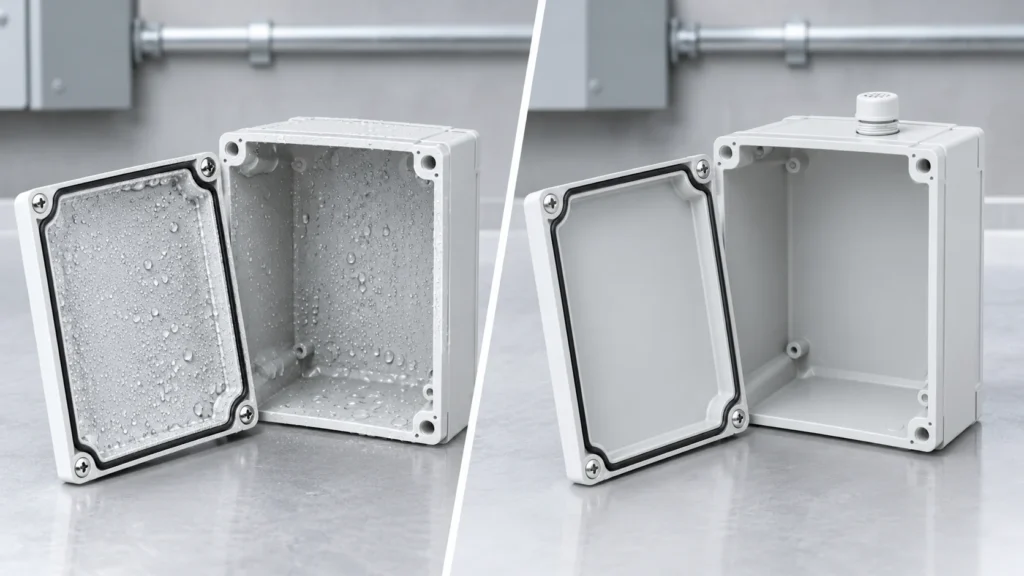
Condensation in junction box assemblies is the failure that makes no sense until you run the numbers: a box with a valid IP67 certificate, correctly installed, undamaged, holding water a year later. Nothing leaked through a hole. The water was carried in as vapour and released onto a cold surface. This guide covers the four routes by which moisture enters a sealed enclosure, works through the arithmetic of one day-night cycle, and sets out what removes the problem rather than relocating it. It applies to any waterproof junction box installed where temperature moves.
A sealed enclosure is not a dry enclosure. It holds whatever air was inside on the day it was closed, plus whatever has diffused or been pumped in since.
| Source | Mechanism | How to confirm it |
|---|---|---|
| Air trapped at assembly | Humid air closed inside carries its full vapour load with it | Wetness in a box closed on a humid morning, dry on a cool one |
| Vapour diffusion | ABS, PA6 and elastomer gaskets slow water vapour but do not stop it | A uniform film on the inside of the lid, not a pool at one point |
| Pressure cycling | Heating raises internal pressure, cooling drops it below ambient, and the box exhales and inhales across micro-leaks | Droplets after the first cold night following a warm week |
| Cable pathways | Stranded conductors and the spaces between cores wick moisture in | Wetness at a terminal block, tracking along one cable |
Each route delivers milligrams, not litres, per event. That is exactly why the problem is dismissed at commissioning and undeniable a year later.
Air at 30 °C and 60% relative humidity holds about 18.2 g of water per cubic metre and reaches saturation at roughly 21 °C. The moment any internal surface drops below about 21 °C, the air touching it gives up water. Outdoors that is routine: the lid radiates to a clear sky and falls below air temperature.
Cool that air to 15 °C and saturation capacity falls to 12.8 g/m³, so the 5.4 g/m³ difference has to condense somewhere. A compact 100×100×70 mm box with about half a litre of free air yields roughly 2.7 mg per cycle; a 200×200×80 mm box with around 2.4 litres yields about 13 mg. Neither sounds like much until you remember the nightly repeat.
In a rigid enclosure the pressure change scales with the absolute temperature change: a 20 °C rise from a 20 °C start gives roughly 0.07 bar internally, a 30 °C rise about 0.10 bar. That explains a detail most buyers ignore. Vent plug datasheets quote airflow at 0.07 bar, which is not an arbitrary test point but approximately what one sunny morning does to a sealed box.
Pressure works both ways. On cooling the internal pressure falls below ambient, the box pulls ambient air in through the gasket line and entry threads, and that inward stroke delivers the next night’s condensate.
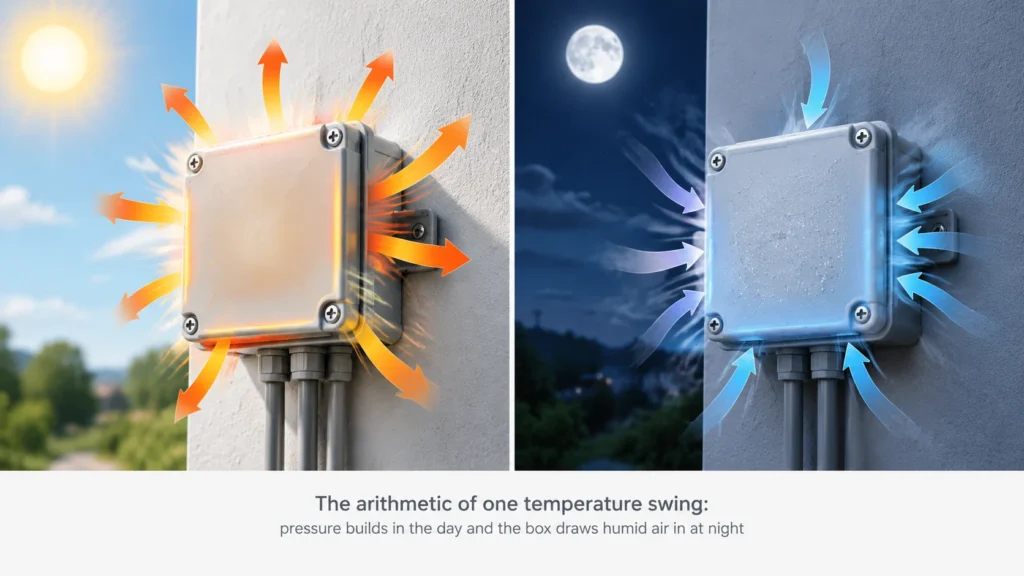
An IP68 box has the smallest leakage paths, so it exchanges the least air, which sounds like an advantage. The vapour that does get in stays in, and a well-sealed box with a large internal volume and metal components supplies the three things condensation needs: a trapped vapour load, a cold surface and no route out. A loosely closed box often looks drier inside precisely because it ventilates freely, at the cost of admitting liquid water and dust. The answer is not a tighter seal but a controlled exchange. The JX-AG IP67 enclosure, rated to one metre immersion and sized up to 280×190×180 mm, is that profile: a large trapped volume under a gasketed lid.
| Measure | Works because | Limitation |
|---|---|---|
| Pressure-equalising vent plug | Continuous vapour exchange equalises pressure and lets moisture leave before it condenses | Must be shielded from standing water; a service part |
| Desiccant sachet | Adsorbs the initial vapour load | Finite capacity, then behaves as a wet object inside |
| Anti-condensation heater | Keeps surfaces above the dew point | Needs power and a thermostat |
| Gel fill or potting | Removes the air space, so there is nowhere to condense | Not serviceable; a partial fill leaves a saturated pocket above the gel |
| Drilled drain hole | Lets water out | Destroys the IP rating and admits water and insects |
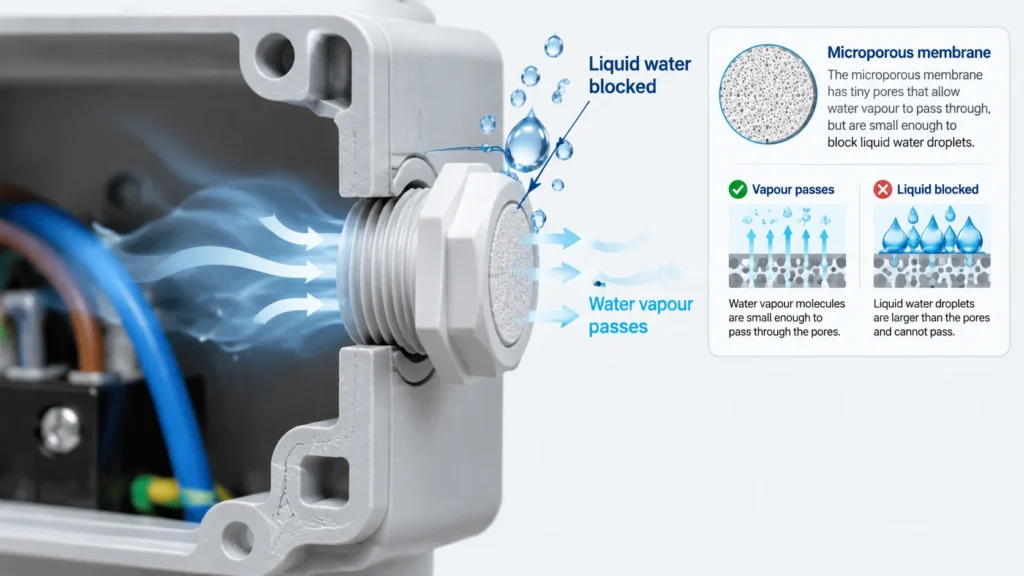
A vent plug is a small threaded body containing a microporous membrane, sealed to the wall by an O-ring. Air and vapour pass; liquid water does not. The breathable vent plug for this duty is specified at 325 ml/min airflow at 0.07 bar, water entry pressure above 5 bar, an O-ring rated IP68, and −40 °C to +120 °C with short excursions to +150 °C.
Two figures deserve interpretation. Water entry above 5 bar is roughly fifty metres of static head, so the membrane is not the weak point of an immersion-rated assembly. And the airflow is a rate, not a verdict: it is quoted at the same 0.07 bar that a 20 °C swing generates. Desiccant suits a box closed once and left alone; heaters suit large cabinets that already have power; gel suits joints that are never reopened. The pattern to avoid is fitting desiccant to a box that is still breathing, which converts a slow problem into a scheduled one.
Sizing uses the airflow figure rather than a rule of thumb: divide the free air volume by the rated flow at 0.07 bar. A half-litre box with a 325 ml/min vent exchanges one internal volume in about a minute and a half, far faster than any real temperature ramp. A ten-litre box takes roughly half an hour, which is where a second vent or a higher-flow body becomes worth considering.
The same membrane principle is built into breathing cable glands, which combine the entry and the pressure path in one component; the trade-offs are compared in this guide to breathing cable glands.
No accessory can remove water that was built in, so three habits matter. Close the box in dry conditions, because assembly on a humid morning loads the enclosure with the maximum vapour it can hold. Never leave an enclosure open overnight through a cool, humid night and then close it in the morning with that moisture sealed inside. And seal every cable path deliberately: correct gland size for the cable’s outer diameter, a plugged spare entry, and a gasket that is compressed rather than crushed. Entry configuration and body sizing are covered in this IP68 junction box selection guide.
One structural choice matters here. The F1 mini junction box uses a silicone O-ring in a groove rather than a flat gasket under a lid, which suits a small enclosure that cycles repeatedly, because an O-ring is less sensitive to uneven screw torque.
Condensation inside a sealed box is not a defective seal and not a reason to buy a higher IP rating. It is a vapour and pressure problem: humid air is trapped or pumped in, a cold surface appears, and water that was always in the air becomes visible. The fix is to give that vapour a controlled way out while keeping liquid water out, which is what a membrane vent does. Size it from free volume and rated airflow, mount it low with the membrane facing down, and specify it with the enclosure rather than after the first failure.
Send the enclosure size, the temperature range and the mounting position and we will confirm whether pressure equalisation is needed and which vent body suits the environment. For the rating side of the same decision, see what an IP rating on a junction box tests.
Yes, and a well-sealed one is more likely to keep it. Waterproofing stops liquid water; it does not remove the vapour in the air closed inside, or stop vapour diffusing through polymer walls.
No. The membrane passes air and vapour but blocks liquid water, and the unit is specified with water entry pressure above 5 bar and an IP68-rated O-ring.
Size it rather than guess: divide free internal volume by airflow at 0.07 bar and compare with the real temperature ramp. A half-litre box equalises in about a minute and a half at 325 ml/min; a ten-litre box takes roughly half an hour.
Only in a box closed once and not reopened. Desiccant has a fixed capacity and saturates, after which it holds moisture inside the enclosure.
No. IP testing is a static immersion or jet test on a new sample and does not include pressure cycling or vapour transmission, so a genuine IP67 box can still condense water inside.
A waterproof junction box joins wires, a distribution box protects circuits. Compare function, standards, IP ratings, sizing and cost before you specify the right enclosure.
Read More
Buying flexible spiral cable glands: what they are, where they are used, the six points to confirm, how to size them, and nylon vs brass selection.
Read More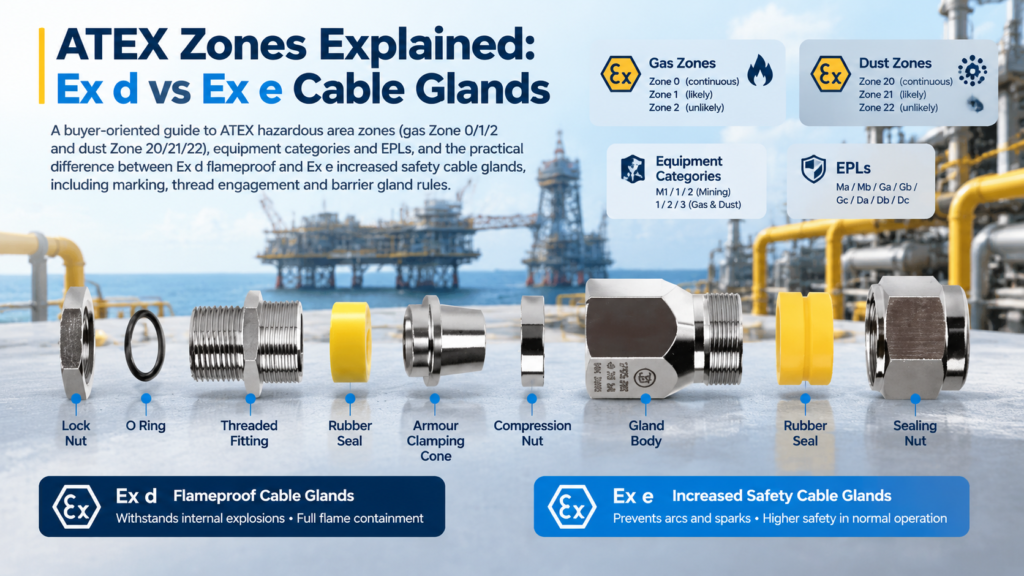
ATEX zones explained in plain terms: Zone 0-2 and 20-22, equipment categories and EPLs, plus how Ex d and Ex e cable glands differ and when a barrier gland is required.
Read More