Blog
Nylon Cable Glands in Solar and Wind Energy Application
Why nylon cable glands are used in solar and wind systems: IP68 sealing, UV and corrosion resistance, and how to specify the right gland.
Read More
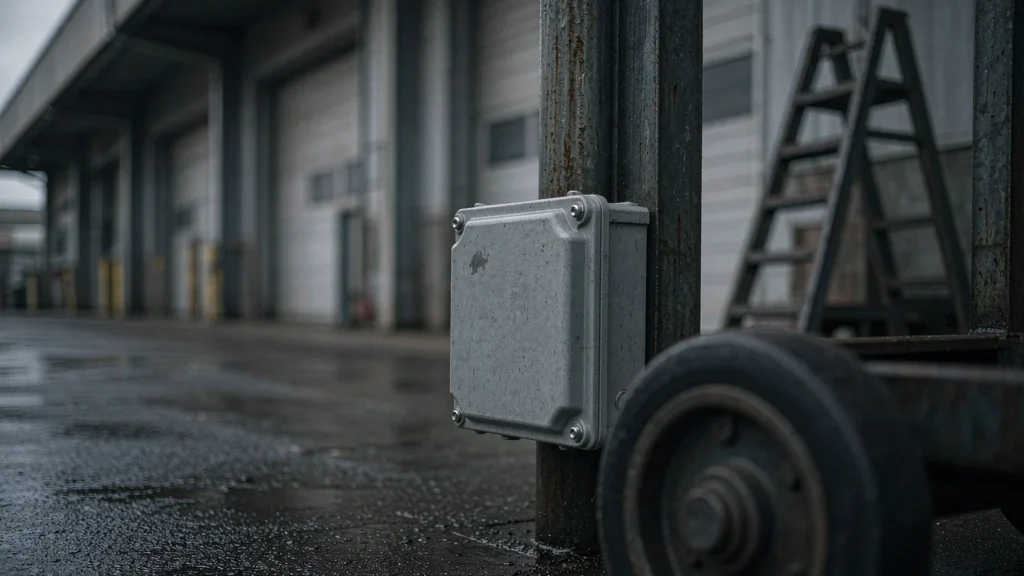
An IK rating on an enclosure states one thing: the impact energy the housing survived in a laboratory test, in joules, under IEC 62262. It is not a forecast of what the box meets on site, and not a promise that the housing stays uncracked. Most buyers comparing a waterproof junction box for an exposed location stop at IP67 and never ask what happens when a ladder, a trolley or a strimmer hits the lid. That is the failure mode the IK code describes — and it is the one that quietly ends the IP rating.
IK08 means the sample absorbed five joules; IK10 means twenty. The scale runs from IK00, not tested, to IK11 at fifty joules, a level added by the 2021 amendment to IEC 62262. The steps are not even: IK08 to IK09 doubles the energy, IK09 to IK10 doubles it again, so IK10 is four times IK08 rather than one grade better. Two boxes listed IK08 and IK10 are not near neighbours in cost — they differ in wall section and polymer.
Energy alone is abstract, so the standard also fixes the hammer. Both figures are published, and both matter when you read a test report.
| Code | Energy | Striker mass | Free-fall height | Typical position |
|---|---|---|---|---|
| IK07 | 2 J | 0.5 kg | 400 mm | Plant room, riser, ceiling |
| IK08 | 5 J | 1.7 kg | 300 mm | Workshop, warehouse, loading bay |
| IK09 | 10 J | 5 kg | 200 mm | Open yard, car park, construction site |
| IK10 | 20 J | 5 kg | 400 mm | Public realm, heavy plant |
| IK11 | 50 J | 10 kg | 500 mm | Special high-risk applications |
These are the free-fall values; a pendulum or spring hammer delivers the same energy by another route. Up to about IK06 the striking face is polyamide, which spreads the blow. From IK07 upward it is steel — a hemisphere 50 mm across, which concentrates the same energy into a much smaller contact patch.
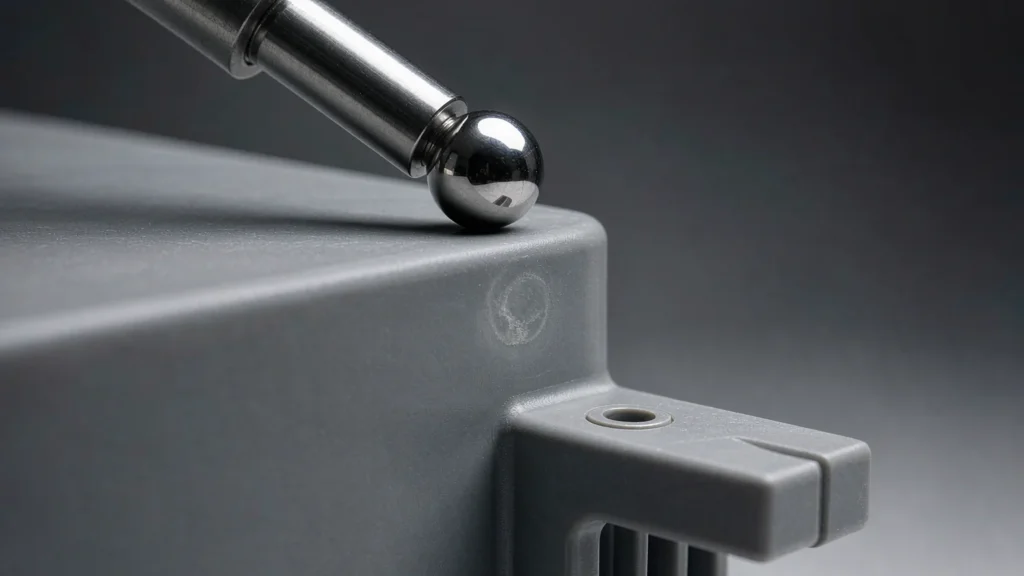
A box can be IP66 and IK07, or IP20 and IK10. Neither declaration implies the other, because they answer different questions on the same sample: IP is about what gets in, IK is about what hits from outside. On a pole in a car park both are equally likely to end the service life. Our breakdown of IP54 to IP68 for junction boxes covers the first half; this article covers the second.
The standard does not require the enclosure to look new afterwards. Dents, scratches and stress whitening are acceptable, provided three things survive: no access to live parts, the lid or door still works, and the enclosure still meets its declared IP rating. That last clause is the one buyers misread. An IK08 box that cracks through a lid screw boss but still passes its immersion test is a compliant IK08 box. “IK08 means it will not crack” is not what the certificate says.
Three procedural details decide whether the number transfers to your site. The sample is mounted the way it will be in service — wall, pole or rail. Each exposed face takes five impacts, distributed across the surface and aimed at the places most likely to be weak: corners, hinge edges, the edge of a window, the middle of a large flat panel. And the sample is tested as delivered: closed, empty, with no glands fitted and no entry holes cut. The certificate describes a box, not your installation.
Every entry you add removes material from the stiffest part of a moulded wall. A 25 mm hole through the side of a box interrupts the wall’s ability to spread a blow round the corner, and the gland that fills it passes impact straight into plain plastic instead of into a thread. This is why field failures cluster at entries rather than across lid faces, and why the choice between a knockout, a membrane grommet and a threaded gland changes the real impact behaviour of a certified box. Our comparison of knockouts, grommets and glands covers the sealing side of the same decision.
IEC 62262 tests at laboratory conditions, near 23 °C on a conditioned sample. Thermoplastics do not hold the same impact strength across the range they are sold for. Dry, cold PA66 is measurably more brittle than the conditioned sample that passed, which is why a box dropped off a van at −5 °C can crack where the same box took a five-joule blow in a lab. UV exposure compounds it: unstabilised polycarbonate loses a large share of its impact strength across two to three outdoor years, and yellowing is only the visible half of that. The outdoor service life of a plastic junction box depends on the stabiliser package, not on the IK number on the datasheet.
Read the code against the position, not the product family.
Mounting height is the underrated variable. A box at 2.5 m meets ladders and branches; a box at 300 mm meets trolley wheels, boots and mower decks. Raising a box by 600 mm often buys more service life than paying for IK10.
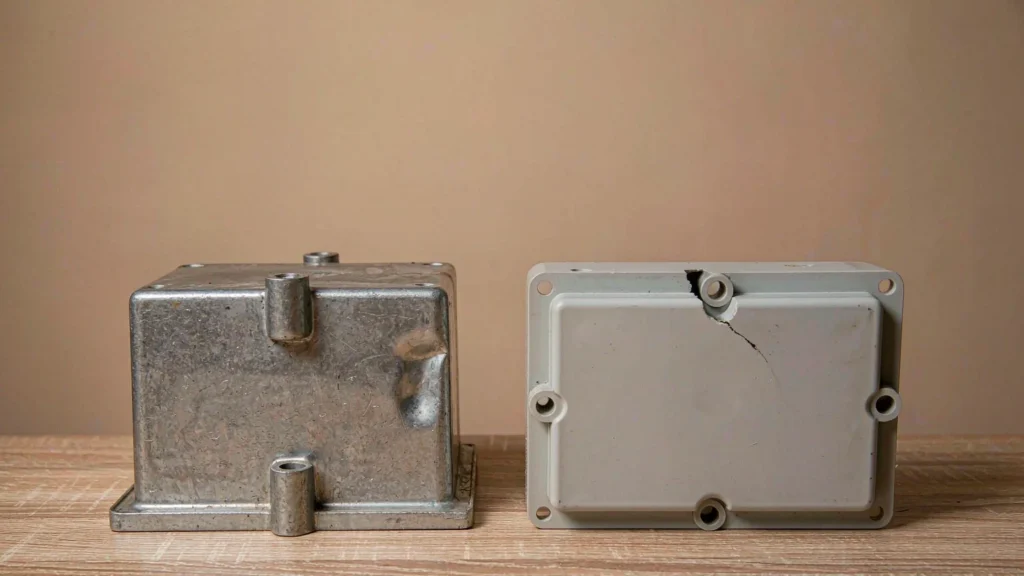
Materials fail differently at identical energy. A cast aluminium box dents, absorbs the blow in deformation, and usually keeps its gasket contact. A thermoplastic box has no plastic hinge to give — past yield it cracks, and a crack at a screw boss is a leak path. Glass-filled grades and polycarbonate raise the ceiling, which is why IK09 and IK10 are easier to certify in metal or reinforced polymer than in unfilled ABS. The reverse trap is just as real: an IK10 metal enclosure can still be the wrong answer outdoors when the alloy and coating are not specified for the environment.
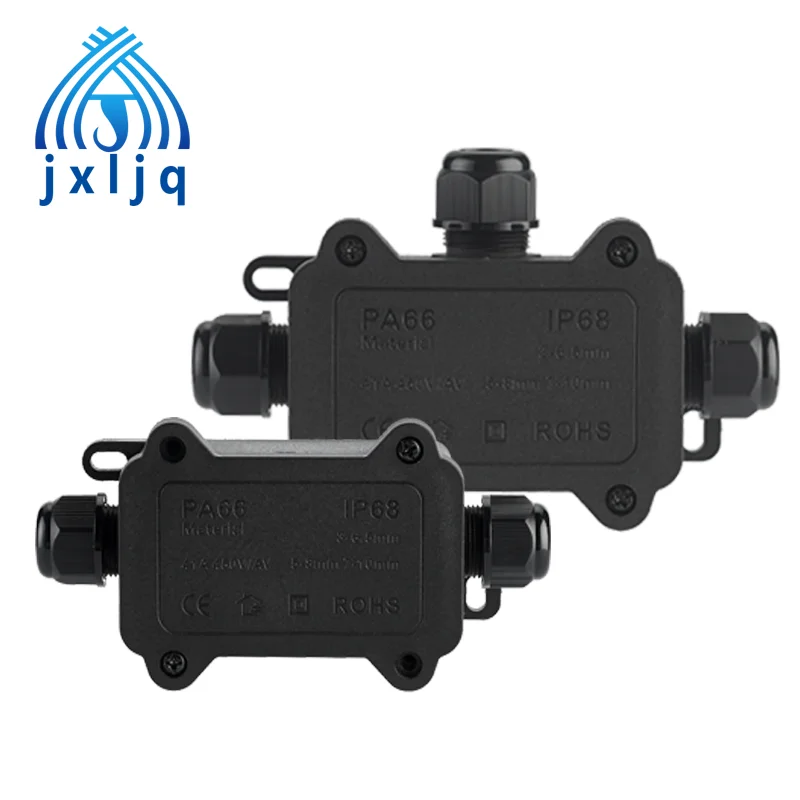
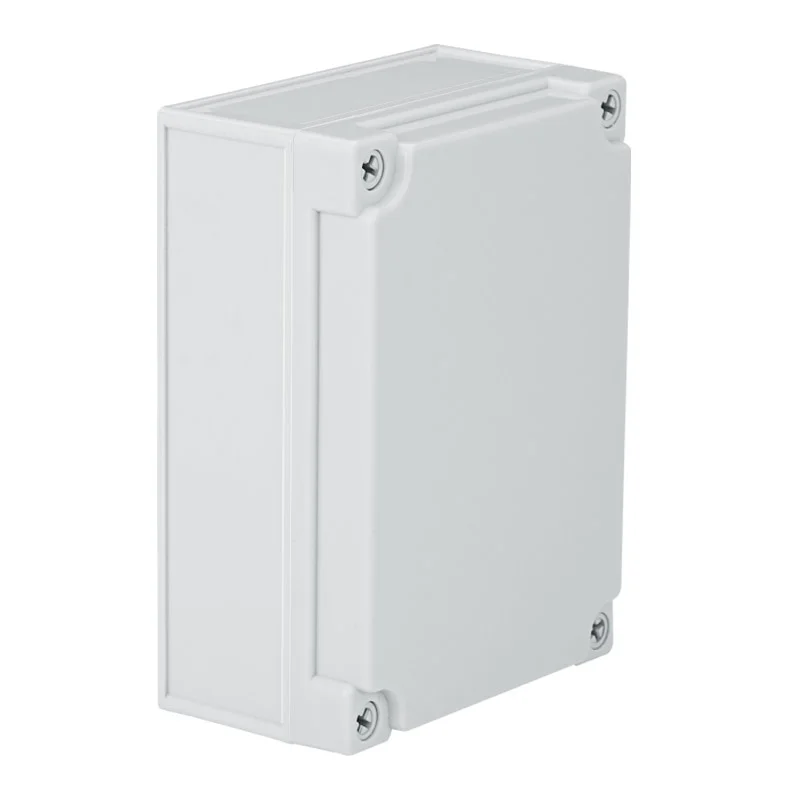
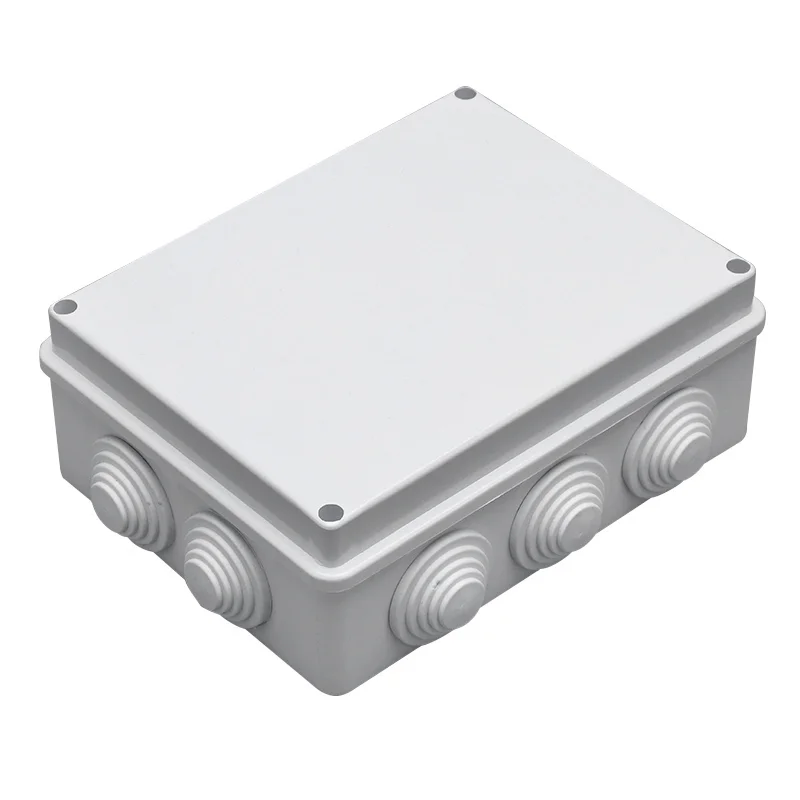
JX-AG is declared IP67 with IK08, in a high-grade plastic housing from 95×65×55 mm to 280×190×180 mm — the pairing that suits exposed and semi-submerged sites, and the reason the JX-AG waterproof junction box is the usual answer to an impact question. JX-RA, ABS with PVC stoppers at IP55/IP65, is declared for impact, heat, low-temperature and chemical resistance but carries no IK code; the JX-RA enclosure datasheet does not claim one and we will not invent it here. F1 publishes IP68, UL94 V-0 and a −40 to +105 °C range, and no IK code either. Where a specification demands a declared impact level, that is JX-AG territory — and the JX-AG IP67 application notes explain the load cases behind the rating.
An IK rating is a single measured blow under laboratory conditions, and it is the most useful number on a box datasheet that nobody asks for. Treat it as one input: read it next to the IP rating, the mounting height, the temperature the site actually reaches, and the entries you intend to cut. Where the site is exposed and the public can reach the enclosure, IK08 in a stabilised polymer is a defensible minimum, and IK10 in the same wall section is marketing unless the material changed with it.
It is stronger — twenty joules against five — but it is only better if the enclosure also keeps its IP rating after the impacts and the material suits your environment. A heavier box in the wrong polymer is not an upgrade.
No. The sample is tested as delivered, normally with its own entries closed. Glands and field-cut holes are outside the certificate, and entries are where most impact damage shows up first.
It can, in reinforced or glass-filled polymers, and in polycarbonate with adequate wall thickness. Unfilled ABS rarely gets there, which is why plastic boxes in the IK08 to IK09 band are far more common.
No. Each face takes five impacts at the rated energy, and the pass criterion is that the enclosure still protects and still seals. Repeated abuse at the same point is a maintenance question, not a rating question.
IK08 covers most exposed building services where the public cannot reach the box. Move to IK09 or IK10 for car parks, yards, construction sites and any position below about one metre where vehicles or trolleys pass.
Why nylon cable glands are used in solar and wind systems: IP68 sealing, UV and corrosion resistance, and how to specify the right gland.
Read More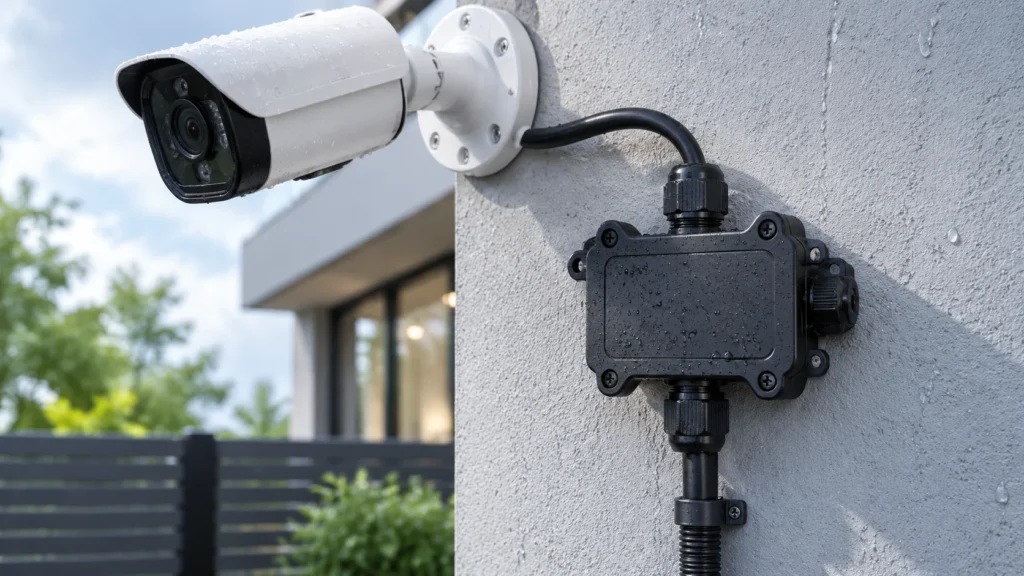
Size a camera junction box before you try to seal it: cable types, the RJ45 that will not pass a gland, bend radius, volume arithmetic and the four places water really gets in.
Read More
Learn how the IP68 rating on cable glands works: what IEC 60529 actually tests, how the two-seal waterproofing mechanism blocks water, and why installation errors cause most leaks.
Read More