Blog
Why use an adaptor or reducer?
When to use a cable gland adaptor, reducer or enlarger: the difference between them, common thread combinations, and how to keep the IP rating when threads do not match.
Read More
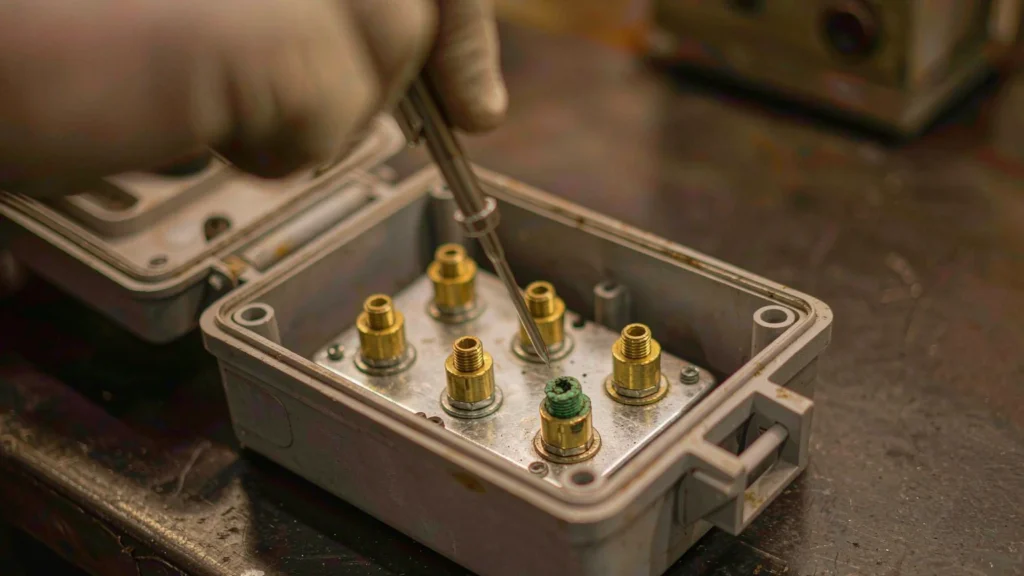
A junction box failure rarely arrives as a clean event. It arrives as a callback: one lighting circuit trips at dawn, a camera drops off the network after the first autumn storm, or a maintenance team finds green powder on a terminal block two years after handover. When returned units reach the bench, the question worth answering is not what broke, but who owned the condition that broke it — the moulder, the specifier, the installer, or the site. That answer decides who pays, and it is usually visible in the first two minutes of a teardown. Most failures we see come from the same waterproof junction box families, installed by competent electricians, and still fail for reasons that were predictable on paper.
“It failed” covers five distinct events. Mixing them wastes the investigation, because the tests that prove one are useless for the others.
These are typical categories from outdoor and light-industrial projects, with the first evidence that separated them on the bench. Shares are indicative of what we see in returned stock, not a market statistic.
| Case | First evidence on teardown | Root cause | Owner |
|---|---|---|---|
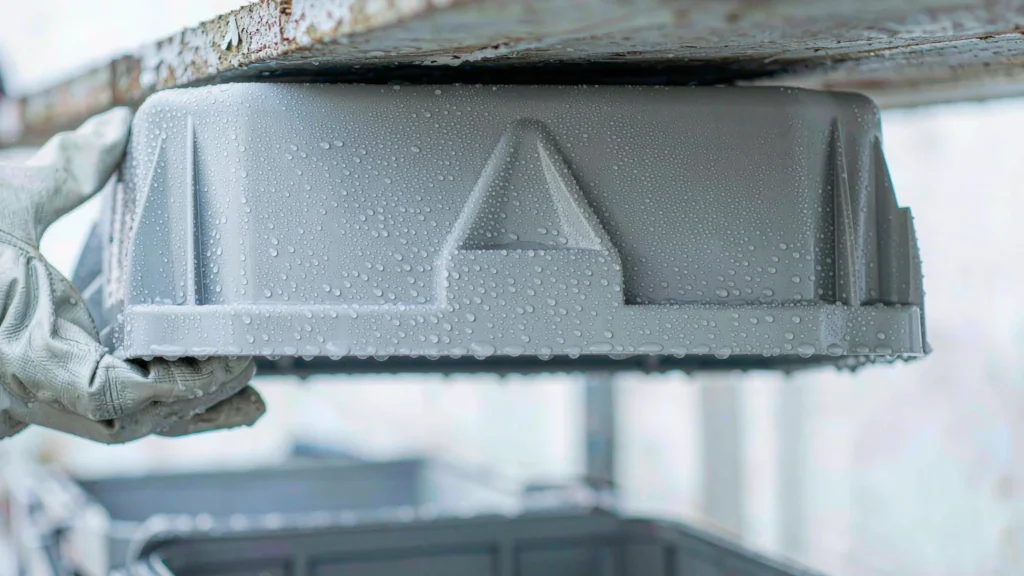
| 1. Trips after rain | Water beads on the lid underside, terminals bright | Condensation, not ingress | Specifier |
| 2. Green terminal | One conductor green to the tip, others clean | Capillary wicking through strand | Installer |
| 3. Cracked lid boss | Radial split at a screw boss, threads stripped | Over-torque on self-tapping screw | Installer |
| 4. Seal leaks year two | Gasket flat, no rebound, permanent set | Reopened repeatedly in service | Specifier |
| 5. Chalky housing | Surface powdering, colour shift, brittle walls | Unstabilised polymer in UV | Moulder |
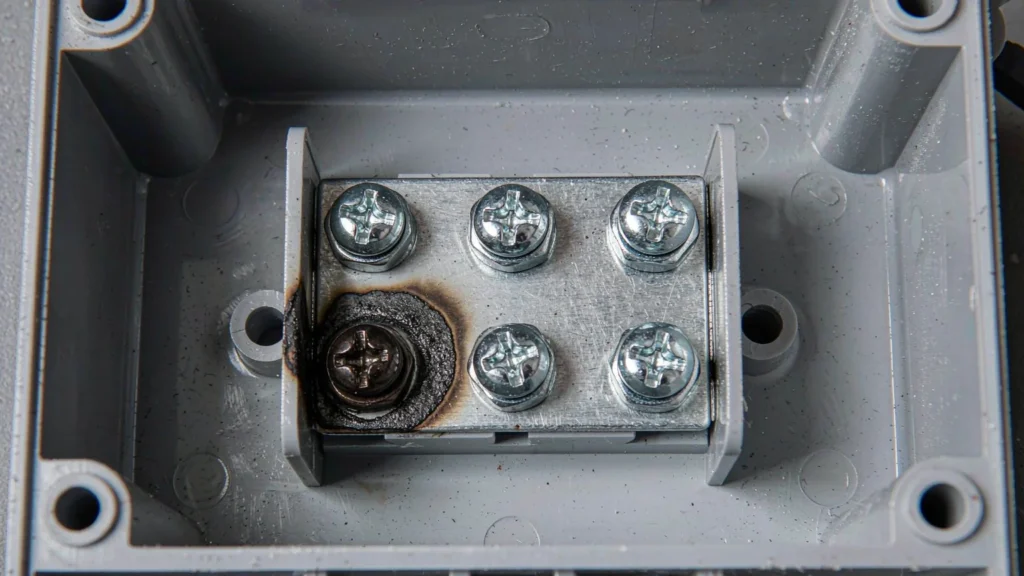
| 6. Melted terminal | Local charring at one screw, rest of box intact | Loose screw under continuous load | Installer |
| 7. No fault found | Box dry, joint sound, circuit still intermittent | Fault elsewhere on the run | Nobody |
Case 7 matters as much as the others. A meaningful share of “failed” boxes return with nothing wrong inside, and the real fault sits in a joint, a gland or a driver three metres away.
Water on the lid underside with bright, uncorroded terminals is condensation, not ingress. Air sealed in at assembly carries moisture; the lid is the coldest surface at night, so it is where the water lands. Nothing crossed the gasket. The fix is a breathable vent or a larger air volume, and the failure belongs to whoever specified a fully sealed box for a site with a 15 K day-night swing.
Chalking, colour shift and walls that snap instead of flexing point to polymer degradation, not to the seal. Unstabilised polyamide absorbs UV and loses impact strength long before it visibly fails. This is a material-grade question, and it is the one case in the list that a buyer can eliminate entirely with a line in the purchase order — which is why grade selection deserves more attention than the IP number on the label.
Charring confined to one screw, with the rest of the box intact, is a termination failure. A screw-crimp terminal that is not fully tightened has a contact resistance of milliohms that rises with every thermal cycle, and at 16 A continuous the wattage at that point is enough to carbonise the surrounding plastic. The housing then burns or does not, depending on its flammability class — the reason a V-0 rating matters even though it never appears in a datasheet headline.
Assigning the cause decides whether a batch is replaced, a site is corrected, or a claim is refused.
| Owner | What proves it | Typical remedy |
|---|---|---|
| Moulder | Grade certificate, UV and impact data, batch date code | Credit or replacement |
| Specifier | IP class, material, volume and venting against site conditions | Design change |
| Installer | Torque, cable range, entry direction, drip loop | Rework on site |
| Environment | Condensation, chemical exposure, submersion depth and duration | Different product class |
One failed unit and a failing batch are different problems with different responses. A single return out of 50 pieces is 20,000 ppm and may still be an accident; thirty returns out of 50,000 is 600 ppm and is almost certainly a process drift. Before treating either as a trend, be honest about sample size: demonstrating 99% reliability at 95% confidence with zero failures requires roughly 300 units tested without a failure. A supplier who says “we have never had a complaint” is quoting a sample of unknown size, which is not data.
The distribution matters too. Early failures point at assembly or a bad lot; a rising rate after eighteen months points at material, UV or gasket ageing. Both look identical in a complaint log and completely different in a lab.
The cheapest quality control happens in the purchase order, before anything is moulded. Four clauses do most of the work: a named polymer grade with UV stabiliser, a flammability class stated to UL 94, a seal range printed on the unit rather than in a catalogue, and an agreed disposition route for returns with a response time. Add a line requiring the IP test report to name the exact assembly, and “it was fine when it left us” stops being a conversation.
Two more for outdoor work: a gasket material with a compression-set limit, and a minimum wall thickness at screw bosses. Both are measurable and cheap to check.
| Situation | Action |
|---|---|
| One unit, clear installation cause | Rework on site, record the cause |
| One unit, no visible cause, circuit still intermittent | Escalate: the box is probably not the fault |
| Repeat failures at one location | Investigate environment before replacing stock |
| Repeat failures across a batch | Quarantine, retain samples, formal claim |
| Charring or melting anywhere | Stop using the batch, escalate to the moulder |
Most junction box failures are decided long before the lid is closed: in the material grade, in the IP class chosen for a site that needed venting, in the torque nobody wrote down. Reading the evidence in a consistent order — housing, gasket, terminal, conductor, environment — turns a complaint into a cause, and a cause into a clause. If you are comparing protection classes for a specific site, the IP rating differences and the cable capacity of each box are the two numbers that settle most of these arguments in advance.
Termination problems and moisture, in that order. A joint that is not fully tightened fails slowly and invisibly; moisture fails it suddenly. Neither is a moulding defect, which is why so few failures are covered by a material warranty.
Replace any box that has cracked, deformed or charred, because the housing is no longer doing its job. Repair is reasonable only where the fault was a single loose termination and the gasket is still elastic; a gasket that has taken a permanent set will not reseal.
Because the rating describes one assembly in one state — closed, as delivered, with factory blanks in unused entries. It says nothing about a box that was opened three times, in which the gasket has compressed and set, or one whose glands were fitted outside their seal range.
Compare the failure date code against the shipping records. Failures clustered in one moulding week are a batch issue; failures spread evenly across months usually point to installation or environment.
Only against water. It does nothing for loose terminals, UV ageing, condensation inside a sealed volume, or chemical attack. A sealed box on a site with a large diurnal swing can fail more often than a vented one.
If you are working through a return or specifying a replacement batch, send us the site conditions and the failed unit’s date code — we will tell you which of the seven above it most likely is. The F1 series ordering data and the installation mistakes that break a seal cover the two most frequent answers.
When to use a cable gland adaptor, reducer or enlarger: the difference between them, common thread combinations, and how to keep the IP rating when threads do not match.
Read More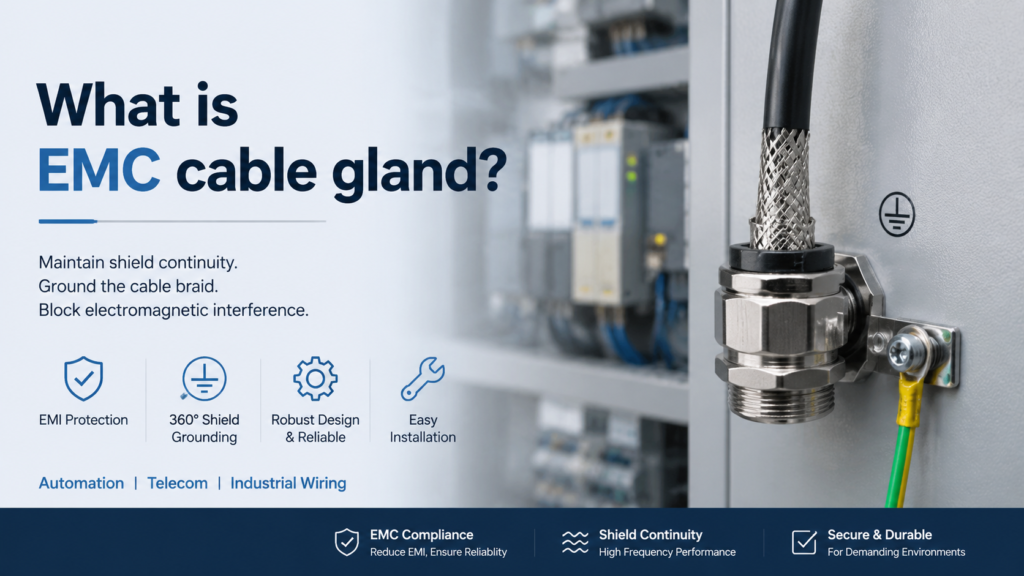
Learn what an EMC cable gland is and how it keeps a shielded cable’s braid grounded to the enclosure to block electromagnetic interference in automation, telecom, and signal systems.
Read More
BW, CW and A2 are positions in the BS 6121 cable gland type code, not rival models. This guide decodes the letter system and shows how to specify the right armored gland type.
Read More