Blog
Junction Box for Security Camera Wiring: Sizing Guide
Size a camera junction box before you try to seal it: cable types, the RJ45 that will not pass a gland, bend radius, volume arithmetic and the four places water really gets in.
Read More
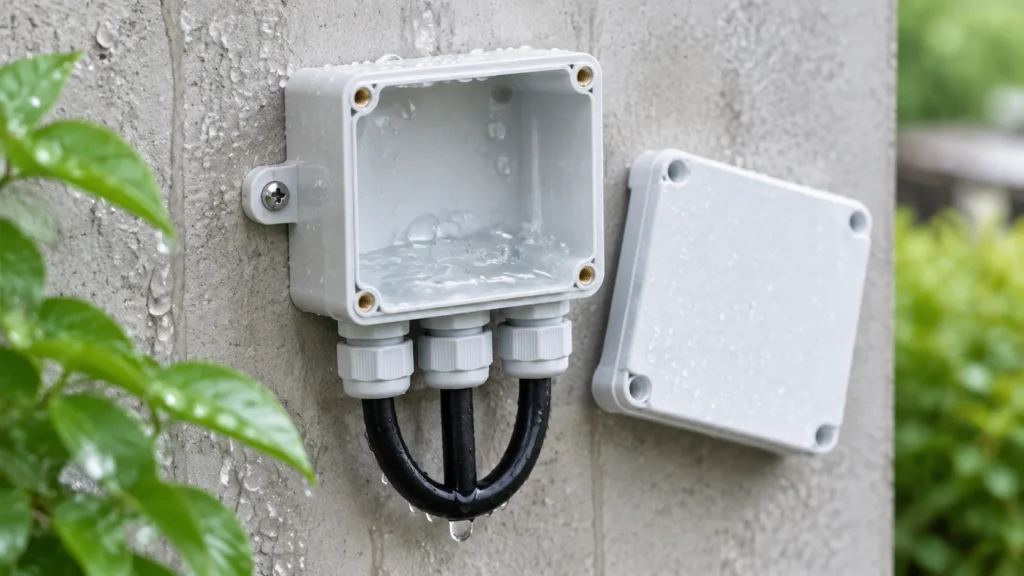
A junction box leaking is almost never a manufacturing failure. The moulded body arrives as a single closed shell with no seam in it. Water gets in through six specific places, and five of them are decisions made during installation. That distinction matters commercially: if you are the buyer, you need to know which mistakes belong in the work instruction; if you are the installer, you need to know which one you have already made. This article works backwards from the evidence — what the water looks like when you open the lid — to the mistake that produced it.
An ingress protection test describes one assembly in one state: the waterproof junction box closed, gasket as delivered, unused entries blanked from the factory, mounted in the tested orientation, with no cable hanging off it. Nothing in that test covers a box drilled on site, packed with terminals, hung gland-up under a gutter and reopened four times during commissioning.
| Test condition | Typical field reality |
|---|---|
| Gasket new, never compressed | Compressed and released two to four times |
| Unused entries blanked at the factory | Some drilled, some taped, some open |
| Box empty, no cables in glands | Cables clamped in every populated gland |
| One orientation, as tested | Whatever the wall or post allowed |
| Clean water, defined depth and time | Rain, spray, dust, salt, daily condensation |
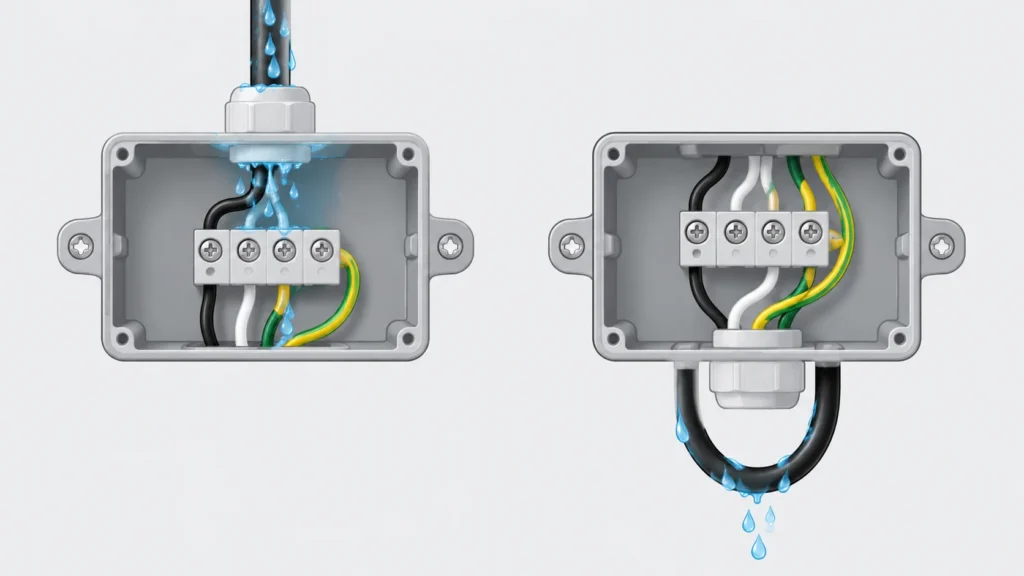
Water running down a jacket reaches the gland from above and sits on it. A gland seals the annulus between jacket and seal; it does not seal a reservoir. Either bring the cable in from below or leave a drip loop so the lowest point of the cable is under the entry. Installers choose the gland-up layout because wall space dictated it, then discover the problem after the first heavy rain. This failure is loud: water arrives in one event, in volume, with grit in it.
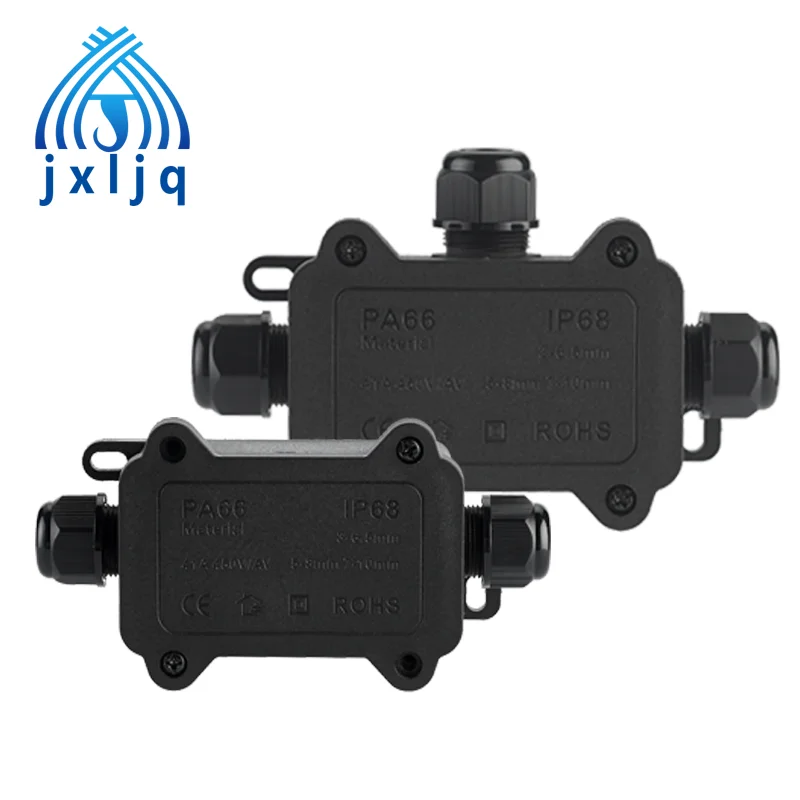
A gland or rubber plug has a clamping range, and outside that range it is a hole. On a 2-way, 3-way or 4-way mini box the plug options are 3–6.5 mm, 5–8 mm and 7–10 mm, and they are not interchangeable: a 9.5 mm cable will not let the 5–8 mm plug close, and a 4 mm cable in the 7–10 mm plug closes but never compresses. Flat and oval cable is the second half of this problem — irrigation and landscape cable is often 3.4 × 6.6 mm or 4.6 × 9.4 mm, and a round seal compressed across a flat profile pinches at the edges and gaps at the flats. Measure the jacket with a caliper, not with a part number. The cable entry hardware you chose is where nearly every first-year leak starts.
Elastomer gaskets take a permanent set. After the first closure the material remembers its compressed thickness, so the second closure produces less contact stress at the same screw torque. A box opened during commissioning and closed again is not the box that was tested, even if nothing looks wrong. The related mistake is sequence: tightening four lid screws around the perimeter in order pulls one edge down and lifts the opposite corner. Go diagonally, in two passes, and stop when the lid meets the body evenly rather than when the screw feels tight.
Lid screws on plastic boxes are usually self-tapping into a moulded boss, which is the thinnest structural feature in the product. Over-torque it and the boss splits, or the wall around it cracks outward. The result is a hairline crack through the body: invisible outside, permanently open, and unaffected by how carefully the gasket was seated. If a screw spins free or clicks, stop — that box now needs replacement or a note in the maintenance file.
Tape lifts in UV. Silicone peels from nylon and polypropylene. A blanking plug fitted without its sealing washer is a plastic disc with a gap behind it. Any one of these leaves a path that is invisible from the front of the box and obvious from the terminals after a season. Every unused entry needs a rated plug seated on a clean flat land, and the count needs to be checked: a 4-way box showing 13 wires is not a 4-way box, it is a junction with an unaccounted opening.
The sixth failure wastes the most diagnostic time, because the box is genuinely sealed. Stranded conductor is a tube. Water enters the strands somewhere else on the circuit — a damaged jacket 20 m away, a wet luminaire, a flooded pull box — and travels inside the copper until it drips out at the terminal. The signature is one wet terminal, green corrosion on one core only, and dry walls everywhere else. The close relative is simple overpacking: cables pressed against the lid hold it off the gasket land, so the seal never reaches compression. The limit is not what fits, it is how many cables a box can take with the lid still closing by hand.
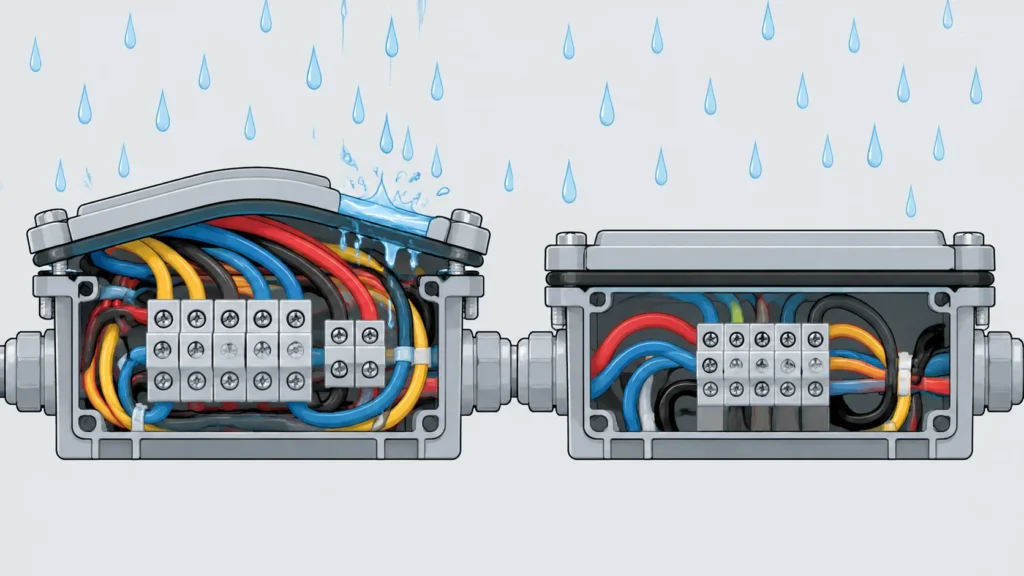
Where the water sits tells you which of the six happened, faster than disassembling the installation and guessing.
| What you see | Route | Action |
|---|---|---|
| Beads on the lid, terminals dry on top | Lid seam, gasket not compressed | Reseat, diagonal two-pass torque |
| One gland wet, jacket wet above it | Entry facing up, no drip loop | Re-route cable or add loop |
| Clear water, no grit, walls dry | Condensation | Vent plug, not silicone |
| Grit or sediment in the water | Open or badly plugged entry | Rated blanking plug with washer |
| Corrosion on one core, walls dry | Wicking inside the conductor | Cut back, re-terminate, seal source |
| Crack radiating from a lid screw | Over-torqued screw | Replace the box |
Clear, grit-free water with dry walls is condensation: air trapped at assembly carries moisture that condenses on the coldest surface every night. It has a different fix, covered in our guide to condensation in junction boxes, and extra sealant will not stop it.
Half of the six are eliminated at the specification stage. On the F1-2T/3T/4T series the seal range and the number of ways are fixed by the order code, and the table makes the limits visible: the 4-way versions stop at 8 mm, so a 9.5 mm landscape cable has no 4-way option at all. The 2-way versions accept 0.5–4 mm² conductors; the 3-way and 4-way accept 0.5–2.5 mm².
| Order code | Ways | Cable range | Typical use |
|---|---|---|---|
| MN-01 / MN-02 / MN-03 | 2-way | 3–6.5 / 5–8 / 7–10 mm | Inline splice, single luminaire |
| MH-05 / MH-06 / MH-07 | 3-way | 3–6.5 / 5–8 / 7–10 mm | Three-leg lighting run |
| MN-8 / MN-9 | 4-way | 3–6.5 / 5–8 mm | Cross junction, small cable only |
Our F1 series ordering data also lists per-piece weight, which matters on a 10,000-piece order. If you are still choosing between protection levels, the gap between a splash rating and a submersion rating is set out in our guide to IP ratings for junction boxes.
Following the eight-step installation sequence for a waterproof junction box from the start is cheaper than finding the mistake afterwards.
A junction box leaking is a system failure, and the system includes the gland, the plug, the torque, the cable route and the amount of copper inside. The box owns one part of it. Read the water, match the evidence to the mechanism, and fix the mechanism — sealing a symptom with silicone only moves the failure to the next rain event.
No, and it makes diagnosis harder. Silicone does not bond reliably to nylon or polypropylene, it cracks under UV, and it hides the gasket that was doing the sealing. Fix the gasket, plug, gland or crack instead, then close the box dry.
If the walls are dry and the water is clear at the bottom, it is condensation, not ingress. Warm daytime air carries moisture in, and the night-time drop condenses it on the coldest surface. A breathable vent plug equalises pressure and reduces it; more sealant cannot.
Look at the jacket above the gland. Wet jacket and wet gland with a dry lid seam means the water arrived on the cable. Beads hanging from the lid with terminals dry on top means the seam leaked.
Not in a box protecting live terminals. A drain hole converts an IP65 or IP68 enclosure into an unrated one and admits insects, dust and splash. If condensation is the problem, use a vent plug; if standing water is the problem, move the box.
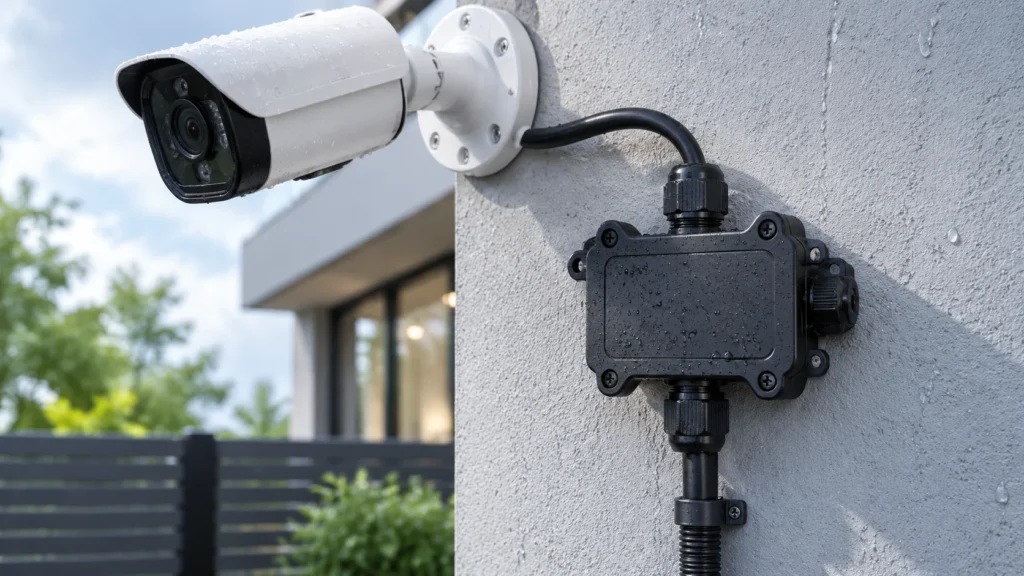
Size a camera junction box before you try to seal it: cable types, the RJ45 that will not pass a gland, bend radius, volume arithmetic and the four places water really gets in.
Read More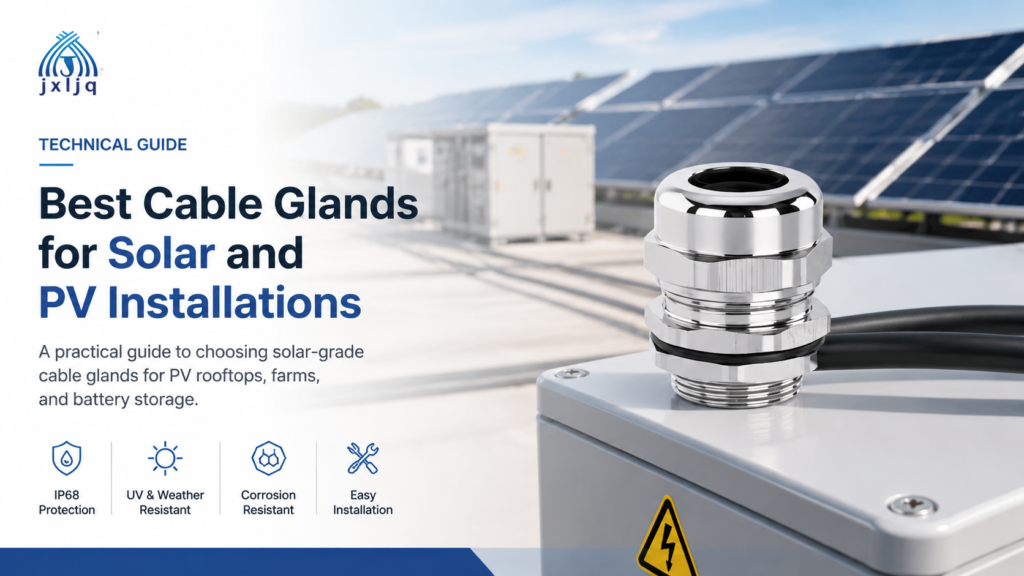
A practical guide to choosing solar-grade cable glands for PV rooftops, farms, and battery storage. Compare materials, IP ratings, and installation tips.
Read More
Specify a mini junction box correctly: 2/3/4-way choice, cable plug ranges, terminal types, IP68 limits for burial, and five installation steps that keep the seal.
Read More