Blog
Junction Box Cable Entry: Knockouts, Grommets or Glands?
Cable entry, not the box, is usually where a waterproof enclosure fails. Compare knockouts, grommets, stoppers and gland threads, and check the hole before you order.
Read More
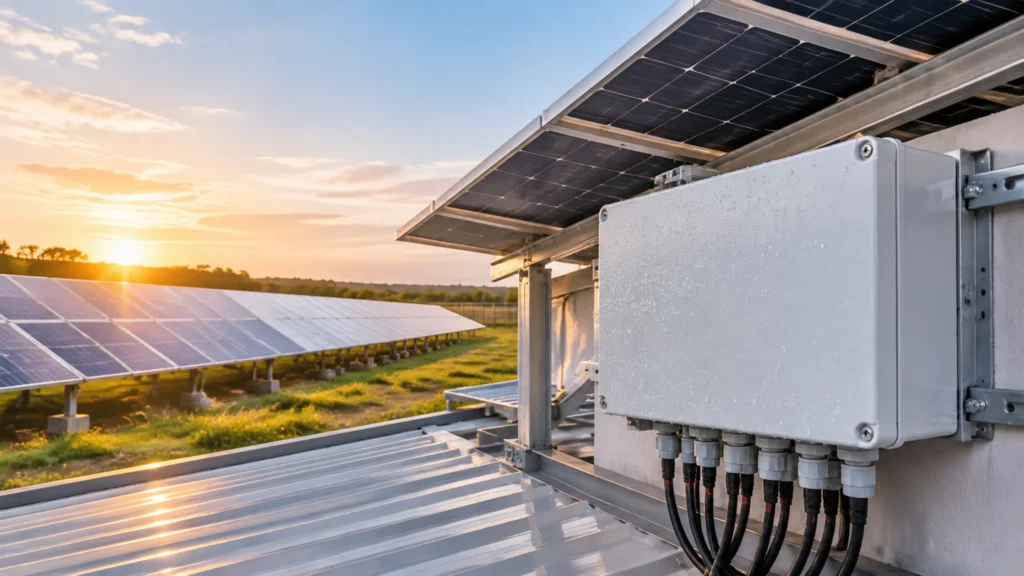
A solar junction box is the field-installed enclosure that joins PV string conductors at a common point before the run reaches an inverter. On most arrays it is not the box that fails. It is the mismatch between three numbers nobody writes on the same line: the box’s voltage rating, the string’s open-circuit voltage at the coldest hour of the year, and the DC current that two parallel strings push through one terminal. Get those right and IP68 becomes a bonus rather than the entire argument.
This guide works through the arithmetic that decides whether the enclosure survives twenty years on a roof or in a field.
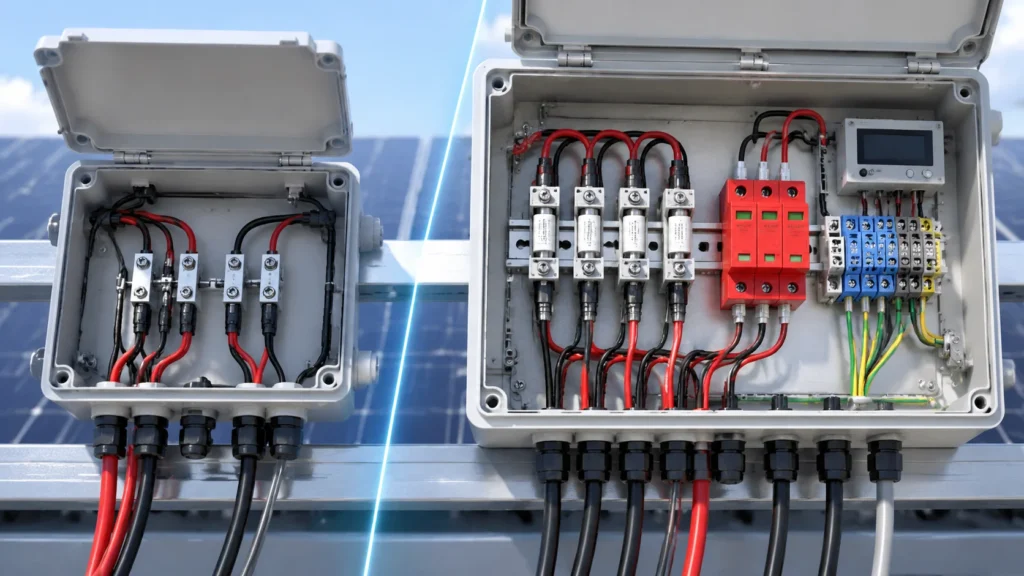
The two get used interchangeably in catalogues, and that is where ordering mistakes start. A junction box is a splice and turning point: conductors enter, get joined or re-routed, and leave. A combiner box does electrical work — it parallels strings, carries a fuse per string, usually a DC surge protective device, often a lockable disconnect and sometimes string monitoring.
The practical consequence is serviceability. A combiner box has to be opened to replace a fuse, so its gasket is a serviceable interface that gets disturbed every few years. A junction box can be closed once and left. That single difference decides whether you should be shopping for IP68 at all: the higher the rating, the more the enclosure relies on a gasket that nobody should touch, which is exactly what a fused combiner box cannot offer.
| Function | Junction box | Combiner box |
|---|---|---|
| Joins string conductors | Yes | Yes |
| String fusing | No | One fuse per string |
| DC surge protection | No | Usually Type 2 SPD |
| Disconnect or monitoring | No | Common above 4 strings |
| Typical IP target | IP67 / IP68 possible | IP65 / IP66 with vent |
| Opened during service | Rarely | Every fuse change |
IPX8 has no fixed test. The second digit means the enclosure survived continuous immersion under conditions agreed between maker and buyer — depth and duration are declared by the manufacturer, not by IEC 60529. Two boxes labelled IP68 can therefore be a 1 m dunk for 30 minutes and a 3 m soak for 24 hours. Neither number says anything about soil.
The second digit is tested on a closed enclosure with its entries fitted and sealed. A conduit is a pipe, not a gland: water enters at the high end, tracks down the conductors and arrives inside the box regardless of the gasket. If a conduit runs downhill into the enclosure, the conduit is testing the rating, not the box.
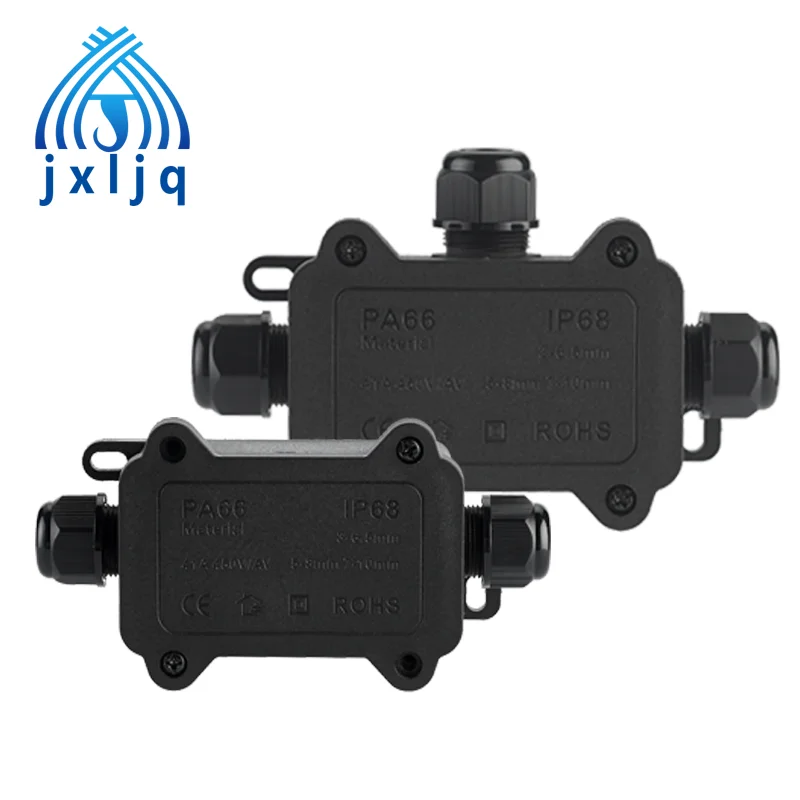
Our F1 mini junction box is rated 450 V and 24 A. Those are honest numbers for an enclosure that size, and they also disqualify it from string-level DC work. A 20-module string with a 45 V open-circuit voltage per module sits at 900 V at standard test conditions. Even a 10-module string lands exactly on the 450 V limit with zero margin.
There is no zero-margin case in PV, because open-circuit voltage rises as cells get cold. A typical module coefficient of about −0.30 %/°C means a 35 K drop from 25 °C to −10 °C adds roughly 10 % to Voc: the same 10-module string reaches about 497 V in a cold snap. Nine modules at 405 V is the realistic ceiling, and 24 A caps you at a single string, since two parallel strings of 13 A short-circuit current already exceed the terminal rating.
| Array element | Typical value | Against a 450 V / 24 A box |
|---|---|---|
| 10 modules × 45 V Voc at 25 °C | 450 V | At the limit, no margin |
| Same string at −10 °C | ≈497 V | Exceeds rating |
| 9 modules at −10 °C | ≈447 V | Inside rating |
| Two strings, 13 A Isc each | 26 A | Exceeds terminal rating |
| Single string, 13 A Isc | 13 A | Inside rating |
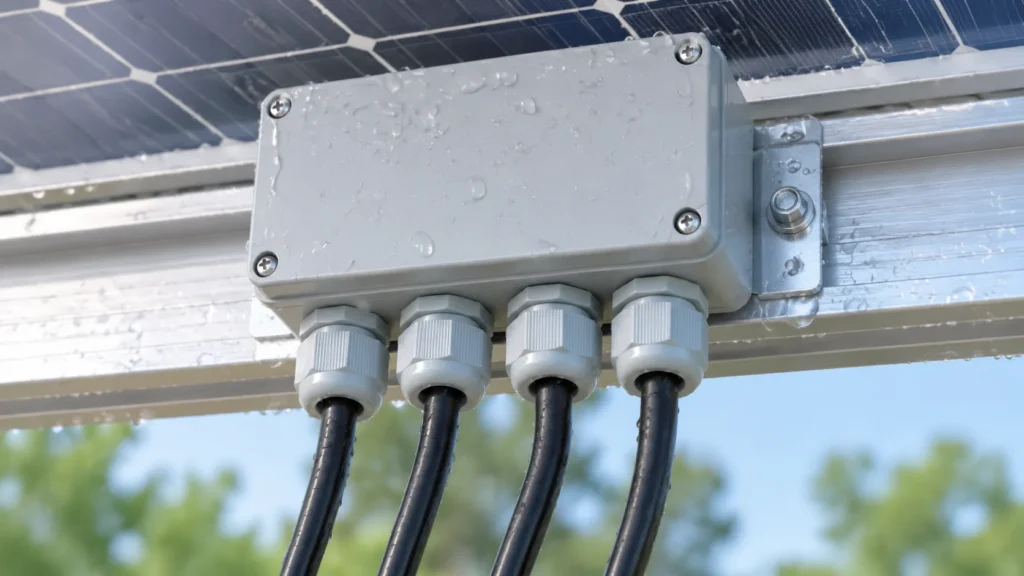
Small boxes belong on the low-voltage side: module-level joins on off-grid and RV systems, 12 and 24 V battery circuits, and AC runs after the inverter. For string-level DC the enclosure has to be rated for the array voltage — 1000 V or 1500 V — and that is a different product class. The JX-AG range, for instance, runs from 95×65×55 mm to 280×190×180 mm in IP67, which is the size band a multi-string splice actually needs.
A rooftop enclosure is killed by heat, ultraviolet light and the fact that nobody wants to go back up. Module backsides run well above ambient, a dark enclosure on a rail absorbs direct sun, and the daily swing works the gasket and the lid screws. Serviceability is therefore a design input: keep the fused device at grade and run unfused string conductors to it.
A ground-mount enclosure is killed by water, animals and machines. Conduits terminating below the water table become sumps, rodents chew gland bodies and cable jackets, and mowers remove anything that sits low. Trackers add continuous cable flexing at the entry, which needs a service loop and strain relief rather than a tighter gland.
| Site | Dominant failure | What to change in the spec |
|---|---|---|
| Pitched rooftop | Heat, UV, gasket creep | UV-stabilised housing, high service temperature |
| Flat rooftop, ballasted | Standing water in trays | Mount above tray level, entries pointing down |
| Ground mount | Water table, rodents, mowers | Raise to 300 mm minimum, armoured entry |
| Tracker | Flex fatigue at the gland | Service loop, strain relief, flexible conduit |
PV cable is not building wire. A 4 mm² H1Z2Z2-K conductor measures roughly 5.5 to 6.5 mm over the jacket; 6 mm² runs about 6.5 to 7.5 mm. A gland whose sealing range starts at 9 mm will not compress on either, and no amount of silicone will fix a seal that never made contact. Order the gland against the datasheet diameter, not against the nominal cross-section.
MC4-style connectors such as our IP68 PV connector are not load-break devices. Opening one under current draws an arc with no zero crossing to extinguish it, and on a 1000 V string that arc carbonises the housing before it stops. Any enclosure housing mating connectors is non-operable under load, so the array needs a real DC isolator elsewhere.
A sealed box is not a dry box. Every temperature swing changes internal pressure by roughly p·ΔT/T; at 100 kPa and a 30 K daily swing on a roof, that is about 10 kPa of pressure difference pushing humid air across the gasket and back out again. Over twenty years that is more than 7,000 cycles, and elastomer compression set is cumulative.
The countermeasure is not a better gasket, it is a breathable vent: a membrane that equalises pressure while blocking liquid water. It also removes the condensation that forms when a warm humid night cools the enclosure faster than the water can escape. Our breathable vent plug exists for exactly this reason, and the mechanism is covered in more depth in condensation in sealed junction boxes.
Choosing a solar junction box is mostly a voltage and current exercise, and only then an ingress exercise. A compact IP68 box is the right answer at module level and on low-voltage DC; at string level the same box is a rating violation no gasket can rescue. For the housings themselves, material choice drives UV life and gasket geometry more than the IP digits do.
No. A module junction box is laminated into the panel at the factory, potted, and carries the bypass diodes. A field solar junction box is a separate enclosure that joins string conductors on site.
Usually not. A roof enclosure faces rain, spray and thermal cycling rather than immersion, so IP66 or IP67 with a UV-stable housing and a pressure vent is the better-engineering answer. Reserve IP68 for enclosures that can genuinely be submerged.
Only within its terminal current rating. Two strings at 13 A short-circuit current exceed a 24 A terminal, so a multi-string array needs a larger enclosure or a proper combiner with one fuse per string.
Almost always through the conduit. A pipe running downhill into the enclosure delivers water past the gasket, and the IP test never covered that path because the test closes the entries.
Look for a declared continuous service range covering at least −40 °C to +85 °C on a rooftop, and check it against the module datasheet. A service temperature claim and a heat deflection temperature are different properties, so do not substitute one for the other.
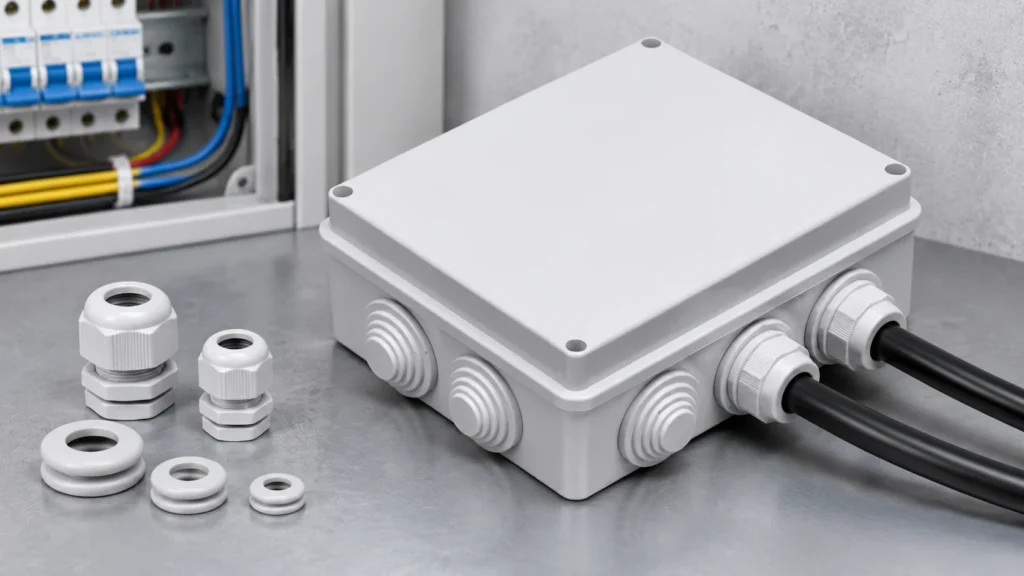
Cable entry, not the box, is usually where a waterproof enclosure fails. Compare knockouts, grommets, stoppers and gland threads, and check the hole before you order.
Read More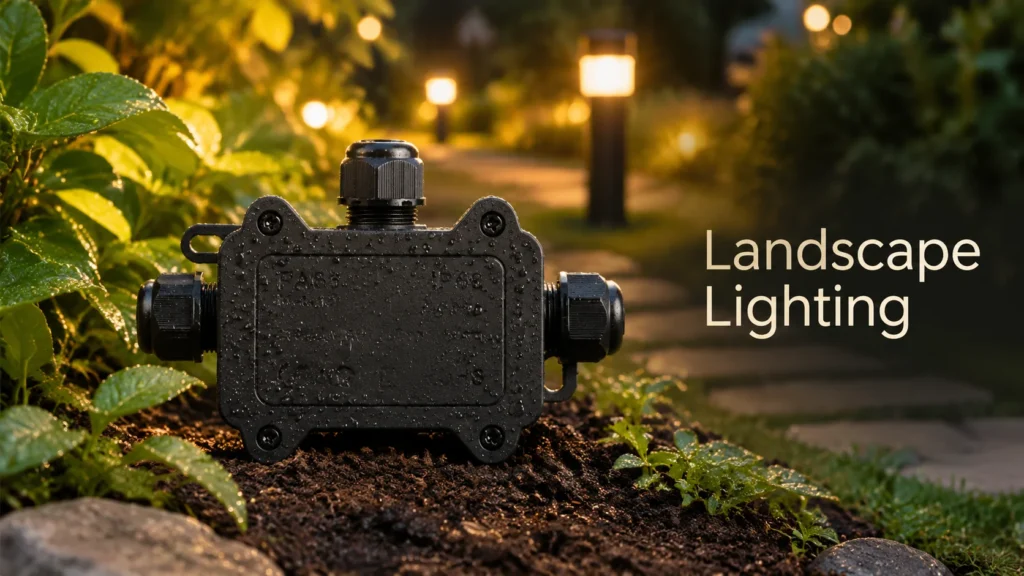
Size a landscape lighting junction box from the circuit up: voltage drop, cable OD, terminal capacity, opening count and burial rules, with real ordering data.
Read More
Why robot cables fail at entry points, how strain relief cable glands protect them, where they matter in a robotic cell, and how to choose and install them.
Read More