Junction Box for Landscape Lighting: Sizing the Splice Before You Buy
Most failed outdoor lighting connections are not caused by a bad box, but by a box chosen before anyone calculated what the circuit needs. A junction box for landscape lighting sits at the intersection of three numbers that do not negotiate: the voltage drop on a 12 V run, the outside diameter of the cable jacket, and the cross-section the terminal will accept. Get those wrong and the highest IP rating on the market will not save the job.
This guide works through the three in order, then burial, opening count, current limits and the installation details that decide whether the splice is dry after two winters.
Start With the Circuit, Not the Box
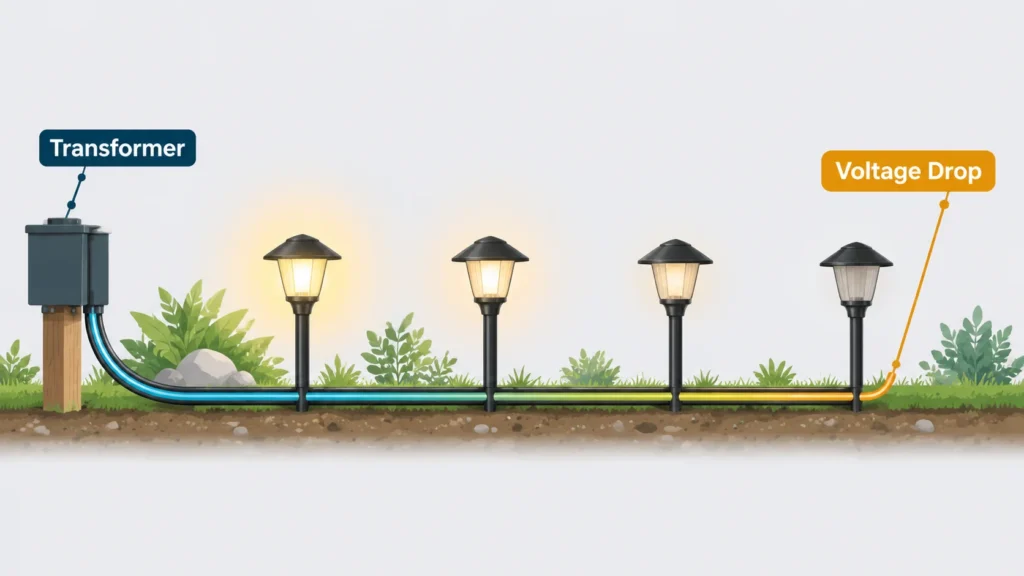
Low-voltage landscape systems run at 12 V, and 12 V forgives nothing. At 120 V a 2 V drop is noise. At 12 V it is nearly 17 percent of the supply, and it shows up as the last fixture sitting dim while the first is fine. Copper resistance is fixed by gauge, and the drop is a loop calculation because current travels out and back:
Voltage drop = 2 × current × resistance per metre × one-way length
Run (12 V, 60 W load, 5 A)
12 AWG (3.31 mm²)
10 AWG (5.26 mm²)
10 m one way
1.7 V (14%)
1.1 V (9%)
20 m one way
3.4 V (28%)
2.2 V (18%)
The lesson is not “buy a bigger box.” On 12 V systems the cable gauge does the load-bearing work, and the splice point is where the gauge often changes. A branch taken off mid-run is a decision about conductor size first and enclosure size second. If run length is still open, work through the junction box size chart approach for volume, then come back to gauge.
The Cable You Are Actually Joining
Landscape lighting cable is usually not round. Two-conductor low-voltage direct-burial cable is manufactured with a flat or oval jacket: 16/2 sits around 3.4 × 6.6 mm and 12/2 around 4.6 × 9.4 mm. A round seal compresses evenly on a circular jacket and unevenly on an oval one, which is why plug ranges are quoted as a window rather than a single size.
Item
Published range or value
Typical landscape fit
F1 plug options
3–6.5 mm / 5–8 mm / 7–10 mm
16/2 lands in the 3–6.5 mm plug; 12/2 needs the 7–10 mm plug
F1 terminal capacity
0.5–4 mm² (2-way), 0.5–2.5 mm² (3- and 4-way)
14 and 12 AWG fit; 10 AWG does not
F1 electrical rating
16 A / 450 V, 24 A / 450 V
Comfortable for branch loads; check transformer total
F1 temperature range
−40 °C to +105 °C
Covers ground freeze and low-mounted fixture heat
Two consequences follow. An oval jacket seals when the major axis sits inside the quoted window and the plug deforms around the flats — if the flat section dominates, test the real cable. And since the plug seals while the terminal conducts, the two limits are independent: a cable can fit the plug and fail the terminal.
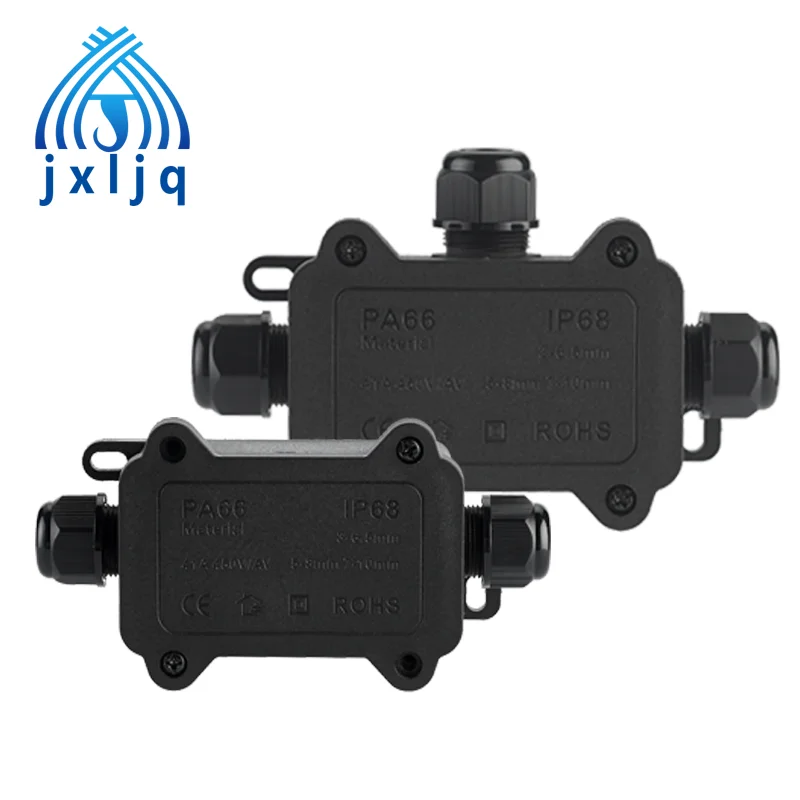
The F1-2T/3T/4T mini waterproof junction box is built for this duty: IP68, flame-retardant PA6 nylon housing, silicone O-ring, nickel-plated brass conductors and screw-crimp termination. The single-configuration variant is on the F1 series page.
Conductor Size vs Terminal Capacity: The Hard Limit
This step most often reverses a purchase decision. Ten AWG copper is 5.26 mm². A 3-way or 4-way F1 terminal accepts up to 2.5 mm², and a 2-way accepts up to 4 mm². A long 12 V run that voltage-drop arithmetic pushes to 10 AWG cannot be terminated in these boxes at all.
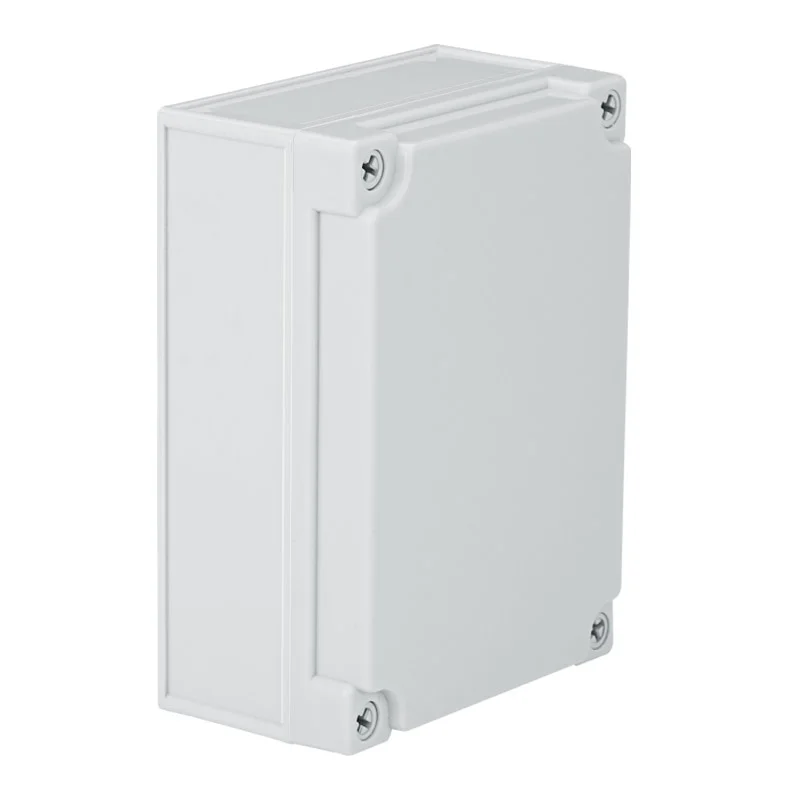
The workable answers are the ones contractors actually use: shorten the run and add a tap point, split the load across two branches, raise the transformer tap voltage, or move to a larger enclosure with a terminal block and separate glands. That last option leaves the mini format behind — which is why the JX-AG enclosure, IP67 with IK08 impact resistance in 16 sizes from 95×65×55 mm upward, sits in the same catalogue.
One reassurance: the splice itself is rarely the voltage-drop culprit. A clean screw-crimp joint adds a few milliohms, a rounding error next to twenty metres of undersized cable. Fix gauge and length first.
How Many Openings Do You Need?
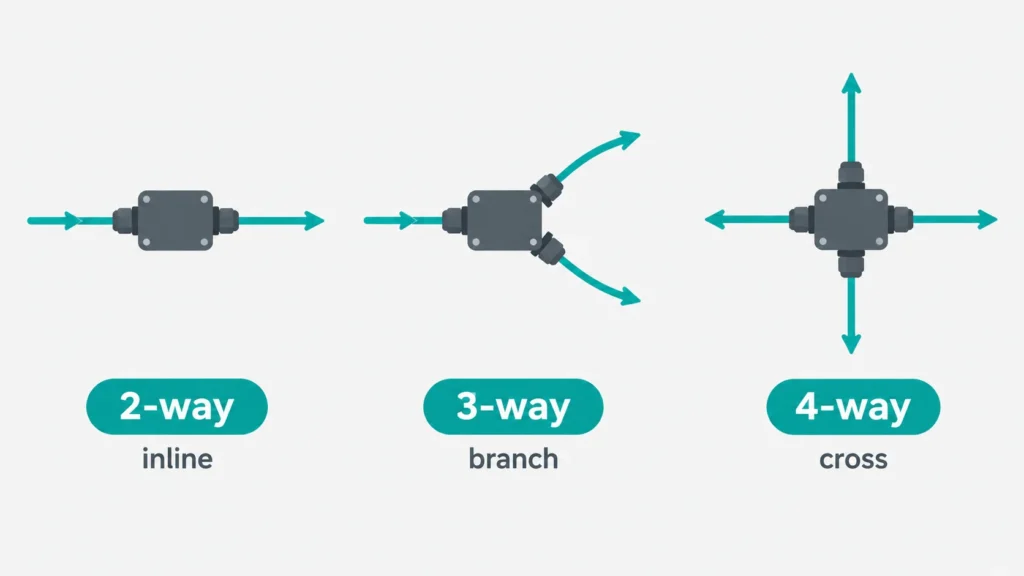
The opening count follows topology, not fixture count. An inline repair or straight extension needs two openings; a branch feeding a second direction needs three; a cross point that splits a run while continuing through needs four.
Order code
Openings
Cable range
Unit weight
MN-01 / MN-02 / MN-03
2-way
3–6.5 / 5–8 / 7–10 mm
71.6 / 72.8 / 70.8 g
MH-05 / MH-06 / MH-07
3-way
3–6.5 / 5–8 / 7–10 mm
78.8 / 77.4 / 76.5 g
MN-8 / MN-9
4-way
3–6.5 / 5–8 mm
85.0 / 79.5 g
Note what the last row is missing: there is no 7–10 mm option on the 4-way body. If a cross point must accept 12/2 cable on all four legs, the four-way mini format will not do it and the plan needs two 3-way boxes or a larger enclosure. Catching that at design stage is cheaper than catching it on site.
An order of 10,000 pieces moves 710 kg to 850 kg depending on opening count, and freight quotes built on a guessed average will miss. For the topology decision itself, the comparison of 2-way, 3-way and 4-way bodies shows when each is the correct answer.
Where the Splice Sits Changes the Enclosure
At the fixture stem or on a wall: splash and rain are the exposure, entries face down, and an IP68 box is generous but harmless.
Under mulch in a planting bed: soil moisture, sprinkler spray and standing water after heavy rain. IP68 with a downward-facing entry and a drip loop is the right duty, and the box should not sit in a low point that collects water.
Direct burial: a different problem, and it deserves a straight answer. Neither the F1 nor the JX-AG datasheet publishes a direct-burial rating. IP68 describes immersion of a closed, new sample in still water; burial adds soil load, root and rodent damage, and slow groundwater. For a genuinely buried splice, house the connection in a grade-level valve box or use a gel-filled splice designed for it, and treat the IP68 enclosure as the housing inside that system. Burial depth is a local code matter — check it before the trench closes.
Installation Details That Decide Whether It Stays Dry
Point unused openings down or plug them. An open port is an IP failure, whatever the label says.
Seal on the jacket, not the conductors. The plug grips the outer sheath; strip length inside the box does not affect sealing.
Loop the cable below the entry. A drip loop moves water away from the seal instead of letting it track along the jacket.
Do not over-torque the screw-crimp terminals. Brass deforms; snug plus a pull test beats force.
Expect condensation, not leaks. A sealed box that breathes through temperature cycles can wet its own terminals from inside — see condensation in sealed junction boxes.
Test at commissioning. Measure voltage at the last fixture, not at the transformer.
Conclusion
Sizing a landscape lighting junction box is arithmetic before it is a product decision. Calculate voltage drop to fix the gauge, check the gauge fits the terminal, measure the jacket to pick the plug range, count the directions to pick the openings, and match the enclosure to whether the splice is above grade, under mulch or genuinely buried. Our mini junction box range covers the 2, 3 and 4-way bodies in IP68; if you are weighing mini against a larger enclosure, the complete mini junction box guide lays out the crossover points.
FAQ
What IP rating does a landscape lighting junction box need?
IP68 for anything under mulch, in a planting bed or exposed to standing water. IP65 or IP66 is adequate for a wall-mounted splice under an eave. The rating only holds if unused openings are plugged and entries face downward.
Can a landscape lighting junction box be buried directly?
Not on the strength of an IP68 label alone. IP68 covers immersion, not soil load or rodent damage. For direct burial, use a grade-level valve box or a gel-filled splice rated for the purpose.
Why does my last fixture look dim?
Voltage drop. At 12 V, 20 m of 12 AWG carrying 5 A loses about 3.4 V. Shorten the run, split the load across branches, raise the transformer tap, or increase the conductor gauge.
Can I use 10 AWG cable in a mini junction box?
Not in the F1 series. Ten AWG is 5.26 mm², and the terminals accept 4 mm² on 2-way bodies and 2.5 mm² on 3- and 4-way bodies. Ten AWG runs need a larger enclosure with a separate terminal block.
How many openings do I need?
Two for an inline splice or repair, three for a branch, four for a cross point. The 4-way body is only offered in 3–6.5 mm and 5–8 mm cable ranges, so 12/2 cable on all four legs requires a different plan.
Does the splice itself cause voltage drop?
Barely. A clean screw-crimp joint adds a few milliohms, which is negligible beside cable resistance. Fix gauge and run length before blaming the connector.
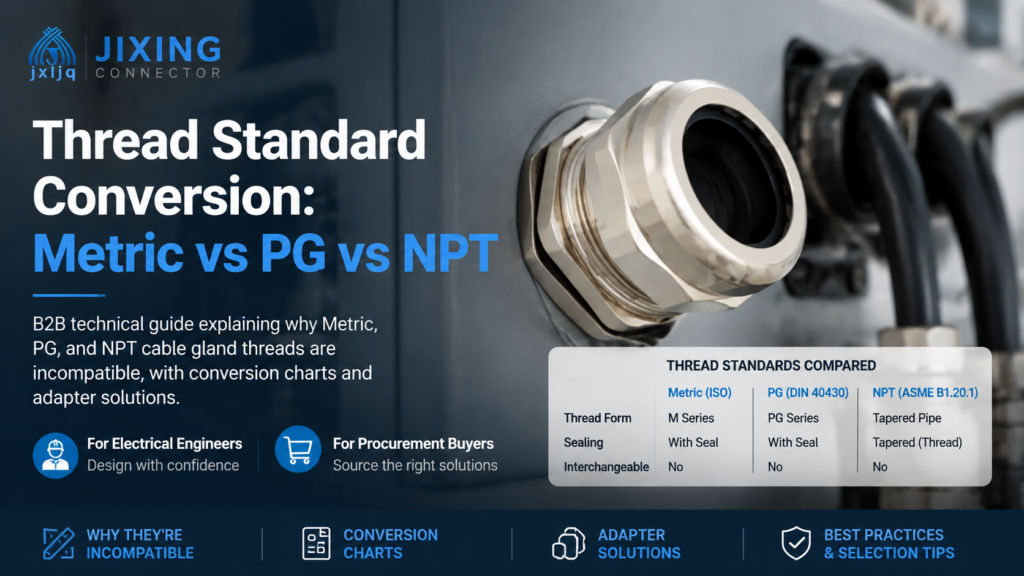
Metric, PG, and NPT cable gland threads are mechanically incompatible. This guide explains the dimensional differences, shows conversion by cable OD band, and lists adapter solutions for legacy enclosures.
Why robot cables fail at entry points, how strain relief cable glands protect them, where they matter in a robotic cell, and how to choose and install them.
When to use a cable gland adaptor, reducer or enlarger: the difference between them, common thread combinations, and how to keep the IP rating when threads do not match.
We use cookies to enhance your browsing experience, serve personalised ads or content, and analyse our traffic. By clicking "Accept All", you consent to our use of cookies.