Blog
The function of Screw Cap
What a screw cap (end cap or blanking plug) does: sealing unused enclosure entries, maintaining IP ratings, plus material and size selection.
Read More
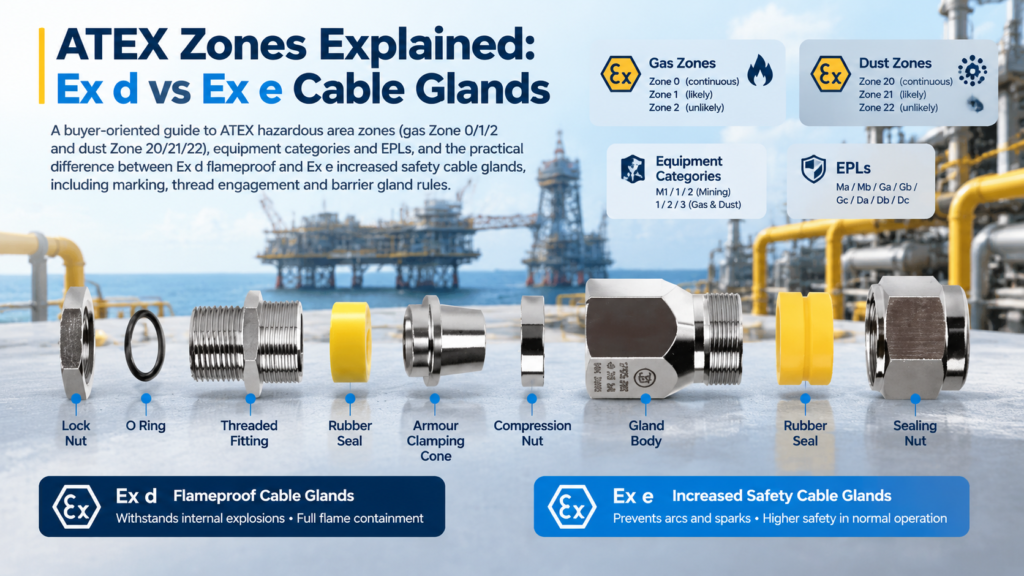
If you specify cable glands for a hazardous area, two questions decide almost everything else: which zone the gland sits in, and whether the enclosure it serves relies on flameproof (Ex d) or increased safety (Ex e) protection. This guide gives you ATEX zones explained in plain terms — Zone 0, 1 and 2 for gas, Zone 20, 21 and 22 for dust — and then works through the practical difference between Ex d vs Ex e cable glands: what each concept actually does, what the standard demands of the gland itself, and how to tell a real certificate from a marketing claim.
The short answer first: Ex d contains an explosion, Ex e prevents one. Both are accepted in Zone 1 and Zone 2 for gas, neither is accepted in Zone 0, and on real projects the two are frequently combined on the same machine as Ex de. Almost everything else — thread engagement, barrier glands, certificate types, the marking on the gland body — follows from that one distinction. If you are already shopping for ATEX cable glands and need to confirm which concept your drawings call for, the sections below give you the selection logic and the paperwork to check.
The single most common misunderstanding in hazardous-area procurement is treating “ATEX” as one certificate. It is not. ATEX is the name given to two separate EU directives that split the responsibility between the company that builds the equipment and the company that operates the plant.
| Directive | Applies to | Who is responsible | What it requires |
|---|---|---|---|
| 2014/34/EU (equipment) | Electrical and non-electrical equipment, protective systems, and safety devices intended for explosive atmospheres | Manufacturer, importer, distributor | Conformity assessment, CE marking plus the hexagonal Ex marking, EU Declaration of Conformity, EU-Type Examination Certificate where required |
| 1999/92/EC (workplace) | The installation site itself | Employer / plant operator | Hazardous area classification into zones, an Explosion Protection Document (EPD), and selection of equipment appropriate to each zone |
Directive 2014/34/EU replaced the older 94/9/EC and became fully applicable on 20 April 2016. The essential health and safety requirements in Annex II did not change, and certificates issued under the old directive remained valid, but three things did change and they still trip up buyers reviewing documentation today:
Practical consequence: if a supplier’s datasheet still quotes 94/9/EC as the governing directive, the document is either old stock or recycled marketing text. The hardware may be perfectly compliant, but the paperwork has not been maintained — and paperwork is what a notified inspection body asks for first.
The workplace directive matters just as much to you as a buyer, because it is the operator’s zone classification that determines which equipment protection level you are allowed to install. You do not choose the zone; the plant’s EPD does.
Zones describe how often an explosive atmosphere is expected to be present. They are defined by frequency and duration, not by the volume of gas or the size of the plant. There are six zones in total — three for gas and three for combustible dust — and they map onto equipment categories and Equipment Protection Levels (EPL) as follows.
| Zone | Atmosphere | How often the explosive atmosphere is present | Equipment category | Minimum EPL |
|---|---|---|---|---|
| Zone 0 | Gas, vapour or mist | Continuously, for long periods, or frequently | 1G | Ga |
| Zone 1 | Gas, vapour or mist | Likely to occur occasionally during normal operation | 2G | Gb |
| Zone 2 | Gas, vapour or mist | Not likely in normal operation, and only for a short period if it does occur | 3G | Gc |
| Zone 20 | Combustible dust | Continuously, for long periods, or frequently | 1D | Da |
| Zone 21 | Combustible dust | Likely to occur occasionally during normal operation | 2D | Db |
| Zone 22 | Combustible dust | Not likely in normal operation, and only for a short period if it does occur | 3D | Dc |
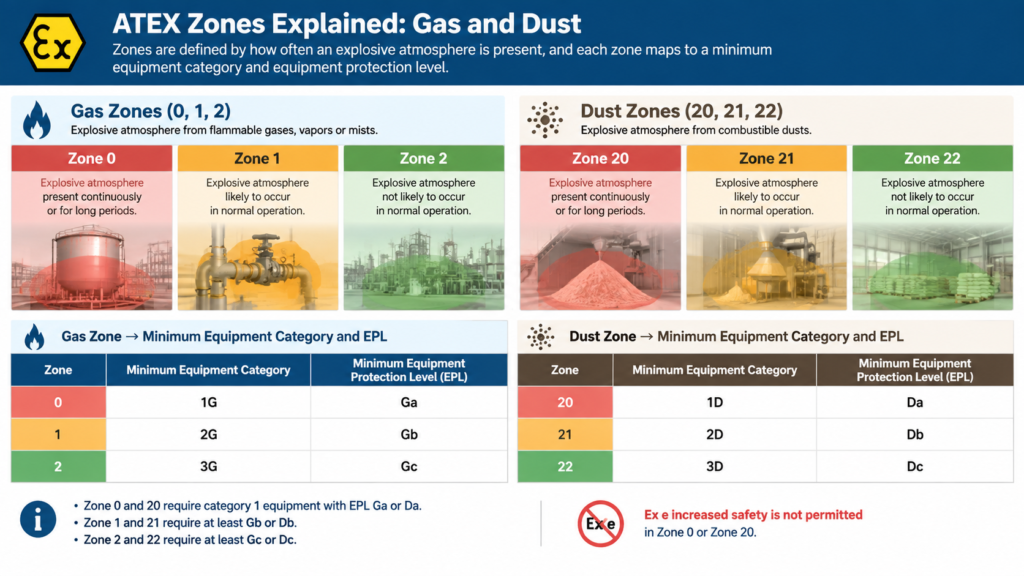
Two details in that table matter more than the rest.
Ex e cannot be used in Zone 0 or Zone 20. Increased safety is a Gb / Gc concept. It relies on the absence of arcs, sparks and hot surfaces during normal operation plus defined abnormal conditions, and that reasoning only holds where an explosive atmosphere is not permanently present. Zone 0 and Zone 20 require category 1 equipment — intrinsically safe (Ex ia), encapsulated (Ex ma), or two independent means of protection. No cable gland marketed as “Ex e” belongs in Zone 0, whatever the sales sheet says.
Dust is its own equipment group under the current directive. Under the repealed 94/9/EC, dust equipment sat inside Group II as categories 1D, 2D and 3D. Under 2014/34/EU, equipment for explosive dust atmospheres forms Group III with the same category numbers. Suppliers that still describe a dust-rated gland as “Group II 2D” are quoting the old framework. It is a small wording difference with a real consequence: it tells you whether the technical file has been updated since 2016.
Every certified gland carries a marking string, and each element narrows the applications it is allowed in. Taking a realistic example — Ex db IIC T6 Gb — here is what each field means.
| Field | Meaning | What to check |
|---|---|---|
| Ex | Mark of explosion-protected equipment | Present on the gland body itself, not only on the packaging |
| db | Protection concept plus level: flameproof enclosure, EPL Gb (IEC 60079-1) | The level letter must be at least as high as the zone requires |
| IIC | Gas group: hydrogen and acetylene, the most demanding group; covers IIA and IIB as well | A gland marked IIB may not be used where IIC is specified |
| T6 | Temperature class: maximum surface temperature 85 °C, the most restrictive class | Must sit below the auto-ignition temperature of the gas present |
| Gb | Equipment Protection Level — suitable for Zone 1 and Zone 2 | This is the field that ties the product to your zone drawing |
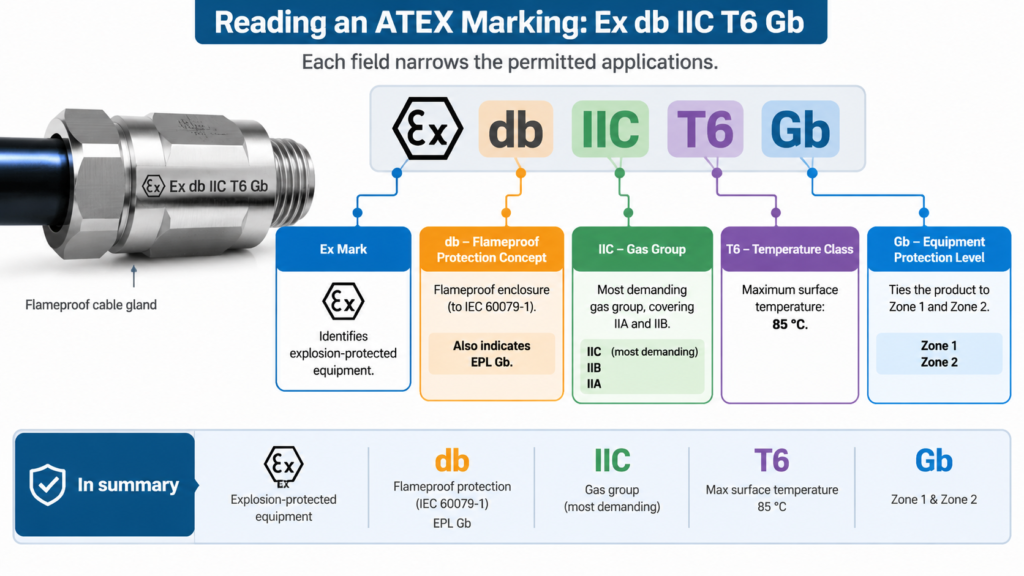
Older documentation frequently writes the concept without a level letter — Ex d instead of Ex db, Ex e instead of Ex eb. Both forms appear in the market and both are widely understood, but current certificates issued against the 60079-0 marking rules use the two-letter form, where the second letter states the EPL the concept achieves: db and eb for Gb, ec and tc for Gc. When you compare quotations, check which form appears on the certificate rather than on the brochure.
One exemption is worth knowing because it confuses people doing incoming inspection: cable glands, blanking elements and thread adaptors do not have to be marked with a temperature class or maximum surface temperature. Their temperature behaviour is determined by the cable and the enclosure they serve, so a gland marked without a “T” field is not missing anything. The gland’s own certificate will still state a permissible ambient range.
Now to the comparison that drives most gland selection decisions. The two concepts start from opposite philosophies.
Ex d (flameproof enclosure, IEC 60079-1) assumes an ignition may happen inside. The enclosure is strong enough to withstand the pressure of an internal explosion without rupturing, and every opening — including the cable entry thread — forms a precision flamepath. Hot gases from an internal ignition are forced along a long, narrow gap, lose their energy on the way, and emerge too cool to ignite the surrounding atmosphere. The integrity of the flamepath is a manufacturing tolerance, not an assembly habit.
Ex e (increased safety, IEC 60079-7) assumes the ignition source can be designed out. The equipment is built so that no arcs, sparks or hot surfaces occur in normal operation and under defined abnormal conditions: larger creepage and clearance distances, reinforced insulation, conservative current density, and tightly controlled maximum temperatures. The enclosure does not need to contain anything, so it can be lighter.
| Feature | Ex d — flameproof | Ex e — increased safety |
|---|---|---|
| Protection principle | Contains an internal explosion and cools the escaping gases | Prevents arcs, sparks and hot surfaces from occurring |
| Governing standard | IEC / EN 60079-1 | IEC / EN 60079-7 |
| Current marking | Ex db (Gb), Ex dc (Gc) | Ex eb (Gb), Ex ec (Gc, Zone 2 only) |
| Zones | Zone 1 and 2 (Gb, Gc) | Zone 1 and 2 (Gb); Ex ec restricted to Zone 2 |
| Enclosure weight | Heavy; cast or machined, pressure-rated | Lighter; sheet metal or reinforced plastic |
| Maintenance access | Normally requires de-energisation before opening in the hazardous area | Often accessible under permit while energised |
| Relative cost | Higher — pressure testing, precision flamepaths, certification depth | Lower — simpler construction and assessment |
| Typical equipment | Motors, switchgear, control panels, lighting | Terminal boxes, junction boxes, heating elements |
Ex de combines the two and is extremely common on large machines: the main body is flameproof Ex d while the terminal box is increased safety Ex e. That arrangement lets the installer terminate cables in a lighter, easier-to-open compartment instead of bolting down a pressure-rated cover. It also changes which gland is correct — and that is the point where a lot of projects get the entry wrong.
The gland is not a passive accessory. In a flameproof installation the entry thread is part of the flamepath, and the gland’s inner seal must perform a flameproof and gas-tight function at the same time. This is why a general-purpose gland cannot simply be substituted, and why the standard sets explicit requirements for the components around it.
| Requirement | Ex d entry | Ex e entry |
|---|---|---|
| Thread engagement | At least 5 full threads or 8 mm, whichever is greater, at every entry | Mechanically secure, correctly matched thread form |
| Flamepath | Required at the entry thread; thread form, pitch and tolerance class must match the enclosure entry | Not applicable |
| Inner seal function | Flameproof and gas tight | Secures the cable against pull-out and keeps the enclosure’s Ex e properties intact |
| Pressure capability | Flameproof glands are designed and tested to hold high static pressure, commonly quoted at 30 bar | No pressure containment requirement |
| Compound filling | Mandatory for barrier glands; not required for a standard Ex d gland | Not used |
| Unused entries | Must be closed with a certified metal blanking element engaged by at least 5 full threads; plastic stoppers are not acceptable | Closed with a suitable certified plug |
| Thread adaptors | Maximum one adaptor per entry, and a blanking element must never be fitted on top of an adaptor | Adaptor must not compromise the enclosure’s protection |
| Ingress protection | The gland, correctly installed, must guarantee the same IP rating as the enclosure: minimum IP54 for Group I and Group II, and minimum IP6X for dust (Group III / EPL Da, Db, Dc) | |
Two consequences follow from that table and both are frequently missed.
First, the entry thread has to match the enclosure, not just the cable. An Ex d flamepath exists between the male and female thread, so the type of thread, the pitch and the tolerance class all matter. Drilling or tapping additional entries on a flameproof enclosure is only permitted by the enclosure manufacturer or their approved agent, and the entry must be perpendicular to the face — a gland sitting at an angle shortens the flamepath on one side. Thread conversion is not a workshop decision. If your enclosure is tapped NPT and your gland is metric, the correct solution is a component-certified metal adaptor, and only one per entry.
Second, IP protection is an installation outcome, not a product badge. The gland has to deliver at least the enclosure’s own IP rating, and for dust areas at least IP6X. Sealing rings for glands that accept a range of cable sizes are marked with the minimum and maximum cable diameters they are approved for; fitting a cable outside that range voids the protection regardless of how tight the nut feels. Where the gland or sealing ring is intended to operate outside roughly −20 °C to +75 °C, the permissible temperature range is marked on the ring itself. Our own Ex d range illustrates how specific these ratings get in practice: the JX-6 series carries the Ex d IIC Gb marking with IP66 and a 10 bar rating, in nickel-plated brass, SS304 or SS316L, with silicone or neoprene sealing and a static ambient range of −60 °C to +100 °C.
Which gland is correct depends on how the cable reaches the protected compartment.
The harder question is whether a standard Ex d gland is sufficient at all, or whether a barrier gland — a flameproof gland with a compound chamber that seals around the individual conductors — is required. A barrier gland stops an internal explosion from travelling down the inside of the cable and out at the far end. Installation standard IEC 60079-14 permits a normal Ex d gland only when all of the following are true:
If any one of those four conditions fails, a barrier gland is required. In practice this is the single most common source of late-stage rework on hazardous-area projects, because cable manufacturers rarely certify their products against all four points in writing. When a cable cannot be confirmed as compliant, the conservative and defensible answer is a barrier gland. Note also that compound filling must be complete: a partially filled chamber does not satisfy the certification.
These three frameworks are often quoted interchangeably in tender documents. They are not interchangeable.
| ATEX | IECEx | North America | |
|---|---|---|---|
| Basis | EU legislation (2014/34/EU, 1999/92/EC) | International certification scheme built on the IEC 60079 series | NEC / CEC with Class and Division, or the Zone system |
| Legal status | Mandatory for the EU / EEA market | Voluntary; widely accepted in the Middle East, Asia, Australia and Africa | Required by local code; listing by an NRTL such as UL or CSA |
| Issued by | Notified Body, listed with a four-digit number | IECEx certification body, with an ExTR test report and a certificate of conformity | NRTL listing marks |
| Marking | CE plus the hexagonal Ex mark | Ex mark with the IECEx certificate reference | Listing mark with class, division or zone details |
| Zone equivalent | Zone 0 / 1 / 2 | Zone 0 / 1 / 2 | Class I Division 1 broadly corresponds to Zone 0 and 1; Division 2 to Zone 2 |
The critical sentence for procurement: IECEx does not satisfy ATEX. An IECEx certificate of conformity is strong technical evidence and often shortens the ATEX assessment, because the underlying test reports follow the same IEC standards — but it is not a legal substitute for the CE and Ex marking on equipment placed on the EU market. Conversely, ATEX certification alone will not satisfy a US installation without NRTL listing. On global projects the practical answer is a supplier who holds both, plus the North American listing for the relevant product family.
For the mechanical side of the installation — engagement depth, tightening values and the order of assembly — the principles are shared with standard glands and are covered in our guide to cable gland torque specifications and sealing points. Thread form differences between metric, PG and NPT entries are set out in the thread standard conversion guide, and the wider product-standard framework is explained in our breakdown of IEC 62444 / EN 50262.
A certificate PDF proves nothing on its own. Work through this checklist and you will separate a maintained technical file from a decorative attachment.
| Check | What good looks like |
|---|---|
| Certificate type | An EU-Type Examination Certificate citing 2014/34/EU. Old EC-Type certificates remain valid but should not be the only document supplied for new orders. |
| Certificate number and body | A traceable number from a Notified Body whose four-digit identifier appears after the CE mark and can be verified in the EU NANDO database. |
| Product description inside the certificate | Names the actual gland series and thread sizes you are buying — not a generic category description. |
| EPL, gas group and ambient range | At least equal to your zone, gas group and site temperature range. |
| Conditions of use (“X” suffix) | Read them. Restrictions on cable type, sealing ring selection or installation practice are binding, not advisory. |
| Production quality notification | For category 1 and 2 equipment, a notified quality assurance notification covering the factory that makes the glands. |
| Marking on the hardware | The Ex marking, certificate reference and thread size legible on the gland body, so it survives site inspection. |
| IP evidence | Ingress protection verified to IEC 60529 using the sealing rings supplied, at the cable diameters actually ordered. Our own approach to this evidence is described in the IP68 test report guide. |
| EU Declaration of Conformity | Issued by the manufacturer, citing the directive and the harmonised standards applied. |
If a supplier can produce the certificate but not the declaration of conformity, or shows a certificate whose product description does not match the part number quoted, treat the quotation as unverified. An overview of how we structure this documentation is available on our explosion-proof cable gland page.
| Mistake | Why it matters | Correct approach |
|---|---|---|
| Fitting a standard industrial gland in a classified area | No flamepath, no certification, no defence in an incident investigation | Use a certified gland with an EPL at least equal to the zone |
| Using an Ex e gland on a direct Ex d entry | The flameproof integrity of the enclosure is lost at the entry | Ex d, or dual-certified Ex d / Ex e, for direct entry |
| Assuming Ex e is acceptable in Zone 0 or 20 | Increased safety is a Gb / Gc concept and does not cover permanent atmospheres | Category 1 equipment with EPL Ga or Da |
| Fewer than 5 full threads engaged | Shortens or breaks the flamepath; the assembly may not pass a non-transmission test | Verify thread engagement of at least 5 full threads or 8 mm at every entry |
| Plastic blanking plugs in unused entries | Not an acceptable flameproof closure and easy to overlook | Certified metal stoppers, engaged by at least 5 full threads |
| Stacking a blanking element on a thread adaptor | Explicitly not permitted, and it defeats the flamepath at that entry | One adaptor maximum per entry, no blanking element on top |
| Skipping the barrier gland assessment | An internal explosion can travel inside the cable and ignite at the remote end | Apply the four cable conditions; if unproven, specify a barrier gland |
| Treating IP as a separate purchase decision | A gland below the enclosure’s IP rating compromises the whole assembly | Match the enclosure IP; IP54 minimum for gas, IP6X minimum for dust |
| Buying on the certificate alone | Certificates can be outdated, generic or for a different series | Verify the certificate, the declaration and the marking on the hardware |
ATEX zones explained comes down to six categories and one selection rule. Zone 0 and Zone 20 need category 1 equipment with EPL Ga or Da. Zone 1 and Zone 21 need at least Gb or Db, where both Ex d and Ex e are acceptable. Zone 2 and Zone 22 need at least Gc or Dc, where the lighter Ex ec concept also becomes available. The gland must always be specified at least as high as the equipment it serves, and for a direct entry into a flameproof enclosure that means an Ex d or dual-certified Ex d / Ex e gland with verified thread engagement, a certified metal closure on every unused entry, and a barrier gland wherever the cable cannot be shown to meet the four conditions in IEC 60079-14.
Get the zone, the EPL and the entry type right, and the rest of the specification — material, thread, IP, sealing range — is straightforward engineering. If you are working from a zone drawing and need to confirm which concept and thread your project requires, our team can review the entry details and match them to a certified gland series. Send us the zone, enclosure type and cable specification and we will come back with the matching configuration.
Ex d is a flameproof enclosure: it withstands an internal explosion and cools the escaping gases through precision flamepaths, so the surrounding atmosphere is not ignited. Ex e is increased safety: it prevents arcs, sparks and hot surfaces from occurring in the first place through larger clearances, reinforced insulation and controlled temperatures. Ex d contains an explosion; Ex e prevents one. Both are accepted in Zone 1 and Zone 2 for gas.
Yes. A flameproof gland is a higher-specification component and may be used on an Ex e enclosure, although it is usually unnecessary. The reverse is not acceptable: an Ex e gland must never be fitted to a direct entry of an Ex d enclosure, because the flamepath at the entry would be lost. Dual-certified Ex d / Ex e glands exist precisely so one part number covers both cases on the same project.
No. Increased safety achieves EPL Gb or Gc, which corresponds to Zone 1 and Zone 2. Zone 0 requires category 1 equipment with EPL Ga — intrinsically safe, encapsulated or another concept rated for continuous exposure to an explosive atmosphere.
No. Compound filling belongs to barrier glands, which are flameproof glands with a sealing chamber around the individual conductors. A standard Ex e gland has no compound chamber, and an Ex d gland does not require compound either unless the cable cannot satisfy the conditions for a normal gland.
IEC 60079-14 permits a normal Ex d gland only when the cable is at least 3 metres long, is circular and compact, is sheathed in extruded thermoplastic, thermosetting or elastomeric material, and contains only non-hygroscopic fillers. If any of those conditions cannot be demonstrated, a barrier gland is required to prevent an internal explosion from travelling along the inside of the cable.
No. IECEx is an international certification scheme built on the same IEC 60079 standards and is widely accepted in many regions, but it is not EU legislation. Equipment placed on the EU or EEA market must comply with ATEX Directive 2014/34/EU and carry the CE and Ex markings. Many manufacturers hold both, and the shared test evidence usually reduces the cost of the second certification.
What a screw cap (end cap or blanking plug) does: sealing unused enclosure entries, maintaining IP ratings, plus material and size selection.
Read More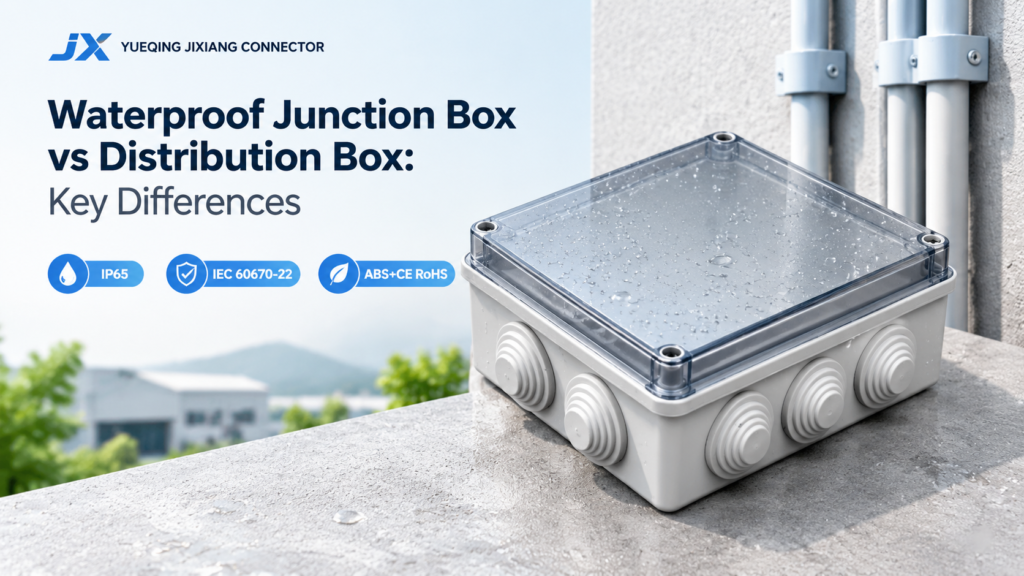
A waterproof junction box joins wires, a distribution box protects circuits. Compare function, standards, IP ratings, sizing and cost before you specify the right enclosure.
Read More
Introduction Outdoor electrical enclosures are constantly exposed to rain, dust, temperature changes, and UV radiation. Choosing the right cable entry solution is essential.The IP68 nylon cable gland is one of the most reliable options for outdoor enclosures. Why IP68 Matters for Outdoor Use Outdoor environments require long-term sealing performance. IP68-rated nylon cable glands provide: Common […]
Read More