Blog
Which is better? 304 vs 316 stainless steel cable glands
Compare 304 vs 316 stainless steel cable glands by chemistry, corrosion resistance and cost, and learn when to specify each grade for marine or industrial duty.
Read More

A cable gland factory tour is the fastest way to find out whether the supplier quoting you is a real manufacturer or a trading company with a catalogue. It is also the fastest way to waste a week, because most tours are staged: the same tidy assembly line, the same wall of certificates, the same coffee. What separates a useful visit from a sales pitch is knowing which production stages a cable gland factory must physically own, what each stage should look like when it is running properly, and which numbers you can verify with arithmetic instead of trust. This guide walks through the seven-stage production chain behind a finished gland, explains what injection molding cable glands actually requires, shows how to sanity-check a claimed monthly output, and gives you a twelve-point checklist to run on your next tour — in person or over live video.
A well-run tour answers four questions that a quotation never can. First, which production steps happen inside the building and which are outsourced. Second, whether the tooling that shapes your part is owned and maintained on site. Third, whether inspection is a process or a final glance. Fourth, whether the capacity the sales team promised matches the machines standing on the floor.
Everything else — the reception area, the showroom, the framed certificates — is presentation. Useful, but secondary. If you only have ninety minutes on site, spend them in the tool room, the injection molding bay, the plating line and the quality lab. Those four rooms tell you more about your future orders than any brochure.
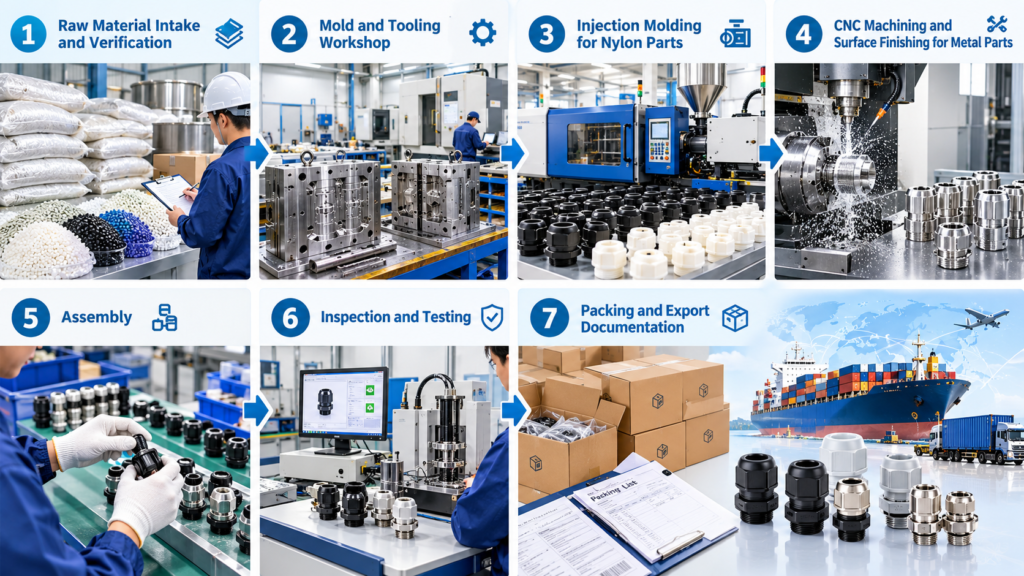
A cable gland looks like a simple object: a body, a sealing nut, a claw or seal insert, an O-ring and a locknut. Producing it consistently at volume requires seven distinct stages, and a genuine manufacturer controls most of them in-house.
The tour starts in the raw material warehouse, not the production floor. For nylon glands you should see sealed resin bags with visible grade markings, batch numbers and a moisture barrier, stored off the floor. For metal glands you should see brass rod or bar stock and stainless steel stock, often segregated by grade — SS304 and SS316L are not interchangeable and should never share an unlabelled bin.
The question to ask is simple: what happens when a batch of incoming resin or bar stock fails the incoming check? A factory with a working system can describe the disposition path — quarantine, return to supplier, or documented acceptance with deviation. A factory without one will describe the problem in generalities.
This is the single most diagnostic room in a cable gland factory. If the factory builds and repairs its own injection molds, you will see a tool room with manual and CNC milling, EDM or wire EDM capability, surface grinding, a mold storage rack with numbered molds, and technicians who can tell you the maintenance interval for each one.
If there is no tool room, every new size, thread variant or seal geometry becomes an outsourced project with unpredictable timing and no guarantee of confidentiality. For an OEM buyer ordering custom thread lengths or a proprietary claw design, that is a material risk, not a detail.
Injection molding produces the nylon body, the sealing nut and the claw. What you should see: machines running with a dehumidifying dryer next to each hopper, a mould temperature controller on the machine, a cycle counter, and a setup sheet clipped to the machine or displayed on a terminal. You should be able to watch the same part drop from the mold, cycle after cycle, at a rhythm you can time with a stopwatch.
What you should not see: dryers that are switched off while nylon is being moulded, hoppers with open lids, or a machine running without a visible setup sheet. Those three details predict dimensional drift and short shots long before they show up in your incoming inspection.
Metal glands follow a different route. Brass and stainless steel bodies are turned on CNC lathes, threads are cut to the specified standard, and the finished part goes through deburring, polishing and — for brass — usually nickel or chrome plating. The plating line matters more than buyers expect, because plating thickness and adhesion determine how the gland survives salt spray and how it looks after two years on a rooftop.
Ask how plating thickness is controlled and how often the bath chemistry is analysed. Ask, too, whether the factory plates in-house or sends parts out. An outsourced plating step adds a transport leg and makes traceability harder.
Assembly is where a cable gland becomes a product rather than a collection of parts. Watch whether inserts, O-rings and locknuts are counted and kitted against an order sheet, or scooped by feel. Watch whether a finished gland is test-fitted with a cable and a spanner before it goes into the carton. Semi-automatic assembly stations with a torque-controlled closing step are a good sign; a table of operators working purely by eye is a warning that your thread engagement tolerance depends on who is on shift.
A functioning quality area has calibration records, a defined inspection plan, and instruments that are actually in use. For cable glands the relevant checks are thread gauging, dimensional measurement of the sealing bore, durometer or hardness checks on the seal, visual inspection for flash and plating defects, and periodic ingress protection verification.
Ask to see the calibration sticker dates on the thread gauges and calipers standing on the bench. Ask which characteristics are inspected on every batch and which are sampled. And ask for the test reports themselves — an IP68 report, for example, should state the lab, the standard, the sample configuration, the mounting condition and the immersion parameters. A badge on a certificate wall is not the same document.
The last stage is where a technically good product often gets damaged. Thread protectors or sleeves, inner poly bags, cartons rated for the part weight, and pallet configuration all matter because a brass gland that arrives with a dented thread is a rejected gland. Ask how many pieces per carton, what the carton crush rating is, and whether heavy metal glands are packed in smaller cartons or a wooden case.
| Stage | What you should see | Question to ask | Warning sign |
|---|---|---|---|
| 1. Material intake | Labelled resin bags, segregated brass and stainless stock, incoming inspection records | What happens to a failed incoming batch? | Unlabelled bins, mixed grades, no incoming records |
| 2. Tooling | In-house mold workshop, numbered mold storage, maintenance log | Who builds and repairs your molds? | No tool room, or molds stored loose and unlabelled |
| 3. Injection molding | Dryers running, mold temperature control, setup sheets, visible cycle counter | How is resin moisture controlled before molding? | Dryers off, open hoppers, no setup sheet |
| 4. Machining and finishing | CNC lathes, thread cutting, in-house plating with bath analysis | Is plating in-house, and how is thickness controlled? | Plating outsourced with no traceability |
| 5. Assembly | Kitted parts, torque-controlled closing, sample cable test-fit | How is thread engagement verified? | Parts scooped by eye, no test fit |
| 6. Inspection | Calibrated gauges, defined inspection plan, real test reports | Which characteristics are checked on 100% of parts? | Uncalibrated instruments, certificates without documents |
| 7. Packing | Thread protection, inner bags, rated cartons, pallet plan | How are heavy metal glands protected in transit? | Loose parts in a single oversized carton |
Buyers often assume that a moulded nylon gland is the simple, low-cost option and that metal glands are the technically demanding ones. The opposite is closer to the truth. Machining a brass body to a thread standard is a well-understood operation. Moulding a nylon gland that seals across a wide cable range, holds under pull-out load, and resists UV and chemical attack for years is a materials and tooling problem that shows up in the field, not in a datasheet.
Polyamide absorbs water from the air. If resin is moulded while it still holds moisture, the water flashes to steam inside the barrel, and the result is silver streaking, voids, weak weld lines and unpredictable shrinkage. This is why every serious nylon cable gland producer dries resin in a dehumidifying dryer before it reaches the machine, and why a switched-off dryer is such a serious warning sign.
The practical implication for buyers: moisture-related defects are often invisible on a sample and appear as a cracked sealing nut three months into service. When you evaluate samples, ask whether they came from a production run or a hand-picked pilot batch, and ask for the moulding parameters used.
The sealing nut, the claw insert and the rubber seal together determine how wide a cable range the gland accepts, how much pull-out force it resists, and whether it still seals after the cable is bent or vibrated. That geometry is created in the mould and then validated by testing — which is exactly why a factory that can iterate on mould design in-house has a real advantage over one that outsources tooling and waits weeks for every revision.
This is the capability to probe during a tour. Ask how many revisions a typical claw design went through before release, and ask to see a mould that has been modified rather than only new ones. A factory that has never modified a mould either never iterated or is hiding the tool room.
Mould cost and part cost are never independent. A single-cavity tool is cheap to build but produces one part per cycle, which pushes unit cost up. A multi-cavity tool costs more upfront but amortises across volume. For a cable gland order of a few thousand pieces, a simple tool is usually correct. For a programme running hundreds of thousands of pieces a year, the extra tooling spend is recovered quickly.
The practical rule: tell the supplier both your first order quantity and your realistic annual demand. A supplier that only asks for the first order quantity is optimising for its own quotation convenience, not for your total cost. A supplier that asks for annual demand, target unit price and application environment is doing the engineering work.
| Order profile | Typical tooling approach | Where the cost sits | Effect on unit price |
|---|---|---|---|
| Trial order, a few thousand pieces | Single or low-cavity tool, existing mould base | Mostly tooling; part cost secondary | Higher unit price, lower total risk |
| Repeat annual orders, tens of thousands | Multi-cavity tool, optimised cooling | Balanced tooling and part cost | Moderate unit price, better consistency |
| OEM programme, hundreds of thousands | High-cavity tool, hardened steel, automated handling | Front-loaded tooling, low cycle cost | Lowest unit price at volume |
| Custom thread or proprietary seal | New tool plus design iterations | Engineering time and trial runs | Unit price depends on iteration count |
Moulds wear. Ejector pins bend, gates erode, cooling channels scale, and parting lines gradually flash. A factory that tracks shot counts and pulls moulds for scheduled maintenance produces consistent parts over years. A factory that runs moulds until a defect appears produces good first batches and inconsistent third batches — which is why so many sourcing problems only surface on the second or third order.
Ask for the shot count on the mould that will run your part, and ask what the maintenance interval is. If nobody can answer, the answer is that maintenance is reactive.
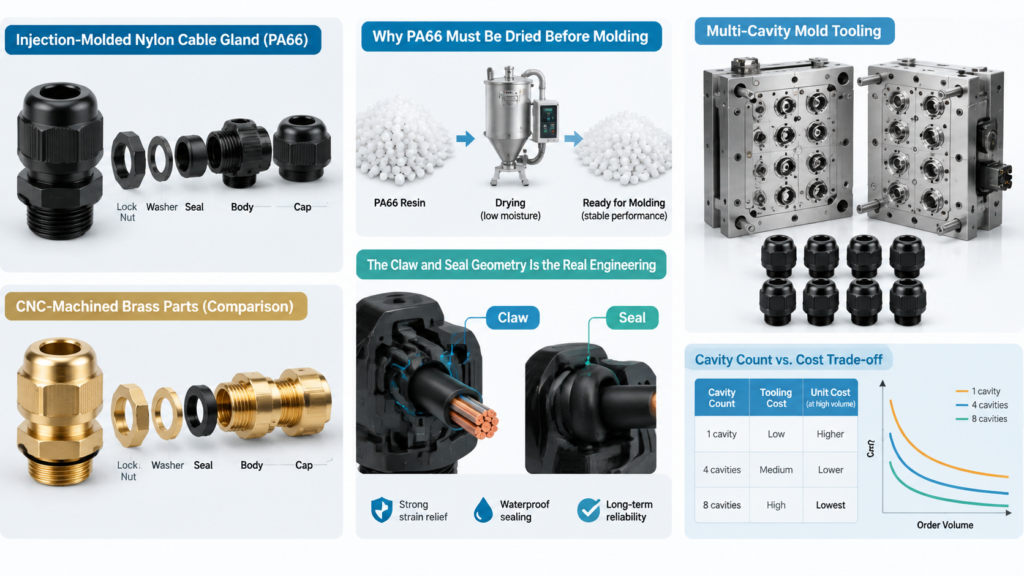
Metal glands are not moulded; they are machined. A typical brass standard cable gland starts as bar stock, is turned and threaded on a CNC lathe, then deburred, polished and plated. Because each part is cut individually, metal production scales with machine time rather than with cavity count, and the constraints are different: tool wear on the threading inserts, chip evacuation, plating uniformity on internal threads, and the surface finish inside the sealing bore.
The buyer-facing consequences are worth knowing. Metal glands usually hold tighter dimensional tolerances and handle higher temperatures and mechanical loads, but they cost more per piece at volume and are more sensitive to plating quality. Nylon glands are lighter, insulating, corrosion-proof by nature and cheaper at volume, but their performance depends on resin grade, drying discipline and mould quality.
A factory that runs both routes in-house — moulding for PA66 nylon glands and CNC machining for metal bodies — can advise on the trade-off without steering you toward whichever line is idle. That is a practical reason to prefer a vertically integrated supplier, and it is worth confirming during the tour by asking which stages are subcontracted.
Capacity claims are the easiest thing to inflate and the easiest to test. You do not need access to the accounting system; you need a calculator and one number from the production floor.
Take the claimed monthly output and divide it by the hours in a month to get the required hourly rate. Then divide that by what a single machine can realistically produce, and you get the minimum number of machines the claim requires.
Work through an example. A factory claims ten million pieces per month. Assume thirty days of continuous operation, or about 720 machine hours per month. That means roughly 13,900 pieces per hour across the whole plant. Now take one injection molding machine running a twenty-second cycle — 180 shots per hour — with a four-cavity mould. That machine produces about 720 pieces per hour. Dividing 13,900 by 720 gives roughly twenty machines running around the clock.
So the claim is entirely plausible for a plant with about twenty moulding machines on continuous shifts. It is not plausible for a workshop with four machines, regardless of how many cavities those moulds have. The arithmetic does not tell you whether the factory is honest — it tells you which follow-up question to ask: how many machines, how many cavities, what cycle time, and how many shifts per day. If the answer to all four is vague, the capacity claim is marketing.
Floor space and headcount should be internally consistent with the machine count. A plant with a large moulding bay, a plating line, an assembly area, a tool room, a quality lab, raw material storage and a finished goods warehouse needs space for all of them. If a supplier claims a very large machine fleet in a small building, one of the two numbers is wrong.
Headcount is the same test in a different form. Injection molding runs with relatively few operators per machine, but assembly, inspection and packing are labour-intensive for small parts. A factory that claims millions of pieces per month and a handful of staff is describing a warehouse, not a production line.
Capacity arithmetic verifies plausibility, not quality. A plant can have plenty of machines and still deliver inconsistent parts if its process control is weak. Treat the numbers as a filter that removes impossible claims, then rely on the process evidence from Stages 1 to 6 to judge everything else.
| Claim | How to test it | What a mismatch suggests |
|---|---|---|
| “Ten million pieces per month” | Divide by 720 hours, then by per-machine hourly output | Required machine count exceeds the floor — or capacity is aggregated across subcontractors |
| “Fifty moulding machines” | Count them and note how many are running | Idle machines may be awaiting maintenance or the plant may be underutilised |
| “5,000 square metres” | Compare against the number of process areas claimed | Too small for the claimed operations, or the area includes a separate site |
| “Moulds built in-house” | Ask to see the tool room and a mould being repaired | Tooling is actually subcontracted; revision lead times will be long |
| “ISO 9001 certified” | Check the certificate scope, issuing body and validity dates | Scope may cover trading only, or the certificate may be expired |
| “IP68 rated” | Request the test report, not the badge | No report, or a report for a different product family |
Honest sourcing starts with an accurate picture of strengths and limitations. Chinese cable gland manufacturing is genuinely strong in specific areas and genuinely weaker in others, and the limitations are usually process and documentation issues rather than product capability.
Mould iteration speed is the standout. The Yueqing and Wenzhou industrial cluster concentrates mould makers, resin suppliers, plating shops and hardware suppliers within a short radius, so a design change that would take a European tool shop weeks to quote can be trialled quickly. Cost efficiency at volume follows from the same density, as does the breadth of thread options: metric, PG, G and NPT variants in the same product family are routine rather than special-order.
Assembly labour cost also remains an advantage for small parts that are difficult to automate, which is why hand-assembled multi-part glands remain economical to source from the region.
Documentation discipline is the most common gap. Factories frequently hold the right certificates but struggle to produce a controlled datasheet, a revision-controlled drawing, a certificate of conformity per shipment, or a coherent test report package. Related to this, batch traceability from resin lot to finished carton is often weaker than the quality system on the wall implies.
Communication bandwidth is the second recurring issue. A supplier may have excellent process knowledge and no engineer who can discuss a tolerance stack in English, which turns a technical question into a multi-day round trip. The third is over-claiming: quoting a specification the process cannot hold, or listing a certification that belongs to a different product family. None of these are unique to Chinese suppliers, but they are the failure modes that appear most often in this category.
| Area | Typical strength | Typical limitation | How to manage it |
|---|---|---|---|
| Tooling and mould iteration | Fast revisions, dense supplier cluster, low tooling cost | Mould maintenance records may be informal | Request shot counts and a maintenance interval in the purchase order |
| Cost at volume | Competitive unit pricing from a few thousand pieces upward | Cheapest quote may imply reduced brass wall thickness or regrind resin | Specify material grade and wall thickness on the drawing |
| Thread and size range | Metric, PG, G and NPT variants routinely available | Thread standard may be quoted loosely | Name the standard and gauge class in the specification |
| Documentation | Certificates generally available on request | Revision-controlled drawings and per-shipment certificates of conformity are inconsistent | Make documents a contractual deliverable, not a favour |
| Technical communication | Deep process knowledge on the floor | Limited English engineering bandwidth | Use drawings and photographs; confirm every change in writing |
| Traceability | Incoming material checks exist | Lot-to-carton linkage often incomplete | Require lot marking on inner packaging |
Use this list on site or over video. Each item asks for evidence rather than an answer, because evidence is what you can compare against the next batch.
| # | What to check | Evidence to capture | Pass criteria |
|---|---|---|---|
| 1 | Business licence scope | Photograph or scan | Manufacturing appears in the business scope |
| 2 | Raw material storage | Photo of resin bags and metal stock with labels | Grades labelled, segregated, stored off the floor |
| 3 | Incoming inspection records | Copy of a recent incoming inspection sheet | Signed, dated, with a defined rejection path |
| 4 | Tool room | Photo of a mould under repair | In-house mould building and maintenance |
| 5 | Mould storage and identification | Photo of the mould rack | Numbered moulds with a maintenance log |
| 6 | Dryer status on running machines | Video of the machine and dryer together | Dryer running whenever nylon is moulded |
| 7 | Setup sheet at the machine | Photo of the setup sheet | Cycle time, temperatures and part number visible |
| 8 | Plating line and bath control | Photo plus the analysis interval | In-house plating with documented bath checks |
| 9 | Calibration status of gauges | Photo of calibration labels | All in date |
| 10 | Ingress protection test report | PDF of the report for your product family | States lab, standard, sample and test conditions |
| 11 | Packing line | Photo of an export carton being closed | Thread protection, inner bags, rated cartons |
| 12 | Finished goods warehouse | Photo of labelled stock | Lot marking and clear order separation |
If travel is not practical, a structured live video walkthrough filters out most unsuitable suppliers before you commit to a flight. The key word is live. A recorded plant video proves nothing except that the factory owns a camera.
Ask for a scheduled call with a walking, handheld camera and no editing. Request the sequence in advance: raw material warehouse, tool room, moulding bay with a machine running, plating line, assembly area, quality lab, packing line, finished goods warehouse. Ask the operator to open a resin bag and show the grade label. Ask to see a thread gauge used on a finished part. Ask to see the mould rack and one mould being maintained. Ask for a live cycle count at a machine so you can time the cycle yourself.
Finally, ask for production records for parts similar to yours — setup sheets, in-process inspection records, and any statistical process control data the factory keeps. A supplier who can produce these during a live call is operating a real quality system. A supplier who promises to send them later, and then sends marketing images, is telling you something important.
The distinction matters because it determines who controls your lead time, your tooling and your corrective actions.
First, the business licence. In China the licence carries a business scope, and a genuine manufacturer’s scope includes manufacturing. A supplier whose scope covers only trading and import-export is an intermediary. Second, the address. An industrial zone address with a loading bay is a factory; a residential address or a virtual office is not. Third, the technical conversation. A manufacturer asks about your annual quantity, your cable diameter range, your application environment and your critical dimensions before quoting. An intermediary asks what you want to buy and what price you want to pay.
If the answers point to an intermediary, that is not automatically disqualifying — some trading companies add real value in logistics, quality coordination and multi-product consolidation. But you should know which one you are dealing with, because the price and the accountability are different. The same verification logic applies to a supplier’s own claims about its history and plant, which is why checking how a manufacturer’s profile is documented across platforms is worth the twenty minutes.
A factory can only quote accurately against a defined requirement. Sending these seven items up front shortens the cycle and makes quotations comparable between suppliers.
If the requirement includes a custom thread length, a multi-hole layout, a specific seal compound or OEM labelling, say so at the quotation stage. Customisation added after tooling is approved is the most common cause of schedule slippage in this category.
A cable gland factory tour is not a courtesy visit; it is an audit with a specific output — a shortlist you can defend. Judge the supplier on what it physically controls: its tool room, its moulding discipline, its plating line, its inspection records and its packing. Verify capacity with arithmetic rather than adjectives. Confirm documents as contractual deliverables. Then start with a trial order that tests the whole chain, including how the supplier handles a problem, because the second order tells you more about a factory than the first.
If you would like to see the production chain described here in practice, you can review the factory profile, examine the quality control process stage by stage, or arrange a live video walkthrough and request samples. For buyers who prefer to start with documentation, the manufacturer’s company and capability profile and its published ingress protection test reporting practice are both useful reference points before the first call.
Ask for the tool room, the moulding bay with a machine running, the plating line, the quality lab and the packing line. At each station ask for evidence rather than an answer: a setup sheet at the machine, a calibration label on a gauge, a mould maintenance log, and the ingress protection test report for your product family.
Factories that publish tooling timelines typically quote two to four weeks for a straightforward new mould, with longer schedules when the part design needs iterations. The larger variable is not the machining time but the number of design revisions, which is why a supplier with an in-house tool room usually reaches a production-ready mould faster than one that outsources.
Neither is automatically better. A factory controls tooling, process parameters and corrective actions directly, which usually means faster revisions and clearer accountability. A trading company can add value in logistics, multi-product consolidation and export paperwork. The important thing is to know which one you are dealing with, because price structure and problem resolution differ.
Divide the claimed monthly figure by the hours in a month, then divide by realistic per-machine output. A claim of ten million pieces per month requires roughly 13,900 pieces per hour, which is about twenty injection molding machines running four-cavity moulds on continuous shifts. If the plant has far fewer machines, ask how the capacity is actually achieved.
Many manufacturers offer free samples for standard products, with the buyer covering freight, and deliver them within about three to seven days. For custom or tooled parts, expect a sample charge. Always ask whether the samples come from a production run or a hand-picked pilot batch, because pilot samples hide process variability.
Not for a first screen. A structured live video walkthrough covering the raw material store, tool room, running moulding machine, plating line, quality lab and packing line eliminates most unsuitable suppliers. An on-site visit is worth the trip once you are committing to tooling or a large annual volume.

Compare 304 vs 316 stainless steel cable glands by chemistry, corrosion resistance and cost, and learn when to specify each grade for marine or industrial duty.
Read More
IP69K cable glands explained: the high-pressure hot-water washdown rating, how it is tested, and how to choose cable entry for food, pharma and outdoor plants.
Read More
When to use a cable gland adaptor, reducer or enlarger: the difference between them, common thread combinations, and how to keep the IP rating when threads do not match.
Read More