Blog
What are Brass Conduit Fittings?
What brass conduit fittings are, why nickel-plated brass is used, the types, key specifications, applications, installation steps and how to choose the right fitting.
Read More
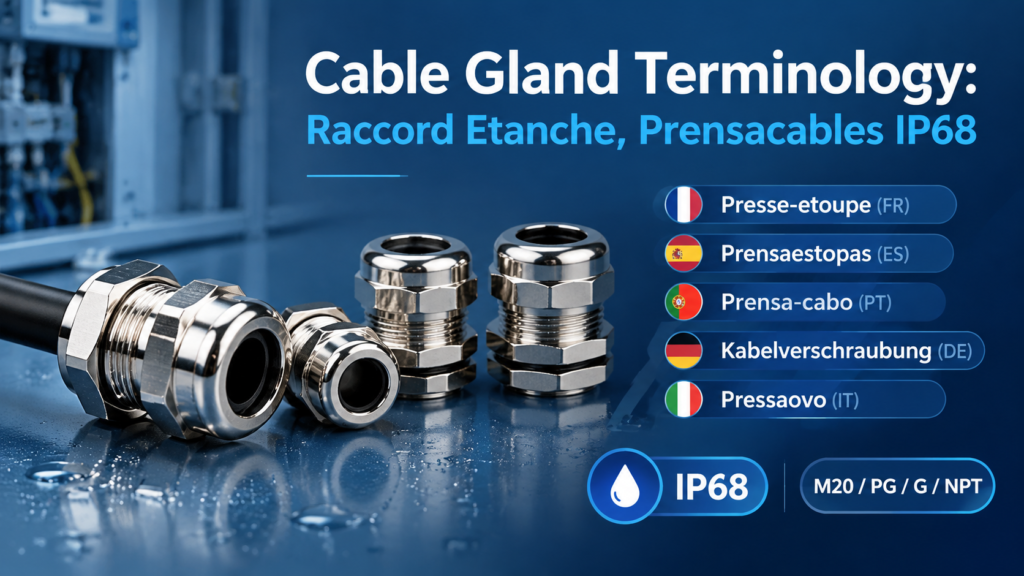
Your French distributor asks for a raccord étanche. Your Mexican integrator specifies a prensacables IP68. Your Brazilian panel shop writes prensa-cabo, and your German client insists on a Kabelverschraubung. All four want the same device — a waterproof cable gland — yet none of those words survives a straight translation into a purchase order.
That is the trap. Cable gland vocabulary is a trade language, not a standardised vocabulary. There is no international register of cable entry terms, so the part name is whatever the local electrical trade decided to call it. The thread size and the IP code, by contrast, are fixed international codes that mean exactly the same thing in Lyon, Monterrey, São Paulo and Yueqing. Translate one layer and you are being helpful. Translate all three and you will receive the wrong part.
This guide maps cable gland terminology across French, Spanish, Portuguese, German and Italian, separates the words that should be translated from the codes that must never be, and gives you a bilingual RFQ block you can paste into any email.
A cable gland is a mechanical cable entry device that anchors a cable, seals the entry point and, where required, bonds the armour or screen to the enclosure. That definition is stable. The name is not.
French uses presse-étoupe, literally “stuffing-box presser” — a term inherited from packed gland technology on pumps and valves. Spanish uses prensaestopas, “packing presser”, from the same engineering lineage. Portuguese uses prensa-cabo in Brazil and passa-cabos in Portugal. German uses Kabelverschraubung, “cable screw connection”. Italian uses pressacavo. English itself splits: the UK says cable gland, while the US says cord grip, cable strain relief, cable fitting or cable connector.
None of these is wrong. That is the problem. When a spec sheet is translated between them, the meaning drifts, and the drift lands on the factory as an ambiguous order.
The fix is to stop treating the whole specification as language-dependent. A cable gland specification has three layers, and only one of them changes language.
| Layer | Example | Translates? | What to write on the order |
|---|---|---|---|
| Part or product name | cable gland, presse-étoupe, prensaestopas, prensa-cabo | Yes | Write both the English term and the local term |
| Thread designation | M20 × 1.5, PG11, G 1/2″, NPT 1/2″ | No | Copy exactly, character for character |
| Ingress protection code | IP66, IP67, IP68, IP69K | No | Copy exactly, then add the test depth and duration |
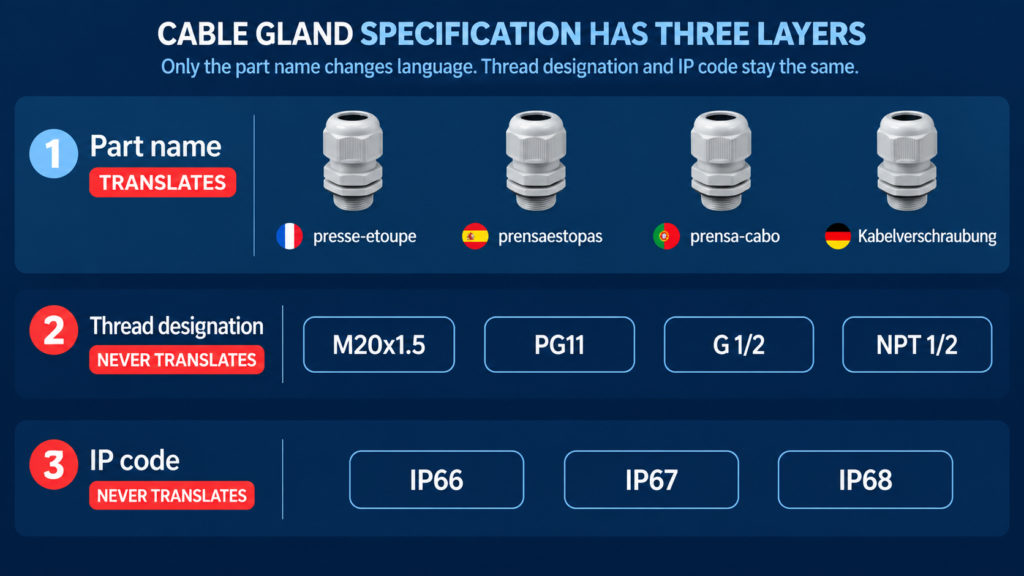
Once you separate those three layers, most multilingual confusion becomes mechanical rather than linguistic. You translate the label, you never translate the code, and you always state the numbers.
The table below covers the vocabulary that appears most often in a real specification, an RFQ or an installation drawing. Use it as a working glossary rather than a dictionary: the terms in the same row describe the same physical function, not necessarily an identical product.
| English | French | Spanish | Portuguese | German | Italian |
|---|---|---|---|---|---|
| cable gland | presse-étoupe | prensaestopas, prensacables | prensa-cabo (BR), passa-cabos (PT) | Kabelverschraubung | pressacavo |
| waterproof cable gland | presse-étoupe étanche | prensaestopas estanco | prensa-cabo estanque | wasserdichte Kabelverschraubung | pressacavo a tenuta stagna |
| strain relief | décharge de traction | alivio de tensión | alívio de tração | Zugentlastung | scarico di trazione |
| locknut | contre-écrou | contratuerca | contraporca | Gegenmutter | controdado |
| sealing washer | rondelle d’étanchéité | arandela de sellado | anilha de vedação | Dichtring | guarnizione |
| O-ring | joint torique | junta tórica | anel de vedação (BR), o-ring (PT) | O-Ring | O-ring |
| cable entry | entrée de câble | entrada de cable | entrada de cabo | Kabeleinführung | ingresso cavo |
| clamping range | plage de serrage | rango de apriete | faixa de aperto | Klemmbereich | campo di serraggio |
| thread | filetage | rosca | rosca | Gewinde | filettatura |
| torque | couple de serrage | par de apriete | binário de aperto | Anzugsdrehmoment | coppia di serraggio |
| junction box | boîte de jonction | caja de conexiones | caixa de junção (PT), caixa de passagem (BR) | Anschlussdose | scatola di derivazione |
| armoured cable | câble armé | cable armado | cabo armado | bewehrtes Kabel | cavo armato |
| screened or shielded cable | câble blindé | cable apantallado | cabo blindado | geschirmtes Kabel | cavo schermato |
| earthing or grounding | mise à la terre | puesta a tierra | ligação à terra (PT), aterramento (BR) | Erdung | messa a terra |
| hazardous area | atmosphère explosive | atmósfera explosiva | atmosfera explosiva | explosionsgefährdeter Bereich | atmosfera esplosiva |
Three regional variations are worth memorising because they cause repeated confusion. Brazilian and European Portuguese diverge on several core terms, so a Portuguese-language drawing from Lisbon may not match the vocabulary your São Paulo customer uses. Latin American Spanish is broadly consistent, but Mexico and Argentina both borrow English words more freely than Spain does. And US English uses cord grip or strain relief where the UK uses cable gland, which matters when a North American client sends a Bill of Materials written against a UL-based specification.
A practical habit: when you write the product line in an email, write the English term first and the local term in brackets. Waterproof cable gland (presse-étoupe étanche) costs you four extra words and removes an entire class of misunderstanding.
The most expensive terminology errors in this trade come from machine translation, not from human misunderstanding. Machine translation engines are trained on general text, and gland in general French, Spanish and Portuguese text is an anatomical word, not an electrical one. Translating “cable gland” word by word produces results that range from confusing to embarrassing.
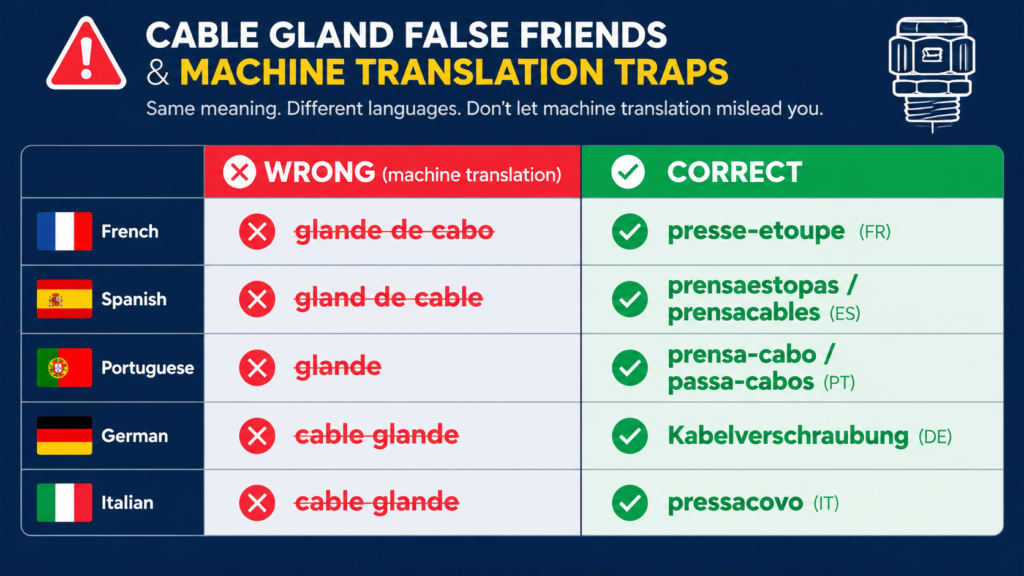
| What gets written | What it actually means | Write this instead |
|---|---|---|
| gland / glande (FR, ES, PT) | An anatomical term. A word-for-word rendering of “cable gland” | presse-étoupe, prensaestopas, prensa-cabo |
| glande de cabo (PT) | A machine-translation artefact with no technical meaning | prensa-cabo or passa-cabos |
| raccord étanche (FR) | Any watertight connection, including hose and conduit fittings | presse-étoupe étanche for a cable gland |
| pasamuros (ES) | A wall bushing or pass-through, which may contain no seal at all | prensaestopas |
| conector (ES, PT) | Could be a plug-and-socket connector, a terminal or a gland | conector de prensaestopas, conector estanco |
| Verschraubung (DE) | Any screwed fitting, including pipe and conduit joints | Kabelverschraubung |
| Kabeldurchführung (DE) | A cable pass-through, which may be an unsealed bushing | Kabelverschraubung when a seal is required |
| cable connector (US) | Usually a plug-and-socket or splice connector, not a gland | cord grip, cable strain relief or cable fitting |
Two of these deserve extra attention. Raccord étanche is a category term, not a part name: a French buyer asking for a raccord étanche may want a cable gland, a conduit fitting or a hose connector, and the only way to know is to ask for the thread size and the cable diameter. And pasamuros is genuinely dangerous, because an unsealed wall bushing will pass a visual inspection and then leak on the first wet day.
Thread designations are the anchor of the whole specification, and they are the part buyers most often damage by translating. M20 × 1.5 is M20 × 1.5 in every language. PG11 is PG11. G 1/2″ is G 1/2″. NPT 1/2″ is NPT 1/2″.
What does change is the name of the thread family. If your customer writes filetage gaz and you read it as “gas thread” and convert it to a metric size, you will ship a gland that does not enter the panel.
| Thread family | Designation on the drawing | Local names you will hear | Notes |
|---|---|---|---|
| Metric | M20 × 1.5 | filetage métrique (FR), rosca métrica (ES, PT), metrisches Gewinde (DE), filettatura metrica (IT) | Defined by ISO 965. The default choice for new designs |
| PG | PG11 | filetage PG (FR), rosca PG (ES, PT), PG-Gewinde (DE) | Panzergewinde. The original DIN 40430 standard is withdrawn; keep PG only to match legacy panels |
| G, parallel pipe | G 1/2″ | filetage gaz (FR), rosca gas (ES), rosca GAS or BSP (PT), Rohrgewinde (DE), filettatura gas (IT) | Parallel thread, seals on a washer or O-ring, not on the threads |
| NPT, taper pipe | NPT 1/2″ | filetage conique NPT (FR), rosca cónica NPT (ES), rosca cônica NPT (PT), kegeliges NPT-Gewinde (DE) | 1:16 taper, seals on the threads. Not interchangeable with G |
One more trap sits inside this layer: fractional inch threads. A NPT 1/2″ gland is not a 12.7 mm gland, and it is not an M12 gland. Never convert a fractional inch thread designation into millimetres. The conversion is arithmetically correct and commercially wrong, because the converted number describes a thread that does not exist. If your customer’s drawing mixes both systems, that is a genuine question worth asking before the order is placed. The metric, PG and NPT conversion reference covers the family relationships in more detail.
The IP code is the second layer that must never be translated. IP68 is IP68. What changes is the name of the rating system, and that is where purchase orders go wrong, because a buyer may reasonably assume that étanche, estanco or wasserdicht is the same claim as IP68. It is not.
| English | French | Spanish | Portuguese | German | Italian |
|---|---|---|---|---|---|
| ingress protection rating | indice de protection (IP) | grado de protección IP | grau de proteção IP | Schutzart (IP) | grado di protezione IP |
| dust-tight | étanche à la poussière | estanco al polvo | estanque ao pó | staubdicht | a tenuta di polvere |
| watertight | étanche à l’eau | estanco al agua | estanque à água | wasserdicht | a tenuta stagna |
| temporary immersion | immersion temporaire | inmersión temporal | imersão temporária | zeitweiliges Untertauchen | immersione temporanea |
| continuous immersion | immersion prolongée | inmersión continua | imersão contínua | dauerndes Untertauchen | immersione continua |
The adjectives in the middle rows are marketing language, not ratings. A gland described as étanche has made no measurable claim. Only the IP code does, and even the IP code needs one addition: IEC 60529 fixes the test conditions for IP67 at 1 metre for 30 minutes, but leaves the depth and duration for IP68 to the manufacturer. Two glands can both be IP68 while one is tested at 1.5 metres for 30 minutes and the other at 10 metres for 72 hours. The IP68 rating explained walks through what the code does and does not prove.
For that reason, the correct line on a multilingual purchase order is never just “IP68”. It is: IP68 to IEC 60529, tested at [depth] for [duration], on the fully assembled gland. Numbers survive translation. Adjectives do not.
North American projects add a second system. NEMA 250 enclosure types appear on US and Canadian specifications alongside IP codes, and the two are not interchangeable. IP66 is often presented as equivalent to NEMA 4 or 4X, but NEMA ratings also address corrosion resistance, icing and construction details that the IP scale ignores. If a specification calls for NEMA 4X and your gland only carries an IP test report, the inspector may reject it regardless of how the two are marketed.
There is one more numerical trap, and it lives in the cable outer diameter. Most of continental Europe, Latin America and Brazil write decimals with a comma. English-language drawings write them with a point. A clamping range written as 6,5 – 12 mm can be read as two separate figures by a reader expecting a point, and a range written as 6.5 – 12 mm can be read as a single malformed number by a reader expecting a comma.
Thousands separators create the mirror problem. A quantity of 1,000 pieces in English is 1.000 pieces in French, Spanish, Portuguese, German and Italian. Misread one way, an order of one thousand looks like an order of one.
The fix is mechanical. Write every dimension with an explicit unit and never rely on the separator alone:
If the cable diameter is the part of the specification you are least sure about, measure it rather than trusting the cable datasheet. A cable marked 10 mm² is not a 10 mm cable. The method for measuring cable outer diameter against a sealing range is worth checking before the order is confirmed, because the sealing range is the single most common reason a correctly rated gland still leaks.
Material names sit in an awkward middle layer. They translate, but they translate into words that carry slightly different technical weight, so the safest habit is to write the material both in words and in its standard designation.
Stainless steel is the clearest example. French says inox, Spanish says acero inoxidable, Portuguese says aço inoxidável, German says Edelstahl and Italian says acciaio inossidabile. But the grade designations you should actually order by are the material codes: 304 and 316, or their EN equivalents A2 and A3. A standard stainless steel cable gland built from 304 or 316 with a PA claw and an NBR seal reaches IP68 and holds its sealing force in coastal, marine and chemical environments, which is why the grade matters more than the adjective.
Brass behaves the same way. French laiton, Spanish latón, Portuguese latão, German Messing, Italian ottone — five words for one material. A nickel-plated brass cable gland is the usual default for general industrial panels, and the plating is worth specifying in words because nickelé, niquelado and vernickelt all describe the same finish.
Nylon is where the vocabulary diverges most. English says nylon, Spanish often says nailon, Spanish and Portuguese engineering drawings say poliamida, German says Polyamid, Italian says poliammide, and French says polyamide. All of them mean PA66 in practice. A standard nylon cable gland in PA66 with an NBR seal is the lightest and most economical option for general outdoor and enclosure work, and it is the product most often ordered under a translated name that omits the material entirely.
| English | French | Spanish | Portuguese | German | Italian |
|---|---|---|---|---|---|
| nylon, polyamide | polyamide (PA) | nailon, poliamida | poliamida | Polyamid | poliammide |
| brass | laiton | latón | latão | Messing | ottone |
| nickel-plated brass | laiton nickelé | latón niquelado | latão niquelado | vernickeltes Messing | ottone nichelato |
| stainless steel | acier inoxydable | acero inoxidable | aço inoxidável | Edelstahl | acciaio inossidabile |
| 304 / A2 | inox 304 / A2 | inox 304 / A2 | aço inox 304 / A2 | Edelstahl 304 / A2 | inox 304 / A2 |
| 316 / A3 | inox 316 / A3 | inox 316 / A3 | aço inox 316 / A3 | Edelstahl 316 / A3 | inox 316 / A3 |
| sealing elastomer | élastomère d’étanchéité | elastómero de sellado | elastômero de vedação | Dichtungselastomer | elastomero di tenuta |
Elastomer abbreviations are the one group that genuinely does not translate. NBR, EPDM and silicone are written the same way on every drawing, and they should stay that way. Write “NBR” and not its local-language expansion, because the abbreviation is the specification.
Standards have a national prefix and an international body. The cable gland product standard is IEC 62444, adopted in Europe as EN 62444. Each country republishes the identical EN text under its own prefix: NF EN in France, UNE-EN in Spain, NP EN in Portugal, DIN EN in Germany and BS EN in the United Kingdom. The technical content is the same document, so a supplier quoting any one of those prefixes is quoting the same requirements — but a buyer who does not recognise the local prefix may think a certificate is missing when it is not.
One naming habit causes genuine problems. EN 50262 was the older European cable gland standard, and it has been withdrawn and replaced by EN 62444. Suppliers who still quote EN 50262 are quoting a superseded document. That is not necessarily dishonesty, but it does mean the technical file may not have been updated. The IEC 62444 and EN 50262 standard guide explains how to read that situation and what to ask for.
Certificate names themselves do not translate. CE marking, the EU Declaration of Conformity, RoHS and REACH are written identically in every EU language. Installation requirements, by contrast, are national: Brazil works to ABNT NBR 5410 for low-voltage installations, and North American projects reference the NEC alongside NEMA enclosure types. A gland that satisfies the product standard can still fail an installation inspection if the national wiring rules were never checked.
The most reliable defence against multilingual drift is a specification block that states the same thing in two languages and never translates the codes. The block below is ten lines long and fits in any email.
| # | Line to write | Language | Why it matters |
|---|---|---|---|
| 1 | Product: waterproof cable gland / presse-étoupe étanche | English plus local | Both parties can read it, and neither has to guess |
| 2 | Thread: M20 × 1.5 (metric) | Code only | Never translate or convert a thread designation |
| 3 | Cable outer diameter: 6.5 mm – 12 mm | Number plus unit | States the range, not the model name |
| 4 | Protection: IP68 to IEC 60529, tested at [depth] for [duration] | Code plus conditions | The code alone is not a specification |
| 5 | Material: stainless steel 304 / A2, NBR seal | Code plus grade | A2 and A3 are the EN equivalents of 304 and 316 |
| 6 | Operating temperature: −40 °C to +100 °C | Numbers | Units and signs survive translation; words do not |
| 7 | Cables per gland: 1 | Number | Removes the single-versus-multiple ambiguity |
| 8 | Certificates required: CE, RoHS, IP68 test report | Names only | Certificate names do not translate |
| 9 | Marking on the part: thread size and IP code | Instruction | Lets the installer verify the part at the panel |
| 10 | Documents in: English, plus local language if available | Instruction | Stops a translated drawing from becoming the only drawing |
Line 10 is the one buyers skip and later regret. When the only drawing in circulation is a translated one, every subsequent question is asked against a document that may have lost a decimal comma or a thread suffix somewhere in the conversion.
Verification is where multilingual sourcing either holds together or falls apart. Six checks cover the failure modes that terminology problems create.
| Ask for | Why it matters | Pass criterion |
|---|---|---|
| A thread gauge check on a physical sample | A translated fractional inch size often becomes a different thread | The gauge threads on by hand for several full turns |
| The IP68 test report with stated depth and duration | IEC 60529 leaves IP68 conditions to the manufacturer | The report names the laboratory, standard, depth, duration and sample |
| A dimensioned drawing in millimetres only | Dual-unit drawings hide decimal comma errors | Every dimension carries an explicit mm unit |
| The gland marked with its thread size and IP code | Marking is the one piece of the specification that cannot drift | The marking matches the drawing and the test report |
| The torque value in N·m | “Tighten firmly” is not a value in any language | A single number with an explicit unit |
| A signed one-page bilingual specification sheet | Gives both parties one document to point at if a dispute arises | Thread, cable range and IP code agree across order, drawing and part |
Note what these checks have in common. None of them depends on vocabulary. They all depend on a code, a number or a physical measurement — the parts of a cable gland specification that mean the same thing in every language your customers speak.
Multilingual cable gland sourcing goes wrong when the whole specification is treated as translatable. It goes right when you separate the three layers: translate the product name so both sides understand each other, never translate the thread designation or the IP code, and always state the numbers with explicit units.
Keep the glossary above next to your quotation templates, add the ten-line RFQ block to your standard enquiry email, and the next raccord étanche or prensacables IP68 you receive will resolve into a clean specification in a single reply instead of three. If you are working through a specification now and want the thread, material and IP details confirmed against a real product, send the requirement to our engineering team and we will check it line by line.
The standard French term is presse-étoupe. The phrase raccord étanche is broader and covers any watertight connection, including hose and conduit fittings, so it is not a precise equivalent. Avoid the word gland, which is an anatomical term in French.
Yes. In Spanish both words describe a cable gland, and both appear on commercial and technical documents. Pasamuros is a different part: it is a wall bushing or pass-through and may contain no sealing element at all.
Brazilian Portuguese uses prensa-cabo, and European Portuguese commonly uses passa-cabos. Machine translation frequently produces glande de cabo, which has no technical meaning and should never appear on a purchase order.
No. M20 × 1.5, PG11, G 1/2″ and NPT 1/2″ are written identically in every language. Only the name of the thread family changes, such as filetage métrique in French or rosca métrica in Spanish and Portuguese. Never convert a fractional inch thread into millimetres.
The code stays as IP68. Only the name of the rating system changes: grado de protección IP in Spanish, indice de protection in French, grau de proteção in Portuguese and Schutzart in German. Words such as estanco, étanche or wasserdicht are descriptive adjectives, not ratings, and should never replace the IP code.
The code means the same thing, but the test conditions do not. IEC 60529 fixes IP67 at 1 metre for 30 minutes, while for IP68 the depth and duration are set by each manufacturer. Two glands can both be IP68 with very different immersion performance, so the test depth and duration must always be stated on the order.
What brass conduit fittings are, why nickel-plated brass is used, the types, key specifications, applications, installation steps and how to choose the right fitting.
Read More
Why nylon cable glands are used in solar and wind systems: IP68 sealing, UV and corrosion resistance, and how to specify the right gland.
Read More
The cable gland questions buyers ask most, answered in one place: sizing, thread standards, materials, IP ratings, armoured and EMC glands, torque and ordering terms.
Read More