An outdoor electrical connection is only as reliable as the box that protects it. Rain, dust, condensation and temperature swings slowly destroy poorly sealed splices, and a failed connection usually means digging, rewiring or replacing fixtures. The shortcut to avoiding this is choosing a waterproof junction box that matches your environment, cable count, cable size and electrical load before you buy. This selection guide explains the five decisions that matter most and shows how to apply them to real projects, from garden lighting and CCTV to solar and water-pump wiring.
If you only need a fast answer: choose an IP68 box with flame-retardant housing for outdoor and wet-area use, pick a 2-way, 3-way or 4-way model that covers your number of incoming and outgoing cables plus one spare entry, verify the terminal rating matches your wire gauge and load, and seal every entry with a cable gland sized to the actual cable diameter. The sections below walk through each step in detail so you can specify the right product the first time.
What Is an IP68 Waterproof Junction Box?
A junction box is a protective enclosure where cables are spliced, terminated or connected to terminals, sensors and small devices. A waterproof junction box adds a sealed housing with a gasketed cover and sealed cable entries, so no water or dust can reach the live connections inside. IP68 is the ingress protection rating defined by IEC 60529: the “6” means total protection against dust, and the “8” means the enclosure can be immersed in water continuously under conditions declared by the manufacturer (in practice, deeper than the 1-metre limit used for IP67).
You need an IP68-rated box rather than an indoor or lightly protected one whenever the connection point is exposed to weather, splashing, standing water, condensation or high-humidity areas such as:
Outdoor garden, landscape and architectural lighting circuits
CCTV and security camera cabling on walls and poles
Solar panel and renewable-energy wiring
Water pumps, irrigation controllers and fountain equipment
Street lighting, signage and other public-area infrastructure
Step 1: Match the Protection Rating to the Real Environment
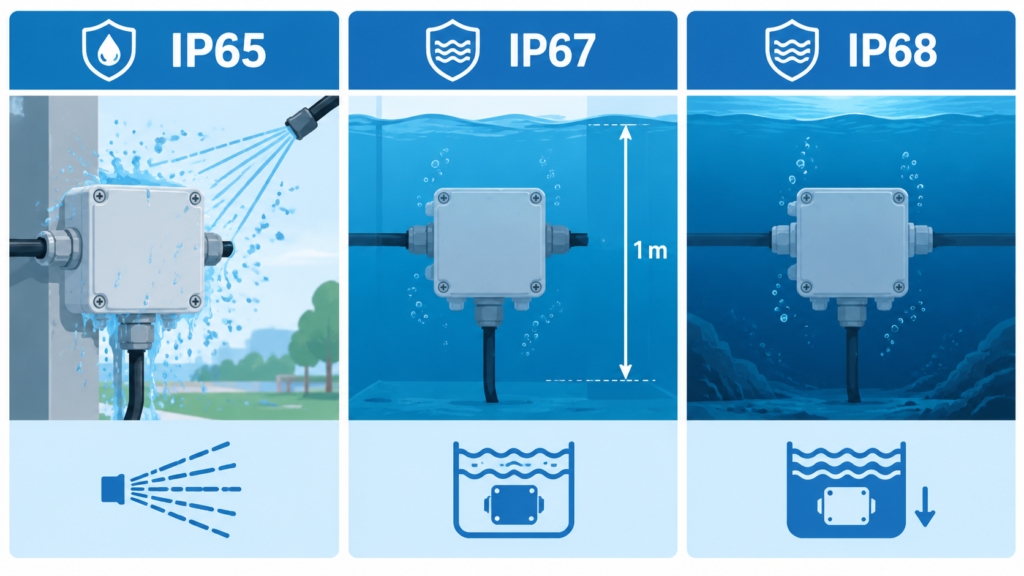
The IP rating is the single most important specification because it defines where the box can be used. The table below summarises the ratings most commonly seen on plastic junction boxes so you can match the product to the exposure.
Rating
Dust protection
Water protection
Typical use
IP55 / IP65
Dust-tight (6) or protected (5)
Low-pressure jets or splash
Sheltered outdoor, industrial and communication enclosures
IP66
Dust-tight
Powerful water jets
Hosed-down equipment and heavy-rain areas
IP67
Dust-tight
Temporary immersion up to 1 m for 30 min
Flood-prone areas and wet outdoor projects
IP68
Dust-tight
Continuous immersion beyond 1 m, per manufacturer declaration
Exposed outdoor, underground-risk and long-life installations
For most permanently exposed outdoor wiring, IP68 is the safest choice because it leaves the largest safety margin against heavy rain, pooling water and condensation. If you are comparing the two most common ratings for this product type, the IP67 vs IP68 comparison explains the practical difference between temporary and continuous immersion in more detail.
Step 2: Count the Ways and Cable Entries You Actually Need
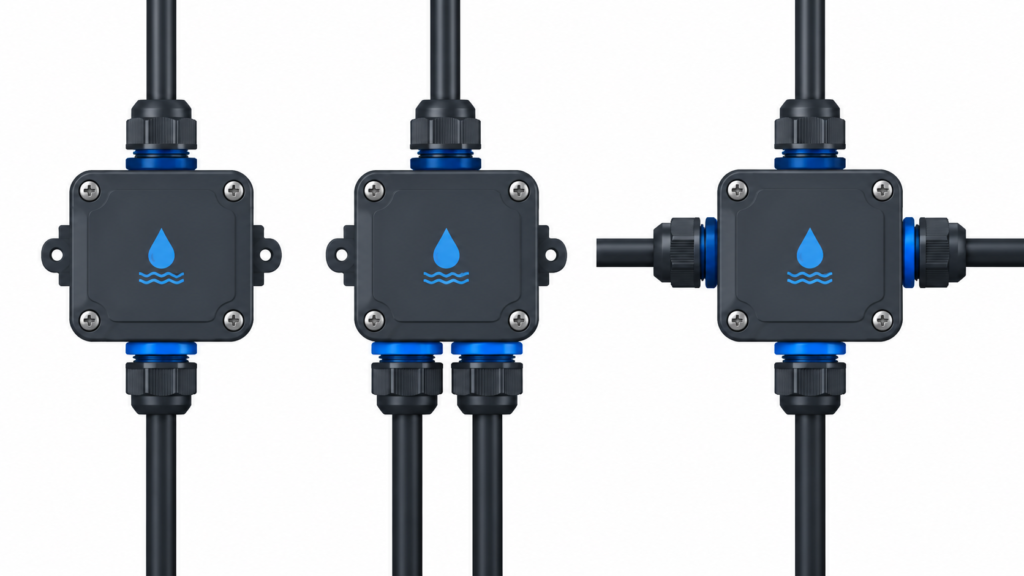
Waterproof junction boxes are described by their number of openings, commonly 2-way, 3-way or 4-way. A 2-way box handles one cable in and one cable out (a simple splice or one fixture connection), a 3-way box suits a daisy-chain of lights or sensors, and a 4-way box works well for a central junction feeding multiple branches.
To select the configuration, count every incoming and outgoing cable at the connection point, then add at least one spare opening for future additions or maintenance. Choosing a 3-way or 4-way box when you only need two entries now is cheap insurance: it avoids replacing the whole enclosure when a light, sensor or branch is added later. The general guidance on sizing for small enclosures is covered in what a small-size waterproof junction box is used for.
Step 3: Check the Cable Range, Wire Gauge and Electrical Rating
The openings of a waterproof junction box are not universal: each model accepts a defined cable outer diameter range, and the internal terminals accept a defined wire cross-section and load. Three figures must be checked together:
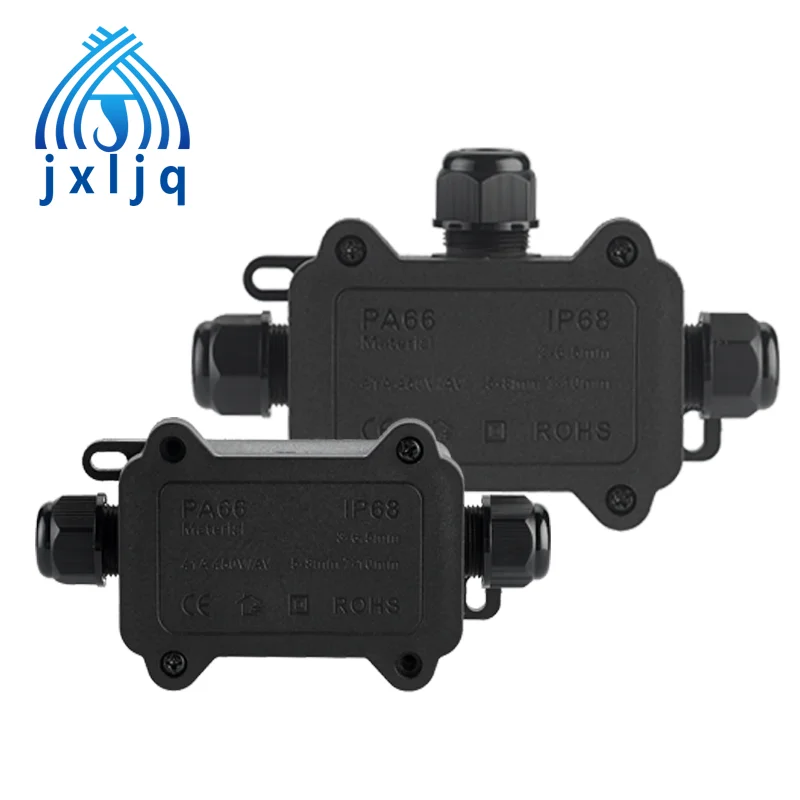
Cable outer diameter (OD): the box must provide a sealing option that fits the actual cable you install. Compact IP68 mini boxes typically cover ranges such as 3–6.5 mm, 5–8 mm and 7–10 mm through interchangeable rubber plugs or glands.
Wire cross-section: terminals are rated for a wire range (for example 0.5–4 mm²) that must include your conductor size.
Voltage and current rating: the terminal rating must be at or above the circuit load. As an example, the F1-2T/3T/4T mini waterproof junction box uses nickel-plated brass conductors with screw-crimping terminals rated at 16 A or 24 A at 450 V, which comfortably covers LED lighting, CCTV and small-pump circuits.
Write down the cable OD and load before comparing models, and use a box whose documented range sits inside your values with margin rather than at the very edge of the range.
Step 4: Choose the Housing Material and Sealing Quality
Housing material decides how the box survives years of sun, heat, cold and mechanical handling. For IP68 outdoor junction boxes, the most common engineering choices are:
Flame-retardant nylon (PA6/PA66): strong, self-extinguishing (UL94 V0 in quality grades) and stable from about -40°C to +105°C, which makes it the standard choice for compact outdoor boxes such as the F1 series.
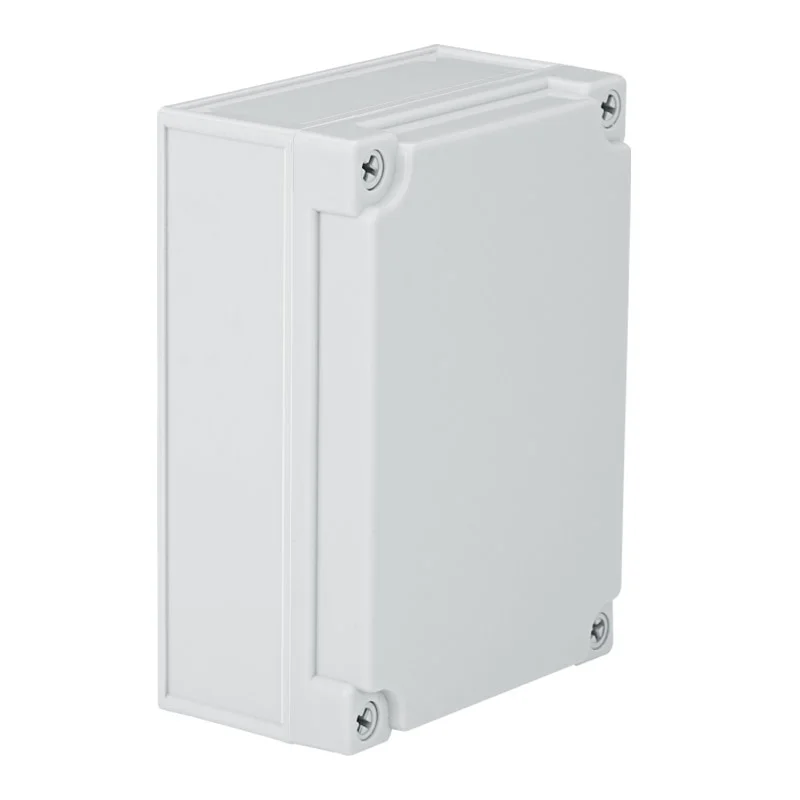
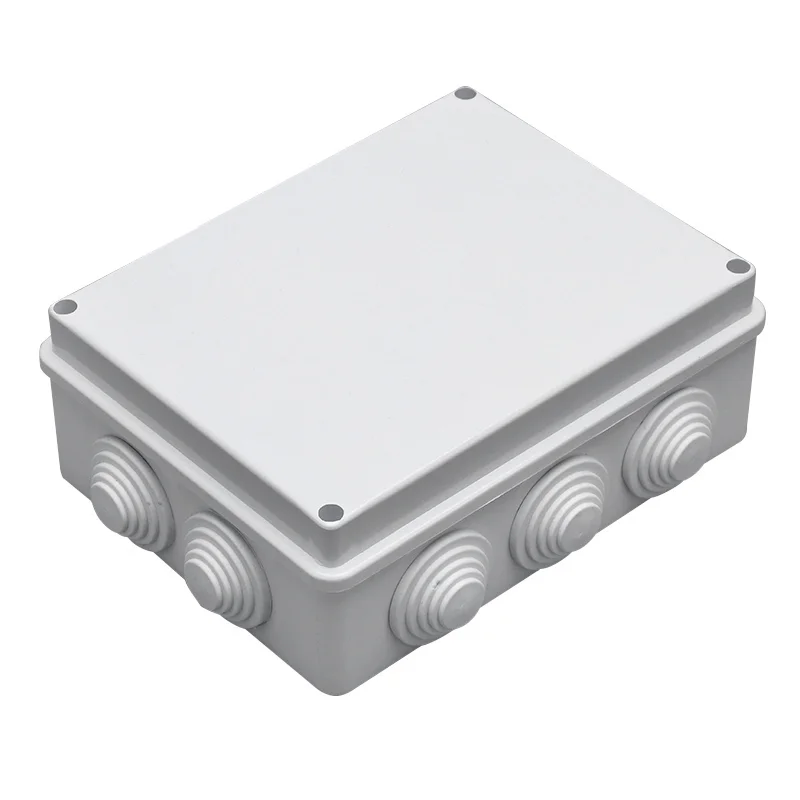
ABS: impact-resistant, economical and a good option for larger IP55–IP67 enclosures that house terminal blocks, DIN-rail devices or communication equipment.
Polycarbonate (PC) blends: chosen when higher UV resistance or transparency is required.
Sealing quality matters as much as the shell: look for a continuous silicone or rubber O-ring/gasket between the cover and the base rather than a glued-on seal, and confirm the screws compress the cover evenly. Temperature range is a practical check too—a box rated to sub-zero temperatures and more than 100°C on the housing and seal avoids cracking and gasket hardening in outdoor installations. For installations where the box is washed, verify the rating resists the cleaning method used on site.
Step 5: Seal Every Entry with a Matched Cable Gland
The housing rating is only as strong as its weakest entry. A hole drilled straight through the wall, or an oversized entry with a loose-fitting cable, will let water in no matter how high the box rating is. Three rules keep the seal intact:
Route every cable through a cable gland or the factory-moulded sealing system whose cable range matches the real OD of the cable.
Never leave unused openings unsealed; close them with the matching plug so the box keeps its dust and water protection.
Install the box so entries point downwards and cables form a drip loop, preventing water from running along the cable into the enclosure.
Most projects fall into one of three profiles. Matching the profile to the right series saves both money and installation effort:
Compact outdoor connections (lights, CCTV, solar, pumps): the F1-2T/3T/4T mini waterproof junction box delivers IP68 protection in 2-, 3- and 4-way versions with three cable-range options from 3 mm to 10 mm, silicone O-ring sealing and screw-crimping terminals—the practical default for garden and low-power outdoor wiring.
Higher-end exposed or semi-submerged installations: the JX-AG high-end waterproof junction box offers IP67 protection with 1-metre immersion capability and an IK08 impact rating in sizes from 95×65×55 mm up to 280×190×180 mm for power distribution, control and marine-type environments.
Larger enclosures for devices and DIN-rail equipment: the JX-RA plastic waterproof junction box provides IP55/IP65 protection with ABS bodies from 50×50×50 mm to 400×350×120 mm, internal mounting holes for PCBs or DIN rails, and custom outlet configurations for communication, industrial and building systems.
Series
Rating
Housing
Ways / sizes
Best matched to
F1-2T/3T/4T Mini
IP68
Flame-retardant nylon, silicone O-ring
2 / 3 / 4-way, cable 3–10 mm
Garden lighting, CCTV, solar, pumps
JX-AG High-end
IP67, IK08
Premium ABS, RoHS
95×65×55 to 280×190×180 mm
Power distribution, marine, outdoor control
JX-RA
IP55 / IP65
ABS body, PVC stoppers, CE & RoHS
50×50×50 to 400×350×120 mm
Communication, industrial, DIN-rail enclosures
All three series are available with OEM/ODM services, including custom sizes, cable-entry configurations, colours and packaging, so a standard model can be adapted to the exact cable set of a project when volumes justify it.
Common Selection Mistakes to Avoid
Buying on price alone and ignoring the IP rating. An indoor box used outdoors will fail within a season; confirm the rating matches the exposure before comparing cost.
Choosing the box before measuring the cable. The enclosure opening must fit the actual cable OD—check the range with the real cable, not an estimate.
Picking a 2-way box with no spare capacity. Future additions then require a full enclosure replacement instead of a small upgrade.
Oversizing the box unnecessarily. A large IP68 enclosure costs more and needs more mounting space; a correctly sized mini box is cheaper, lighter and often easier to seal.
Drilling extra holes or pulling cables through unsealed openings. This voids the waterproof rating of any junction box.
Conclusion
Selecting an IP68 waterproof junction box is a five-step process: define the environment and required IP rating, count the ways and cable entries with one spare, verify cable OD and terminal rating against your load, choose a flame-retardant housing with a quality silicone seal, and seal every entry with a matched cable gland. When these checks line up, the connection point stays dry, accessible and safe for years of outdoor service.
If you are sourcing junction boxes for a specific project and want help matching the model, cable range and entry configuration, our team can recommend the right series from the full waterproof junction box range or adapt a standard model to your cable set. Contact us with your cable sizes and quantities for a recommendation and sample support.
FAQ
What is the difference between IP67 and IP68 junction boxes?
IP67 enclosures withstand temporary immersion in up to 1 metre of water for about 30 minutes, while IP68 enclosures are rated for continuous immersion under conditions declared by the manufacturer (normally deeper than 1 metre). For permanently exposed outdoor wiring, IP68 provides the larger safety margin; IP67 suits locations that may be briefly flooded.
How many cables can a waterproof junction box take?
It depends on the number of ways. A 2-way box takes one cable in and one out, a 3-way box suits a daisy-chain of fixtures or sensors, and a 4-way box handles a central junction feeding multiple branches. Count your cables and add one spare way for future expansion.
What cable diameter can an IP68 junction box accept?
Compact IP68 mini boxes typically accept cables from 3 mm up to 10 mm through interchangeable sealing plugs (for example 3–6.5 mm, 5–8 mm and 7–10 mm). Larger enclosures accept bigger glands, so check the documented cable range against the actual cable OD before buying.
Can an IP68 junction box be installed underground?
An IP68 rating means the enclosure resists continuous immersion, but direct burial also involves soil pressure, drainage and access for maintenance. Confirm the manufacturer’s depth and pressure declaration, seal all entries with compatible glands, and consider a protective arrangement or inspection access for buried installations.
Do I need cable glands with the junction box?
Yes. The box rating is only valid when every cable passes through a sealed entry that matches its diameter. Using cable glands or the factory sealing system, and plugging unused openings, is what keeps an IP68 junction box genuinely waterproof.
When it comes to protecting electrical cables and ensuring long-lasting performance in harsh environments, brass cable glands are a top choice. These sturdy, reliable connectors offer IP68 waterproof protection, making them suitable for a wide range of industrial, outdoor, and marine applications. Whether you’re a professional installer or a DIY enthusiast, installing brass cable glands […]
IP69K cable glands explained: the high-pressure hot-water washdown rating, how it is tested, and how to choose cable entry for food, pharma and outdoor plants.
We use cookies to enhance your browsing experience, serve personalised ads or content, and analyse our traffic. By clicking "Accept All", you consent to our use of cookies.