Blog
Cable Gland Size Chart: Metric, PG & NPT Sizes Explained
Compare metric, PG, and NPT cable gland sizes in one chart. Learn how to measure cable diameter, match sealing ranges, and avoid sizing mistakes.
Read More
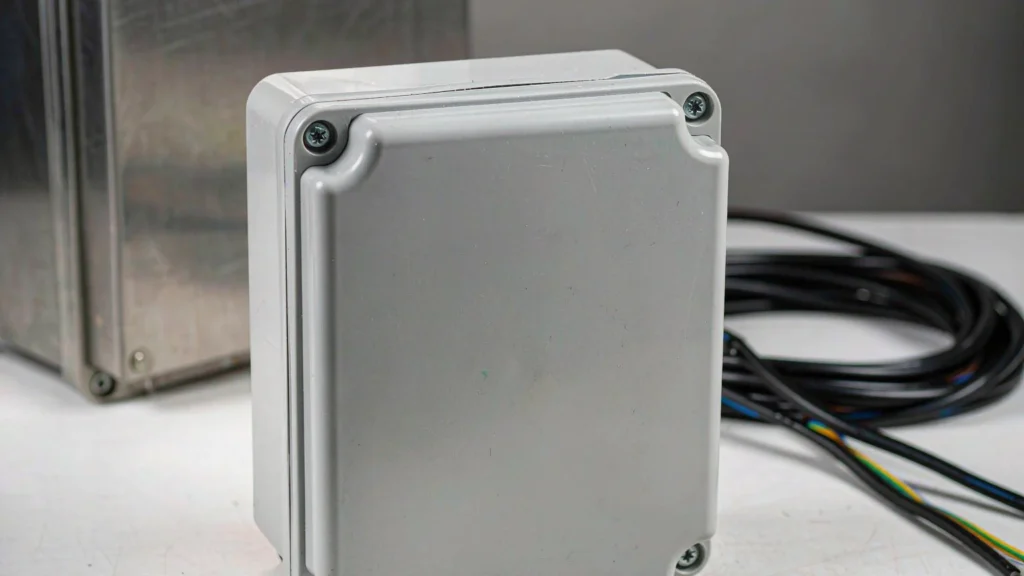
A buyer who asks for an “E90 junction box” is usually asking for something that does not exist as a product, and the reason is not a gap in any supplier’s catalogue — it is what E90 measures. E90 classifies a complete wiring system holding its circuit for ninety minutes in a fire. No enclosure can carry that classification on its own, least of all a thermoplastic one. This article explains what the E90 class actually is, why it cannot be attached to a box, and what a plastic E90 junction box can legitimately claim instead.
It is a deflection guide as much as an explanation: most of the cost in these enquiries comes from quoting a product to a specification that should have been reframed first.
The phrase fire rated appears in tenders and datasheets for at least three unrelated properties. They use similar notation, which is why they are constantly confused, and different tests prove them.
| Claim | What it means | Where it comes from | What it is not |
|---|---|---|---|
| E30 / E60 / E90 | A complete cable system keeps its circuit for 30, 60 or 90 minutes in a fire | DIN 4102-12; EN 50200 and IEC 60331 test cables similarly | Not a material property, not a component property |
| EI 30 / EI 60 / EI 90 | A wall or shaft resists fire and limits temperature rise on the far side | EN 13501-2, from furnace tests to EN 1363-1 | Not electrical continuity; a box inside inherits nothing |
| UL 94 V-0 | A small specimen stops burning shortly after the flame is removed | UL 94, or IEC 60695-11-10 | Not a duration, not a temperature, not circuit integrity |
The notation is the trap. E90 and EI 90 look like variants of one thing and are not: one is a circuit that keeps working, the other a barrier that keeps containing. A tender that says E90 next to a cable route wants the first; EI 90 next to a wall wants the second. Answering either with a V-0 enclosure answers a third question.
In the DIN 4102-12 system, the object under test is an installed wiring system rated up to 1 kV: power cables, control and data cables, and the structures that carry them — trays, ladders, clamps. The assembly is built inside a furnace at realistic spacing, loaded and supported as it would be on site, then heated on a defined curve of roughly 800 °C at thirty minutes, 900 °C at sixty and 1,000 °C at ninety.
The pass criterion is narrower than most people assume. The system has to avoid short circuit and avoid losing continuity of its cores for the classification period, and the standard explicitly does not cover the voltage drop caused by conductor resistance rising with temperature. E90 does not promise the circuit still works properly at ninety minutes; it promises it has not shorted and has not opened. That is the right test for emergency lighting and fire alarm circuits, where a dim or high-resistance circuit is still usable and an open one is not.
Read the classification off that description and the problem is immediate: the outcome depends on the cables, the supports, the joints and the way they are installed together. Change the box in the run and you have changed the system. There is no mechanism by which a component can be certified in isolation and dropped into an untested assembly.
A supplier offering an E90 junction box is therefore almost always offering one of three things. The box may be part of a tested system — a specific enclosure with specific glands tested inside a complete run, with a report naming that assembly. That is legitimate and narrow: the report covers the tested combination, and a different gland or terminal voids it.
Or the requirement was written loosely. Many specifications say E90 when the author meant a reaction-to-fire performance: V-0 housing, a glow-wire threshold, low smoke. Those are real and available in plastic, but they do not deliver ninety minutes of circuit integrity, and swapping one for the other without saying so is how projects end up with a signed submittal and a failing commissioning test.
Or the E-class belongs to the construction around the box. A joint inside a protected shaft or a tested ceiling assembly may be acceptable because the enclosure is doing the protecting, and the box then only has to be small enough for the assembly still to pass. That argument has to be made explicitly.
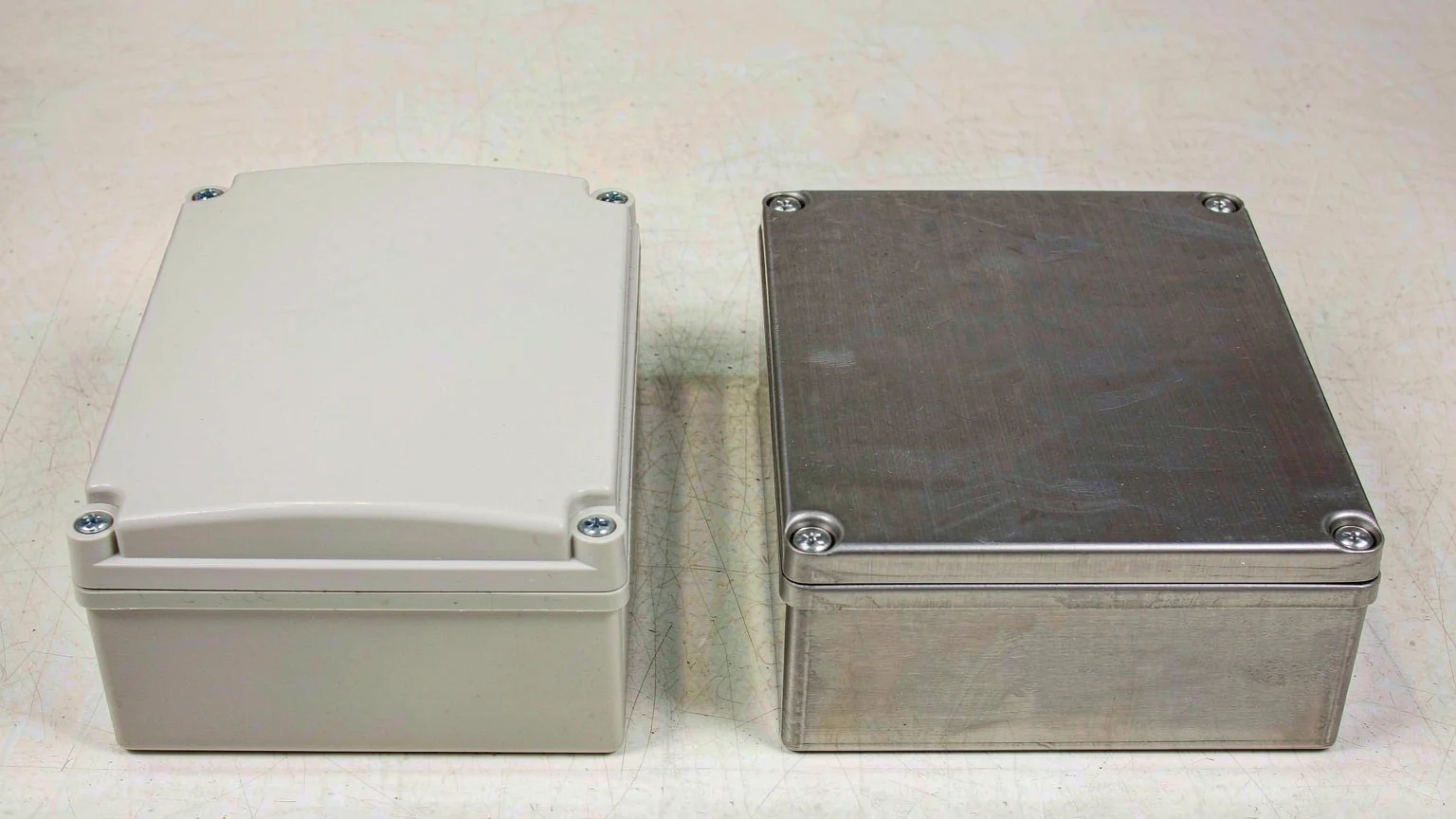
ABS and PA66 soften and then melt well inside that window. Their softening ranges sit in the low hundreds of degrees, and a wall that has lost its stiffness no longer holds a gasket, no longer holds a lid, and no longer keeps a terminal block in position. The failure is mechanical before it is electrical: the enclosure stops being an enclosure, and only then does the circuit fail.
This is where a V-0 rating gets misread. V-0 is assessed on a small bar with a controlled flame applied briefly, and it asks whether the specimen self-extinguishes and whether burning material drips. A material can pass V-0 and still melt into a puddle in a real fire, because melting and burning are different processes and the test looks at one of them. Our guide to UL 94 V-0 and glow-wire testing covers what those tests actually prove; neither is a duration.
One consequence matters for purchasing: those four answers come from four different tests, and no single certificate covers more than one of them. A datasheet that offers a V-0 result in answer to an E90 question is not lying — it is answering a different question.
Failing to hold E90 does not leave a plastic enclosure with nothing. It leaves it with a shorter list, stated accurately: a reaction-to-fire classification for its material, a glow-wire figure, a halogen-content statement, a RoHS declaration and an IP rating — each defensible as long as it stays attached to its test.
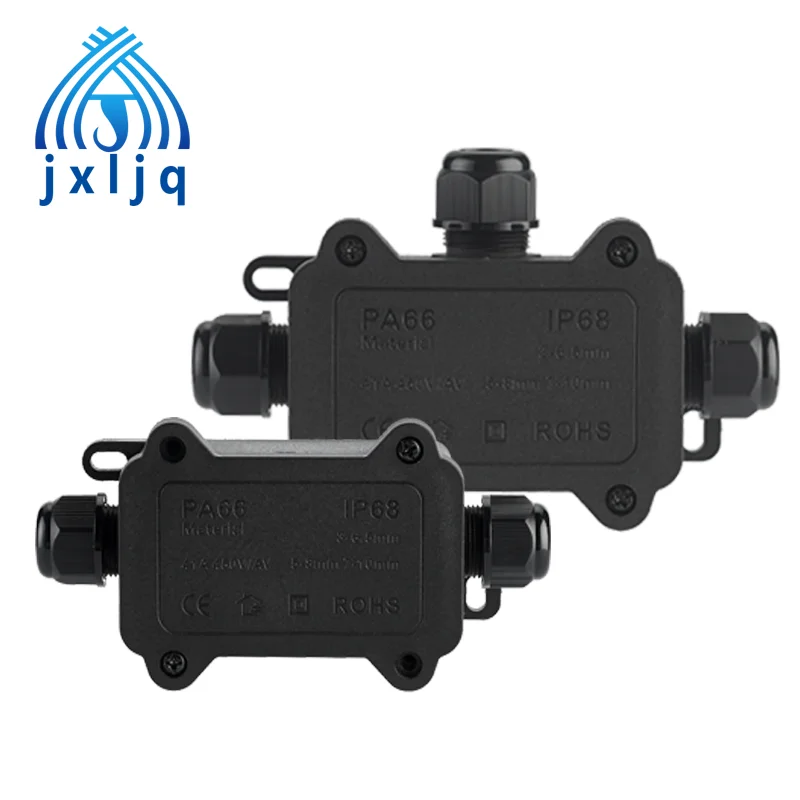
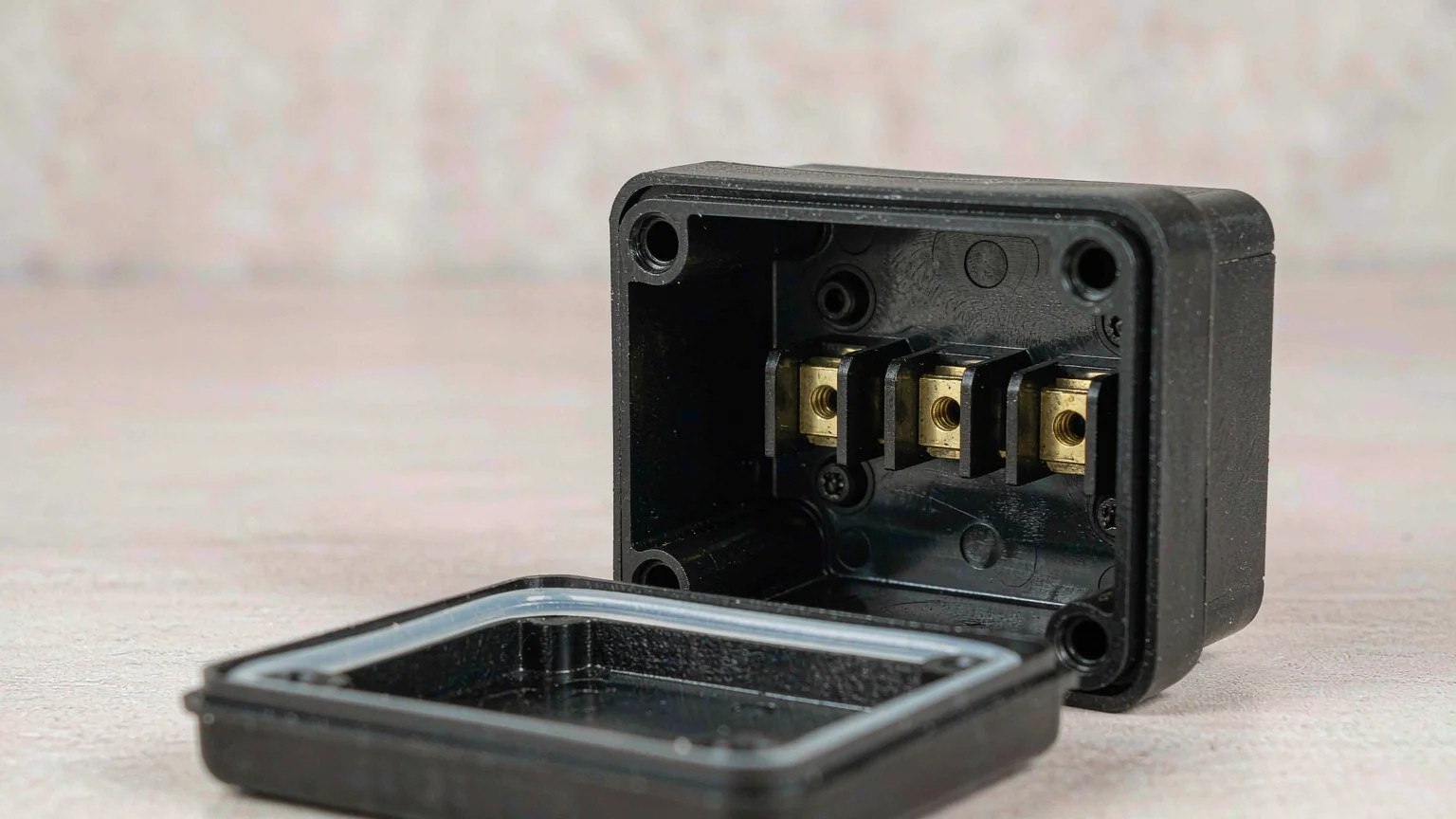
In our own range the position is simple. The F1 mini junction box uses flame-retardant PA66 rated V-0, with a silicone O-ring and a working range of −40 °C to +105 °C. The JX-RA series is ABS at IP55/IP65 with CE and RoHS documentation. The JX-AG series is IP67 with an IK08 impact rating. None of the three carries an E-classification, and no E30, E60 or E90 claim should be made for them. Where circuit integrity is required, the answer is a different product family built and tested as a system.
The documents that do exist for these enclosures are a separate subject, covered in CE and RoHS documents for junction boxes. A document pack proves what was declared; a fire classification proves what was tested. They are not interchangeable, and neither substitutes for a material choice argued against the real environment.
Read the clause in context first. If it sits in a section about cable systems and emergency circuits it means DIN 4102-12 or the EN equivalent, and the question becomes whether this joint is inside a tested run. If it sits in a section about compartmentation the number is EI and the box is not the subject. If it says fire retardant housing, the requirement is V-0 or a glow-wire figure and can be met immediately.
Then ask who owns the classification: a joint inside a protected shaft is usually the installer’s or the building’s responsibility, and the box only has to fit. A joint in an unprotected ceiling void may need a tested enclosure or a change of route.
Then put the answer in writing with the test named. A submittal that says “V-0 housing to UL 94, no E-classification claimed” survives a review; one that says fire rated does not. If the project does need a tested assembly, say so early — that is a longer lead time and a different price, and discovering it after the order is placed costs a month. The selection guide shows where rating decisions sit in the buying sequence.
E90 is a property of a tested wiring system, not of a box. No thermoplastic enclosure can carry it, and any datasheet that appears to offer it is describing a tested assembly, a narrower reaction-to-fire result, or a misunderstanding of the notation. What a plastic junction box can honestly deliver is a V-0 material, a glow-wire figure, a documented RoHS position and a defined IP rating — which is what most fire-rated enquiries need once the clause is read properly.
No. V-0 describes how a small material specimen behaves when a flame is removed. E90 describes whether a complete installed wiring system keeps its circuit for ninety minutes in a furnace. One is a material class, the other a system test.
Not as a standalone product. The classification belongs to a tested assembly of cables, supports and joints. A plastic box might appear inside one, but the report covers that combination and changing a gland or terminal invalidates it.
That the circuit has not shorted and its cores have not opened for ninety minutes under the standard fire curve. Not voltage, current or proper operation, because the standard excludes conductor resistance rising with temperature.

Compare metric, PG, and NPT cable gland sizes in one chart. Learn how to measure cable diameter, match sealing ranges, and avoid sizing mistakes.
Read More
A metric junction box size chart for the JX-AG and JX-RA ranges, plus the four measurements — conductor count, volume, bend radius and gland depth — that decide which model to order.
Read More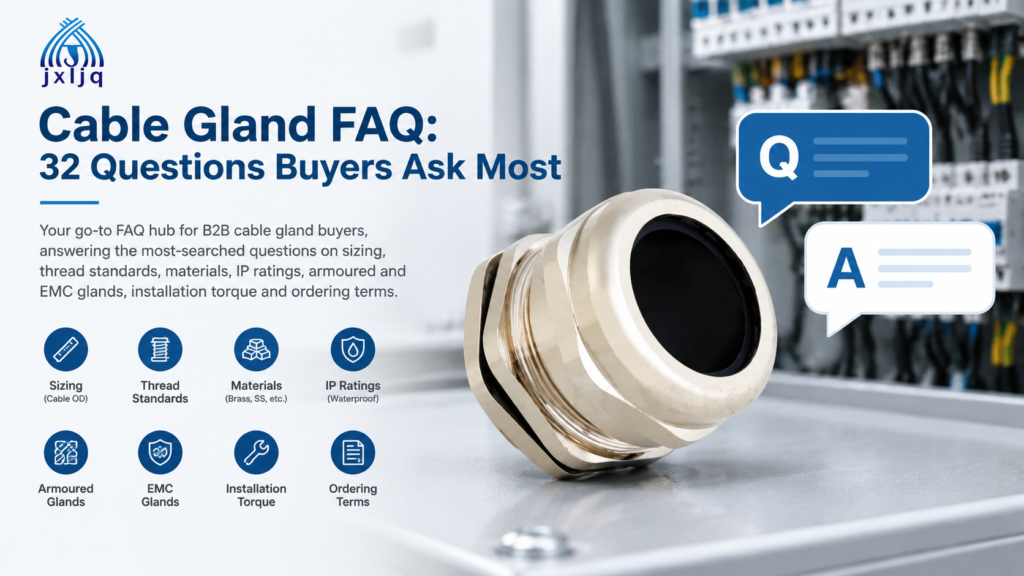
The cable gland questions buyers ask most, answered in one place: sizing, thread standards, materials, IP ratings, armoured and EMC glands, torque and ordering terms.
Read More