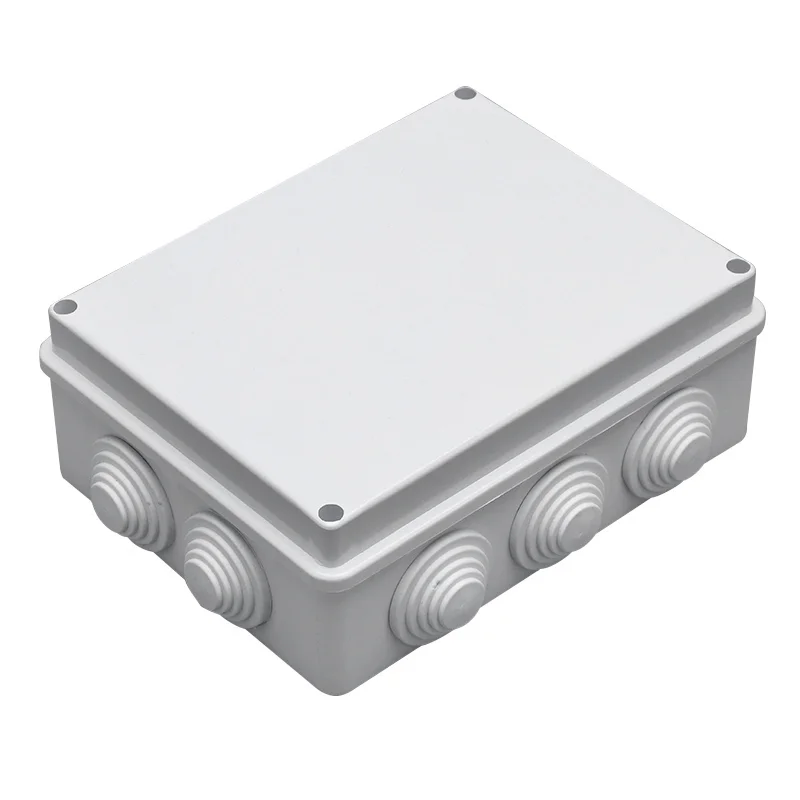
A cold room junction box is not an outdoor box with a lower number on the datasheet. The steady −25 °C is the easy part. What fails these enclosures is the cycling that comes with it — defrost heaters, doors opening, warm product going in — and the vapour pressure that keeps pushing moisture toward the cold side all day. Both act on the seal continuously, and neither appears on a product page.
This article covers the three material stresses a freezer applies, why the defrost cycle sets service life, where the water in a sealed box really comes from, and which of our models can be quoted for cold-room work.
Why −40 °C Is Three Problems, Not One
Low temperature is usually treated as one material property. In service it splits into three failure paths, and a box can pass one while failing another.
Impact strength. Thermoplastics lose toughness as they cool, so a lid that survives a dropped spanner at 20 °C can crack at −25 °C under the same blow.
Contraction. PA66 moves about 8 × 10⁻⁵ per K against 2 × 10⁻⁵ for the brass insert moulded into it. Over a 65 K swing a 30 mm boss contracts 0.15 mm while its insert contracts 0.04 mm, leaving 0.11 mm of strain at the knurl. Cooling grips the insert, warming releases it — a fatigue load, not a static fit, and the reason insert pull-out appears on boxes that were never over-torqued.
Elastomers. Silicone stays elastic to about −55 °C, EPDM to −50 °C, NBR only to −40 °C. An O-ring that stops being elastic stops following its groove.
The Defrost Cycle Is the Real Service Life
A freezer running four defrosts a day completes roughly 1,460 thermal cycles a year at the evaporator, with a smaller swing at the panel. An outdoor box in a temperate climate sees about 365.
That ratio matters because gasket failure is driven by cycle count, not time. Compression set accumulates every time the elastomer is squeezed and released at a new temperature, and the set that counts is taken at the coldest point, where recovery is slowest. Three years on a freezer wall is about as many cycles as twelve on a mast, which is why a cold room junction box that fails at thirty months has done a decade of work. Set the interval from the defrost count: six a day halves it.
Where the Water Actually Comes From
Cold rooms are vapour pumps. At 30 °C and 60% relative humidity the outside air carries water vapour at about 25 mbar of partial pressure; over ice at −25 °C the equilibrium is below 1 mbar. The gradient is more than an order of magnitude and acts permanently inward.
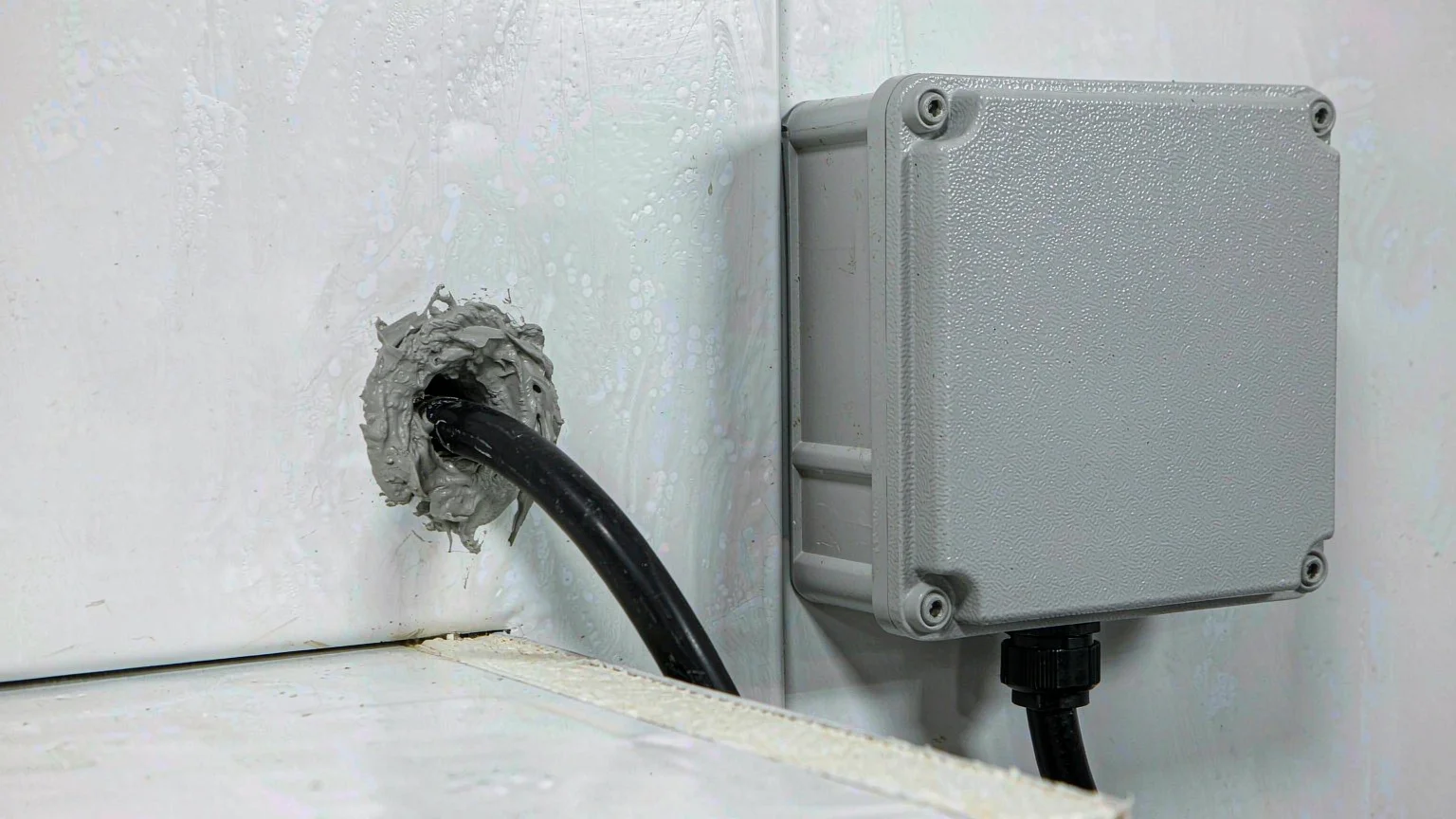
That gradient, not the enclosure, decides whether the wall stays dry. The vapour barrier — the sealed penetration, the mastic, the taped panel joint — is the primary defence. The box is a second barrier and cannot compensate for a penetration left open behind it.
The box is the second barrier, not the first
When a box on the cold side holds water and the gasket looks perfect, the water usually arrived through the panel: it condensed inside the insulation, ran down the cable and entered along the strands — the mechanism behind most condensation complaints in sealed boxes. The first question in a cold room is never which box but how the penetration was sealed.
Frost Heave: The Failure Nobody Expects
Water expands about nine percent when it freezes, and that is enough to lift a lid or split a boss. Cold rooms are the one environment where plugging every unused entry stops being tidiness and becomes a freeze–thaw requirement.
The usual sites are an upward-facing gland, a knockout closed with a push-in cap that does not seat, and the thread of a sealing nut where a few drops sit. Each freeze pushes the joint apart a fraction of a millimetre; each thaw admits more water. Face unused entries downward, use rated blanking plugs with their washers, and keep the box above the floor wash line and clear of door thresholds.
Polymer and Elastomer Choices at Low Temperature
Our own data shows the trap: only one of the three box families carries a published low-temperature figure, and it is the smallest one.
Material
Behaviour below zero
Cold room verdict
PA66, flame retardant (F1)
Published −40 to +105 °C; absorbs moisture, so dry cold air lowers impact reserve
Fan, light, defrost and probe circuits
ABS (JX-RA)
Embrittles earlier; no low-temperature figure published
Anteroom and warm-side boxes
Polycarbonate
Good cold impact, stress-cracks against sanitisers
Not in washdown zones
Stainless steel
No polymer limit; condensation still forms inside
Washdown and hygienic areas
We quote −40 °C to +105 °C for the F1 series with a silicone O-ring, and we do not quote a low-temperature rating for JX-RA or JX-AG, because neither datasheet publishes one. A supplier who quotes −40 °C for every plastic box is quoting a polymer family, not a tested product.
Cable Stiffness and Internal Pressure
A PVC jacket at −25 °C is too stiff for the bend radius assumed on the drawing: the stiffness loads the sealing nut and then the terminal, so support the cable from the structure and measure the seal range on the cold cable.
The second effect is pressure. A box closed on the dock at 30 °C and moved into a −25 °C room develops an internal vacuum: about 1.05 bar falls to 0.86 bar, a differential near 0.19 bar — the same pull as 1.9 m of water acting inward on every joint.
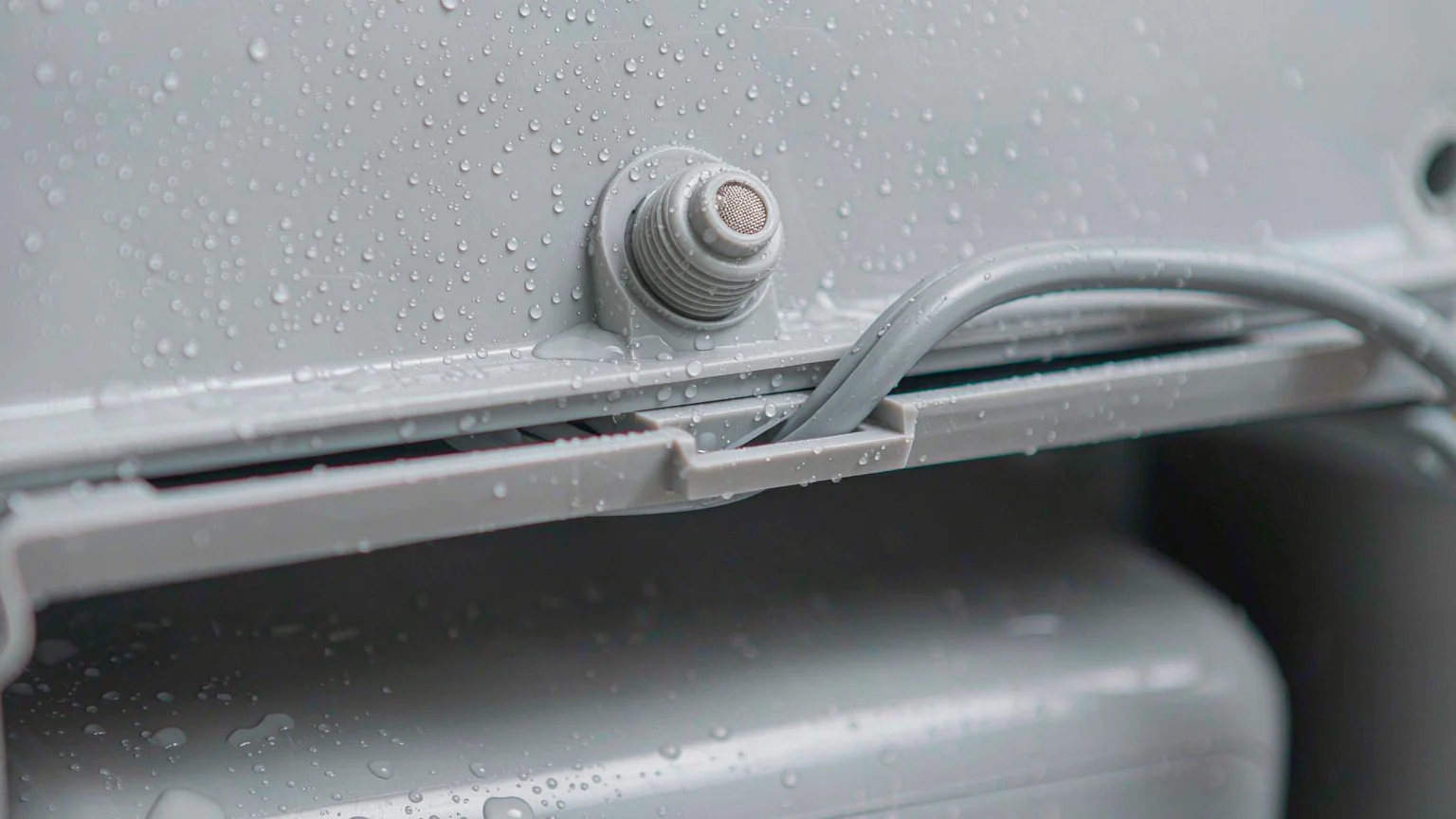
A breathable vent plug equalises that. Ours passes 325 ml/min at 0.07 bar, carries an IP68 O-ring and is rated −40 °C to +120 °C. In a freezer, mount it dry side toward the warmer space and keep it out of the evaporator airstream, where the membrane can ice over.
Circuit by Circuit: What the Box Has to Carry
A cold room mixes circuits with very different demands, so the enclosure should follow the circuit, not the room.
Circuit
Typical conductor
Suitable enclosure
Evaporator fan, door heater, internal light
0.75–2.5 mm², up to 16 A
F1, 3T or 4T, 450 V / 24 A
Defrost control and sensors, 24 V
0.5–1.5 mm²
F1, 2T
Probe and instrument wiring
Shielded, small section
F1, shield earthed one end
Condensing unit feed
4–6 mm², 20–32 A
Not the F1: 24 A, and a 2T–4T block will not take 6 mm²
Routing a compressor feed through a mini box is a quiet error: the block will not take 6 mm² and the lid has to close over a cable that will not bend. The F1 series is a fan-and-light enclosure.
Installation Rules That Only Apply Below Zero
Four rules are specific to the cold. Do not drill, cut or torque a thermoplastic enclosure below about 5 °C: the polymer is at its most brittle and a crack runs from a drill exit, so pre-drill and fit glands in the workshop. Close the lid with box and gasket at room temperature, so the seal takes its first set warm. Re-torque once, diagonally, after the first defrost cycle. And support the cable independently of the entry.
Where Our Range Fits
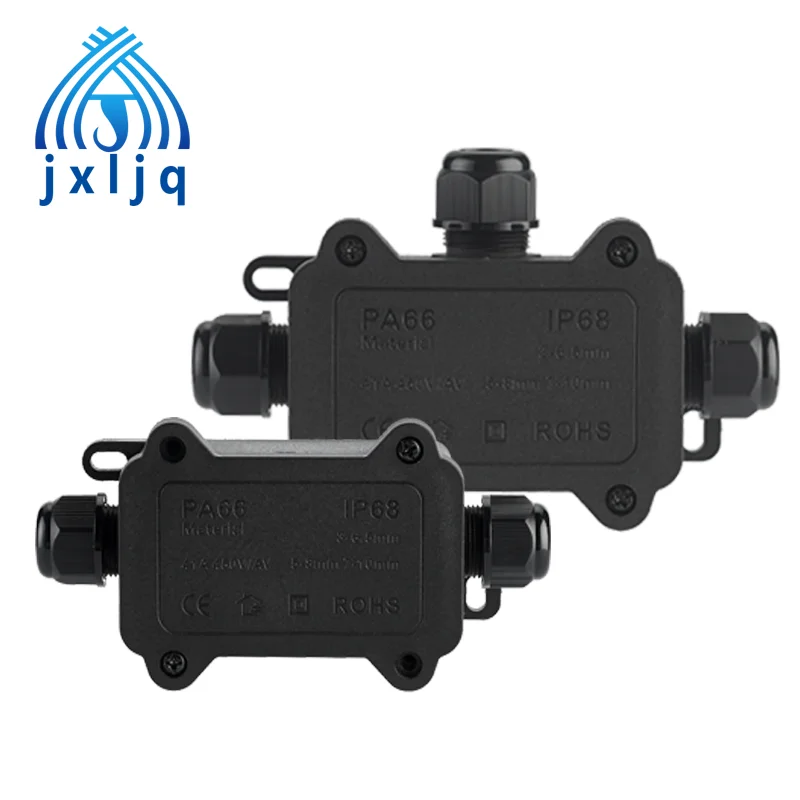
For cold-room circuits we quote the F1 mini junction box: IP68, PA66 flame retardant to V-0, silicone O-ring, −40 °C to +105 °C, 450 V / 24 A, in 2T, 3T and 4T versions with three cable ranges. For the anteroom and plant room, the JX-RA series covers IP55 and IP65 from 50 × 50 mm to 400 × 350 × 120 mm. For wet but not sub-zero locations, JX-AG gives IP67 to one metre and IK08.
What we do not claim is as useful: we have no enclosure tested below −40 °C. If the spec asks for −50 °C, the answer is a different product, not a longer sentence in a quotation. The wider logic sits in the selection guide.
Conclusion
A cold room rewards different questions. Ask for the temperature range and the O-ring material before the IP rating. Count defrosts to set the inspection interval. Check the panel penetration before blaming the gasket. Plug every entry, because in a freezer an open hole is a frost-heave site. Then choose by circuit, not by room.
Frequently Asked Questions
Can a standard IP68 junction box be used in a freezer?
Not on the strength of the IP rating, which says nothing about temperature. Ask for the operating range and the O-ring material. The F1 series is rated −40 °C to +105 °C with a silicone O-ring, and that is what makes it suitable.
Why is there water in a cold room junction box when nothing leaks?
Usually the water never crossed the lid gasket. Vapour migrates through an unsealed panel penetration, condenses in the insulation and runs in along the strands. The second cause is pressure pumping: a box closed warm and cooled fast draws moist air through any imperfect joint.
Does a cold room junction box need a vent plug?
Wherever it moves between warm and cold spaces, because that is when the internal vacuum forms. Fit it dry side out, away from the evaporator airstream, and expect to replace it periodically.
Which of your boxes is rated for a blast freezer?
None below −40 °C. The F1 is published to −40 °C; JX-RA and JX-AG carry no low-temperature figure. Colder duty needs a specialist enclosure.
Introduction: Why Material Selection Matters in Cable Glands Choosing between a brass cable gland and a stainless steel cable gland is not just a cost decision. It directly affects long-term sealing reliability, corrosion resistance, and system safety in industrial electrical installations. In real-world projects, many failures do not come from the cable gland design itself, […]
NEC 314.29, the gravel-pit exception, cable depth rules and the conduit convection loop that fills a buried IP68 box with water. What to build instead of burying a splice.
Seven field returns, the teardown evidence that identified each root cause, and the purchase-order clauses that keep a junction box failure from repeating on the next batch.
We use cookies to enhance your browsing experience, serve personalised ads or content, and analyse our traffic. By clicking "Accept All", you consent to our use of cookies.