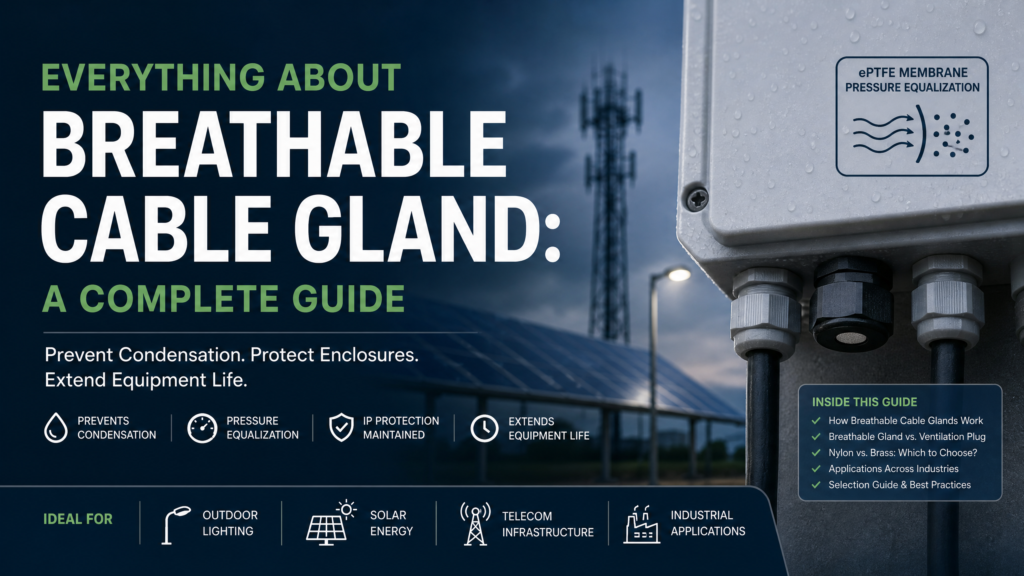
A breathable cable gland is a cable entry device that does two jobs at once: it seals and secures the cable like a standard gland, and it lets air pass through a microporous membrane so the enclosure can equalize pressure. That second function solves a problem standard glands cannot — condensation. When a sealed enclosure heats up and cools down, pressure differences draw in moist air, and the trapped moisture condenses on internal surfaces, corroding components and causing failures. A breathable cable gland vents that pressure while blocking water and dust. This guide covers how breathable cable glands work, how they differ from ventilation plugs, which materials suit which jobs, and how to choose a high-quality one.
What Is a Breathable Cable Gland?
A breathable cable gland is a cable gland with an integrated venting system — usually an ePTFE membrane — that allows a controlled flow of air into and out of the enclosure while still providing a secure seal around the cable. Unlike a regular cable gland, which seals the entry completely, a breathable gland lets the enclosure “breathe.”
This design matters in outdoor and high-humidity environments where temperature changes cause pressure buildup. The key difference from a standard gland:
Standard cable gland — seals the cable entry against dust and water, but traps air and moisture inside the enclosure.
Breathable cable gland — seals the entry and also equalizes pressure through a venting membrane, preventing moisture buildup and condensation.
For applications where electronics sit in enclosures exposed to temperature swings, that venting function is what keeps the inside dry over years of service.
Why Condensation Forms in Sealed Enclosures
Condensation is the reason breathable cable glands exist. Even a fully sealed enclosure can suffer internal moisture problems, and the mechanism is easy to understand:
When equipment runs, or during daytime heat, the temperature and pressure inside the enclosure rise.
When the equipment shuts off or the environment cools, the air inside contracts, creating a pressure difference between inside and outside.
That vacuum draws moist air in through seals and cable entries.
When the moist air cools and pressure equalization does not happen, condensation forms on the internal surfaces — and stays trapped.
The result is corrosion, rust, fogged lenses, nuisance trips, and eventually component failure — even inside enclosures rated IP66 or IP68. Condensation is the classic “how did water get in here?” problem that high-protection enclosures still face.
How a Breathable Cable Gland Works
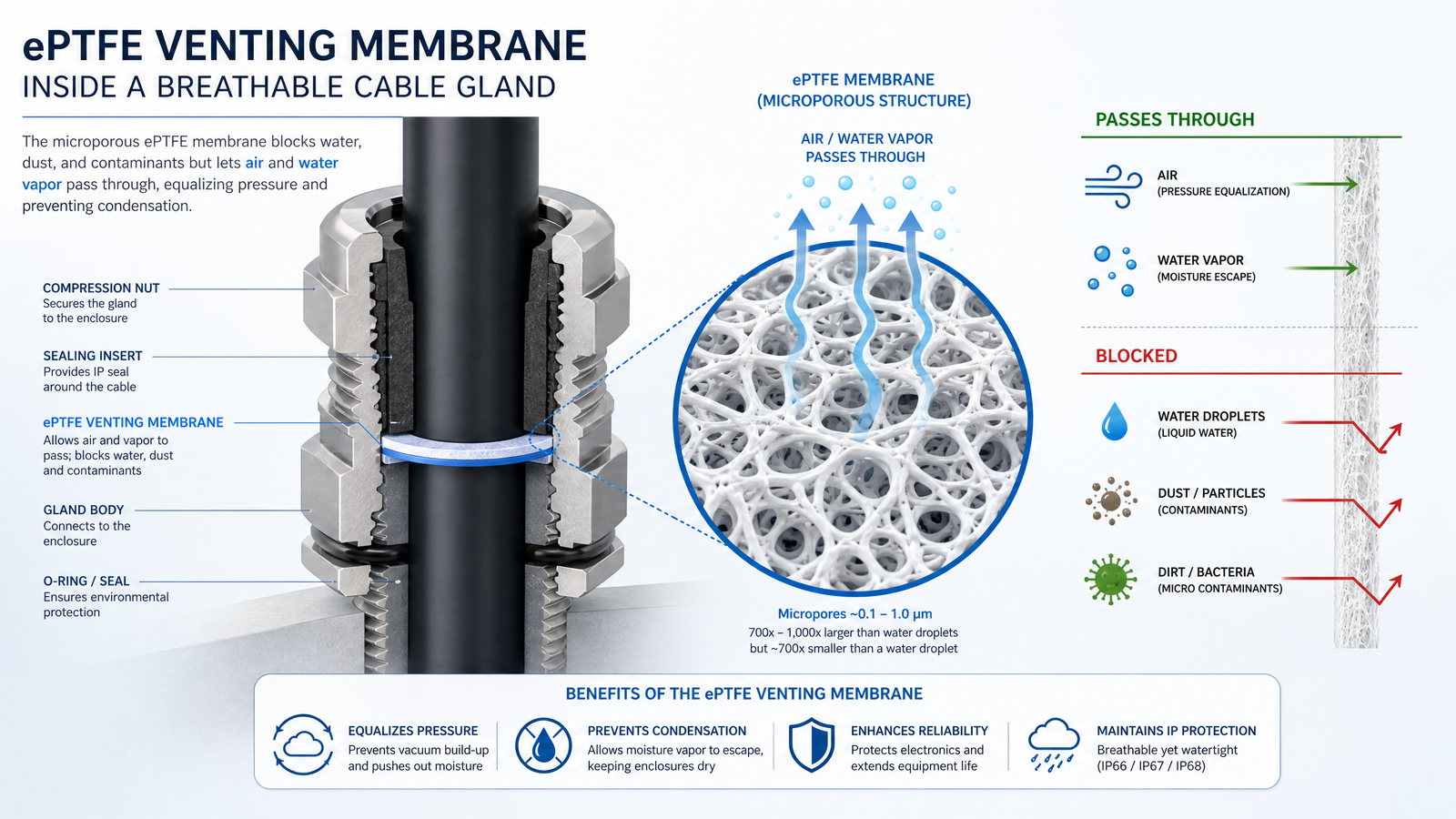
At the core of a breathable cable gland is the venting membrane, typically made of expanded PTFE (ePTFE). The ePTFE membrane has a microporous structure with billions of tiny pores — small enough to block water molecules, dust, and contaminants, but large enough to let air and water vapor pass through.
This structure gives the membrane several useful properties:
Natural hydrophobicity — liquid water cannot pass through.
Uniform pore size and high porosity — consistent, reliable airflow.
Good air permeability — pressure equalizes quickly.
High chemical and corrosion resistance — the membrane survives harsh environments.
Because the membrane lets air move in both directions, the enclosure equalizes with its surroundings. When temperature rises, excess pressure escapes; when it drops, dry air enters instead of moisture being drawn in. The enclosure stays at the same pressure as the outside, the seal is not stressed, and condensation never gets a chance to form. All of this happens passively — no power, no moving parts, no maintenance.
Breathable Cable Gland vs Ventilation Plug
Ventilation plugs and breathable cable glands both use ePTFE membranes for pressure equalization, and both protect against condensation in outdoor equipment such as lighting. The difference is what else they do.
Feature
Breathable Cable Gland
Ventilation Plug
Pressure equalization
Yes
Yes
Cable entry and clamping
Yes — a cable passes through
No — seals an empty entry hole
Airflow rate
Good
Higher (e.g. ≥1.2 L/min/cm² @ 70 mbar)
Best fit
Enclosures with cable entries needing both sealing and venting
Enclosures with spare entries, or where maximum airflow is needed
The ventilation plug can breathe more freely than a breathable gland because it has no cable passing through it, but it cannot clamp a cable at the same time. Which one you use depends on where you install it. For general outdoor use, a breathable cable gland alone is usually sufficient. For harsher conditions — or high-power floodlights where the entire housing generates heat, not just the cable connection — the recommended approach is a breathable cable gland for the cable entry plus a ventilation plug for additional airflow.
Nylon vs Brass Breathable Cable Glands
Breathable cable glands are available in two main materials, and the choice follows the same logic as other cable glands.
Nylon Breathable Cable Glands
Nylon breathable cable glands are the most popular venting solution for moisture- and temperature-sensitive sectors such as shipping, lighting, communication equipment, solar, and automotive. They are an economical and convenient option: no additional components, extra mounting, or drilling are needed, and they can replace standard nylon glands directly because they share the same clamping ranges and lock nut.
Brass Breathable Cable Glands
Nickel-plated brass breathable cable glands provide better durability and protection against harsh environments, with the same pressure-equalization function. Brass is the right choice where mechanical strength, corrosion resistance, and long service life in demanding conditions matter more than weight or cost.
Both materials reach IP68 protection, offer effective pressure equalization through the integrated ePTFE membrane, and resist condensation and contaminants. The trade-off is the usual one: nylon is lighter and more economical, brass is stronger and tougher.
Applications of Breathable Cable Glands
Breathable cable glands are used wherever sealed enclosures face temperature swings, humidity, or pressure changes:
Outdoor lighting — LED luminaires and floodlights that heat up during operation and cool at night; venting prevents fogging and extends lamp life.
Solar and renewable energy — junction boxes, inverters, and wind turbine control systems exposed to extreme daily temperature cycling.
Telecommunications — outdoor cabinets and 5G enclosures that need both moisture protection and heat management.
Marine and coastal — enclosures exposed to salt air, high humidity, and rapid weather changes.
Automotive and railways — control and signal systems subject to vibration and temperature variation.
Industrial control — electrical and electronic enclosures, terminal boxes, and process control panels in humid plants.
In all of these, the breathable gland replaces expensive ventilation systems and drip holes — the classic alternatives that either cost too much or sacrifice the enclosure’s IP rating.
How to Choose a High-Quality Breathable Cable Gland
Because the venting membrane is the part that makes the gland work, quality matters more here than with a standard gland. Check these points when sourcing:
Material. Look for durable, rust-resistant construction — nickel-plated brass for harsh environments, or quality nylon for lightweight, economical use.
Certifications. Choose products certified to recognized quality standards such as CE, and verify the manufacturer holds relevant quality management and RoHS compliance.
IP rating. Confirm a high ingress protection rating — IP68 indicates resistance to both dust and continuous immersion while the membrane vents.
Membrane performance. Check that the gland uses a genuine ePTFE membrane with adequate airflow, water-entry pressure resistance, and quick recovery after liquid contact.
Customization. A supplier that offers customization lets you match thread, size, and material to your exact installation.
How to Select the Right Size
Sizing a breathable cable gland is straightforward:
Check the mounting panel. If there is an existing tapped hole, measure the hole size and match the gland’s thread to it using the supplier’s size chart. Consider whether the thread type and a lock nut are required.
No existing hole? Choose a breathable gland in any thread size that suits the cable and enclosure.
Confirm cable fit. The gland’s clamping range must cover the cable’s outer diameter, just as with a standard gland.
Common sizes cover M12, M16, and M20 threads, with black and white options available to match enclosure aesthetics.
Conclusion
A breathable cable gland solves the condensation problem that sealed enclosures cannot avoid. It combines the sealing and strain-relief functions of a standard gland with a microporous ePTFE membrane that equalizes pressure and lets moisture escape — passively, with no power and no maintenance. Use a breathable gland wherever a sealed enclosure faces temperature swings and humidity: outdoor lighting, solar, telecom, marine, automotive, and industrial control. Match the material to the environment, confirm the IP rating and membrane quality, and select the thread size for your panel. For enclosures needing maximum airflow, add a ventilation plug at a spare entry. Get these right, and the enclosure stays dry for the life of the equipment.
FAQ
What is the difference between a breathable cable gland and a normal cable gland?
A normal cable gland seals the cable entry completely. A breathable cable gland adds a microporous ePTFE membrane that allows air and vapor to pass through while blocking water and dust, equalizing pressure and preventing condensation.
Do breathable cable glands still provide IP68 protection?
Yes. The venting membrane blocks liquid water and dust while letting air pass, so the gland maintains its IP68 rating — dust-tight and protected against continuous immersion — even while it vents.
How does condensation get into a sealed IP68 enclosure?
Temperature changes create pressure differences. When the enclosure cools, a vacuum forms and draws moist air in through seals and cable entries. That moisture condenses inside and stays trapped, causing corrosion and failures despite the high protection rating.
Can I use a breathable cable gland instead of a ventilation plug?
For general outdoor use, a breathable cable gland alone is usually enough. In harsher conditions or high-heat applications like high-power floodlights, the recommended practice is to use both — a breathable gland at the cable entry and a ventilation plug at a spare entry for additional airflow.
What is an ePTFE membrane?
ePTFE (expanded polytetrafluoroethylene) is PTFE that has been expanded into a microporous structure. It is naturally hydrophobic, has uniform pore size and high porosity, allows good airflow, and resists chemicals and corrosion — ideal for venting membranes in breathable cable glands.
Which material should I choose, nylon or brass?
Nylon breathable cable glands are lighter, more economical, and ideal for general outdoor and moisture-sensitive applications. Nickel-plated brass offers better durability and corrosion resistance for harsh environments. Both reach IP68 with the same pressure-equalization function.
Are you looking for a nylon cable gland but do not know how to tell a high-quality one from a cheap copy? The market is full of nylon cable glands that look identical at a glance, yet their sealing reliability, flame resistance, and service life can be completely different. This guide focuses on quality evaluation […]
[vc_row][vc_column][vc_column_text]The application of outdoor lighting can be seen everywhere in our life nowadays. The old-fashioned way to connector wire such as wrap a few layers of insulating glue unable to meet the requirements of outdoor lamps. You will know how importance of cable glands for outdoor lamps in the article. Why need the cable glands for […]
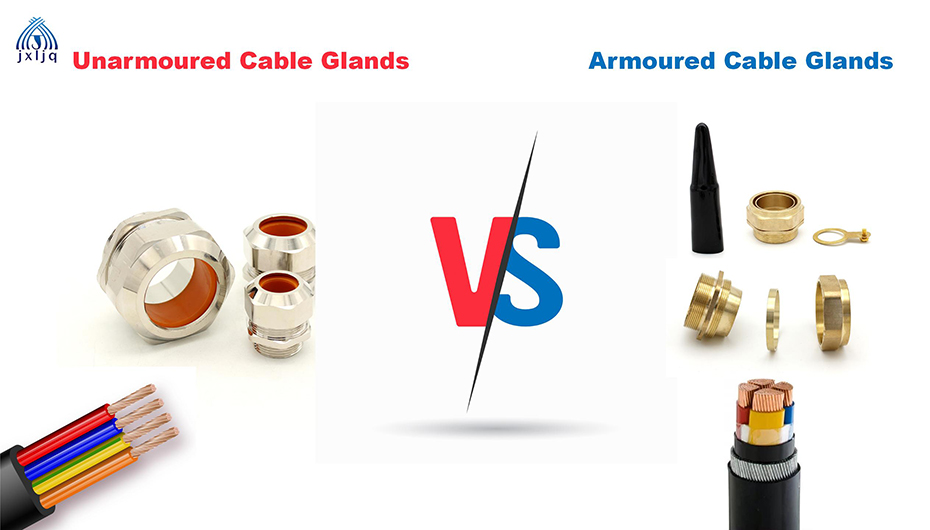
What is armoured cable gland? Under IEC standards, there are two main cable gland types according to mechanical properties, which are non-armoured cable gland and armoured cable gland. This main difference between unarmored and armoured cable gland is that the armoured cable gland are designed for use with steel-wired armoured (SWA) cables. What is armoured […]
We use cookies to enhance your browsing experience, serve personalised ads or content, and analyse our traffic. By clicking "Accept All", you consent to our use of cookies.