What an IP69K Junction Box Is Actually Tested Against
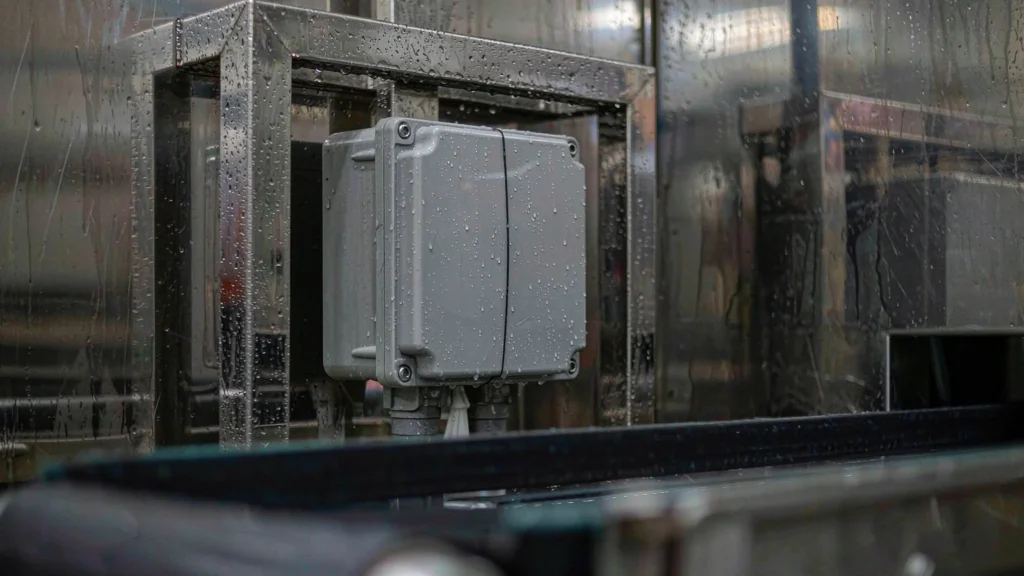
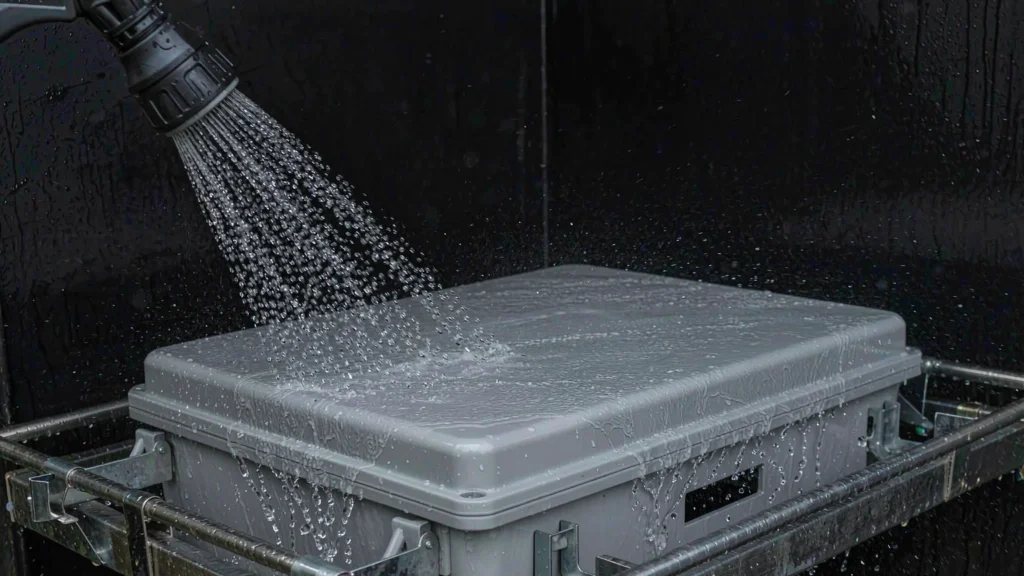
An IP69K junction box is not a stronger IP68 box. It is a box tested against a different enemy. Where IP68 assumes slow, static pressure from immersion, IP69K assumes an 80 °C water jet at 80 to 100 bar, fired from four angles at 100 to 150 mm for 30 seconds each. A plastic enclosure that survives a week at one metre of depth can still fail that jet in half a minute, because a jet does not press on the lid — it finds the gasket land, the cover screws and any unused knockout and drives water sideways past them.
So washdown duty is a design question, not a label question. Below: what the rating measures, where plants actually lose boxes, how material and cable entries decide the outcome, and how to write an RFQ that returns a tested part.
One thing first: none of our standard ranges — the JX-AG, JX-RA or F1 — carries an IP69K claim. The JX-AG is IP67 with IK08, the JX-RA is IP55 or IP65 in ABS, and the F1 is IP68 in flame-retardant PA6. For daily caustic washdown those are the wrong tool, and the honest answer is a different specification, not a bigger number on the same moulding.
The Rating Measures a Snapshot, Not a Service Life
The IP69K test, defined in ISO 20653 and adopted into IEC 60529 as IP69, runs on a new sample at a fixed distance for two minutes of total jet exposure. It says the enclosure did not admit water under those conditions, on that day. It says nothing about what the seal does after 2,000 cleaning cycles — roughly one month of production in a two-shift dairy plant. So ask for the report rather than the logo, since the report names the laboratory, pressure, temperature, distance and angles; and ask whether the test ran with glands and cables installed, because an empty box with plugged entries passes far more easily than your installation will.
The Four Stresses a Washdown Zone Applies
Plants rarely apply one condition at a time, and each attacks a different part of the assembly. Rating the box only against pressure is the commonest specification error we see.
Stress
What it attacks
What fails first
80–100 bar jet
Gasket land, cover joint, entry threads
Unused entries closed with push-out membranes
80 °C water, then cold rinse
Internal pressure and vacuum
Gasket pulled inward; condensation inside
Caustic and chlorinated foam
Polymer surface, seal elastomer
ABS and PC stress cracking; silicone swelling
1–3 cycles per day
Gasket compression set
A seal that no longer springs back
The Pressure Cycle Nobody Writes Into the Spec
Here is the mechanism that separates a good washdown installation from a bad one, and it is arithmetic rather than opinion. Heat a sealed box with a hot jet and the trapped air expands and escapes past the gasket — the seal is pushed outward. Then the rinse hits, the housing drops to 20 °C, and the same fixed volume now holds cooler air at lower pressure.
Take a box sealed at 80 °C and rinsed to 20 °C. At constant volume, pressure scales with absolute temperature: 1 bar at 353 K becomes about 0.83 bar at 293 K. That is a vacuum of roughly 0.17 bar inside the box — the equivalent of 1.7 m of water pressing inward, against a gasket designed to keep water out, not to hold itself in. If moisture is already present the problem compounds, because water at 80 °C has a vapour pressure near 0.47 bar: it flashes during the hot phase and re-condenses on the coldest surface during the rinse. That is how a box that passed its jet test is found half full of water three weeks later with no visible leak path.
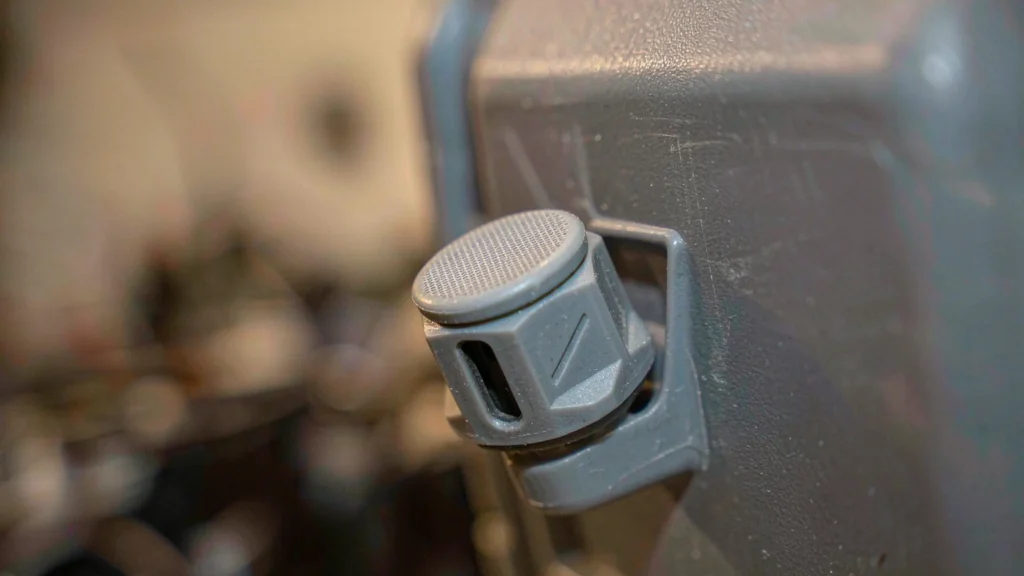
Two fixes follow: a gasket in a machined groove resists inward pull where a flat gasket held only by cover-screw compression does not, and a pressure-equalisation element removes the driving force entirely.
Where Washdown Boxes Actually Leak
Across field returns the same four points appear, in this order of frequency — and only the first is a housing problem.
Unused entries sealed with a membrane or plain cap. A push-out membrane is a dust cover; at 80 bar it deforms or bursts and leaves a direct path into the terminals.
A flat cover gasket on a warped lid. Four corner screws do not distribute load, so the middle of a 200 mm lid bows and the gasket unloads.
Top-facing cable entries. Water collects in the gland body and works down the jacket. A downward entry with a drip loop removes the failure mode for free.
Screws into blind plastic bosses. Repeated inspection wears the thread, preload drops and the gasket relaxes.
Plastic or Stainless: What the Chemistry Decides
Stainless is the usual recommendation in washdown zones and mostly correct, but grade and seal matter as much as metal, and plastic is not automatically wrong. The decision is the cleaning chemistry, not the water.
Material
Caustic foam
Chlorinated / acid
Practical note
ABS
Poor over time
Poor
Stress cracks under sustained caustic; splash only
PA6 / PA66
Moderate
Moderate
Absorbs moisture, so dimensions and stiffness drift
PBT, glass-filled
Good
Good
The realistic plastic option for daily washdown
Polycarbonate
Poor
Poor
Attacked by ammonia and quaternary ammonium sanitisers
304 stainless
Good
Pitting risk
Fine for dairy and bakery, not brine or seafood
316L stainless
Good
Good
Where chlorinated foam or salt is routine
Seal material follows the same logic and fails more quietly. Silicone tolerates heat and steam, EPDM handles caustic and steam but swells in oils, and FKM resists oils and acids but degrades in hot water. A box specified for “washdown” with the wrong elastomer passes the jet test and fails the year. Geometry adds the audit half: a sloped top, no upward-facing ledge, a gasket in a groove and captured cover screws.
Cable Entries Decide More Than the Housing
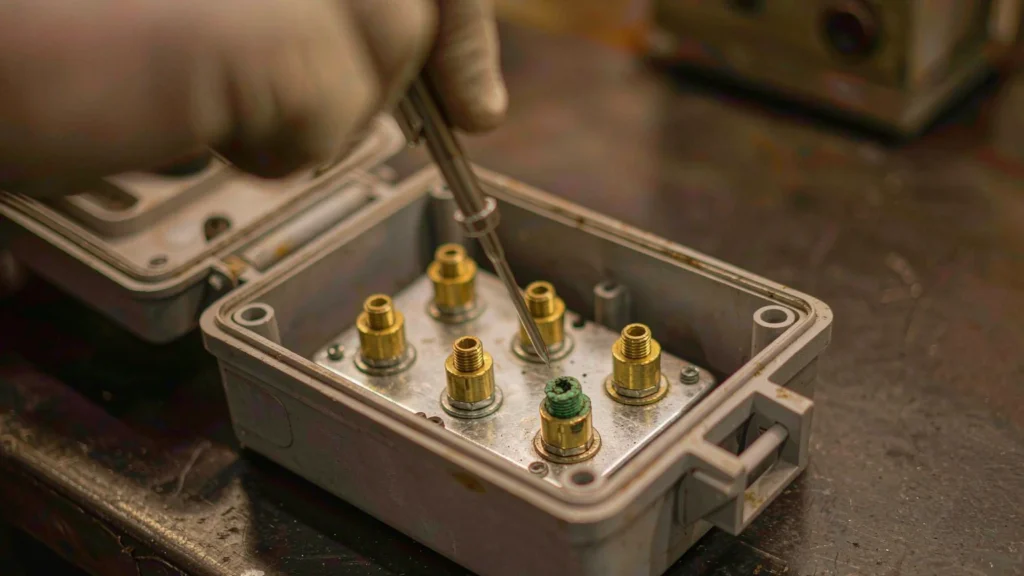
A four-entry box has four chances to leak, and the housing’s rating does not transfer to the glands screwed into it. If the gland is not rated for the same jet, the assembly is not rated at all. Three rules cover most of it: match the gland’s rating to the box, seal every unused entry with a rated plug rather than a membrane, and keep entries on the underside where geometry allows. Settle the entry type before ordering — the trade-offs are in our guide to junction box cable entries — and see IP69K cable glands for the gland side of the same problem.
The Counter-Intuitive Fix: Let the Box Breathe
Sealing a washdown box harder does not stop the thermal cycle above. A breathable vent plug does, by equalising pressure through a membrane that passes vapour but not liquid water — ours is rated waterproof to 3–5 m with an IP68 O-ring, moves 325 ml/min at 0.07 bar, and works from −40 °C to +120 °C. With no differential there is no pumping action, and condensation drops because moisture leaves as vapour instead of condensing on terminals. The catch is siting: the vent must face away from the jet and be a rated component, not a hole with a sticker over it.
How to Write the RFQ So the Answer Is Real
Most washdown failures are specification failures. If the RFQ says “IP69K” and nothing else, the cheapest compliant reply is a claim. Ask for the following instead.
Specify
Ask for
Test evidence
Third-party report naming pressure, water temperature, distance, angles, duration
Configuration
Report covering the housing with glands and cables installed
Seal
Elastomer type, groove or flat land, compression set, replacement interval
Entries
Number, thread standard, and the rated plug used on unused entries
Cycles
Written statement of service life at your cleaning frequency
Chemistry
Compatibility list against your actual cleaning agents and concentrations
Conclusion
Washdown duty is decided by three things in order: what the cleaning cycle really is, whether the seal survives thermal cycling rather than just pressure, and whether every entry is closed to the same standard as the housing. Get those right and IP69K becomes a confirmation instead of a hope. If your application sits between splash and full washdown, our waterproof junction box range covers IP55 to IP68.
FAQ
Is IP69K better than IP68?
Neither; they answer different questions. IP68 covers continuous immersion at a stated depth and time, IP69K a high-pressure high-temperature jet. A box can hold IP68 for a week and fail an 80 bar jet in thirty seconds, and the reverse also happens.
Can a plastic junction box be used in a washdown zone?
Yes, with the right polymer. Glass-filled PBT handles daily caustic cleaning; ABS and polycarbonate do not, because sustained alkali and certain sanitisers cause stress cracking.
Do I need IP69K on every box in a food plant?
No. Dry rooms and packing areas usually need IP65 or IP66. Reserve the jet rating for open-product zones.
What does IP69K testing actually involve?
A jet of 80 to 100 bar at 80 °C, from four angles at 100 to 150 mm, 30 seconds per angle, on a turntable rotating at about 5 rpm. The criterion is no harmful ingress.
Can you supply an IP69K version of the JX-AG?
Not as a catalogue item. For washdown we quote a project-specific housing in a suitable polymer or stainless with rated entries, and supply the test evidence with the sample.
Seven field returns, the teardown evidence that identified each root cause, and the purchase-order clauses that keep a junction box failure from repeating on the next batch.
An IP rating is a test result, not a quality grade. What IP54 to IP68 actually test, where IP65 to IP68 differ, and why one junction box series can carry two ratings.
Compare 304 vs 316 stainless steel cable glands by chemistry, corrosion resistance and cost, and learn when to specify each grade for marine or industrial duty.
We use cookies to enhance your browsing experience, serve personalised ads or content, and analyse our traffic. By clicking "Accept All", you consent to our use of cookies.