Blog
Cable Gland Accessories: Lock Nuts, Earth Tags & Sealing Washers
Cable gland accessories explained: locknuts, earth tags, sealing washers, reducers, blanking and vent plugs — and when each one is required.
Read More
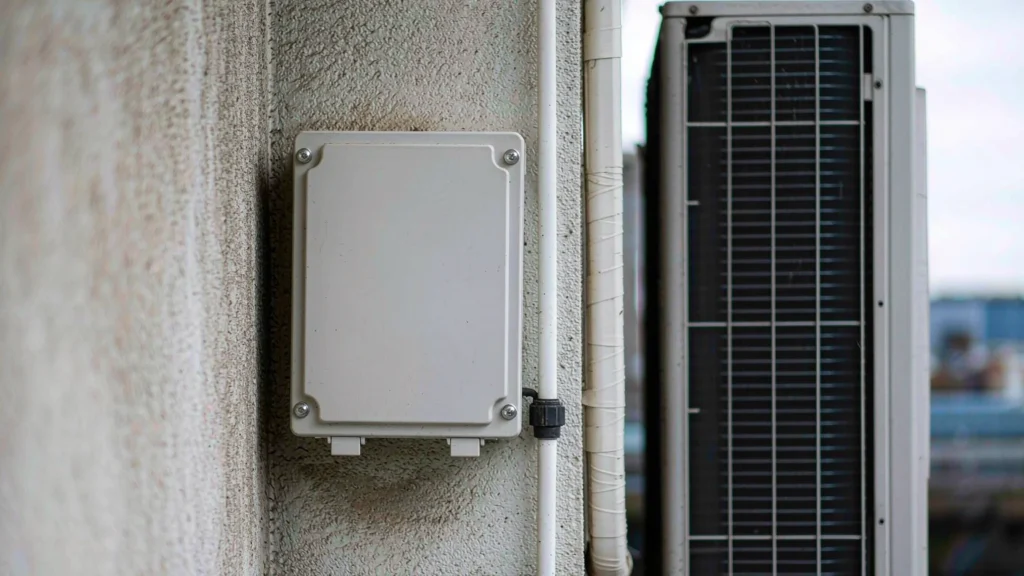
An HVAC junction box sits in one of the worst positions on a building: bolted to a wall beside a condenser, under a condensate drain, in full sun, and shaking every time the compressor starts. Most failures blamed on the box are specification failures — a control enclosure used as a disconnect, a lid that collects drip water, a terminal too small for the conductor it is asked to carry. This guide covers the two boxes an air conditioner actually needs, how to size each, and where to mount them.
Owners and even some installers talk about “the box on the wall” as one thing. Electrically it is at least two, and the requirements barely overlap. A thermostat control box carries a Class 2 circuit at 24 VAC and a few hundred milliamps. The line-voltage disconnect carries the full compressor and fan load at 208–240 V single phase or 400 V three phase. One is a wiring accessory; the other is a switching device with a legal definition.
| Box in the system | What it carries | Enclosure demand |
|---|---|---|
| Control / thermostat junction box | 24 VAC Class 2, 0.5–1.5 mm² control cores | Small sealed box, tool-light cable entry, serviceable lid |
| Condensate overflow switch box | 24 VAC safety loop, two conductors | Same box or a second one beside the pan; dry position only |
| Line-voltage disconnect | Full unit load, 2.5–16 mm² | Listed disconnect with switched contacts — not a plain enclosure |
| VRF / communicating control | Shielded low-voltage pair plus drain wire | Room for shield termination and a spare loop |
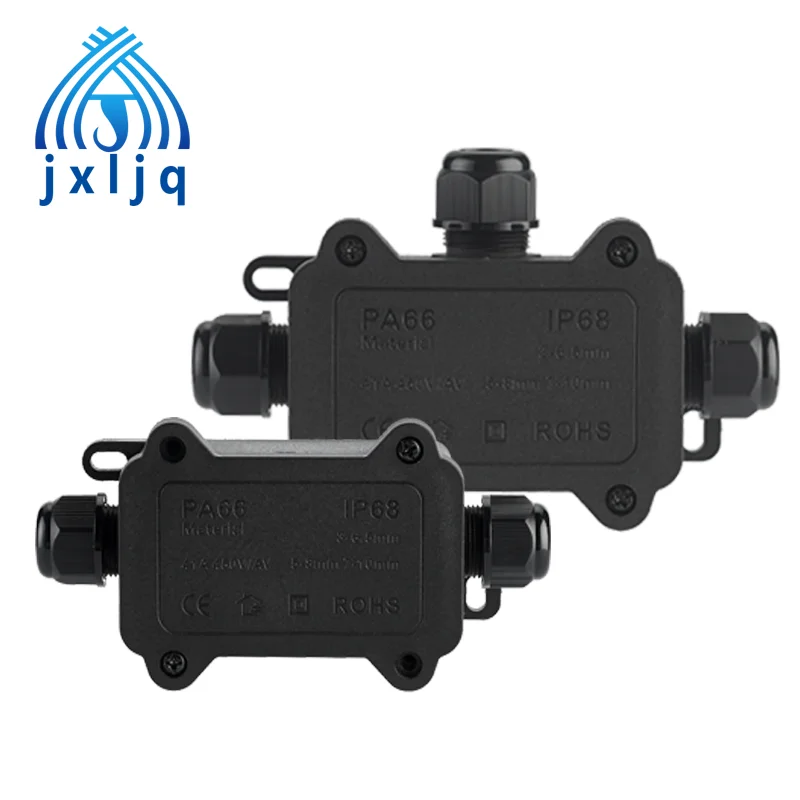
Control wiring is thin, which makes a compact mini box genuinely suitable — but only inside the limits printed on its datasheet. On the F1 series mini junction box the terminals accept 0.5–4 mm² on the 2-way version and 0.5–2.5 mm² on the 3-way and 4-way versions, with a rated 16 A or 24 A at 450 V and a cable range of 3–6.5 mm, 5–8 mm or 7–10 mm outside diameter.
| Circuit to be joined | Conductor | Fits an F1 terminal? |
|---|---|---|
| 24 VAC thermostat control | 0.5–1.5 mm² | Yes, any core count |
| Control plus spares at 2.5 mm² | 2.5 mm² | Yes, but 3- and 4-way boxes, not 2-way only |
| 230 V auxiliary fan at 16 A | 2.5 mm² | Yes electrically, within the 450 V rating |
| 230 V compressor circuit | 6 mm² or larger | No — terminal stops at 4 mm² and cable at 10 mm |
That last row is the whole argument. A 32 A single-phase unit on a 40 A breaker needs about 6 mm² copper, which will not enter the terminal block or the entry grommet of a mini box. Forcing it in is how a “waterproof” box becomes an overheating one.
Codes require a disconnecting means within sight of and readily accessible from the outdoor unit, so that a technician servicing the fan motor is not working on a circuit someone can re-energise from inside the house. A sealed plastic enclosure with a terminal block inside does not satisfy that. It has no contacts, no marked open position, and no way to be locked off. Use a listed non-fused disconnect or a circuit breaker in a rated enclosure, and keep the junction box for joints the disconnect does not cover.
Condensate is the quiet destroyer of HVAC enclosures. A primary drain line, a secondary pan, a trap, and a float switch all sit within a metre of where the control box usually goes. Water leaves a drain line as a drip, not a stream, so the box is not immersed — it is wetted repeatedly on one face, which is far harder on a gasket than a single dunking.
| Position | Verdict | Reason |
|---|---|---|
| Below the pan or trap outlet | Never | Drip lands on the lid and tracks into the gasket line |
| On the unit cabinet side panel | Avoid | Fan vibration plus the panel must come off for service |
| Wall, 300 mm above the pan | Preferred | Out of the drip shadow, reachable, lid faces sideways |
| Attic, under a drip leg | No | Same drip problem with worse access and higher ambient |
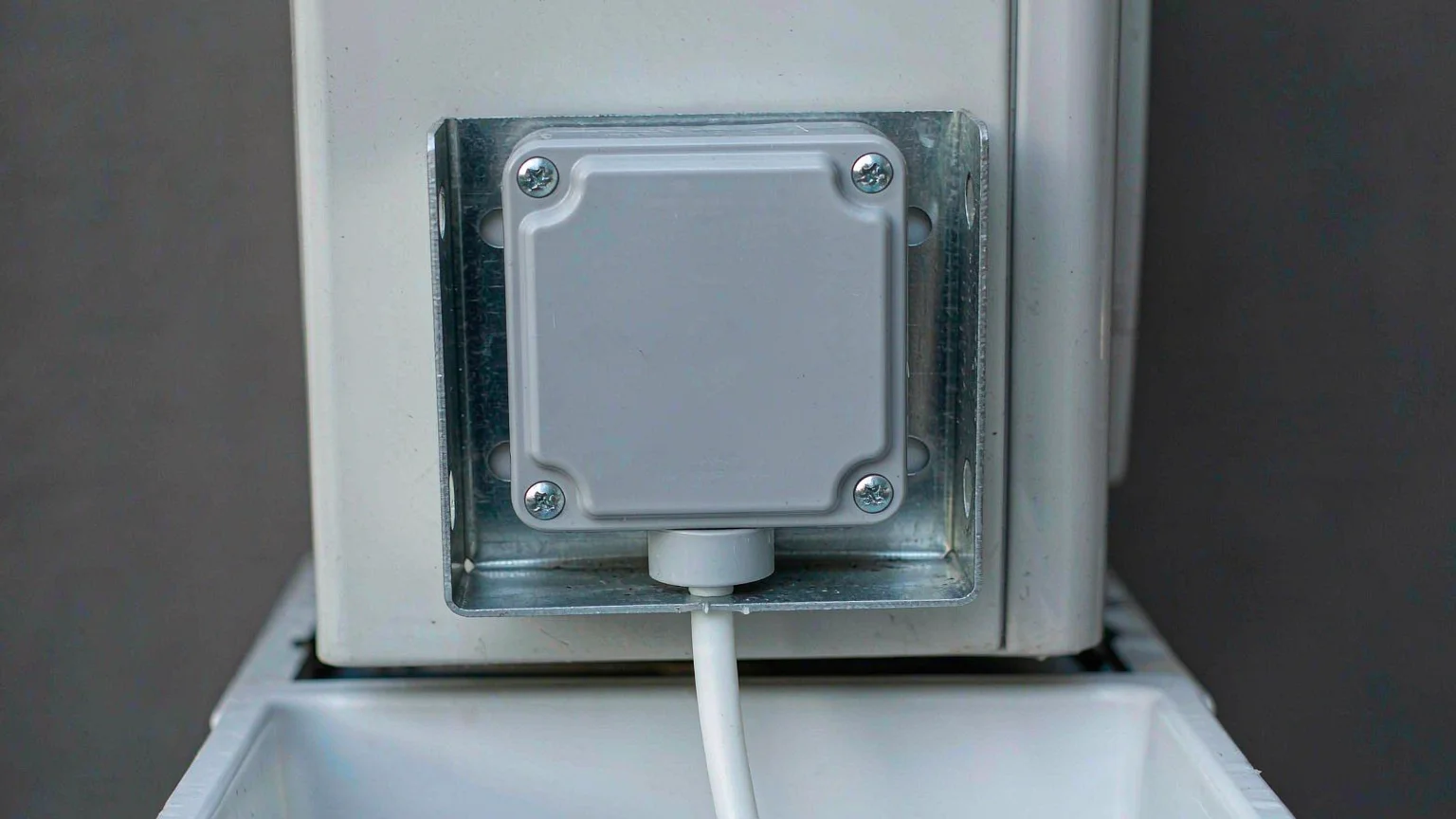
A sealed HVAC junction box on a sunlit wall is a small oven. Internal temperature is roughly ambient plus the rise from the load inside, and near a condenser the ambient itself can be 10–15 K above air temperature. The F1 housing is rated −40 °C to +105 °C, which covers the climate but not the arithmetic of a dark box with a 3 W transformer inside it. If the joint carries real current, ventilate the pressure with a breathable vent plug rather than leaving a lid screw loose.
An outdoor unit starts and stops several times an hour. Each cycle sends a pressure wave through the cabinet and into anything bolted to it. Two things give way: the fastener preload and the gasket.
Not the screw thread. Plastic bosses creep under sustained load, so the joint relaxes even when nothing turns. A lid that was tight in spring can be finger-loose by autumn without a single thread having rotated. Re-torque at commissioning and again after the first heating season.
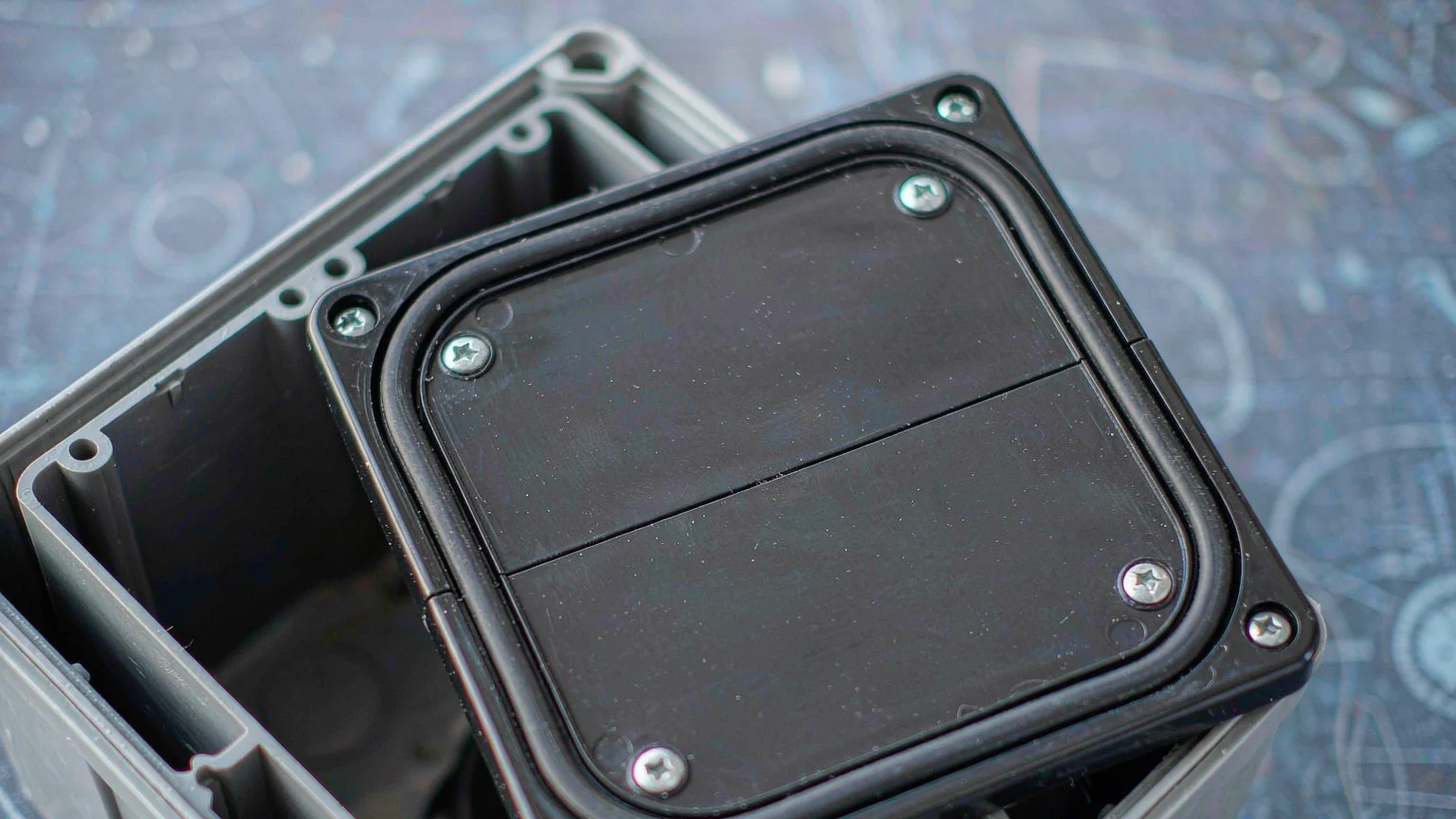
Bolting the box to the unit puts it in the loudest place available and guarantees the box moves during service. A short wall bracket with a drip loop in the cable costs nothing and removes both problems.
The float or overflow switch is the cheapest protection on the system and the easiest to wire badly. It belongs in the 24 VAC control loop in series with the thermostat call, so a full pan stops the unit instead of flooding the ceiling. Two conductors, no polarity, and it must fail safe: if the switch or its wiring opens, the unit must stop, not run. Bring it into the same control box, label the pair, and leave enough slack to lift the lid without stretching the cores.
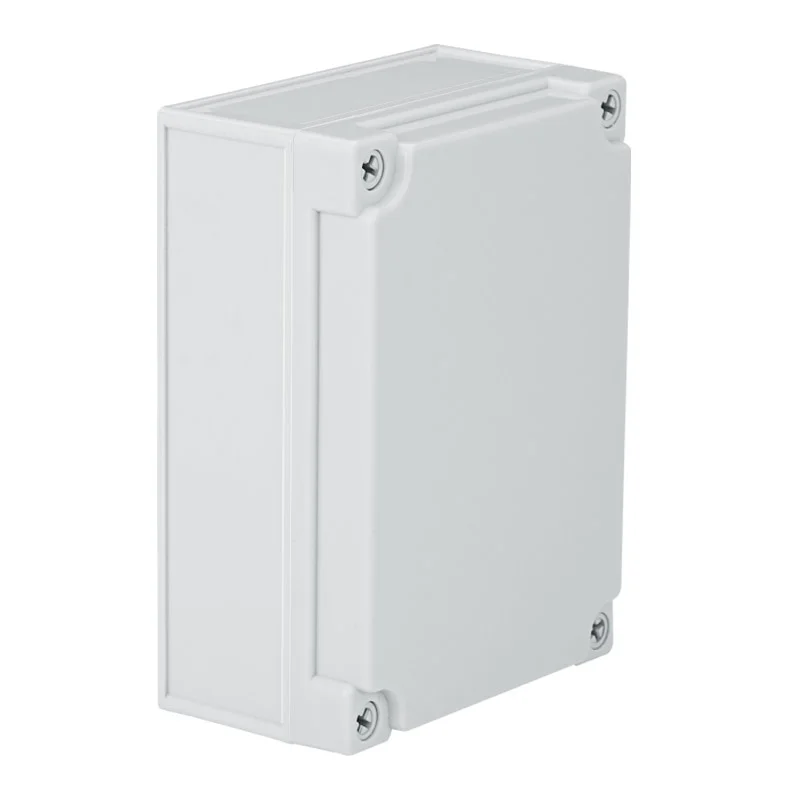
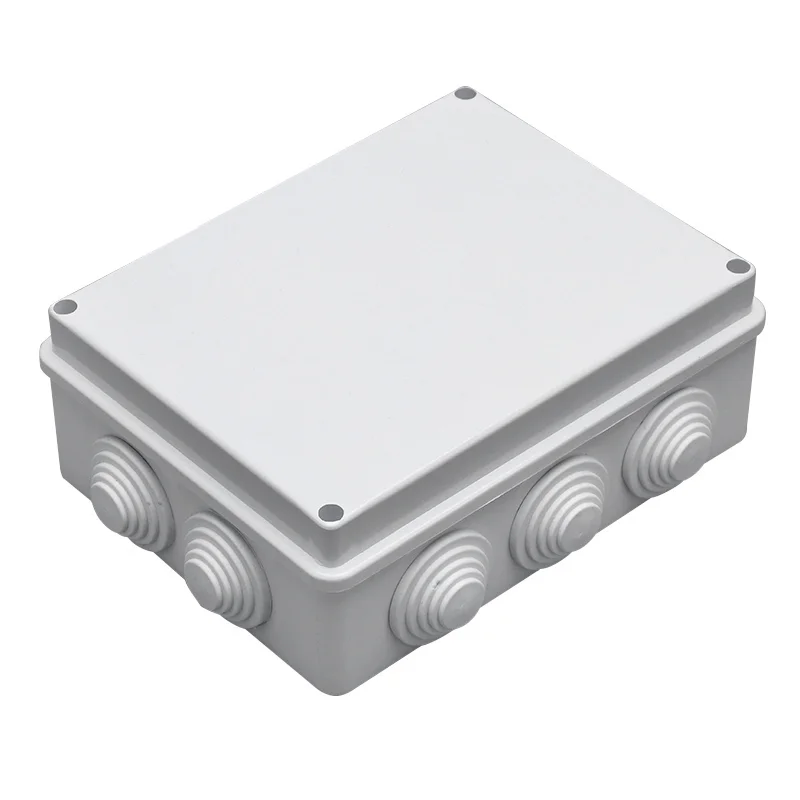
Two plastics cover nearly every case. Flame-retardant PA66 with a silicone O-ring, as used on the F1, handles heat, UV and repeated lid opening, and its V0 rating matters where the box sits near combustible construction. ABS, as on the JX-RA plastic waterproof junction box, gives a larger, cheaper enclosure at IP55 or IP65 with CE and RoHS documentation — a good fit for indoor air handlers and mechanical rooms, less so for a sunlit roof where UV exposure shortens service life.
Four lines settle most arguments later: the IP rating and whether the box is mounted in the drip shadow; the conductor size and terminal range; the enclosure material and its temperature rating; and whether the box is a joint or a disconnecting means. Add the cable entry type — grommet, knockout or gland — because that single choice decides how the seal performs in service.
For an HVAC junction box on a residential split system, the F1-2T/3T/4T covers 24 V control joints, overflow switch loops and auxiliary 230 V loads up to its 450 V terminal rating. The JX-RA range, from 50×50 mm up to 400×350×120 mm, covers larger control and monitoring assemblies where a DIN rail or PCB mounts inside. For anything carrying the compressor circuit, we will tell you to buy a listed disconnect — that part is not ours to sell, and pretending otherwise is how a spec sheet loses its credibility.
Separate the control circuit from the line-voltage circuit, size the box against the terminal range rather than the cable outside diameter, and keep it out of the condensate drip shadow. Those three decisions do more for service life than any rating printed on the lid. If a joint keeps collecting condensation, the box is not the problem — the pressure cycling is.
No. A disconnect needs switched contacts, a marked open position and the ability to be locked off. A sealed enclosure with a terminal block has none of these, however high its IP rating.
IP65 is a reasonable floor for a wall position under an eave, and IP67 where the box takes direct rain or washdown. The mounting position matters more than the number.
Not in the same compartment. Class 2 control wiring and line-voltage conductors need separation by barriers or by using two enclosures.
Above the pan and outside the drip shadow of the trap outlet, with the lid facing sideways or down so water cannot pool on the gasket line.
If the box cycles between hot afternoons and cold nights, yes. Pressure equalisation stops the inward pumping that pulls moist air past the gasket.
At least −20 °C to +80 °C for most sites. The F1 is rated −40 °C to +105 °C, which leaves margin for a box mounted close to a condenser discharge.

Cable gland accessories explained: locknuts, earth tags, sealing washers, reducers, blanking and vent plugs — and when each one is required.
Read More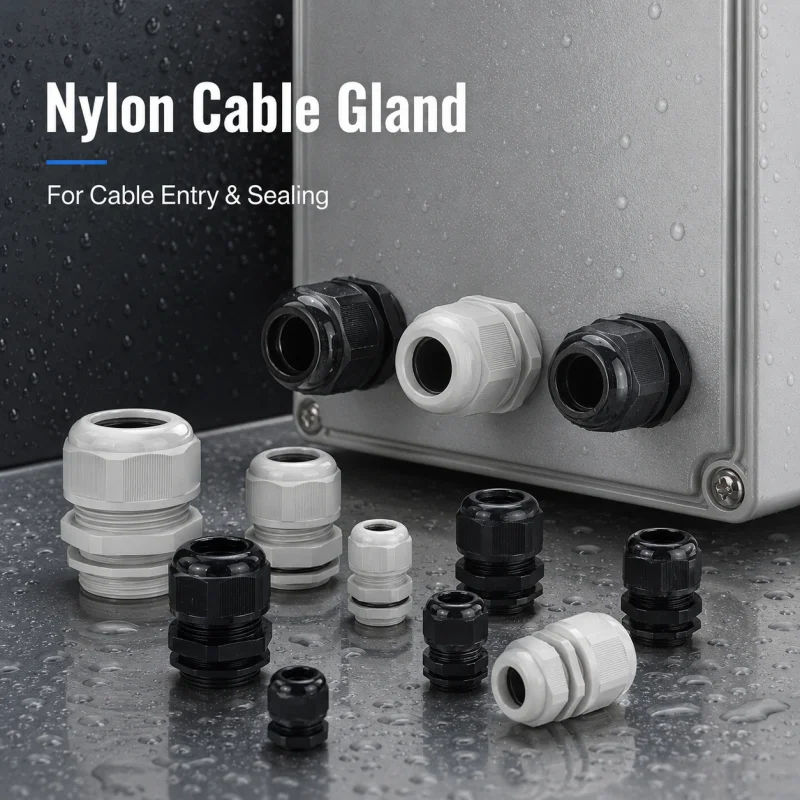
1. IP68 Nylon Cable Gland Overview: What It Is and Why It Matters An IP68 Nylon Cable Gland is a cable entry sealing component used to secure and protect electrical cables as they pass into enclosures, junction boxes, or industrial equipment. Its primary function is not only to fix the cable in place but also […]
Read More
Salt spray, chloride film and galvanic couples: how to zone a coastal site, choose the right housing and gland, and keep a marine junction box sealed.
Read More