Blog
2-Way vs 3-Way vs 4-Way Mini Junction Box: Which Configuration to Order
2-way, 3-way or 4-way? How entry count changes the box you order, with the full F1 order-code table, cable ranges and the conductor limit most buyers miss.
Read More
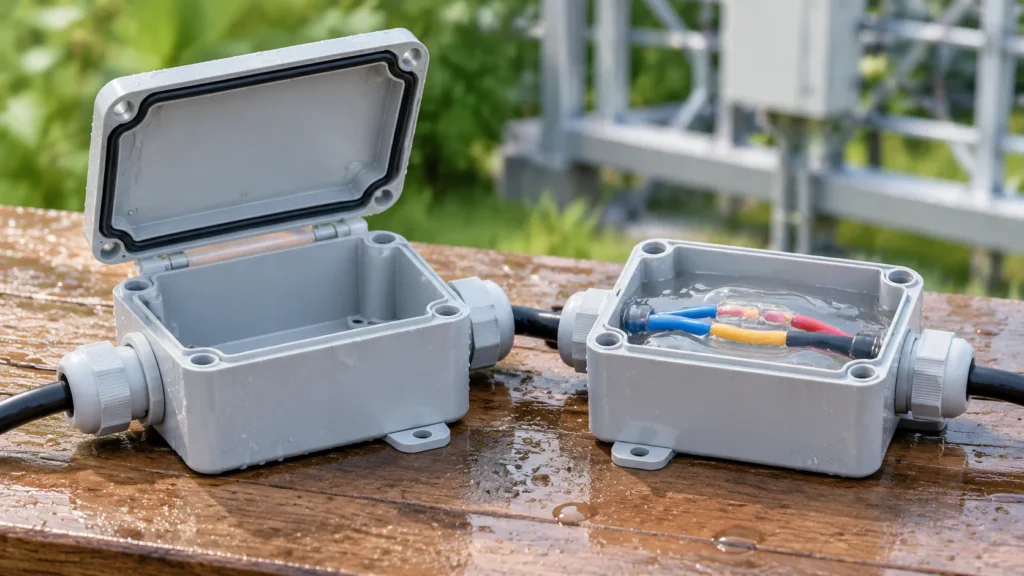
A gel filled junction box and a mechanical-seal mini junction box solve the same problem from opposite directions. One fills the space around the splice so water has nowhere left to sit. The other keeps water out of the space entirely and lets you open the lid again next year. Neither is better in general, and the datasheets do not settle it: the decision turns on whether anyone will ever re-enter the box, how hot the enclosure gets in service, and whether the gel is poured in a factory or on site in the rain. This comparison starts by separating three sealing methods that the market usually lumps into two.
Most buying guides frame this as a two-way contest. In practice there are three sealing architectures, and the middle one behaves nothing like the other two.
| Sealing method | How it seals | Re-openable | Best fit |
|---|---|---|---|
| Silicone O-ring and gland (mechanical) | Elastomer compressed between lid and body; each cable entry compressed around its jacket | Yes — reopen and replace the O-ring | Serviceable splices, inspection and testing regimes |
| Re-enterable gel or grease-filled connector | Soft gel displaced by the conductors, stays viscous, excludes air from the contact | Yes, for a limited number of cycles | Valve boxes, small repairs, splices reached by hand |
| Cured potting gel or resin | Two-part compound cures into a solid block around the splice | No — it must be cut out | Buried or inaccessible joints, permanent connections |
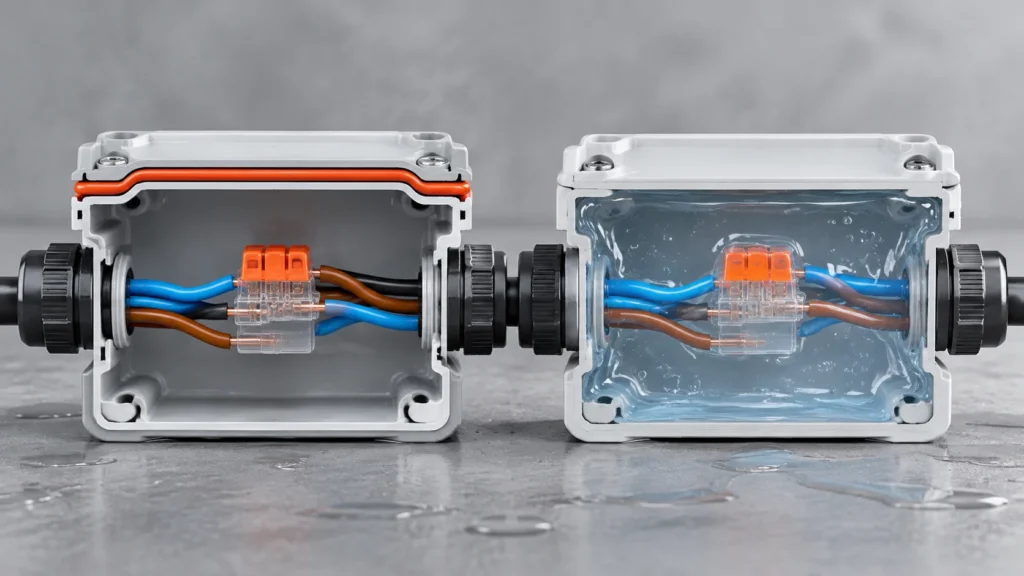
Note what that table does to a very common claim. Several guides state that gel is the re-openable option and mechanical seals are permanent. That is exactly backwards for cured gel, which is the least re-enterable product in the category. If a specification says “gel filled” without saying which of the two gel types, you do not yet know whether the joint can be serviced.
A gel filled junction box is not a box that keeps water out. The IP rating belongs to the housing and the cable entries; the gel is a second, independent barrier that protects the conductor joint. Water still gets in through a gland tightened on an oval jacket, through condensation, or through a flooded handhole. The gel occupies the volume around the splice so that water inside the box has no path to bare copper. Buying a gel-filled box does not remove the requirement for correctly sized entry seals, and it does not upgrade an IP65 housing to IP68.
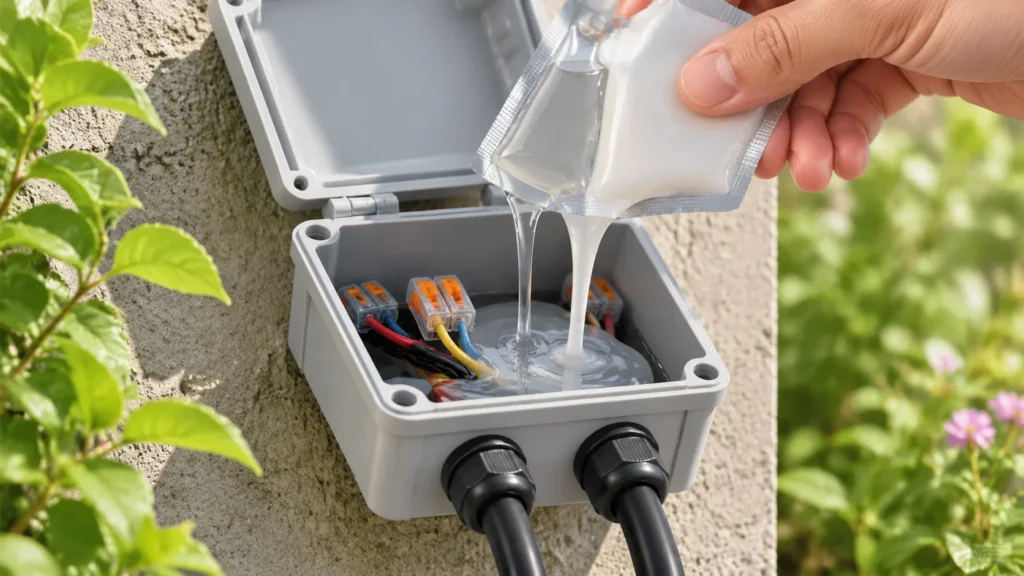
The failure mode of gel is voiding. A compound mixed and poured at 5 °C traps air and shrinks as it cross-links, and a void the width of a hair holds a film of water against a terminal. Factory potting under vacuum and a sachet poured on site should not be priced as the same product.
The mini junction boxes in our own range are rated -40 °C to +105 °C. A silicone gel is not automatically rated to match. Unfilled silicone gel expands roughly 250 to 300 µm per metre per kelvin, against 70 to 90 for PA66 and about 17 for copper. Over a 60 K swing on a 60 mm span, the gel moves about 0.9 mm while the housing moves about 0.3 mm. The surplus goes out of the gasket line as a slow weep of oil that gets reported as a leak.
Filled potting compounds sit closer to the housing expansion, but they are brittle: on a cold night the block can crack the lid it has bonded to. Inside a metal cabinet in direct sun, internal air can run 15 to 20 K above ambient — a planning figure, not a measurement of our products. Two rules follow. First, treat the gel’s continuous temperature rating as the rating of the assembly, because it is usually the lowest number in the stack. Second, if the joint must survive both a hot cabinet and a cold night, a mechanical seal has fewer moving parts in tension.
Reopening a mechanical box costs an O-ring. Reopening a cured gel box costs a splice: the block is cut away, the conductors cleaned and re-terminated, and the old compound does not come off a brass terminal politely. On a retrofit site that is the number that decides the specification, not the unit price.
The mechanical side has its own discipline. An O-ring compressed for two years takes a permanent set, so closing the lid again without a new seal is a guess — the mechanism behind most “it was fine until we opened it” callbacks. See the six installation mistakes that break an IP rating.
Gel sits against the cable jacket for years. Plasticiser migrates out of PVC insulation into many gels, softening the gel and swelling the jacket while the housing still looks perfect. XLPE and PE are far more stable. A PVC cable in a gel-filled box deserves a compatibility statement from the compound supplier, not an assumption.
| Scenario | Better choice | Why |
|---|---|---|
| Landscape lighting tap on a stem, 2–3 conductors | Mechanical mini box | Reopenable, inspection access, 3–10 mm cable range |
| Irrigation valve box splice, permanent | Re-enterable gel connector | Pit floods; splice must tolerate standing water |
| Direct-buried run with no future access | Cured potting | Nothing will be opened again; treat it as permanent |
| Sensor or camera junction on a pole | Mechanical mini box | Re-termination is likely; heat rise under a metal housing |
| Splice inside a sealed cabinet that condenses | Gel plus a vent | Moisture arrives from the air, not from outside |
If the joint sits in a sealed enclosure rather than a flooded pit, the moisture problem is condensation, and the answer may be a vent rather than more gel — see condensation in junction boxes and the breathable vent plug. For burial questions specifically, can you bury a junction box covers what the code actually permits.
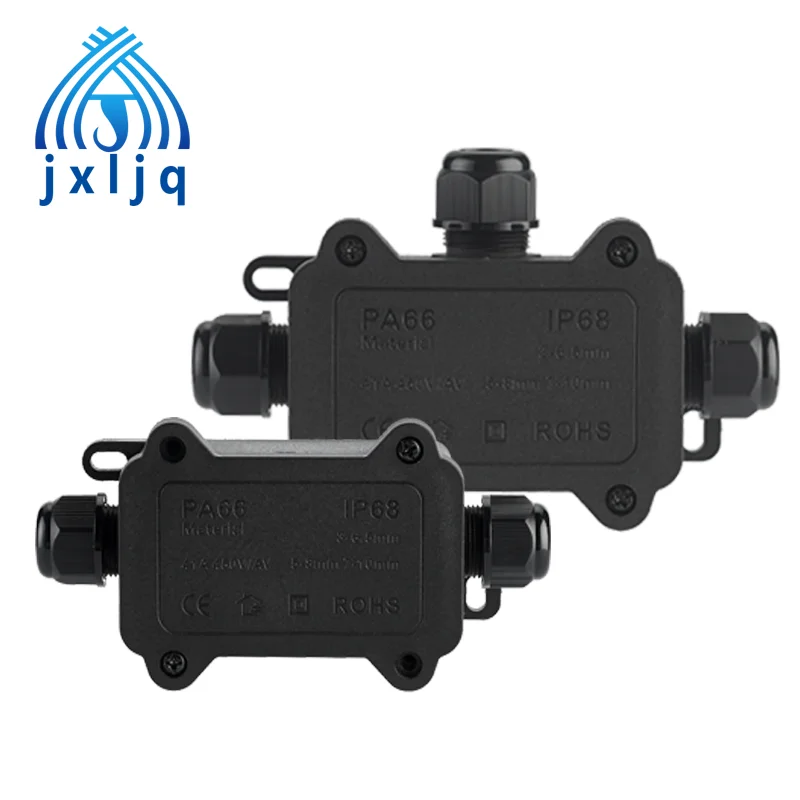
Our mechanical mini range is the F1 series: IP68, silicone O-ring, flame-retardant polyamide housing, 450 V, 16 A or 24 A by way count, 0.5–4 mm² on the 2-way and 0.5–2.5 mm² on the 3- and 4-way. Eight codes cover the range, and the 4-way stops at 8 mm.
| Order no. | Openings | Cable range (mm) | Weight (g) |
|---|---|---|---|
| MN-01 | 2-way | 3–6.5 | 71.6 |
| MN-02 | 2-way | 5–8 | 72.8 |
| MN-03 | 2-way | 7–10 | 70.8 |
| MH-05 | 3-way | 3–6.5 | 78.8 |
| MH-06 | 3-way | 5–8 | 77.4 |
| MH-07 | 3-way | 7–10 | 76.5 |
| MN-8 | 4-way | 3–6.5 | 85.0 |
| MN-9 | 4-way | 5–8 | 79.5 |
Everything on that table is a mechanical seal. If your specification requires a gel filled junction box, we build it as a project variant around the same housing rather than pretending the catalogue part is something it is not. Full dimensions are on the F1-2T/3T/4T product page, the category view is at mini junction boxes, and the selection walk-through is in the mini junction box guide.
Choose a mechanical-seal mini junction box when the joint will be opened, tested or re-terminated, when the cable is above 8–10 mm, or when the enclosure runs hot. Choose gel when the joint is permanent and the water is guaranteed — a valve box, a handhole, a buried splice — and say whether that gel is re-enterable or cured, because the difference is a service call. The IP number describes the housing, not whether the splice inside will be clean in five years.
Yes. The gel protects the splice; the housing and entries still have to suit the location, and a gel box with an unsealed gland fills with water like any other.
Only if the housing, terminals and compound are specified together. Field pouring at low temperature traps voids, and the housing must be rated for the cured block’s expansion.
Usually, because burial means the joint will not be reopened and the water table does the rest. Neither option turns a standard enclosure into a product rated for direct burial.
Thermal expansion. Unfilled gel expands several times more than the polyamide housing, and the surplus escapes at the weakest joint. It looks like a leak but is not water ingress.
2-way, 3-way or 4-way? How entry count changes the box you order, with the full F1 order-code table, cable ranges and the conductor limit most buyers miss.
Read More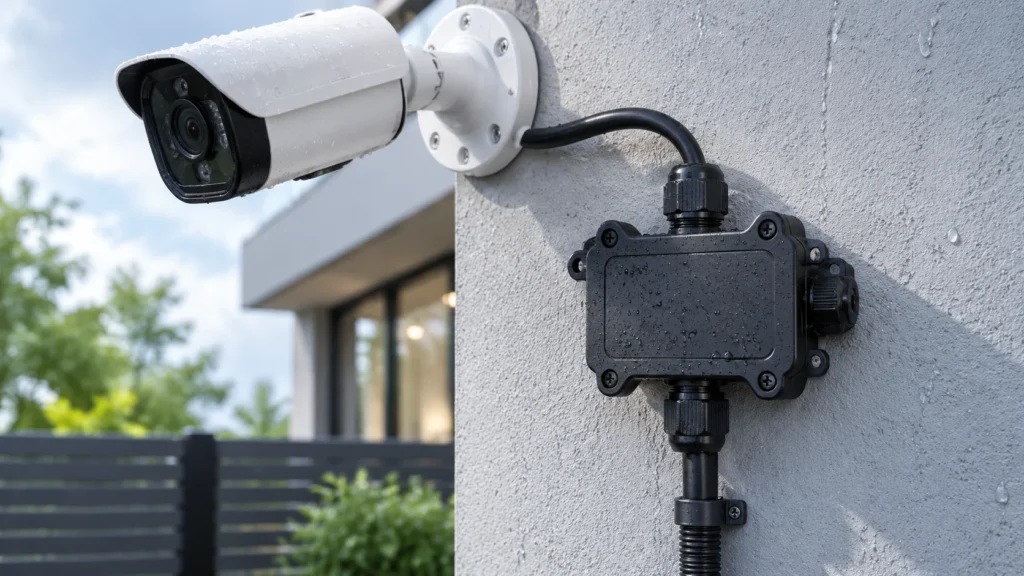
Size a camera junction box before you try to seal it: cable types, the RJ45 that will not pass a gland, bend radius, volume arithmetic and the four places water really gets in.
Read More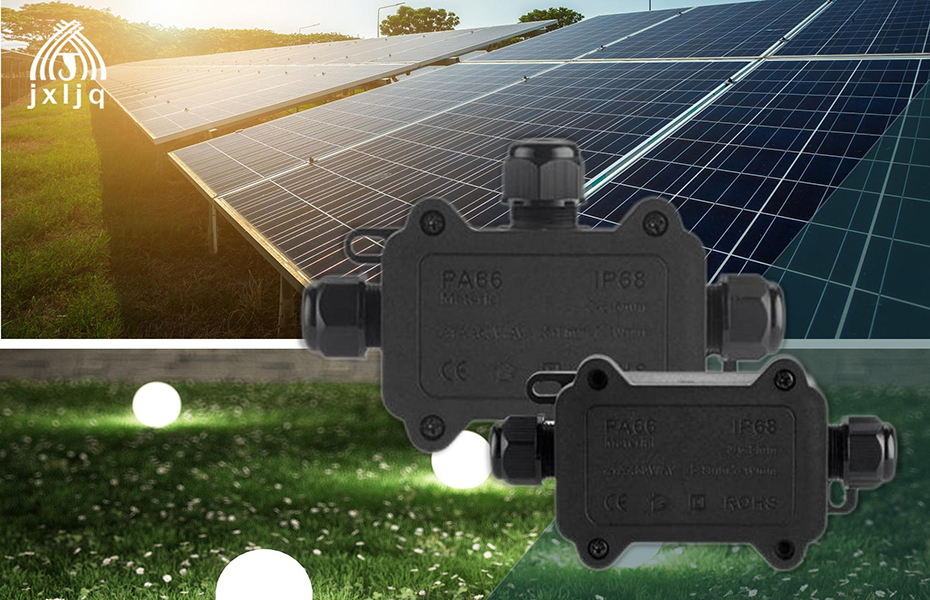
What small waterproof junction boxes are used for: outdoor lighting, buried fixtures, security, solar and pump wiring, with features, selection and DIY installation.
Read More