Blog
Why use an adaptor or reducer?
When to use a cable gland adaptor, reducer or enlarger: the difference between them, common thread combinations, and how to keep the IP rating when threads do not match.
Read More
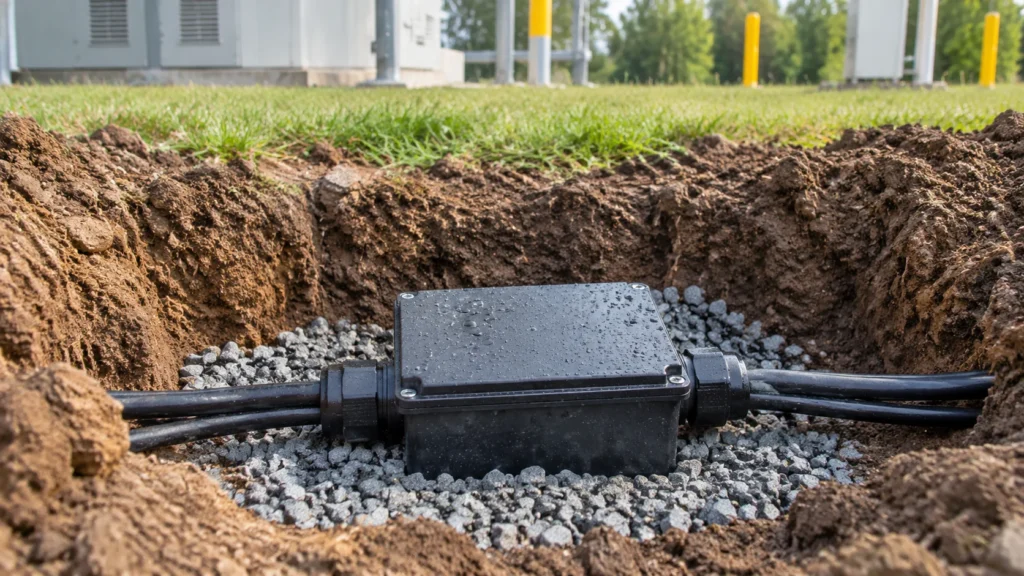
Can you bury a junction box? In most jurisdictions, no — not one that contains splices. NEC 314.29 requires boxes to be installed so the wiring inside can be reached without excavating anything used to establish finished grade. There is exactly one narrow exception, for listed boxes covered by gravel, light aggregate or noncohesive granulated soil with their location effectively identified, and it is far narrower than most forum answers suggest.
Everything below unpacks that exception, separates the box rule from the cable rule that people confuse it with, and explains why an IP-rated waterproof junction box buried in soil still fills with water.
The accessibility rule is not bureaucratic. A splice is the least reliable point in a circuit: it can loosen, corrode or arc, and it is the joint most likely to need attention over the life of the installation. Code writers concluded that a joint nobody can reach is a joint nobody will maintain, so the requirement is about maintenance access rather than moisture.
That framing matters, because it tells you which part of the problem a higher IP rating can solve and which part it cannot. Moisture protection is an enclosure question. Accessibility is a wiring question. A box can pass the first test and fail the second, and burying it guarantees the second failure.
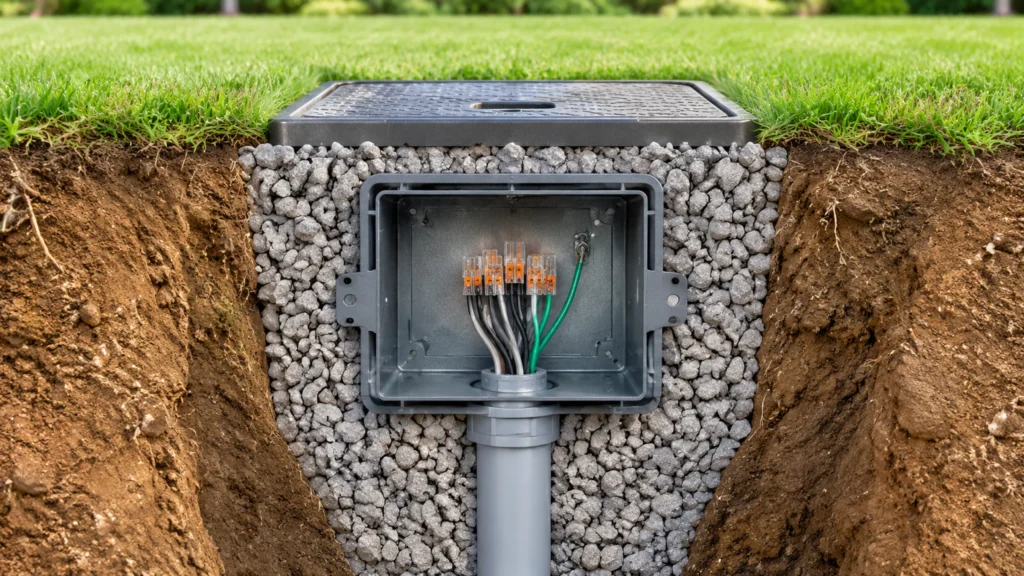
NEC 314.29(B) covers underground boxes and handhole enclosures, and its exception permits listed boxes and handhole enclosures where they are covered by gravel, light aggregate or noncohesive granulated soil, provided the location is effectively identified and accessible for excavation. Note what is on that list and what is not: earth, paving, concrete and finished grade are absent.
So the permitted installation is a handhole raised into a gravel-filled pit, with a cover you can lift and a location you can find again on a drawing. The forbidden installation is a box under a lawn or a driveway. In practice that means the exception works for a service pit and does not work as a way to save a trench run.
| Installation | Permitted | Condition |
|---|---|---|
| Box in a gravel-filled pit, cover at grade | Yes | Listed box, location recorded, excavatable |
| Box under noncohesive granulated soil | Yes | Same three conditions, still accessible |
| Box under earth to finished grade | No | Excavation required to reach wiring |
| Box under paving, concrete or a driveway | No | Explicitly named in the code text |
| Box cast into a slab | No | Structure cannot be removed without damage |
Most searches that start with a buried box actually need the cable depth rule. NEC Table 300.5 sets minimum cover over direct-buried cables and conductors, measured from finished grade: 24 inches in general, 18 inches where the trench sits below a 2-inch concrete slab, and 12 inches for residential branch circuits at 120 V or less with GFCI protection and overcurrent protection of 20 A or less.
Those numbers describe how deep the conductor must sit. They say nothing about whether you may put a box down there, and satisfying one requirement never satisfies the other. A perfectly legal 24-inch cable run with an illegal box spliced into it is still a failed inspection.
| Condition | Minimum cover | Governs |
|---|---|---|
| Direct-buried cable, general | 600 mm / 24 in | Cable depth |
| Trench below 50 mm concrete | 450 mm / 18 in | Cable depth |
| Residential ≤120 V, GFCI, ≤20 A | 300 mm / 12 in | Cable depth |
| Any junction box with splices | Not applicable | Accessibility, not depth |
IPX8 means the enclosure survived continuous immersion at a depth and duration the manufacturer declares. Neither figure appears in the digits, and neither is defined by IEC 60529. Soil is not water either: it adds sustained load on the lid, chemistry from fertiliser and road salt, and a temperature that never dries the enclosure out.
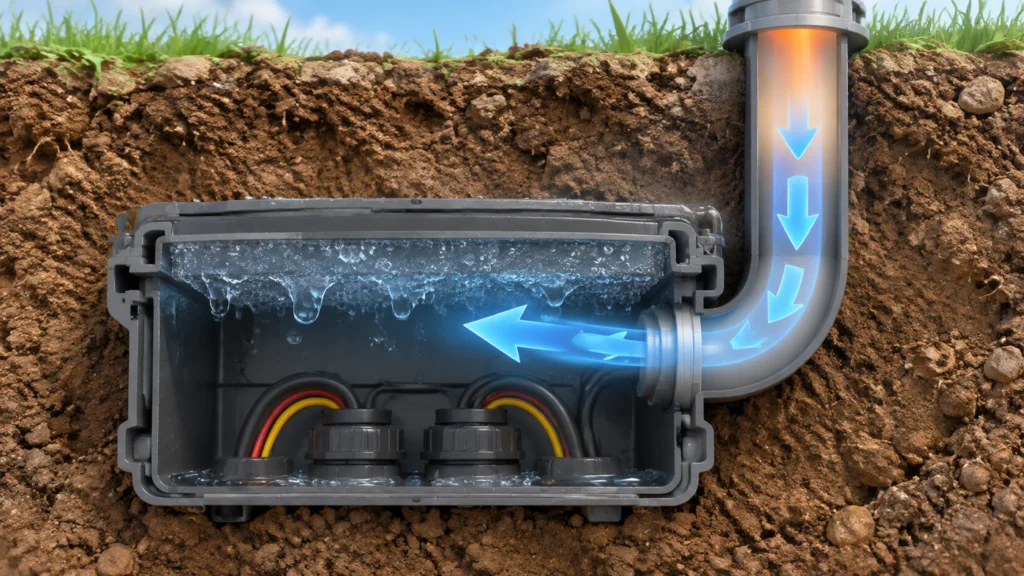
The mechanism that actually destroys a buried box is a convection loop through its own conduits. Soil holds a near-constant temperature. The conduit connects the box to warm, humid air above grade. By day that air expands and drifts down; by night the box cools below the dew point of the air above it, and moisture condenses on the inside of the lid and runs down onto the terminals. Two cycles a day, every day.
That is why a buried box so often arrives at its first inspection half full. The gasket held; the water came down the pipe and condensed out of the air. Our guide to condensation in sealed boxes covers the same physics above grade, where it is slower and easier to manage.
The options rank by how much of the code problem you remove, not by how much they cost. Bringing the splice to grade removes it entirely. Encapsulating the splice removes the box, and with it the accessibility requirement — provided the kit is listed for direct burial and your inspector agrees.
| Option | Accessible | Serviceable | Best fit |
|---|---|---|---|
| Box above grade | Yes | Yes | Default answer |
| Listed handhole in gravel pit | Yes | Yes | Long runs, gate posts, garden circuits |
| Encapsulated splice kit | Not applicable | No | Short branch taps, no pit possible |
| Gel-filled enclosure | No | No | Landscape and irrigation taps |
Where a handhole or pit is unavoidable, the details that decide whether it survives are unglamorous. Backfill with gravel or light aggregate rather than excavated clay, so water drains instead of sitting against the lid. Keep the pit out of vehicle paths, because covers crack under wheel loads. Photograph the position, mark it on the drawing and note the depth.
Then design for water arriving from above: entries should point down where possible, every gland should match the measured cable diameter, and each unused opening should be blanked. A pit that fills after heavy rain is normal; a pit that holds water against the lid for days is not.
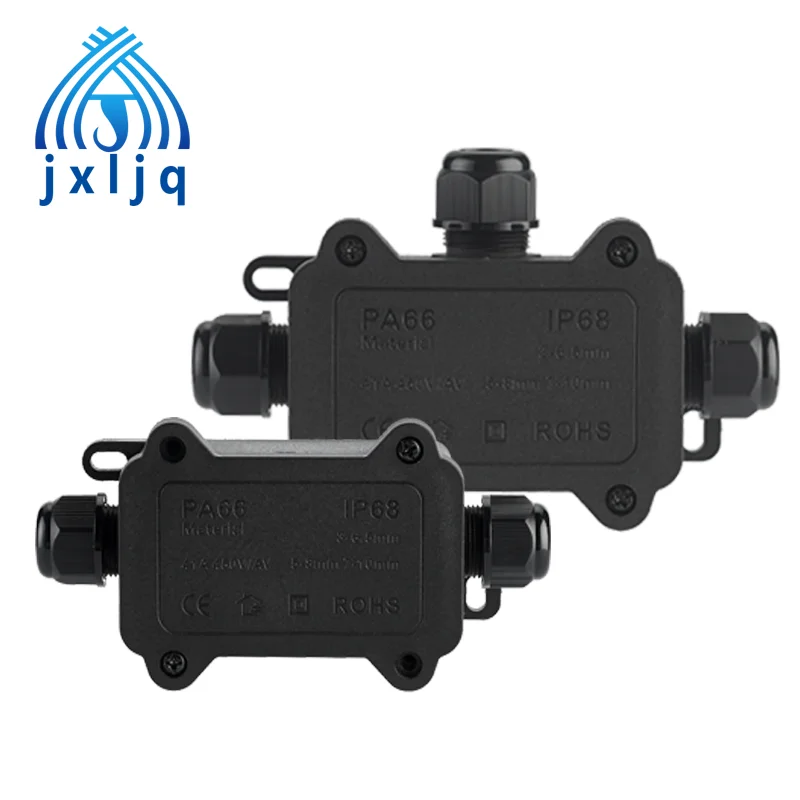
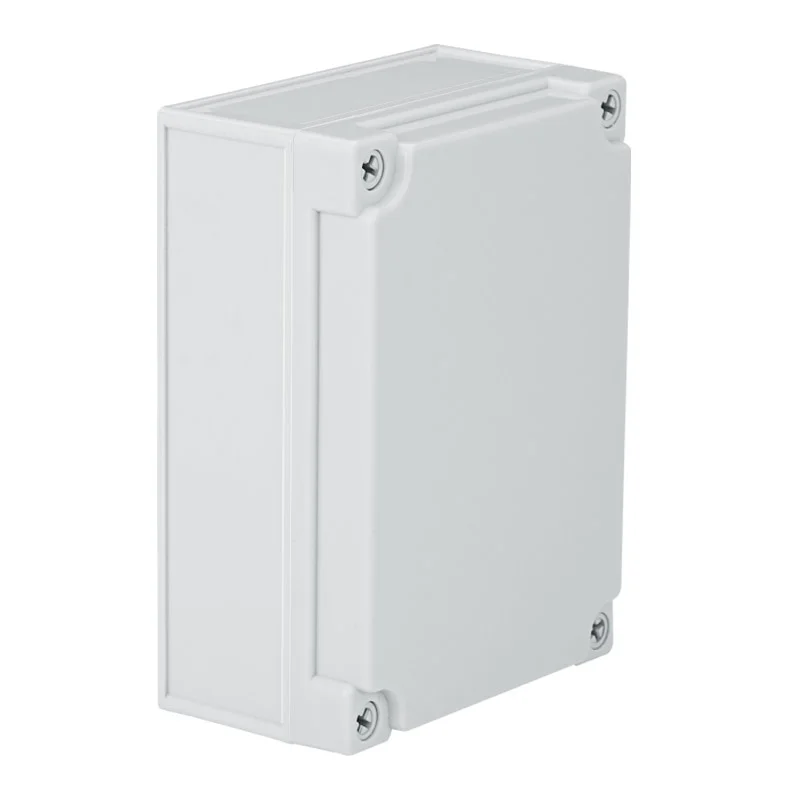
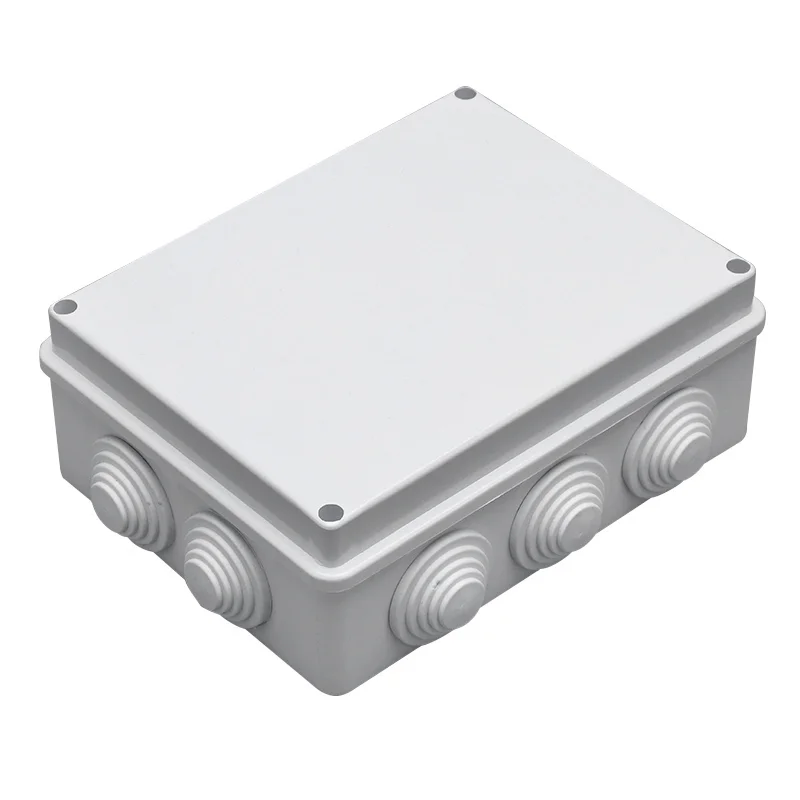
It is worth being blunt here, because supplier pages are where most burial myths start. Our F1 series is IP68 in flame-retardant PA66 with a silicone O-ring, rated −40 °C to +105 °C, 450 V and 24 A. The JX-AG series is IP67 with an IK08 impact rating in ABS from 95×65×55 mm to 280×190×180 mm. The JX-RA series is IP55 or IP65 in ABS.
None of those datasheets states direct-burial suitability, so none of them should be read as a burial rating. IP68 covers immersion under declared conditions; it does not cover soil load, soil chemistry or the fact that a buried lid must stay liftable. If your design needs an enclosure in the ground, the honest specification is a listed handhole, not a higher IP digit.
So can you bury a junction box? You can bury an enclosure; you cannot bury a splice that has to remain accessible, and bringing the joint to grade is usually cheaper than arguing about it. Use the selection guide to pick the housing once the joint is above grade, and check what each IP level really tests before you accept a rating as a burial claim. If the joint is outdoors but not underground, NEMA 4X versus IP68 is the more relevant comparison.
The rating does not change the accessibility rule. An IP68 box may survive immersion, but NEC 314.29 still requires the wiring to be reachable without excavation, so the rating cannot legalise a buried splice.
There is no burial depth for a box with splices. The depth figures people quote, 24, 18 and 12 inches, come from Table 300.5 and apply to direct-buried cable, not to enclosures.
A handhole is a listed enclosure designed to be installed with its cover at grade and opened from above. That design is what makes the 314.29(B) exception usable for an underground circuit.
Yes, and it is a reasonable retrofit. The valve box keeps soil off the enclosure and gives you access, while the inner box handles splashing. Drain the outer pit with gravel and keep the cover liftable.
Treat it as any other outdoor joint: splice above grade in a waterproof enclosure, or use a listed direct-burial connector. The landscape lighting wiring guide covers the voltage drop and terminal limits that decide the box size.
When to use a cable gland adaptor, reducer or enlarger: the difference between them, common thread combinations, and how to keep the IP rating when threads do not match.
Read More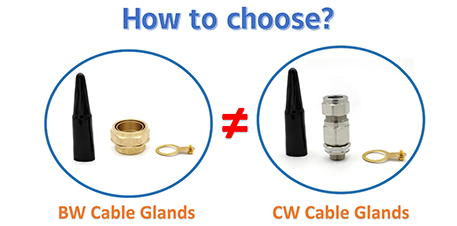
BW and CW cable glands both terminate SWA armoured cable, but they are built for different environments. Learn the key differences, IP ratings, and how to choose.
Read More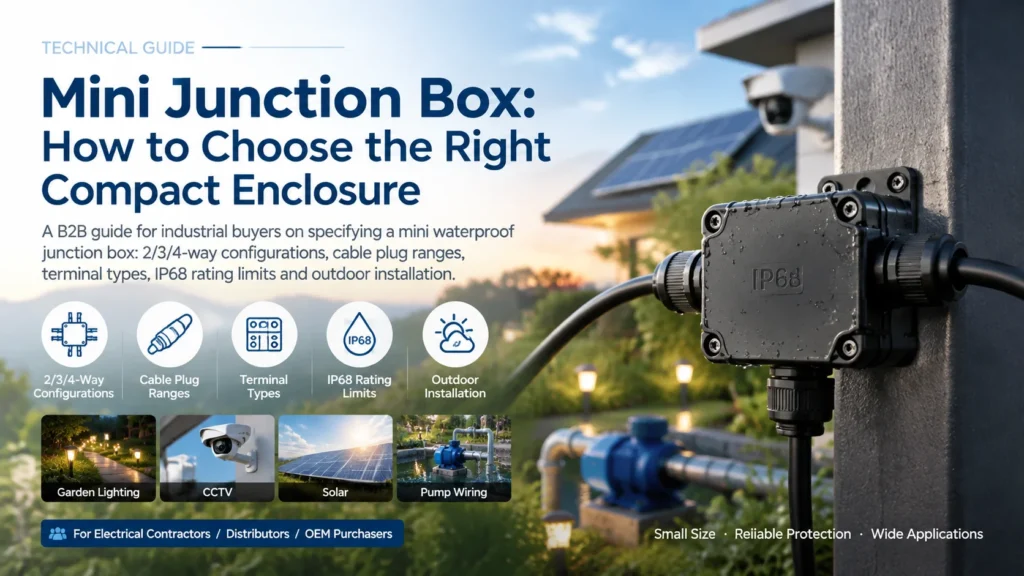
Specify a mini junction box correctly: 2/3/4-way choice, cable plug ranges, terminal types, IP68 limits for burial, and five installation steps that keep the seal.
Read More