Blog
Cable Gland Torque Specifications and Sealing Points Guide
A practical guide to cable gland torque specifications and sealing points, covering nylon, brass, and stainless steel torque values by thread size.
Read More
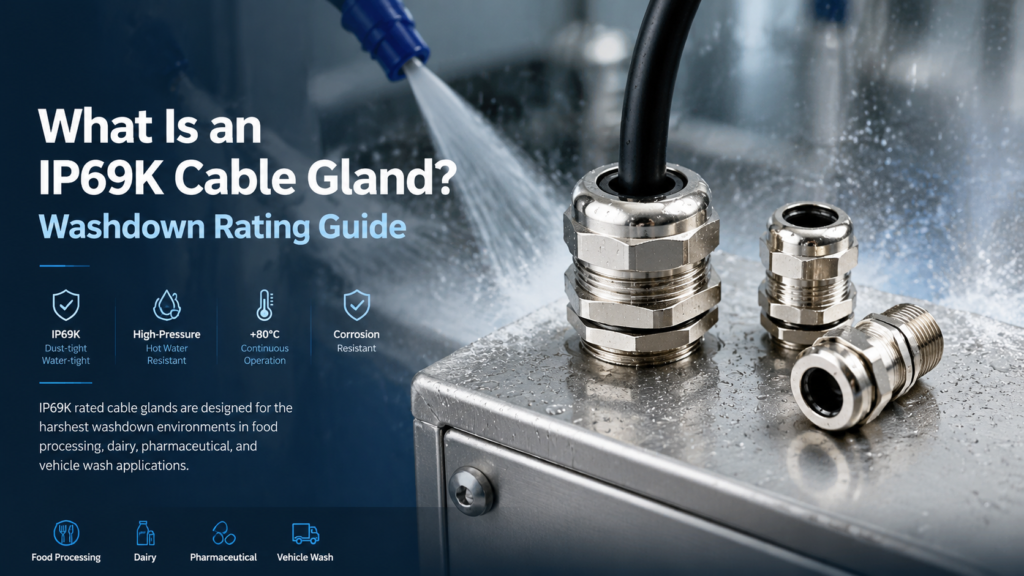
If your equipment is hosed down with hot, high-pressure water at the end of every shift, ordinary IP65 or IP66 cable entry may not survive for long. IP69K is the rating designed for exactly that environment: dust-tight protection against close-range jets of water at up to 80°C and 80–100 bar. This guide explains what an IP69K cable gland rating really means, how the test works, how it compares with IP67 and IP68, and how to choose cable entry hardware for washdown areas without over- or under-specifying.
IP stands for Ingress Protection. The first digit covers solids and dust; the second covers water. IP69K breaks down as follows:
| Code part | Meaning | What the test checks |
|---|---|---|
| 6 | Dust-tight | No dust ingress after 8 hours in a dust chamber with the enclosure under slight negative pressure |
| 9K | High-pressure, high-temperature water jets | Survives close-range jets of water at 80°C and 80–100 bar, sprayed from several angles |
The “K” suffix comes from German standard DIN 40050-9, developed for road vehicles and later carried into ISO 20653. Formal ISO documents sometimes write it as IP6K9K because the K marks those specific automotive test methods; product data sheets simply say IP69K.
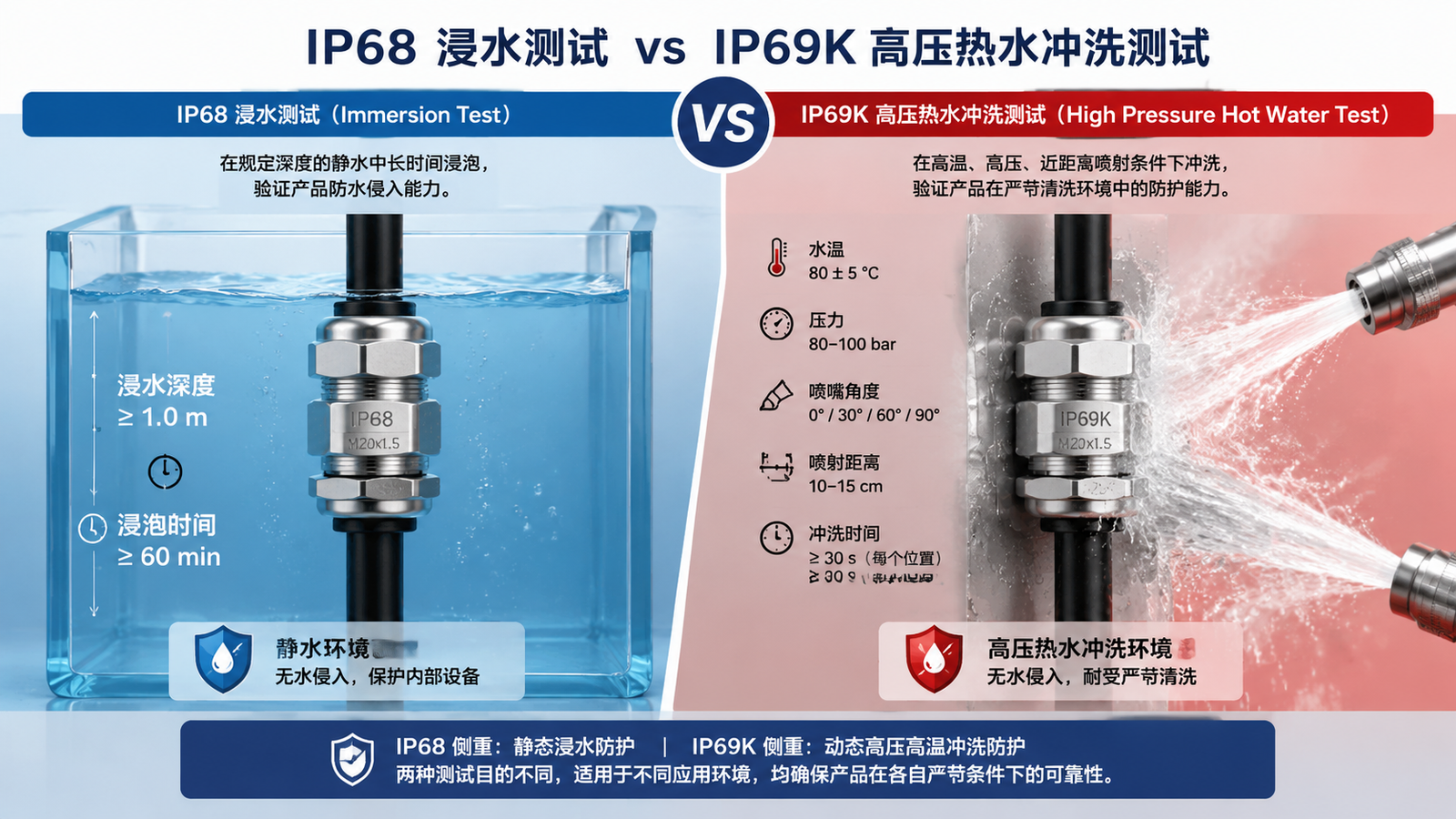
A common misconception is that IP69K is “more waterproof” than IP68. It is not a higher step on the same ladder. IP69K measures resistance to dynamic jet cleaning, while IP67 and IP68 measure resistance to static immersion. A product can pass one and fail the other, which is why washdown-rated equipment is often dual-rated IP68/IP69K.
Because the ratings test different failure modes, the right choice depends on how water actually reaches the equipment.
| Rating | Water test | Typical conditions | Best suited to |
|---|---|---|---|
| IP67 | Temporary immersion | 1 m depth, 30 minutes, room-temperature water | Rain, splash, short-term flooding |
| IP68 | Continuous immersion; depth and time set by the manufacturer | Typically more than 1 m for a defined period | Marine, underground and sump applications |
| IP69K | High-pressure hot water jets | 80°C water at 80–100 bar from 100–150 mm | Food plants, dairies, vehicle washes and other pressure-cleaned areas |
If water exposure is rain and puddles, IP68-oriented products are usually the right start; if a cleaning crew points a pressure washer at your equipment daily, plan around the IP69K washdown profile. For more on immersion ratings, see how the IP68 rating works and the IP67 vs IP68 comparison.
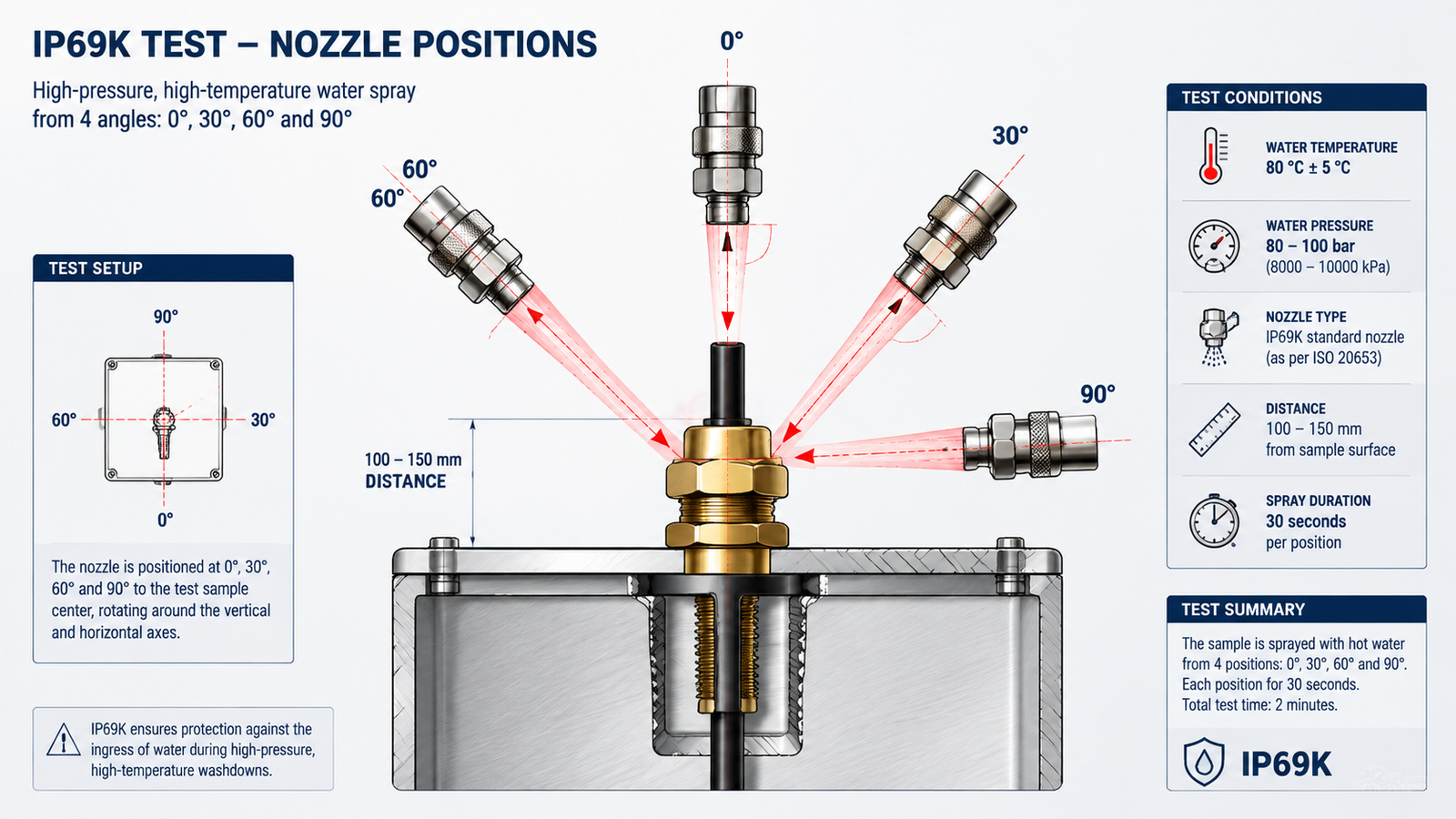
The water test is deliberately aggressive. The enclosure sits on a rotating turntable while nozzles spray water heated to 80°C ± 5°C at 80–100 bar (about 8–10 MPa or 1,160–1,450 psi) from only 100–150 mm away. The spray is applied at 0°, 30°, 60° and 90° for 30 seconds per angle at a flow of 14–16 L/min, for roughly two minutes total.
| Parameter | IP69K test condition |
|---|---|
| Water temperature | 80°C ± 5°C |
| Pressure | 80–100 bar (8–10 MPa) |
| Flow rate | 14–16 L/min |
| Nozzle distance | 100–150 mm from the surface |
| Spray angles | 0°, 30°, 60°, 90° |
| Duration | 30 s per angle, turntable rotating at 5 ± 1 rpm |
Two factors make this test hard to pass. First, 80°C water makes plastics and elastomers expand; if the housing and seal expand at different rates, a microscopic gap can open at the moment high pressure is applied. Second, the jet is close and focused, so a weak seal or a loosely torqued gland is found quickly. Thermal stability of the seal material and correct assembly matter as much as the nominal protection degree.
IP69K-level protection is rarely a nice-to-have; it is usually a consequence of how equipment is cleaned:
In food-contact and hygienic zones, the rating is only part of the story: smooth external surfaces without deep crevices leave fewer places for residue and bacteria to collect, and materials must tolerate the cleaning chemicals and temperature cycles. Confirm what the customer’s hygiene or safety standard requires before choosing hardware.
Here is the nuance many short product descriptions skip: IP69K is normally declared on a complete enclosure, luminaire or machine, not on individual components. Cable glands are separately tested and the familiar IEC 60529 rating for a gland is usually IP68, which covers continuous immersion but is not itself a washdown test.
In practice, washdown-proof equipment pairs an enclosure that passes the IP69K test with cable entry that does not become the weak point under hot, high-pressure water. What makes a gland survive that role:
For corrosive detergents, a standard stainless steel cable gland is the sensible pick; the nickel-plated brass longer-thread version suits thick control-panel plates and general washdown areas. Whichever you choose, verify the complete assembly – enclosure, gland, cable and torque – against the cleaning regime you actually run.
Once you have confirmed that washdown, not immersion, is the real exposure, work through this checklist:
When you are unsure whether a standard gland will hold up in a specific cleaning regime, discuss the washdown temperature, pressure and detergent with the supplier before committing to a design.
IP69K means dust-tight protection against close-range jets of hot water at 80–100 bar – a very different test from the immersion ratings most people know. Start from the real cleaning conditions, pick a gland with the right body material, seal temperature rating and thread length for the enclosure, install it correctly, and verify the complete assembly. For help selecting cable entry hardware for food, pharma or outdoor washdown applications, contact us with your cleaning parameters and enclosure details.
Not “better” – different. IP68 tests continuous immersion, while IP69K tests resistance to high-pressure hot water jets used in cleaning. A product can pass one and fail the other, which is why washdown equipment is often dual-rated IP68/IP69K.
IP68 glands are tested for continuous immersion at a depth and duration set by the manufacturer. IP69K is a system-level washdown test with 80°C water at 80–100 bar. For pressure-cleaned equipment, choose an IP68 gland with washdown-suitable materials and verify the whole assembly against your cleaning regime.
Often yes, if the body and seal materials survive the water temperature and detergents and the gland is correctly sized and torqued. IP68 itself does not certify washdown resistance, so test the finished enclosure under your actual cleaning conditions when an IP69K declaration is required.
For caustic or chlorine-based chemicals, stainless steel (304/316) is safest. For general food-plant washdown, nickel-plated brass is a proven, cost-effective option. Nylon suits lighter cleaning regimes where aggressive hot chemicals are not present.
The test uses water at 80°C ± 5°C sprayed at 80–100 bar (about 8–10 MPa) from 100–150 mm, at four angles for 30 seconds each.
Not usually. Rain, splash and flooding are immersion or low-pressure spray scenarios where IP66, IP67 or IP68 products are appropriate. IP69K matters only when equipment is cleaned with high-pressure hot water.
A practical guide to cable gland torque specifications and sealing points, covering nylon, brass, and stainless steel torque values by thread size.
Read More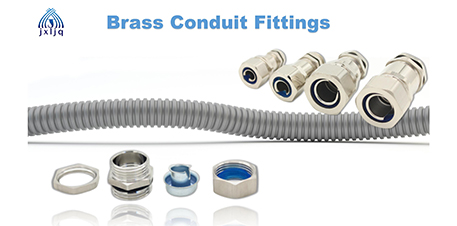
What brass conduit fittings are, why nickel-plated brass is used, the types, key specifications, applications, installation steps and how to choose the right fitting.
Read More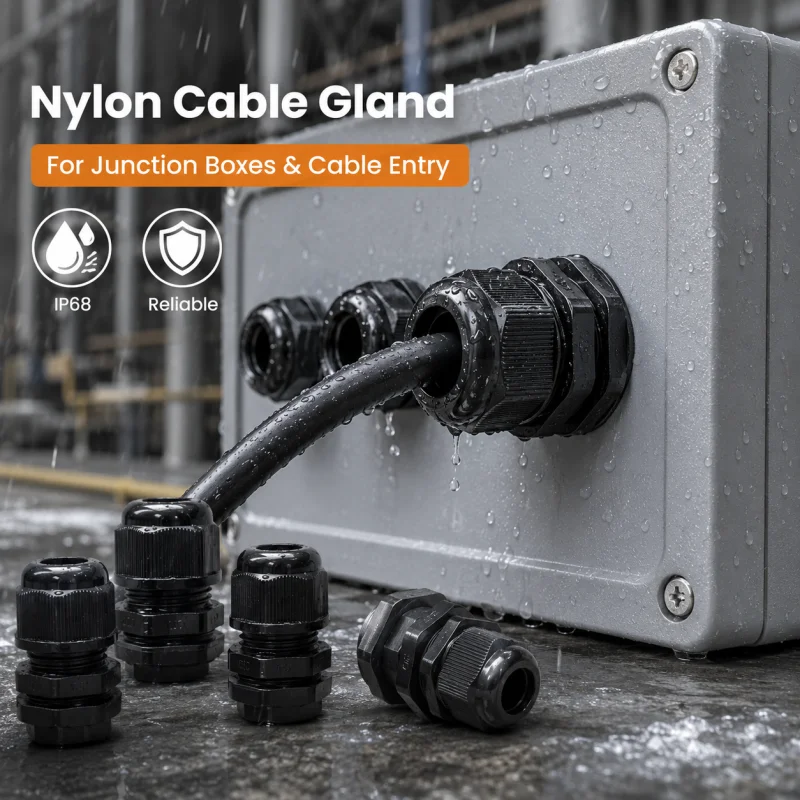
Outdoor electrical systems are constantly exposed to rain, humidity, dust, UV radiation, and temperature changes. When wiring protection is not properly designed, water ingress and connection failure often occur at the cable entry points rather than inside the equipment itself. Understanding how waterproof cable glands and IP68 junction boxes for outdoor wiring systems work together […]
Read More