Blog
EMC Cable Gland Grounding: 360° Shield Termination Guide
Practical EMC cable gland grounding guide: 360° shield termination steps, panel preparation, common mistakes, and continuity checks.
Read More
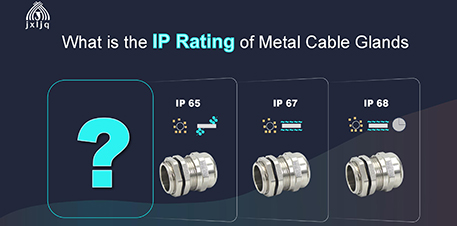
An IP rating on a metal cable gland is a two-digit code defined by the international standard IEC 60529. The first digit states how well the gland keeps out dust, and the second states how well it resists water. On industrial metal cable glands you will most often see IP65, IP66, IP67, IP68 or IP69K. The rating is not a marketing badge: it is a test result, and choosing the wrong one is one of the most common reasons sealed enclosures fail in the field.
This guide explains how to read the code, what each rating means in practice, and how to choose the right one for your environment.
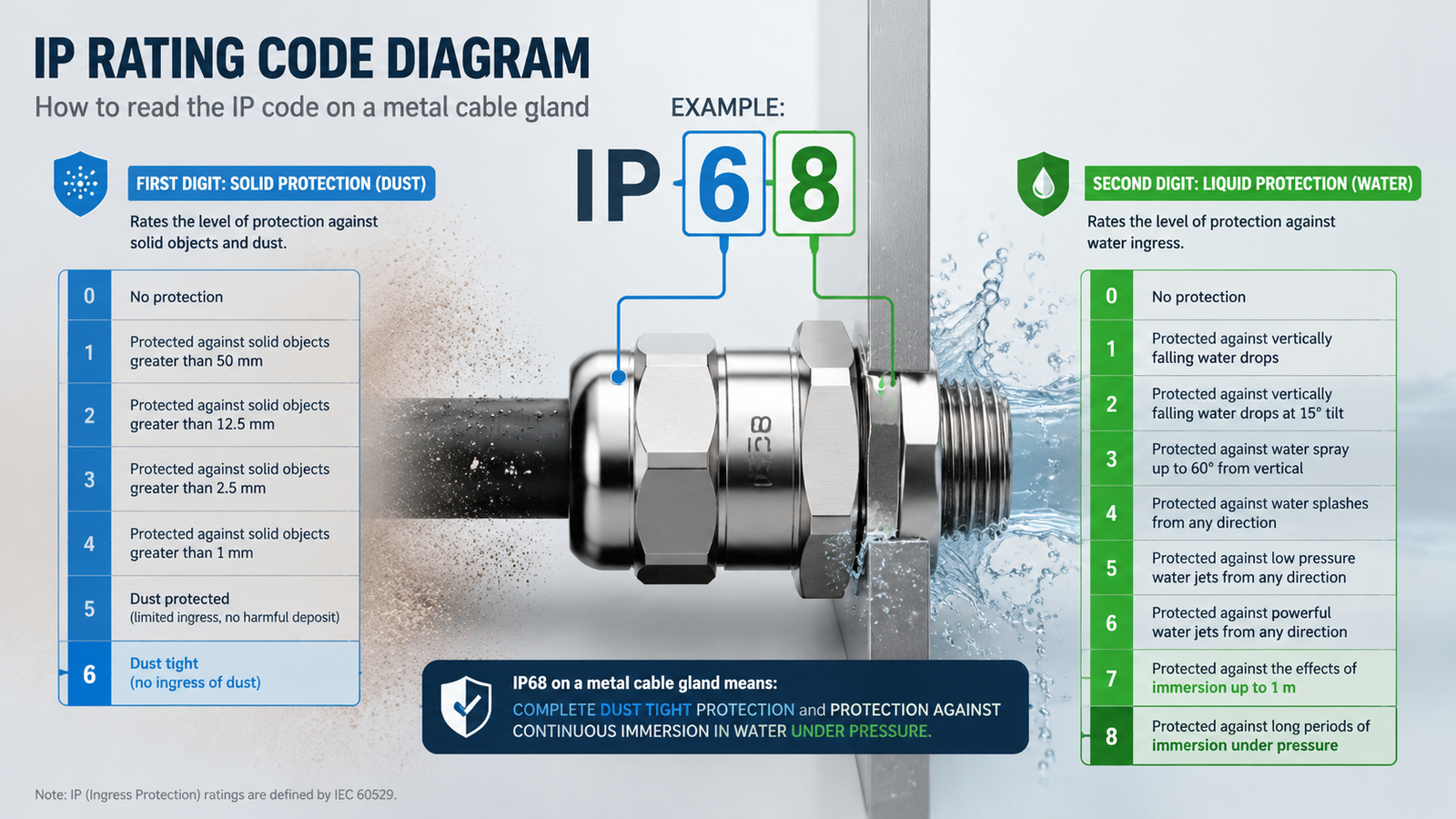
The IP (Ingress Protection) code always uses two digits, for example IP68. Each digit tests a different failure mode.
| First digit | Solids protection | Second digit | Water protection |
|---|---|---|---|
| 5 | Dust-protected: limited ingress, no harmful deposit | 5 | Low-pressure water jets from any direction |
| 6 | Dust-tight: no dust ingress at all | 6 | Powerful water jets (12.5 mm nozzle, 100 L/min) |
| 7 | Temporary immersion up to 1 m for 30 minutes | ||
| 8 | Continuous immersion at manufacturer-defined depth and duration | ||
| 9K | High-pressure, high-temperature water jets (80°C, up to 100 bar) |
Every gland for outdoor or industrial duty carries at least a 6 as the first digit: dust that settles on sealing faces destroys the water seal over time. The second digit is where the real decision is made.
Metal glands use different sealing systems, and the sealing system determines the achievable rating.
| Rating | What it withstands | Typical applications |
|---|---|---|
| IP65 | Dust-tight, low-pressure jets and rain | Indoor panels, sheltered outdoor enclosures |
| IP66 | Dust-tight, powerful jets and heavy sea spray | Outdoor switchgear, washdown with standard hosing |
| IP67 | Dust-tight, temporary immersion at 1 m for 30 minutes | Flood-prone sites, ground-level sensors |
| IP68 | Dust-tight, continuous immersion at defined depth | Buried runs, pumps, marine, permanent submersion |
| IP69K | Dust-tight, close-range high-pressure hot water jets | Food and beverage lines, pharmaceutical washdown |
Note the difference between IP66 and IP67: a gland rated IP66 passes the high-flow jet test but has no verified immersion performance, while an IP67 gland passes the 1-metre immersion test but is not verified against powerful jets. They are different tests, not steps on one ladder; for both washdown and flood risk, specify a gland with both ratings or step up to IP68.
IP68 and IP69K are the two ratings buyers most often confuse. IP68 is a static test: the gland is immersed at a depth and duration the manufacturer specifies, typically 2 to 10 metres for 1 to 24 hours. It is the rating for cable entry points that sit permanently underwater or buried in wet ground.
IP69K comes from DIN 40050-9, now part of ISO 20653, rather than IEC 60529. The gland is sprayed at close range with water at 80°C and up to 100 bar. This is partly a mechanical test: the jet can shear off weak seals and push water past glands that pass immersion tests easily. IP69K suits equipment that is pressure-washed regularly, such as food and pharmaceutical plants.
So IP69K is not “better” than IP68; a gland can be IP68 yet fail IP69K. Choose based on real exposure: continuous submersion points to IP68, aggressive cleaning points to IP69K, and operations facing both should carry both ratings.
Cable glands are governed by IEC 60529 for ingress protection and IEC 62444 for mechanical strength, sealing and strain relief. The IP test is performed on a complete, correctly assembled gland fitted with a cable inside its declared clamping range and the matching O-ring or grommet.
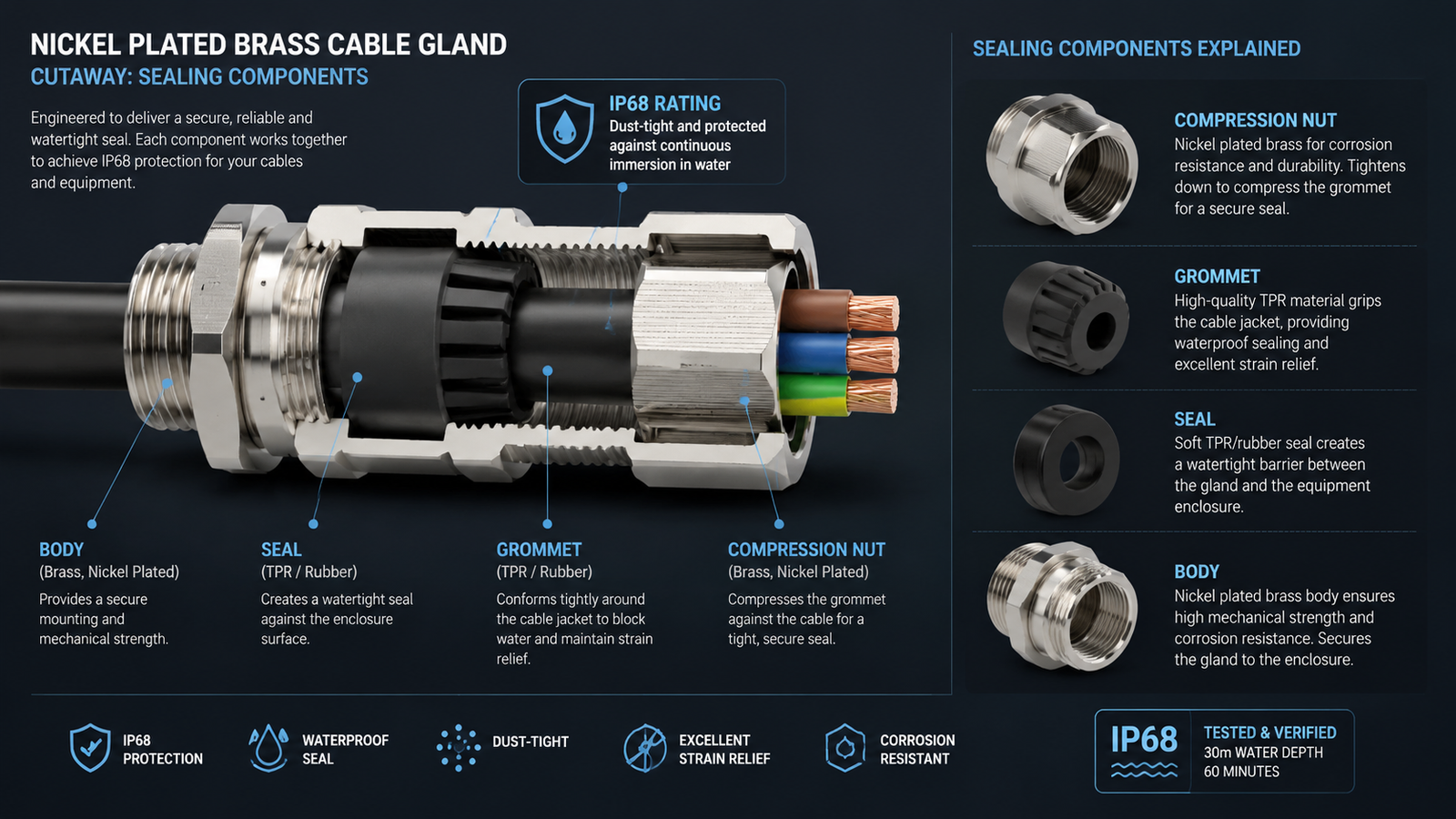
No. Brass, stainless steel and nylon glands can all reach IP68 or IP69K because the rating depends on the sealing system, not the metal. What the material changes is whether the gland keeps that rating over years of service. A nickel-plated brass gland such as our standard brass cable gland is the workhorse for industrial cabinets: good corrosion resistance, mechanical strength and thread sealing at a competitive cost.
Where the environment is aggressive, the metal matters more. Brass is not one single product line: stainless steel versions add further corrosion resistance for offshore and chemical duty, and explosion-proof glands add flame-path certification for hazardous areas. The IP digits stay the same across all of them, so the choice is driven by the environment, not by the rating.
A gland only performs to its rating if it is fitted correctly. These are the failures we see most often on site:
The seal itself is where ratings are won or lost. A brass cable gland with a silicone rubber seal is a common choice when the cable jacket is soft or slightly irregular, because silicone conforms more easily than harder grommets and keeps its elasticity through temperature swings.
Work backwards from the worst condition the gland will face and pick the lowest rating that covers it:
For motor, pump and gearbox entries, a compact MG brass cable gland is often the most space-efficient IP68 option, offering the same sealing in a shorter body that fits tight terminal boxes. It is worth reading how IP68 behaves in real installations in our guide to how IP68 ratings work for cable glands before you finalise a specification.
The IP rating of a metal cable gland is a compact, test-backed statement about dust and water sealing. Read it as two independent axes, verify the IP68 depth and duration for any submersion claim, and treat IP69K as a high-pressure washdown test rather than an upgraded IP68. Then choose a material that keeps the seal intact, install with the correct torque and O-ring, and the printed rating will hold up in service.
If you are specifying glands for an outdoor, marine or washdown project, compare brass, stainless steel and EMC options with verified IP ratings across our waterproof cable gland range, or contact us with your cable size and environment and we will recommend a matching gland.
No. IP68 proves continuous immersion at a manufacturer-defined depth, while IP69K proves resistance to high-pressure, high-temperature water jets. They test different conditions. Choose IP68 for submersion and IP69K for aggressive washdown.
Yes. Brass and stainless steel cable glands are available in IP67, IP68 and IP69K. IP67 means dust-tight plus temporary immersion at 1 metre for 30 minutes, which suits flood-prone sites.
For rain and normal hosing, IP66 is the safe minimum because it covers powerful jets from any direction. Choose IP67 where temporary flooding is possible and IP68 for buried, marine or permanently submerged installations. Always confirm the manufacturer’s stated depth for IP68.
The sealing design determines the rating, so brass, stainless steel and nylon glands can all reach IP68 or IP69K. Material affects long-term reliability: nickel-plated brass suits general industry, while stainless steel is better for salt water and chemical washdown.
Usually yes. Most metal glands achieve their full IP68 or IP69K rating only with the O-ring fitted between body and enclosure. Without it, water travels along the thread, so never skip the O-ring.
IP66 protects against powerful water jets but has no verified immersion performance. IP68 protects against continuous immersion at a manufacturer-defined depth. A gland rated IP66 is for washdown, and an IP68 gland is for submersion; they are not interchangeable.
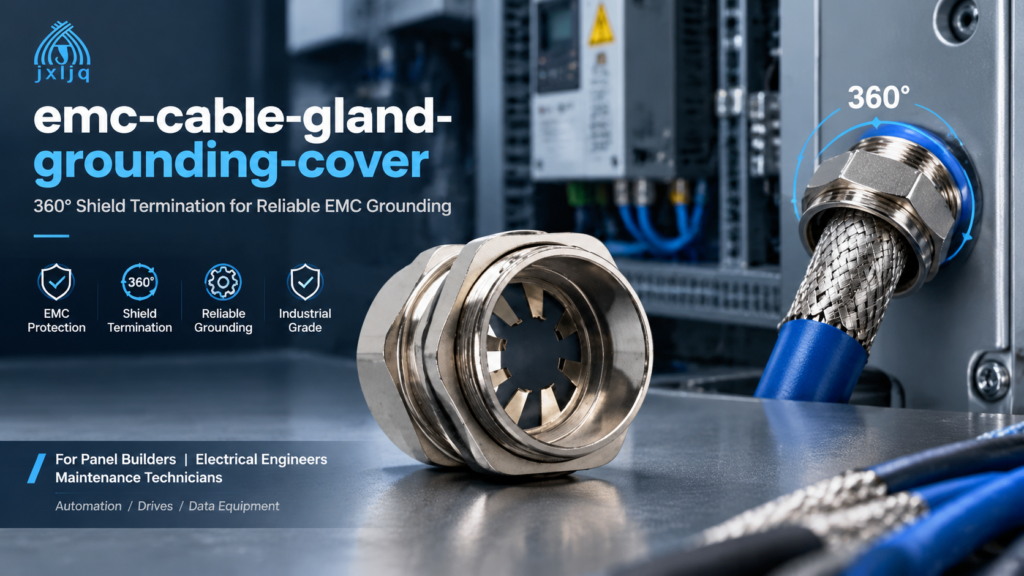
Practical EMC cable gland grounding guide: 360° shield termination steps, panel preparation, common mistakes, and continuity checks.
Read More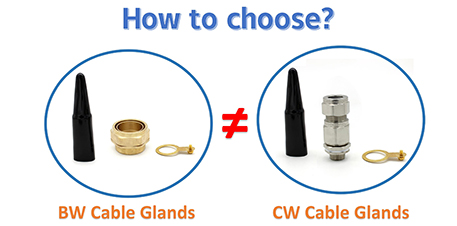
BW and CW cable glands both terminate SWA armoured cable, but they are built for different environments. Learn the key differences, IP ratings, and how to choose.
Read More
Introduction: Why Material Selection Matters in Cable Glands Choosing between a brass cable gland and a stainless steel cable gland is not just a cost decision. It directly affects long-term sealing reliability, corrosion resistance, and system safety in industrial electrical installations. In real-world projects, many failures do not come from the cable gland design itself, […]
Read More