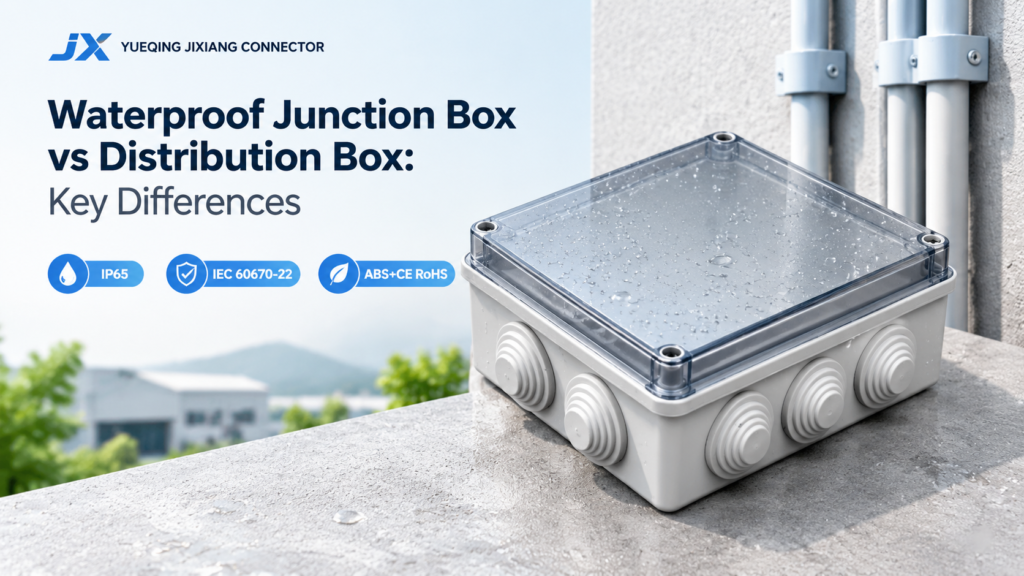
Waterproof junction box vs distribution box: the two names get used interchangeably on site, but they describe products with different jobs, different internal components and different certification standards. A waterproof junction box is a connection point that keeps spliced conductors dry. A distribution box is a power distribution point that also protects every circuit leaving it. Confusing the two is one of the most common specification errors in outdoor electrical work, and it is an expensive one: a box chosen for the wrong role either fails inspection or costs five times more than the project needed.
This comparison breaks the difference down the way a buyer actually has to decide — function, internal components, standards, electrical ratings, IP protection, sizing and cost. It also corrects a myth that appears in a lot of supplier content: that junction boxes are inherently less waterproof than distribution boxes. They are not. Water resistance is a property of the enclosure, not of the product category, and a properly rated waterproof junction box will outperform an indoor distribution board in any wet location.
The Short Answer: Junction Box vs Distribution Box
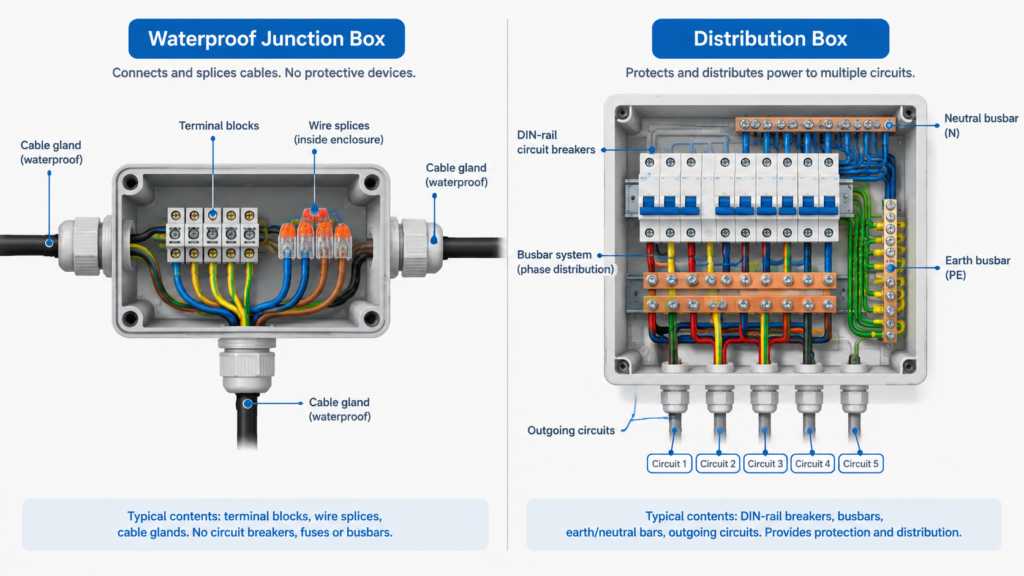
If you only need one paragraph: a junction box joins, branches or terminates conductors and contains no overcurrent protection. A distribution box receives power and splits it into multiple protected branch circuits, so it contains circuit breakers, fuses or residual current devices on a busbar system. You cannot substitute one for the other, because a junction box cannot provide fault protection and a distribution box is oversized and over-specified for a simple splice.
Feature
Waterproof Junction Box
Distribution Box
Primary function
Join, branch, terminate or pull conductors
Distribute incoming power to multiple branch circuits
Typical contents
Terminal blocks, connectors, splices, DIN rail or PCB inside
IEC 61439 series (LV switchgear and controlgear assemblies)
North American reference
NEC Article 314; UL 514A / 514C
NEC Articles 312 and 408; UL 67 / UL 891
Environmental rating
IP55, IP65, IP67, IP68 depending on model
IP rating varies widely — indoor boards are often IP20 to IP41
Typical size
50 × 50 mm up to 400 × 350 mm
Larger, with space for breaker access and cable bending
Who works on it
Electrician or installer, for maintenance and re-termination
Qualified electrician; often operated by ordinary persons
Relative cost
Lower
Higher — bus work, breakers and thermal verification
What Each Enclosure Actually Does
Waterproof Junction Box: A Connection Point
A junction box exists because conductors have to meet somewhere. Cables are pulled in runs, they branch, they change direction, and they terminate. Every one of those points needs an accessible, protected space where the connection can be made and inspected later. The box does three jobs: it mechanically supports the cable and relieves strain, it keeps moisture, dust and accidental contact away from live parts, and it keeps the joint accessible for testing.
What a junction box deliberately does not contain is any device that interrupts a fault current. There is no breaker, no fuse, no residual current device. That is not a limitation of a particular model — it is the definition of the product. When a manufacturer adds a DIN rail inside a sealed box so you can mount terminal blocks or a small PCB, the box is still a junction box; it is simply a flexible enclosure.
Distribution Box: A Power Distribution Point
A distribution box, sometimes called a distribution board, panelboard or load center depending on the region, sits between the supply and the loads. Incoming power lands on a busbar system, divides into outgoing circuits, and each circuit leaves through its own protective device. The protection is the point: if one branch short-circuits, only that branch is isolated. Distribution boxes also carry the labeling, isolation points and metering that make a system safe to maintain.
Because distribution boxes handle fault current, they are engineered and type-tested as complete assemblies, not as empty boxes. Their enclosure, busbars, breaker mounting, clearances and ventilation are verified together. That verification is what a junction box has never had and cannot claim.
The Differences That Actually Matter
1. Function: Joining Conductors vs Protecting Circuits
The functional split determines everything downstream. A junction box solves a routing problem — two cables need to become three, or a run needs to be extended. A distribution box solves a control and safety problem — one supply needs to feed several loads with independent protection. If your requirement can be described without the words “breaker”, “fuse” or “trip”, you almost certainly need a junction box.
2. Internal Components: Terminal Blocks vs Breakers and Busbars
Open a waterproof junction box and you will find terminal blocks, crimped or screw connections, sometimes a DIN rail, occasionally a small circuit board. Open a distribution box and you will find breakers or fuses mounted on a busbar, a neutral and earth bar, phase identification, and space reserved for cable bending radius. The internal layout is not cosmetic. A distribution box needs front access with the door open and the arc path considered; a junction box needs to be sealed against water first and accessed only when the joint is serviced.
3. Standards and Certification: Two Different Worlds
This is where most confusion becomes a compliance problem. Junction boxes and connecting enclosures are covered by IEC 60670-22, which governs boxes and enclosures for electrical accessories in household and similar fixed installations. In North America the equivalent references are NEC Article 314 together with UL 514A for metallic outlet boxes and UL 514C for nonmetallic outlet boxes.
Distribution assemblies are covered by an entirely different family: the IEC 61439 series for low-voltage switchgear and controlgear assemblies. Part 1 sets the general rules, and Part 3 covers distribution boards intended to be operated by ordinary persons. In North America, panelboards fall under UL 67 and NEC Article 408, while cabinets and cutout boxes fall under NEC Article 312. A supplier who quotes an IEC 61439 certificate for a plain sealed box, or an IEC 60670 certificate for a board full of breakers, has mixed up the two product families.
4. Electrical Ratings: What a Junction Box Cannot Claim
Assemblies certified to IEC 61439 carry ratings that a junction box does not have. The most important is rated short-time withstand current — the fault current the assembly can carry for a specified short duration without damage. IEC 61439-1 also requires temperature-rise verification for the complete assembly, so the heat generated by breakers and busbars under load is tested, not assumed. Junction boxes have no equivalent rating because they contain no interrupting devices and no busbar system.
The practical consequence: a sealed box with a DIN rail and a few breakers inside is not a certified distribution board, even if it looks like one. It may function, but it has no type-tested fault withstand and no verified thermal performance. On a project that requires a compliant assembly, that difference is the whole argument.
5. Size, Layout and Access
Distribution boxes are larger because they must be. Breakers need front clearance, cables need bending radius, and the installer needs working room inside the enclosure. Junction boxes stay compact because their only interior requirement is enough volume for the conductors and connectors, plus the bending radius the cable needs. A 100 × 100 × 70 mm sealed box can handle a surprising number of splices; the same space would be unusable for a three-circuit board.
6. Cost and Installation
Junction boxes are cheaper per unit and faster to install. Distribution boxes cost more because you are buying an assembly — enclosure, busbars, breaker positions, labeling and testing — and the installation demands more planning, more careful cable management and, in most jurisdictions, a qualified electrician. The cost error runs in both directions. Specifying a distribution box for a lighting branch splice wastes budget; specifying a junction box where overcurrent protection is required fails inspection.
The Myth: “Junction Boxes Are Less Waterproof”
IP Rating Is a Property of the Enclosure, Not the Category
Some supplier articles claim that junction boxes offer less environmental protection than distribution boxes and should be kept indoors or under eaves. That is wrong, and it is worth correcting because it leads buyers to over-specify. Water and dust protection is defined by the enclosure’s IP rating under IEC 60529, and a waterproof junction box is built specifically to achieve it. A sealed ABS junction box rated IP65 or IP67 will outperform a standard indoor distribution board rated IP20 to IP41 in exactly the wet conditions the claim is about.
What is true is the reverse dependency: a distribution box installed outdoors needs an enclosure rating appropriate to the location, and outdoor boards are commonly specified at IP65 or IP66. The rating follows the environment, not the product name.
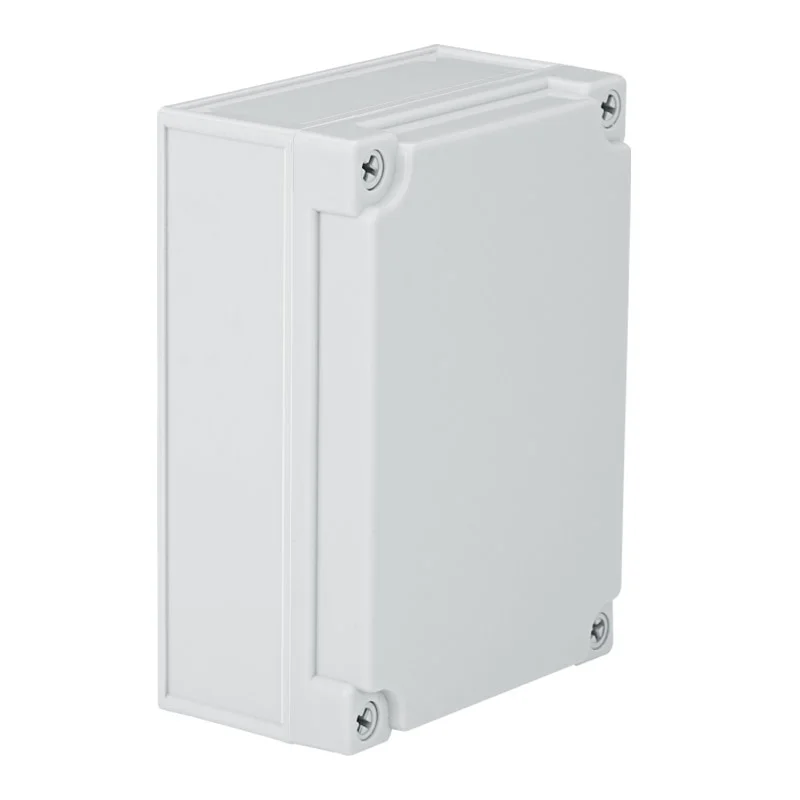
Higher protection levels are available when the application demands it. An IP67 enclosure such as the JX-AG high-end waterproof junction box, rated for immersion up to one metre and tested to IK08 for impact, is designed for exposed outdoor, industrial and marine installations where a general-purpose board would not survive.
How IP Ratings Map to Outdoor Conditions
Two things are worth knowing before you compare boxes. First, the second digit of the IP code defines water protection: IPX5 resists water jets, IPX6 resists powerful water jets, IPX7 tolerates temporary immersion at one metre for 30 minutes, and IPX8 covers continuous immersion with the depth and duration agreed between manufacturer and user, and always more severe than IPX7. Second, an IP rating covers ingress only. It says nothing about corrosion resistance, UV ageing, gasket life or impact — impact is covered separately by the IK rating under IEC 62262, and corrosion resistance is what the NEMA 4X designation addresses in North America.
Rating
Water protection
Rough NEMA equivalent
Typical outdoor use
IP55
Dust protected, low-pressure water jets
Type 3R (rain, sleet, snow)
Sheltered outdoor walls, under eaves
IP65
Dust-tight, low-pressure water jets
Type 4 (watertight)
Exposed walls, general outdoor wiring
IP66
Dust-tight, powerful water jets
Type 4 / 4X
Washdown areas, coastal and dusty sites
IP67
Temporary immersion, 1 m for 30 minutes
Type 6 (temporary submersion)
Below grade, flood-prone and marine locations
IP68
Continuous immersion, depth set by manufacturer
Type 6P (prolonged submersion)
Permanently wet or submerged installations
NEMA and IP are not interchangeable, and the mapping above is approximate. NEMA Type 4X adds a corrosion-resistance test that the IP code does not include, which matters for salt-mist environments. If your project is coastal or offshore, ask for both the IP rating and the corrosion evidence.
Waterproof Junction Box Dimensions and IP by Model
Model data is where the comparison stops being theoretical. A practical range gives you the actual enclosure volume and entry configuration available per size, so you can match the box to the conductor count and the gland sizes you intend to use. The table below shows one production range as an example, including the IP rating that applies to each size — note that the smallest box is IP55 while the larger sizes are IP65, which is a common and easily missed detail.
Model
L × W × H (mm)
Entry holes
Hole size (mm)
IP rating
JX-RA50 × 50
50 × 50 × 50
4
25
IP55
JX-RA85 × 85 × 50
85 × 85 × 50
7
25
IP65
JX-RA100 × 100 × 70
100 × 100 × 70
7
25
IP65
JX-RA150 × 110 × 70
150 × 110 × 70
10
25
IP65
JX-RA200 × 155 × 80
200 × 155 × 80
10
36
IP65
JX-RA255 × 200 × 120
255 × 200 × 120
12
36
IP65
JX-RA400 × 350 × 120
400 × 350 × 120
16
36
IP65
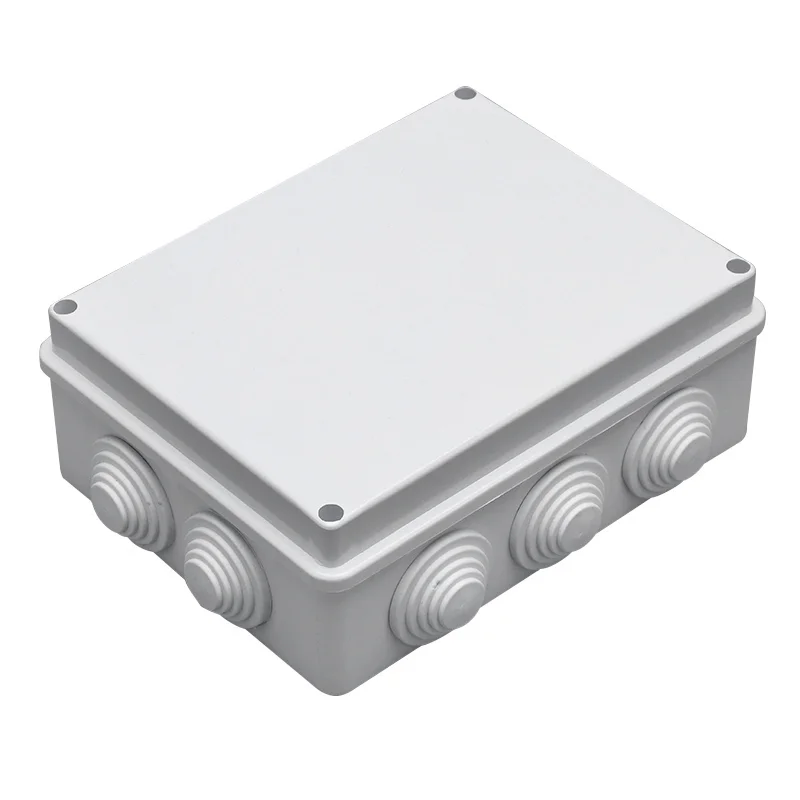
A range like this is the enclosure, not the finished function. The JX-RA plastic waterproof junction box, for example, is an ABS body with PVC stoppers, CE and RoHS certified, with mounting holes inside for a PCB or DIN rail and screw or nail fixing points outside for walls and boards. That combination makes it equally usable as a plain splice point or as a small terminal enclosure. What it does not become is a distribution box: the moment you need branch circuit protection, you have left the junction box category entirely.
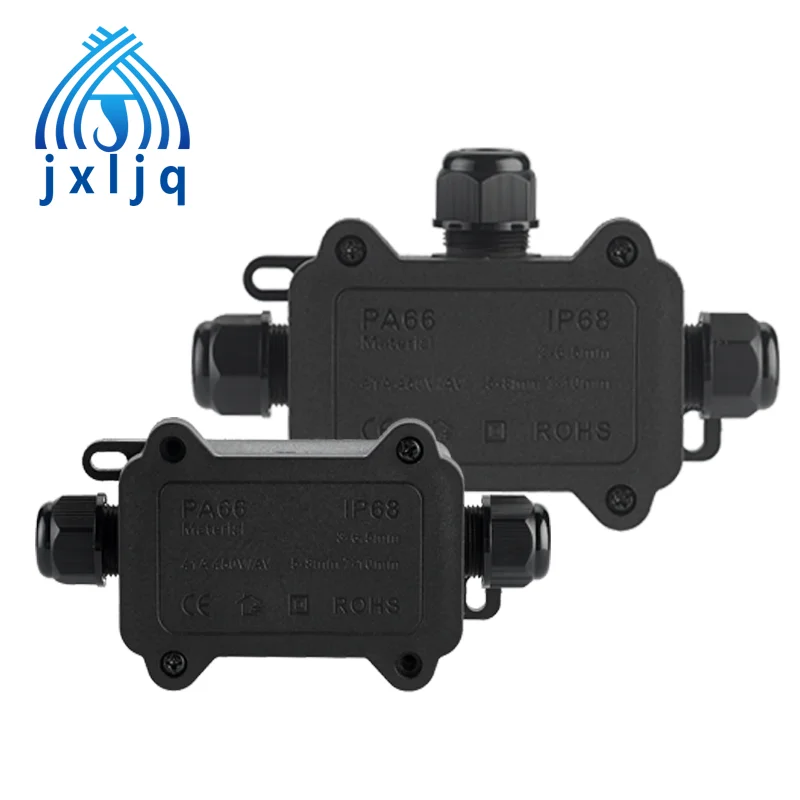
For tighter outdoor wiring where the enclosure has to sit at the end of a cable run rather than on a wall, compact connection boxes follow the same logic at a smaller scale. An IP68 unit such as the F1-2T/3T/4T mini waterproof junction box, with a flame-retardant PA6 nylon housing, silicone O-ring, nickel-plated brass conductors and 2-, 3- or 4-way configurations for cables from 3 mm to 10 mm, replaces an inline joint that would otherwise need a full enclosure.
IP Integrity Is a System Property, Not a Box Property
Here is the part that decides whether your IP65 box is actually IP65 in service. The rating is verified on the enclosure as supplied, with all entries closed. Every hole you add changes the tested configuration. That is not a technicality — it is the single most common reason an outdoor junction box fails in the field.
Four things break enclosure integrity:
Unused entries. A box supplied with seven 25 mm holes and only three cables has four open paths for water and dust. Unused entries must be closed with the correct stopper or blanking plug, and the plug must carry the same environmental rating as the box.
Mismatched glands. A cable gland is a sealed interface only when its thread, sealing range and IP rating match the enclosure and the cable. A gland that is the right size but the wrong protection level becomes the weakest point in the system. Choosing a matched standard nylon cable gland with the same IP class as the box keeps the rating continuous from cable to enclosure.
Gasket condition and torque. Lid gaskets need to be seated, clean and compressed evenly. Overtightening deforms the gasket and creates gaps; under-tightening leaves it uncompressed. Fasteners should be tightened evenly in a cross pattern.
Mounting and cable support. An unsupported cable hanging from a gland transfers load to the seal. Strain relief and correct cable routing protect the gland and the gasket over time.
A large share of “junction box vs distribution box” confusion is terminology, not engineering. The same physical product carries different names in different markets, and a purchase order written in one convention can be read in another.
Region
Term used for a connection point
Term used for a distribution point
United States
Junction box, outlet box, pull box
Panelboard, load center, distribution panel
United Kingdom
Joint box, junction box, adaptable box
Distribution board, consumer unit
Germany / Central Europe
Abzweigdose, Verbindungsdose
Verteilerschrank, Unterverteilung
Export catalogs (China)
Waterproof junction box, terminal box, sealed box
Distribution box, power distribution cabinet
Watch for two specific traps. First, “distribution box” is used loosely in export catalogs for any sealed box used near power distribution, including boxes that contain nothing but terminals. Second, “junction box” in North American residential work often means a metal or plastic box for an outlet or switch, which has nothing to do with the sealed industrial enclosures discussed here. When the requirement is critical, describe the contents — terminals, breakers, or both — rather than relying on the product name.
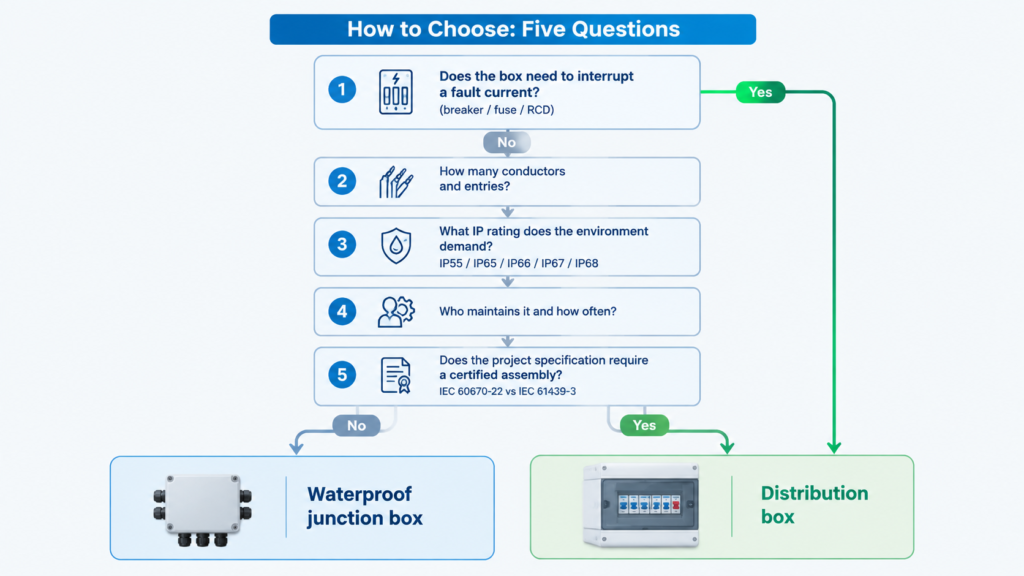
How to Choose: Five Questions
Work through these in order and the decision usually makes itself.
Does the box need to interrupt a fault current? If yes, you need a distribution box with breakers, fuses or RCDs. If no, a junction box is the correct product.
How many conductors and entries are involved? Count every incoming and outgoing cable, add the entries you may need later, and size the box with 20 to 30 percent spare volume. Overcrowded boxes run hotter and are harder to service.
What does the environment actually demand? Match the IP rating to the worst realistic condition — jets, immersion or continuous wet — and add corrosion evidence for coastal or chemical sites. Remember that impact and UV are separate from IP.
Who will work on it, and how often? A junction box is serviced rarely and should seal first. A distribution box is accessed for breaker operation and inspection, so front clearance and labeling matter more than a compact footprint.
What does the specification actually require? If the project calls for a certified assembly, an enclosure with breakers inside will not satisfy it. Confirm the standard early — IEC 60670-22 and IEC 61439-3 are not interchangeable.
Where the Confusion Costs Money
Mistake
Consequence
Correct approach
Using a junction box where branch protection is required
Inspection failure; no fault isolation for downstream circuits
Specify a distribution board to IEC 61439-3 or UL 67
Specify a sealed junction box with adequate entry count
Assuming junction boxes are not waterproof
Over-specification and budget waste on a protected application
Select by IP rating against the actual environment
Leaving unused entries open
Rating lost in service; water and dust ingress; corrosion
Close every unused entry with a rated stopper or plug
Mismatching gland and enclosure protection levels
The lower rating governs the whole assembly
Match gland IP, thread and sealing range to the box
Quoting the wrong product standard
Non-compliant submittal; rejection at approval stage
IEC 60670-22 for connection boxes, IEC 61439 for assemblies
Conclusion
The distinction is functional, not cosmetic. A waterproof junction box joins and protects conductors, carries an IP rating suited to its environment, and is certified as an enclosure under IEC 60670-22 or its regional equivalents. A distribution box distributes power to multiple protected circuits, contains the devices that interrupt faults, and is type-tested as an assembly under IEC 61439 or UL 67. Choose by asking what the box has to do, not by what it looks like — and never assume that a sealed box containing a DIN rail has become a distribution board.
Protection level is the second decision, and it belongs to the enclosure rather than the category. Match the IP rating to the real environment, close every unused entry, and use glands that carry the same rating as the box. That is what keeps the rating true after installation rather than only on the datasheet.
If you are specifying sealed enclosures for an outdoor, industrial or marine project and want the dimensions, entry configuration and IP rating confirmed against your cable schedule, contact the Jixiang Connector team with your requirements. Samples are available for testing before you commit to a production order.
FAQ
What is the main difference between a waterproof junction box and a distribution box?
A junction box joins, branches or terminates conductors and contains no overcurrent protection. A distribution box receives power and splits it into multiple branch circuits, each protected by a breaker, fuse or RCD. Function, contents and certification standard all differ, and the two are not interchangeable.
Can I use a waterproof junction box as a distribution box?
No. A junction box has no overcurrent protection, no busbar system and no type-tested fault withstand or thermal verification. Putting breakers inside a sealed enclosure does not make it a compliant distribution board. If the circuit needs branch protection, specify a distribution board built to IEC 61439-3 or UL 67.
Is a junction box less waterproof than a distribution box?
No. Water and dust protection is determined by the enclosure’s IP rating under IEC 60529, not by the product category. A waterproof junction box rated IP65, IP67 or IP68 is more resistant to water than a standard indoor distribution board rated IP20 to IP41.
Do distribution boxes need to be waterproof outdoors?
Yes, and the required level depends on exposure. An outdoor distribution board should be rated for the actual conditions — commonly IP65 or IP66 for exposed installations — and coastal or chemical sites also need corrosion resistance, which the IP code does not test.
What IP rating do I need for an outdoor junction box?
Match the rating to the worst realistic condition. IP55 suits sheltered walls and under-eave locations, IP65 or IP66 suits exposed outdoor and washdown areas, IP67 covers temporary immersion and below-grade or flood-prone positions, and IP68 is for continuous or prolonged immersion.
Does adding cable glands affect the IP rating of a junction box?
Yes. The IP rating is verified on the enclosure as supplied, with entries closed. Cutting or opening entries changes the tested configuration, so unused holes must be sealed with rated stoppers and every gland must match the enclosure’s thread, sealing range and IP class.
How do I size a junction box for the number of cables?
Count all incoming and outgoing conductors, add the entries you may need for future changes, and select a box with roughly 20 to 30 percent spare volume beyond the minimum needed for the conductors and their bending radius. Overcrowding raises internal temperature and makes re-termination difficult.
Introduction: Why Material Selection Matters in Cable Glands Choosing between a brass cable gland and a stainless steel cable gland is not just a cost decision. It directly affects long-term sealing reliability, corrosion resistance, and system safety in industrial electrical installations. In real-world projects, many failures do not come from the cable gland design itself, […]
IEC 62444 replaced EN 50262 as the cable gland standard. This guide decodes the classification codes, type tests and datasheet items buyers should verify.
Introduction Outdoor electrical enclosures are constantly exposed to rain, dust, temperature changes, and UV radiation. Choosing the right cable entry solution is essential.The IP68 nylon cable gland is one of the most reliable options for outdoor enclosures. Why IP68 Matters for Outdoor Use Outdoor environments require long-term sealing performance. IP68-rated nylon cable glands provide: Common […]
We use cookies to enhance your browsing experience, serve personalised ads or content, and analyse our traffic. By clicking "Accept All", you consent to our use of cookies.