Blog
Cable Gland Case Studies: 6 Field Failures and How to Avoid Them
Six cable gland case studies from real installations: the failure, the root cause, and the corrected specification — plus five tests for verifying project claims.
Read More
A junction box leak test on site answers a different question from the IP rating on the box. The rating describes a sample tested in a laboratory, empty or as delivered, under a defined head for a defined time. What stands on the wall is an assembly of box, glands, cable, terminals and torque — an object that has never been tested at all.
Three methods are practical without a tank, a chamber or a certificate. Each proves something specific and leaves something else untouched. This article sets out what each one measures, where it can mislead, and how to write an acceptance criterion a second person can repeat.
A type test and a site test differ in three ways that matter. The sample is a production unit rather than the installed one. The water is a controlled head rather than rain, a hose or a flood. And the criterion is defined by the standard rather than by whoever is holding the hose.
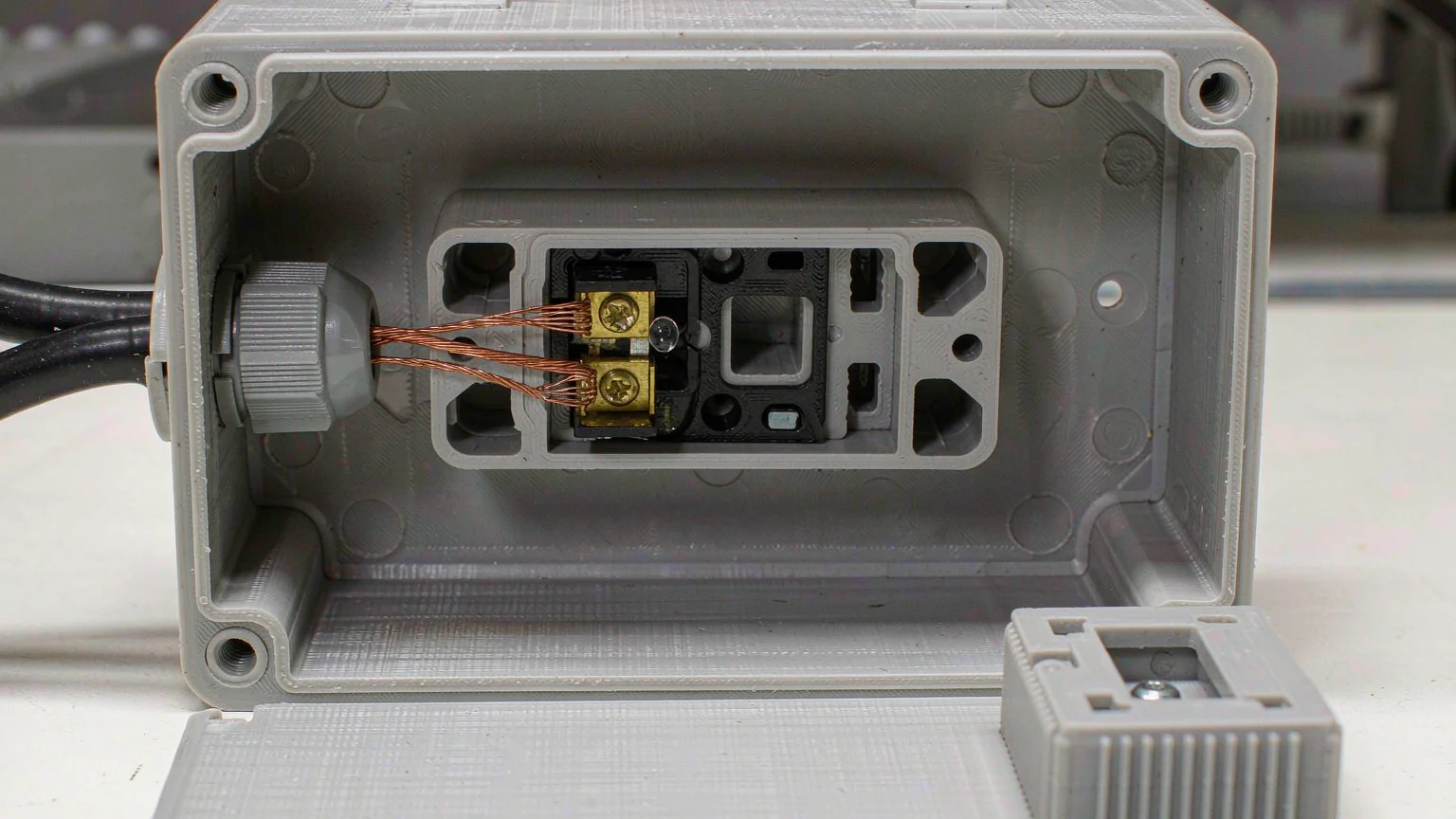
No field method therefore generates or renews an IP rating, and no site result belongs in a submittal as one. What a field test can do is catch the failures that actually occur: a gasket twisted in its groove, a gland tightened onto a jacket outside its range, a blanking plug without its washer, a lid closed on grit.
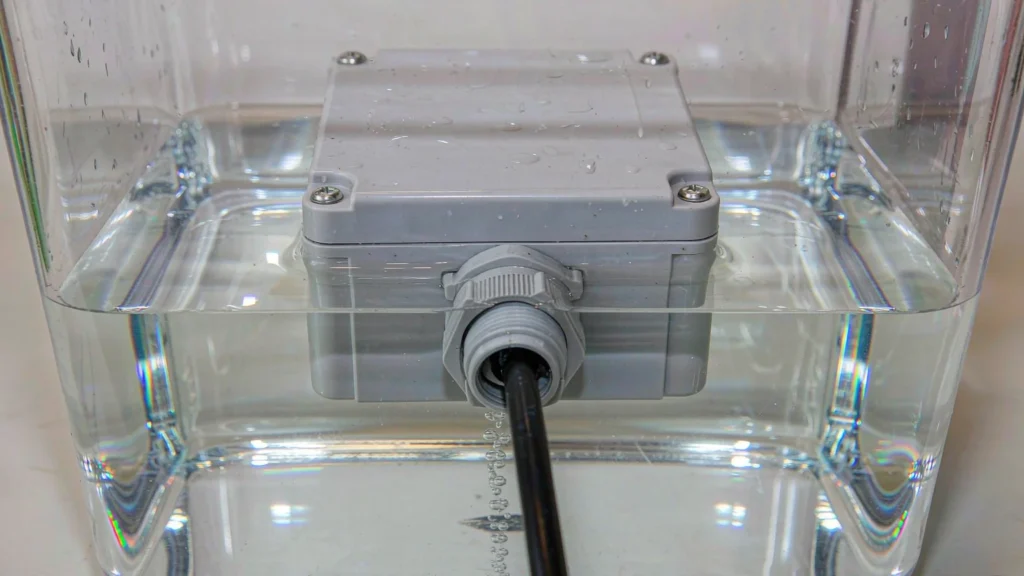
Fill a container deep enough to cover the box, weight the box so it stays under, and leave it for fifteen to thirty minutes. It is the cheapest form of junction box leak test and the easiest to interpret, because the result is water you can see.
Its limit is the head. Three hundred millimetres of water is about 3 kPa, while a one-metre immersion is roughly 10 kPa, so a shallow dip cannot speak for a deeper duty. Two details also change the outcome. Air trapped under the lid cushions the top of the box, so a defect high on the wall may never see water at all — tilt and agitate to release it. And a warm box plunged into cold water is no longer a static test; it is Method 3 by accident.
Seal every entry, connect a low-pressure source to one port, and watch a gauge. It is fast, it leaves the electronics dry, and it is the only one of the three that produces a number rather than an opinion.
The trap is direction. Positive pressure pushes the lid gasket outward, while service conditions push it inward; a lip that seals one way and lifts the other will pass a pressurised test and leak in rain. Vacuum loads the seal correctly, but can also draw a soft gasket into the groove clearance and give a pass that does not survive the first cold night.
Take a one-litre box at 0.3 bar gauge. A gauge resolving 10 mbar cannot see a volume change below about 0.8% of the enclosure, roughly 8 ml. A three-millimetre soap bubble is about 0.014 ml. On a small enclosure a coarse gauge is therefore two to three orders of magnitude less sensitive than a bubble test at the same joint — which is why “the needle did not move” is weaker than it sounds. Treat this as an order-of-magnitude estimate, not a calibration.
Warm the closed box to about 40 °C, then immerse it in cold water. The trapped air contracts, the internal pressure falls by roughly 4 mbar per kelvin, and the enclosure draws inward through any path that is open. A joint that survives a static soak can fail this in a minute.
It is the closest of the three to the mechanism that actually floods boxes in service: not a static head, but the repeated pumping of a sealed volume as the sun, the day and the equipment cycle its temperature. It is also the harshest, so a failure here justifies a second look before the joint is condemned.
The most common false pass comes from testing a box rather than a joint. Water travels inside a cable: through the interstices between strands, and along the interface between conductor and jacket when the sheath is damaged a metre away. A perfectly sealed enclosure with a cable entering it is not a sealed system, because the other end of that cable is somewhere else.
So the test must be run with a cable stub in place, and the reading taken at the terminal rather than at the floor of the box. If the terminals are wet and the gasket land is dry, the water did not cross the lid — it arrived along the copper. That distinction changes the repair, and explains why a box can be condemned twice for one fault at the other end of the run.
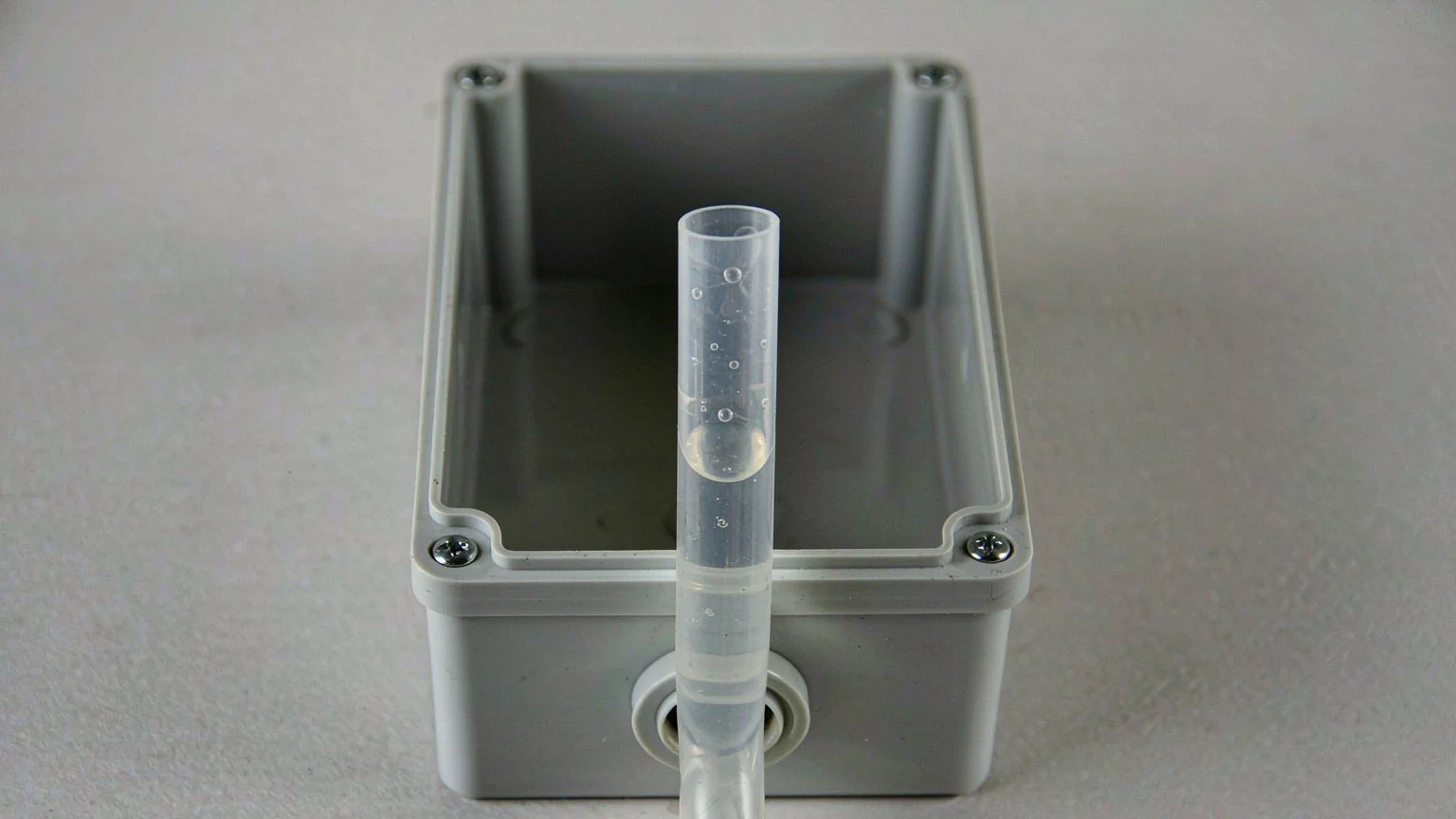
A static head is easy to generate and easy to state. One metre of water is 9.8 kPa, so a half-metre length of clear tube pushed onto the lowest entry applies about 4.9 kPa to that one joint — enough to test the worst-placed entry at a real head, without a tank.
This is the method to use when the specification names a depth. Fit a tube to the entry, fill it to the depth in the specification, and watch the joint for thirty minutes. You are then testing the actual interface at the actual pressure, which is closer to the requirement than any whole-box soak you can build on site.
| Method | Proves | Does not prove | Time |
|---|---|---|---|
| Shallow immersion | Gross entry at low head, in the correct direction | Anything about depth, or about pumping | 15–30 min |
| Pressure or vacuum decay | The assembly holds a sealed volume; gives a number | Sensitivity on small boxes; positive pressure tests the wrong direction | 2–5 min |
| Thermal shock dip | Whether the seal survives a pressure reversal | Long-term compression set; a single cycle is not a season | 10 min |
| Standpipe head test | The named depth, at the worst-placed entry | Other entries; the seals you did not fill | 30 min |
Write the criterion before the test, in terms you can observe. A junction box leak test passes when there is no free water inside the enclosure, no continuous stream of bubbles at any joint for sixty seconds, or a gauge drop under 5 mbar over five minutes with the box shaded and the temperature stable within one kelvin. “IP68” is not a field criterion, because nobody on site can grant it.
When a test fails, isolate before repairing. Bubble one interface at a time, or blank the entries one by one, until the loss stops. The usual order of probability is the lid gasket, then the gland thread, then the cable seal, then a blanking plug missing its washer — the last is the most common and the cheapest to fix. Which combinations are worth buying in the first place is set out in the selection guide.
One line per joint is enough: date, ambient temperature, method, head or pressure, duration, result and who ran it. Add a photograph of the open box before closing. A record like this does more for a warranty discussion than any claim on a datasheet, because it shows the joint was verified in the state it was handed over in.
The installation sequence sets up most of what the test finds; the common installation mistakes explain the rest. Our F1 series uses a silicone O-ring that tolerates the pressure reversal a thermal dip creates, and a vent plug can double as the test port on an otherwise sealed box. What the depth figure on a datasheet does and does not guarantee is set out in the IP68 depth guide.
A junction box leak test is worth running because the installed joint has never been type tested. Use immersion to find gross faults, decay to get a number, thermal dip to reproduce the pumping real weather applies, and a standpipe when a depth is named. Test the joint, not the box: put a cable in, read at the terminal, isolate one interface at a time. Then write the criterion in observable terms so the next person can repeat it.
Yes, and it is the only method that leaves the wiring dry. Seal the entries, apply a low pressure through one port and read the gauge. Positive pressure tests the lid gasket in the opposite direction to rain, and a coarse gauge is far less sensitive than a soap bubble on a small box.
Look at the gasket land and the terminal separately. A dry gasket land with wet terminals means the water travelled inside the cable, from a damaged sheath or an open end elsewhere on the run. A wet gasket land means the enclosure failed.
No. IP ratings come from type tests on samples in a laboratory, and no field method can generate or renew one. A site test proves that this joint, in this state, held against the head or pressure you applied for the time you applied it.
Long enough for pressure and temperature to settle: thirty minutes for immersion or a standpipe, five for decay, and about a minute of observation per joint for bubbles. A shorter test measures the weather, not the seal.
Six cable gland case studies from real installations: the failure, the root cause, and the corrected specification — plus five tests for verifying project claims.
Read More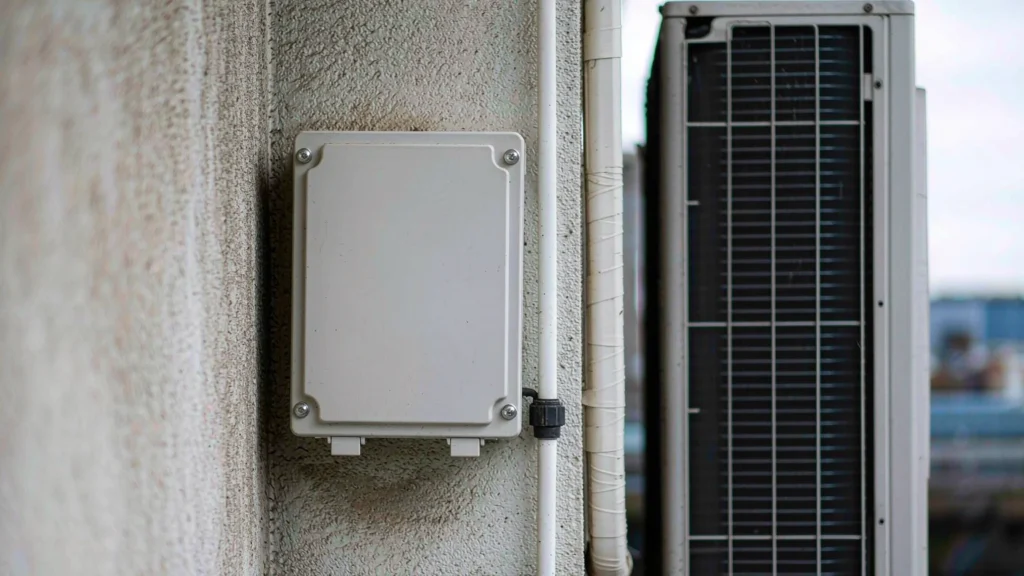
An HVAC junction box carries either 24 V control or the full compressor load, and the two need different enclosures. Sizing rules, disconnect boundaries and mounting clear of the condensate drain.
Read More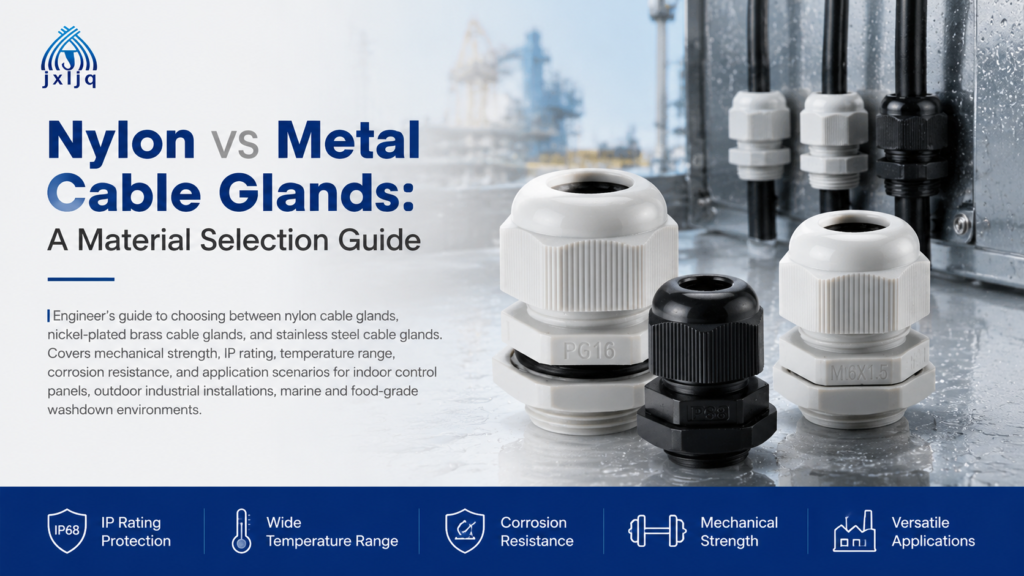
Engineering guide to choosing between nylon, brass, and stainless steel cable glands — environment-driven material selection, side-by-side specs, and a quick selection matrix.
Read More