Blog
IP68 Depth Rating: What the Code Does Not Tell You
IP68 leaves depth and duration to the manufacturer, so the badge alone means little. How to read a depth claim, test a seal, and specify conditions on a PO.
Read More
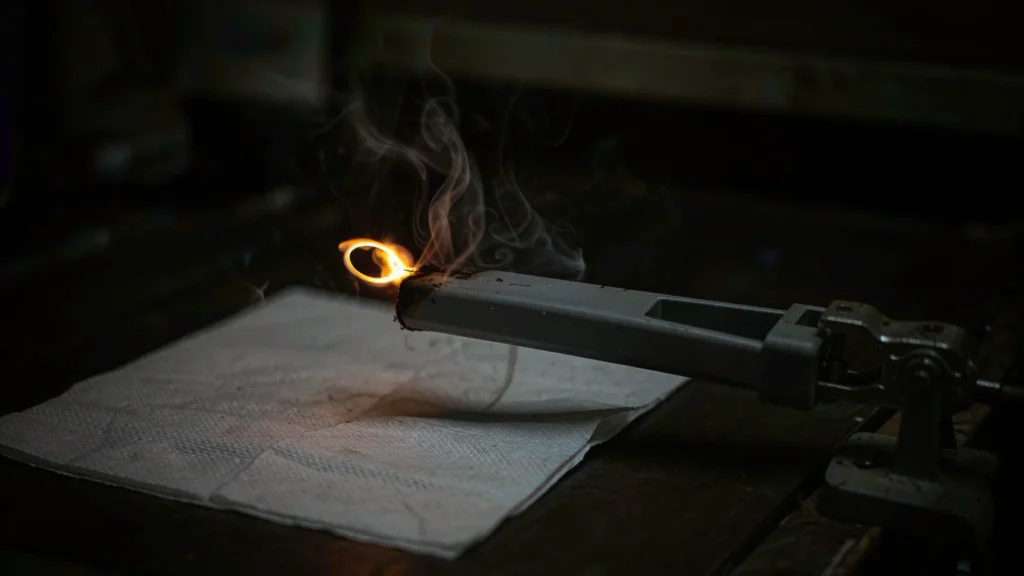
When a datasheet calls a UL 94 V-0 junction box “self-extinguishing”, the claim rests on five plastic strips 125 mm long, burned in a laboratory. Nothing about your box was tested: not the wall thickness you actually mould, not the lid gap, not the terminal block bolted inside it. The rating describes a material at a stated thickness, and the job of the buyer is to find out whether that thickness is the one being shipped.
The second half of the question — will it resist a glowing connection — is asked by a different test entirely. This article covers both, in the order they matter on the bench.
UL 94 is a family of tests, not a single grade. The vertical burning tests share one specimen geometry and differ in what they tolerate, which is why V-2 and V-0 sound interchangeable in a quotation and are not.
| Rating | Afterflame, each application | Total, ten applications | Dripping |
|---|---|---|---|
| HB | Horizontal burn, rate limited | Not applicable | Not assessed |
| V-2 | 30 s maximum | 250 s maximum | Permitted, may ignite cotton |
| V-1 | 30 s maximum | 250 s maximum | Not permitted to ignite cotton |
| V-0 | 10 s maximum | 50 s maximum | Not permitted to ignite cotton |
| 5VB | 60 s maximum, 500 W flame | Five applications | Hole may form in the plaque |
| 5VA | 60 s maximum, 500 W flame | Five applications | No hole in the plaque |
The step from V-1 to V-0 is a factor of five in total afterflame, and the step to 5VA changes the specimen from a strip to a plaque because a wall is a surface, not an edge.
A UL 94 result is quoted at a thickness. A grade listed at 3.0 mm says nothing about a 1.5 mm wall, and thin sections are usually worse: less material to absorb heat, faster through-burn. Two mouldings from the same resin can therefore carry different ratings, and only one may match the drawing.
Colour matters for the same reason. Pigments and flame-retardant packages interact, so a card that covers natural and black may not cover a custom grey — which is precisely the sort of change that arrives through a custom colour order without anyone re-testing.
Glow wire simulates a different accident: an overheated connection or a failing component pressing against plastic, not a flame arriving from outside. A heated element is held against the specimen for 30 seconds, and the pass criteria concern what happens after it is withdrawn.
| Test | Question it answers |
|---|---|
| Glow-wire flammability, IEC 60695-2-11 | At 650, 750, 850 or 960 °C, does the specimen extinguish within 30 s without igniting the tissue below? |
| Glowing-wire flammability index, 60695-2-12 | The highest temperature that still passes that test |
| Glow-wire ignition temperature, 60695-2-13 | The highest temperature at which the material does not ignite at all during the 30 s application |
The 60670 family calls up a glow-wire test on insulating parts that retain live parts, at 650 °C, so a box sold into Europe is being judged by this route whether or not anyone mentions it — the detail sits in our IEC 60670-22 breakdown.
A material can be V-0 at 1.5 mm and still fail a 750 °C glow-wire ignition test, and that contradiction is not a defect in either standard. The UL 94 flame is a 20 mm burner applied for ten seconds; the glow-wire tip is a solid element at a fixed temperature held for thirty. One measures how a flame propagates along an edge, the other measures whether a hot surface can start a fire at all.
Practically: V-0 protects the box from a fire that started elsewhere. Glow-wire performance protects the box from being the origin. A box in a control cabinet needs the second more than the first.
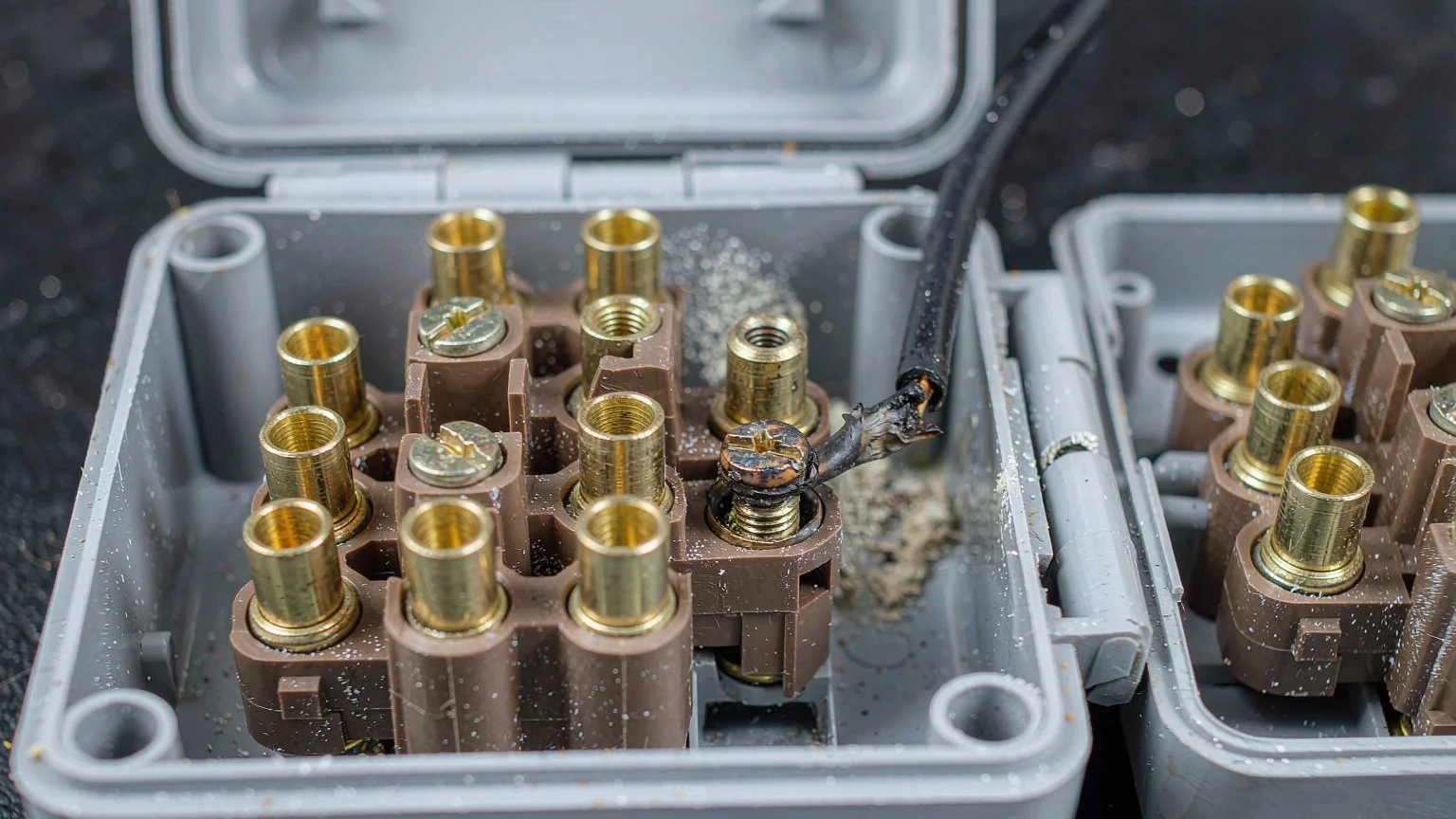
Almost never as a flame. The classic origin is a terminal that was tightened to feel, not to a figure. Take a joint at 0.5 Ω carrying 10 A: the dissipation is 50 W, sitting inside a box with roughly 0.044 m² of surface. At a generic 5.5 W/(m²·K) that is close to 200 K above ambient — an illustrative figure, not a measurement, but enough to show why the plastic deforms long before anything burns.
That is the sequence worth designing against: the housing softens, the lid or the boss gives way, air reaches the joint, and only then does a fire exist. Our field failure cases put thermal events in their own class for exactly this reason.
Unfilled PA66 sits around 24% limiting oxygen index and ABS nearer 18%, so neither passes V-0 without help. The additive package is what the grade really names. Halogenated systems are efficient but produce corrosive, opaque smoke; the halogen-free alternatives each carry a cost. Red phosphorus works well in PA66, tints the compound dark red or black, and needs care with moisture. Melamine cyanurate suits unfilled nylon but not glass-filled. Metal hydroxides need 50–60% loading, which is where impact strength and elongation go.
This explains an oddity buyers notice late: the cheap flame-retardant grade is often black, and the natural-colour version either costs more or carries a lower grade. The stiffness lost to the additive also feeds back into impact performance, which is why a V-0 housing is not automatically a tougher one.
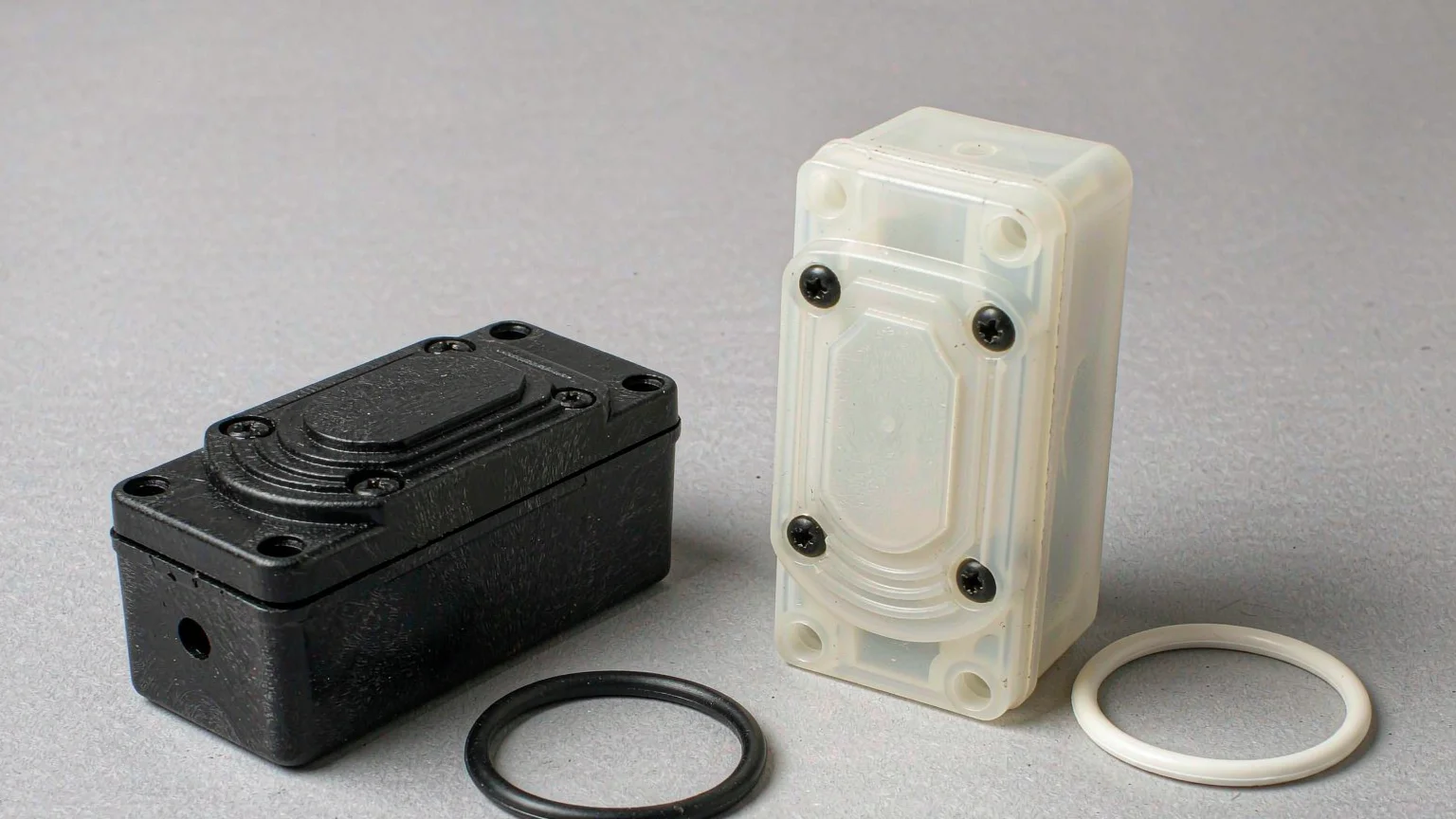
Housing grade is where the specification goes, and then the accessories arrive. Cable glands are usually PA66, silicone O-rings survive to about 200 °C, and the translucent stoppers on many ABS boxes are plasticised PVC — the part most likely to discolour and harden first.
Inside, a DIN rail, a terminal block and the cable sheath each have their own rating. A V-0 housing containing an HB terminal block is not a V-0 assembly, and no single number on the box describes that combination.
Four items turn a marketing grade into a requirement.
Add the RoHS clause while you are there. The brominated flame retardants that once made this easy are restricted substances now, which is why the additive package behind a modern V-0 grade is worth documenting — the reasoning is in our CE and RoHS document guide.
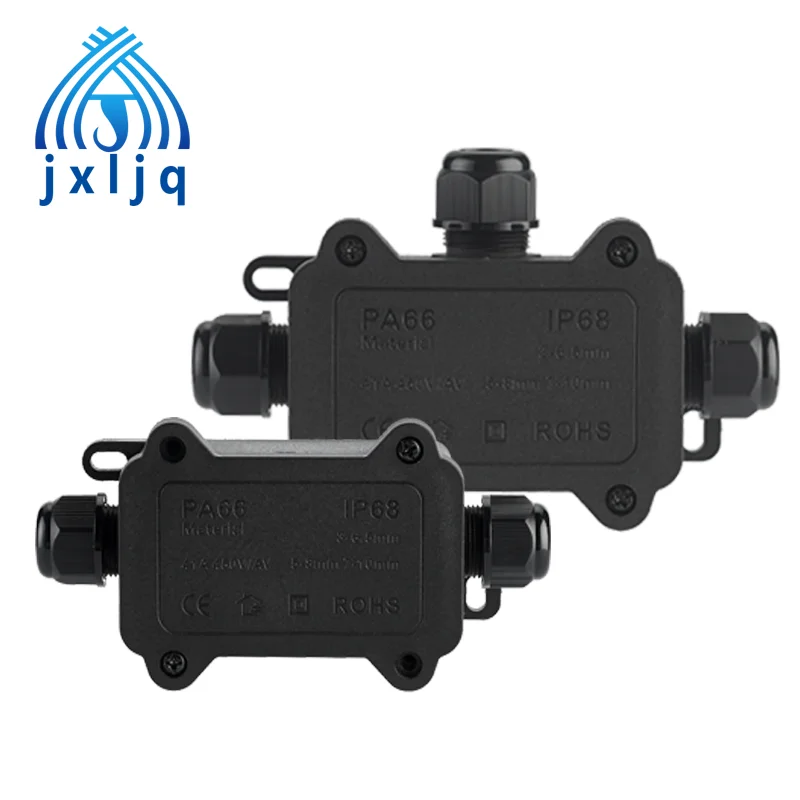
The F1 series mini junction box is moulded in flame-retardant PA66 to a V0 grade, with a silicone O-ring, IP68 sealing, a working range of −40 °C to +105 °C and a 450 V / 24 A rating. It is the one product in our mini junction box range that carries a flammability claim at all.
What the page does not state is the thickness the V0 grade applies to, or which standard was used to reach it. Ask, and we will answer in writing rather than let you infer it. The ABS series — JX-RA and JX-AG — carry no flammability grade, and we prefer to say that plainly; a comparison of what ABS, PA66 and polycarbonate actually do under heat is in our material guide.
UL 94 tells you how a material behaves in a flame at a stated thickness. Glow wire tells you whether a hot connection can start one. Neither number describes a finished box, and neither can be inferred from the other, so both belong on the order line with the grade, the thickness and the edition attached.
Where a supplier states a grade without those qualifiers, the honest reading is that the grade is unverified for your part. That is a fair position to hold — provided it is stated before the mould is cut, not after the first shipment is rejected.
No. V-0 limits afterflame to 10 seconds per application at a stated thickness; it is not a fire barrier and says nothing about a sustained flame or an external heat source. It also does not cover the terminals, the cable or the accessories inside the box.
If the box ships into both North America and Europe, usually yes. UL 94 answers the material question asked by North American files; glow wire is the route the 60670 family takes. They test different ignition sources and are not substitutes.
Because the rating is thickness-specific and colour-specific. A 1.5 mm wall and a 3.0 mm wall are separate specimens, and a custom pigment can change the result. Always ask for the rating at your wall thickness and in your colour.
Not on its own. The figure only means something alongside the test method — ignition temperature and flammability index are different numbers — and alongside the part it applies to. A high figure on the housing and an unrated terminal block still leaves the assembly weak.
IP68 leaves depth and duration to the manufacturer, so the badge alone means little. How to read a depth claim, test a seal, and specify conditions on a PO.
Read More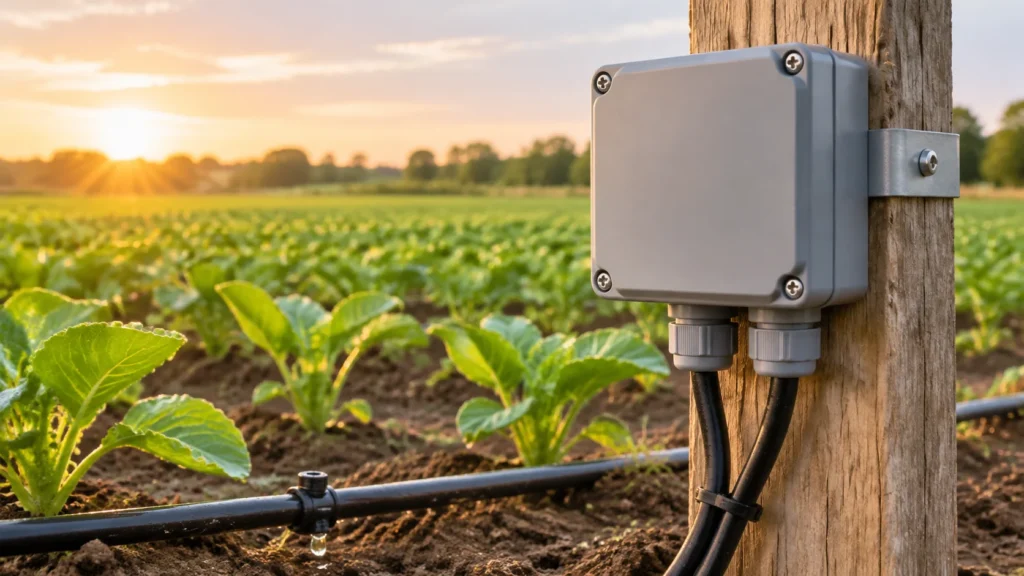
An irrigation box usually fails for reasons upstream of the enclosure: entry count, 24 VAC volt drop on the common, valve boxes that drain by design, and condensation.
Read More
Why robot cables fail at entry points, how strain relief cable glands protect them, where they matter in a robotic cell, and how to choose and install them.
Read More