A UL 50E enclosure and an IP-rated box are routinely quoted as if they were the same claim written in two languages. They are not. UL 50E certifies the enclosure as a manufactured product; IEC 60529 assigns numerals to a test sample. One is a continuing obligation, the other a single experiment, and the gap between them is where North American purchase orders go wrong.
This article separates the two, shows exactly where they overlap, and lists the questions that get a usable answer out of any supplier. Our waterproof junction box range is the example throughout.
Two Standards, Two Different Questions
IEC 60529 answers one question: what did this sample survive when sprayed, jetted or immersed under stated conditions? It says nothing about who built it, or whether the factory still builds it the same way next year.
UL 50E asks something narrower and harder: is this enclosure construction acceptable for the environment its type number claims, and does production still match the sample that was evaluated? The second half is the part buyers underrate. A test report is issued once. Certification carries follow-up inspections, so the claim has to keep being true to stay on the label.
Where UL 50E Sits in the UL Family
Enclosure questions usually arrive addressed to the wrong standard. Four documents do most of the work, and only one of them is about the box you are buying.
Document
Covers
Ask for it when
UL 50
Enclosures for electrical equipment, non-environmental
Indoor cabinet, no water or dust claim
UL 50E
Enclosures, environmental considerations
The box claims a Type rating for water, dust or corrosion
UL 508A
Industrial control panels
Your box arrives with devices wired inside
UL 746C
Polymeric materials in electrical equipment
You need the flammability and UV basis of the plastic
A cable gland under UL 514B is a separate file again — our own note on UL listed cable glands covers that side, and the two files are never interchangeable.
What UL 50E Actually Asks a Box to Survive
The standard does not invent new environmental conditions. It takes the Type ratings defined in NEMA 250 and turns them into construction requirements and repeatable tests, then adds the manufacturing controls that make the result reproducible.
Test family
What it punishes
Impact
Thin walls, brittle compound, unsupported lid spans
Deflection and heat
Thermoplastics that creep under load at service temperature
Fasteners, inserts and plating, not the housing alone
Gasket ageing
Elastomer that hardens or takes a set over years
UV exposure
Outdoor claims made on unstabilised resin
Two of these are worth dwelling on. Impact is tested on the assembly as sold, so a large unsupported lid face fails long before the wall thickness does. Gasket ageing is the test that separates a box that passed in March from a box that still seals in year five.
The Type Number Is the Real Specification
Buyers ask for “a UL 50E enclosure” and stop there. The standard is a framework; the Type number is the requirement. A Type 1 box and a Type 4X box are both UL 50E products and share almost no test content.
Type
Environment
Nearest IP
1
Indoor, no unusual conditions
IP20 to IP30
3R
Outdoor rain, sleet, snow; ice-resistant
IP14 to IP24
4
Watertight, hose-down, outdoor
IP66
4X
Type 4 plus corrosion resistance
IP66
6
Occasional temporary submersion
IP67
12
Indoor dust, dripping liquid
IP52 to IP54
The mapping is approximate on purpose. Type 4X and IP66 both survive a hose, but the hose is not the same hose, and the corrosion clause has no IP equivalent — the difference is set out in our NEMA 4X versus IP68 comparison.
“UL Listed” Is Usually the Wrong Phrase
An empty junction box is normally certified as a Recognized Component, not Listed. That matters because it changes what you are entitled to ask for. Listing applies to a complete product that can be installed on its own; a bare enclosure is a component that becomes part of a Listed panel under UL 508A.
So a supplier who says “our boxes are UL listed” has either misread their own file or is describing a panel they did not build. The correct question is whether the enclosure is Recognized under UL 50E, under which file number, and with which Type ratings on the card.
Why the Two Systems Cannot Be Converted
No arithmetic turns an IP code into a Type number. The test conditions differ in duration, nozzle, direction, water volume and pre-conditioning, and each system asks something the other ignores. UL 50E adds corrosion, gasket ageing and construction rules; IEC 60529 adds immersion depth and duration figures the Type system never states.
The conversion only works one way: a Type 4X box will normally meet IP66, while an IP66 box may fail Type 4X on corrosion of its own screws. Treat any one-line equivalence table as an approximation, never as evidence.
Six Questions That Get a Real Answer
Send these as written and most vague replies disappear.
Which UL file number covers this enclosure, and is it Recognized or Listed?
Which Type ratings appear on the card, and does the card cover the size we are ordering?
Is the certification for the enclosure as supplied, or only for the resin?
What are the fasteners and inserts made of, and what corrosion class applies?
Which gasket compound, and what ageing data supports the outdoor claim?
If we specify a different opening layout, does the certification still apply?
The last one is the commercial trap. A custom entry layout is a construction change, and the same logic already governs custom openings and MOQ on our own range.
The Documents Behind the Claim
Three pieces of paper do the work. The UL file number, looked up in UL Product iQ, confirms the certification exists and lists the Type ratings and construction details on record. The follow-up service record shows the factory is actually being inspected. The material card — the resin supplier’s yellow card — proves the plastic behind the housing, where substitutions happen quietly.
Ask for the file number before the datasheet. A datasheet is marketing; a file number is a searchable record that someone else maintains.
Where Our Range Actually Stands
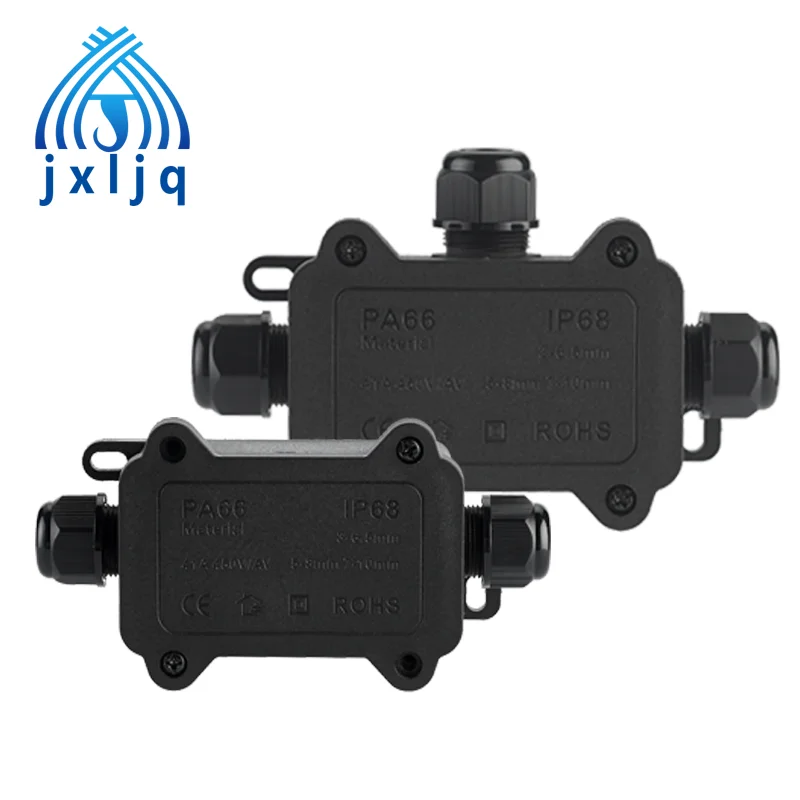
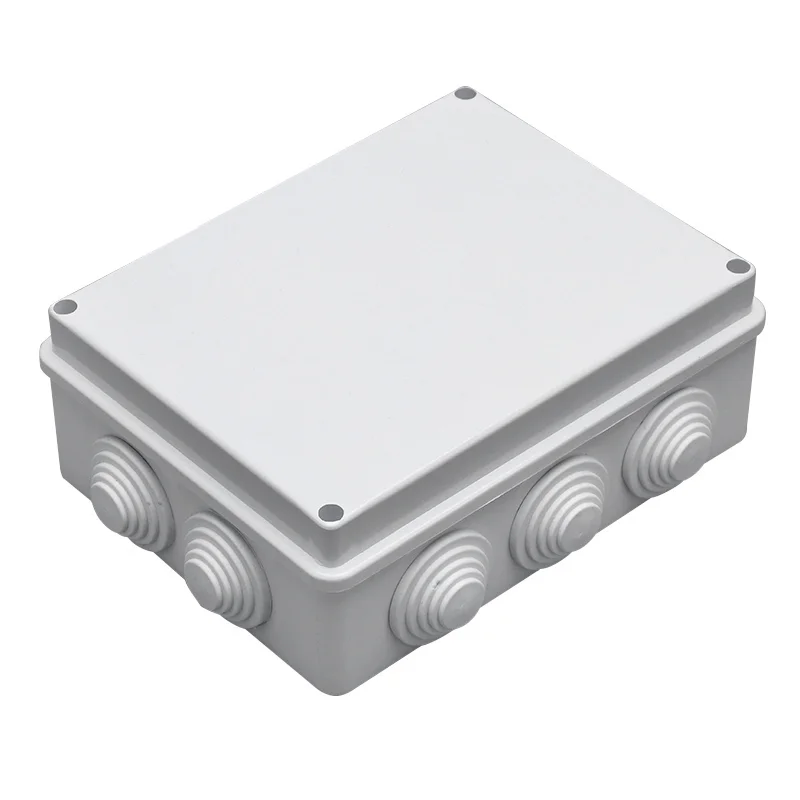
Being direct is more useful here than a logo. The JX-AG high-end waterproof junction box is certified to IP67 with an IK08 impact rating, moulded in ABS and RoHS compliant, with sizes from 95×65×55 mm to 280×190×180 mm. It does not currently hold a UL 50E file, and we will not imply one.
What we can supply for a North American project is the material evidence — resin grade, the supplier’s card for that grade, gasket compound, fastener plating — plus a sample for your own panel evaluation. If the project needs a Recognized enclosure, say so at RFQ stage and we will tell you before the order rather than after.
Putting Both Systems on One Order
Most export orders end up carrying both claims because the machine ships to two markets. Write them as separate lines instead of one blended sentence: an IP line with the two numerals and the test condition, and a Type line with the NEMA number and the corrosion requirement.
Then add the two clauses that make either line enforceable — the file number where certification is claimed, and a statement that any change to openings, gasket or resin is a new configuration requiring re-evaluation. That single sentence prevents the most common dispute, which is a box that passed as a sample and arrived as something else.
Conclusion
UL 50E and IEC 60529 are not rival answers to one question. IEC 60529 tells you what a sample survived; UL 50E tells you what a factory is allowed to keep selling. Specification work needs both, written on separate lines, with the Type number and the file number named. Where certification is absent, say so early — a supplier who admits the gap is easier to audit than one who offers a certificate for a part number that never existed. Our IP rating guide for junction boxes covers the numerals themselves, and the IEC 60670-22 article covers the European equivalent route.
FAQ
Is a UL 50E enclosure the same as a UL listed junction box?
No. The enclosure is usually a Recognized Component evaluated to UL 50E and marked as such. “Listed” applies to a complete product, typically a control panel assembled to UL 508A using recognized enclosures. Ask for the file number and whether it is Recognized or Listed before you accept either phrase.
Can an IP66 box be sold as Type 4X?
Not on the strength of the IP test. Type 4X adds corrosion resistance, gasket ageing and construction requirements that IEC 60529 does not test. A box that meets IP66 may still fail Type 4X because its screws corrode, even though the seal is sound.
Does a custom opening void the certification?
It changes the evaluated configuration. Unless the file already covers that opening layout, the certification does not carry over, and the IP rating is equally affected because the tested geometry has changed. Get the answer in writing before tooling is cut.
Which document proves the plastic is what the datasheet says?
The resin supplier’s yellow card, matched to the exact grade and colour. It records the material’s ratings and the thickness at which they apply. Certification of the enclosure and certification of the compound are separate claims and should never be quoted as one.
A leaking junction box is usually an installation failure, not a product defect. Six mistakes explain most water ingress, plus a diagnostic table that maps the water you see to the mistake behind it.
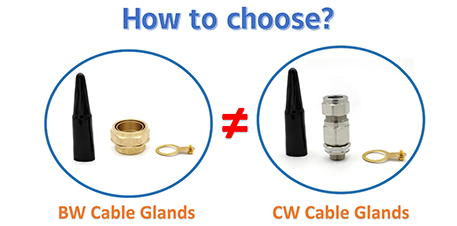
BW and CW cable glands both terminate SWA armoured cable, but they are built for different environments. Learn the key differences, IP ratings, and how to choose.
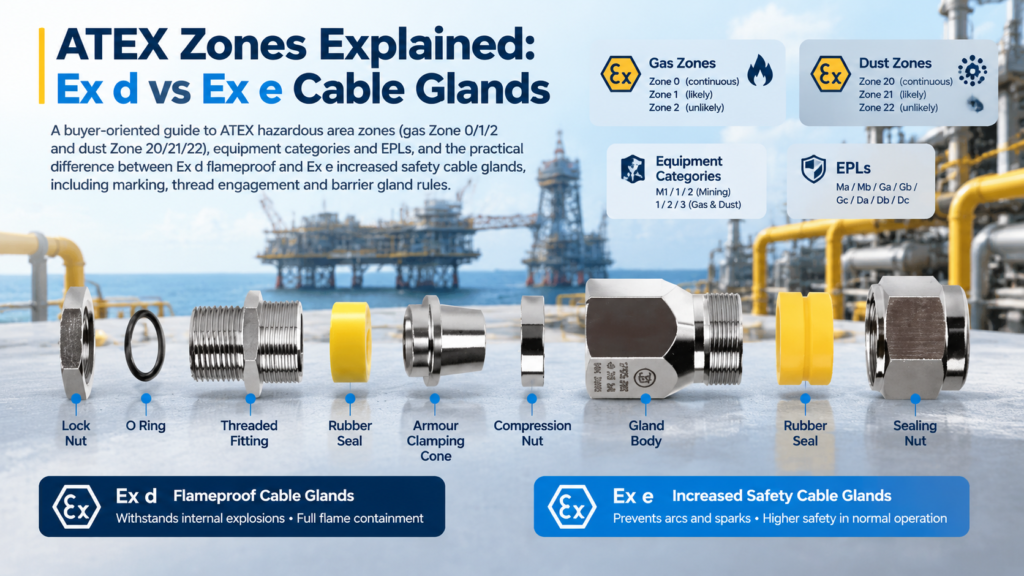
ATEX zones explained in plain terms: Zone 0-2 and 20-22, equipment categories and EPLs, plus how Ex d and Ex e cable glands differ and when a barrier gland is required.
We use cookies to enhance your browsing experience, serve personalised ads or content, and analyse our traffic. By clicking "Accept All", you consent to our use of cookies.