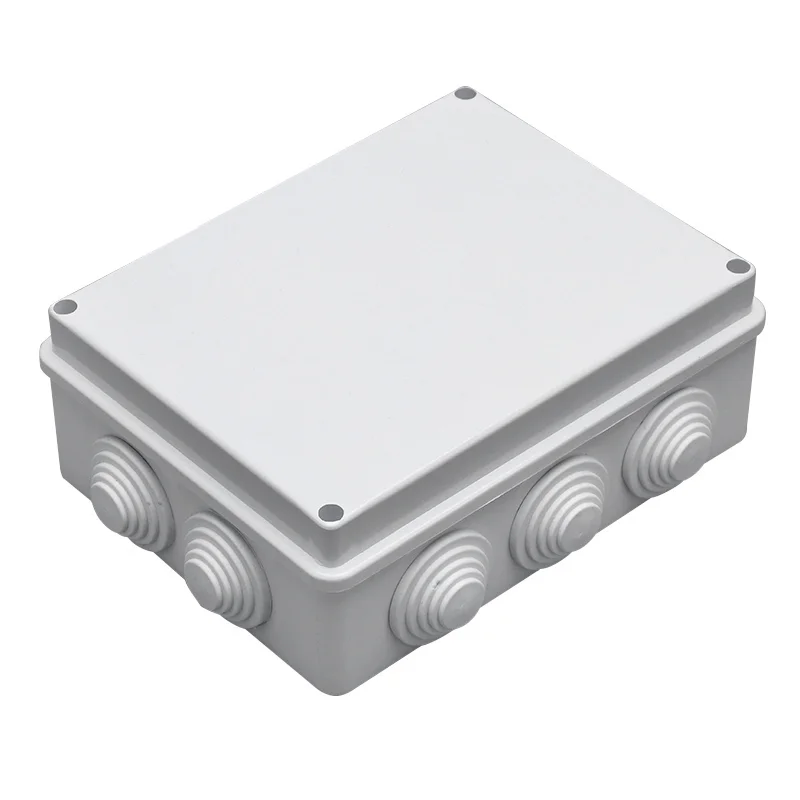
A junction box price is not one number. The same 110×80×70 mm box can leave two factories at a 3× difference in unit cost, and neither supplier is lying — they are quoting different plastic, a different mould, a different carton. Buyers who compare on unit price alone usually find the gap after the container lands, in a gasket fitted in a hurry.
This guide breaks the quotation into the five blocks that generate it, and gives a checklist for comparing two offers from our waterproof junction box range or any other supplier.
The Five Blocks in Any Quotation
Block
Share of FOB, typical
What moves it
Resin, gasket and inserts
35–45%
Polymer family, flame-retardant grade, wall thickness, part weight
Moulding
12–18%
Cavity count, clamp force, cycle time, machine hourly rate
Assembly
10–18%
Gasket fitting, screw insertion, terminal blocks, lid tether
Tooling amortisation
3–8% at 20,000 pcs
Whether the mould is billed separately, cavity count, steel grade
Test, packing, inland freight
9–14%
Batch IP testing, carton design, cube efficiency
The ranges are indicative for a mid-size flame-retardant ABS or PA66 box in Asian production — use them to sanity-check an offer, not to build one. Material is the largest line and the only one you can change by changing the specification.
Material Cost: The Line You Can Move
Polymer choice changes the resin line by a factor, not a percentage. Taking standard ABS as 1.0, a flame-retardant ABS compound such as the body of the JX-RA enclosure typically lands at 1.1–1.25, the flame-retardant PA6 of the F1 mini junction box at 1.3–1.6, and polycarbonate at roughly 2–2.5. On a 160 g part that is the whole margin on a small order.
Wall thickness is the second lever, and it is usually overspecified. Uniform 3 mm walls on a 175 mm box add weight without adding much sealing performance; ribs and a locally thickened gasket land do the same job with less resin. The trade-offs in detail sit in our junction box material comparison.
Do not compare on price per kilogram. The product is mostly air: the 95×65×55 mm box is roughly 353 g per litre of envelope, the 280×190×180 mm box 98 g/L. A per-kilogram price therefore flatters large boxes by a factor of three and a half; price per litre of volume does the opposite.
Moulding: Cavity Count and Clamp Force
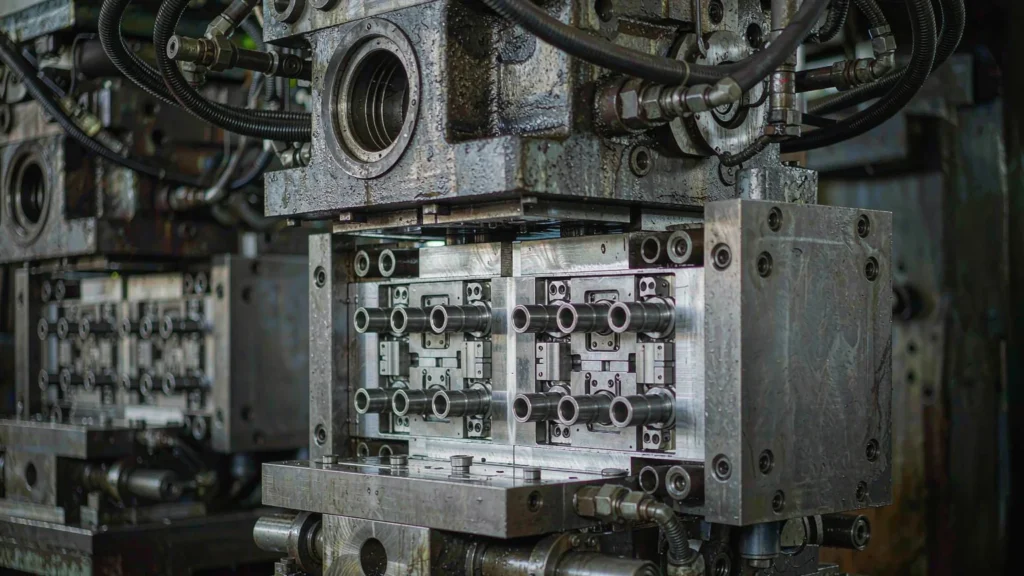
Moulding cost per part is machine time divided by parts per cycle. A 110×80×70 mm base and lid on a single-cavity tool might run a 30-second cycle; a four-cavity tool runs a similar cycle for four parts, so the machine cost per part falls by roughly four. What rises instead is clamp force, because the projected area multiplies with the cavity count.
Clamp force in tonnes is approximately projected area in cm² × cavity pressure in bar, divided by 1,000. A 110×80 mm part projects about 88 cm²; at 400 bar that is roughly 35 t per cavity, so a four-cavity tool with a realistic runner needs a 160–200 t machine. If a supplier quotes a four-cavity tool but describes a 120 t press, one of the two numbers is wrong, and the part will flash at the seal land.
Tooling: Paid Once, Amortised Forever
Tooling sits somewhere in the price, as a separate line or spread across the order. Spreading it is not cheaper; it hides the exit cost if you move supplier.
Amortisation base
5,000 pcs
20,000 pcs
100,000 pcs
USD 4,000 single cavity
+0.80 / pc
+0.20 / pc
+0.04 / pc
USD 12,000 four cavity
+2.40 / pc
+0.60 / pc
+0.12 / pc
A four-cavity mould is therefore the wrong decision for a 5,000-piece first order. Ask for the tool cost as a separate line with the cavity count stated, and check the steel grade against the volume you are promising — a P20 tool will not run 500,000 pieces.
Assembly and the Manual Floor
Every step after moulding is labour or a machine that behaves like labour. Fitting a gasket, driving four screws, snapping in a terminal block and closing a lid is 30–60 seconds on a small box. At USD 6 per hour fully loaded that is USD 0.05–0.10, a fifth of the price of a USD 0.65 box.
Two design details change it: a gasket pre-formed to the groove and held by a lip fits faster and straighter than a loose O-ring, and captive lid screws remove a dropped-screw step. Both are tooling decisions that also cut the chance of a gasket fitted twisted.
Testing: What a Certificate Actually Costs
IP testing is two purchases. A type test at an accredited laboratory, done once on a design, is a project cost in the hundreds of dollars. A batch immersion check inside the factory costs minutes of labour and a tank, and catches the short shot or the torn gasket.
An offer including neither is unfinished, not cheap. Ask which of the two is included, on what sample size, and whether the report names the enclosure and the test depth rather than the factory. The inspection sequence we run is on our QC control page.
Packaging and Cube: The Number Buyers Skip
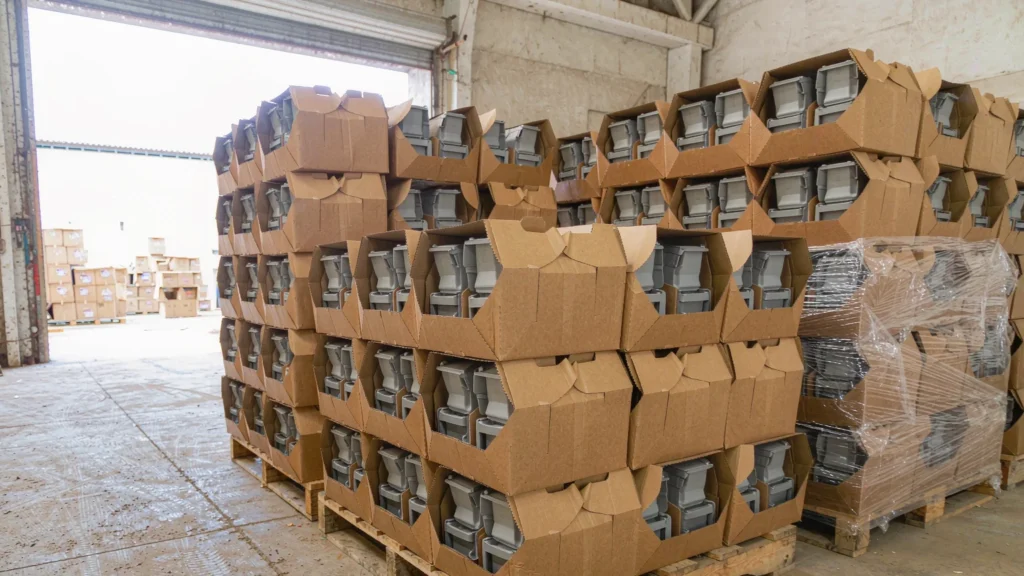
Carton design is the least discussed cost driver: ocean freight is charged on whichever is greater, weight or volume — and a hollow plastic box is always volume-charged. Here is the published carton data for five sizes of the JX-AG range, taken as-is:
Envelope
Pcs / carton
Pcs / m³
Pcs per 40HQ (68 m³ usable)
95×65×55 mm
160
≈2,520
≈171,500
110×80×70 mm
90
≈1,420
≈96,500
175×175×100 mm
40
≈310
≈20,900
250×150×100 mm
24
≈180
≈12,300
280×190×180 mm
12
≈97
≈6,600
The spread is 26 to 1. At USD 2,500 per 40HQ all-in, freight is about USD 0.015 per unit on the smallest box and USD 0.38 on the largest — a 25× gap no resin negotiation recovers. Carton density also falls from roughly 290 kg/m³ to 130 kg/m³, so every size is volume-charged.
On small boxes freight is irrelevant; on large boxes it can equal the moulding cost, and the first thing to renegotiate is carton nesting, not the piece price.
The Customisation Price Ladder
Custom work is priced per change, not per box, and the order of the ladder is remarkably consistent:
Colour. A colour change means a purge and a minimum resin batch, so it carries an MOQ rather than a premium.
Openings. An extra entry is a slide or a drilled operation — cheap per hole, expensive per setup.
Printing. A pad-print plate costs once; the per-unit cost after that is small.
New geometry. A new boss, gasket groove or lid is new tooling and should be quoted as such.
“ABS” and “FR-ABS V-0” differ by up to a quarter on the largest line
Part weight stated in grams
Wall thickness is invisible in a photo and visible on a scale
Tooling as a separate line with cavity count
Reveals whether the unit price is subsidising a mould you do not own
Batch IP test included, with sample size
The difference between a certified design and a certified shipment
Carton dimensions and pieces per carton
The freight element can exceed the moulding cost on large boxes
Incoterm and packing list basis
FOB and CIF quotes are not comparable on unit price alone
Conclusion
A junction box price is a specification in disguise. Fix the polymer, the part weight, the cavity count, the gasket and the carton and the quotations converge within a few percent. Leave any of them open and the cheapest offer wins on the one line you did not check.
FAQ
Why is a small junction box sometimes more expensive per piece than a larger one?
Because tooling and assembly are per piece, not per gram. A small box carries the same gasket step, the same screw insertion and a share of the same mould cost, so a lighter part can cost more than a heavier one.
Should I pay for tooling separately or let the supplier amortise it?
Pay separately and own it. An amortised tool hides the cost in the unit price, makes comparison impossible and complicates moving the part to a second source later.
Does a flame-retardant grade add much to the unit price?
Typically 10–25% on the resin line, the largest block in the quotation. That is smaller than most buyers expect, and it is not the line to cut if the box sits near a heat source.
How much does IP testing add per order?
A one-off type test at an accredited laboratory is a project cost. Routine batch immersion checks add minutes of labour, not dollars per unit — which is why they can be included at negligible cost, and also why they are easy to leave out.
Can packaging really change the landed cost that much?
On large boxes, yes. The 280×190×180 mm size ships about 97 pieces per m³ against 2,520 for the smallest, so freight per unit differs by 25×. Nesting lids separately in the carton is often worth more than a price negotiation.
A marine cable gland is a sealing device used for cable entry in industrial electrical installations, shaped like a sleeve. When a cable passes through the gland, epoxy glue or a compression seal is used to achieve explosion-proof, waterproof, and dust-proof sealing at the enclosure entry point. On a ship, every cable that passes through […]
What “UL Listed” really means for cable glands: UL 514B scope, Listed vs Recognized marks, NPT threads for the US market, and the documents to request before ordering.
We use cookies to enhance your browsing experience, serve personalised ads or content, and analyse our traffic. By clicking "Accept All", you consent to our use of cookies.