Blog
Application of PA66 Nylon Cable Glands for weather station
How PA66 nylon cable glands protect weather station sensors, data loggers and control boxes: IP68 sealing, UV and corrosion resistance, and gland selection.
Read More
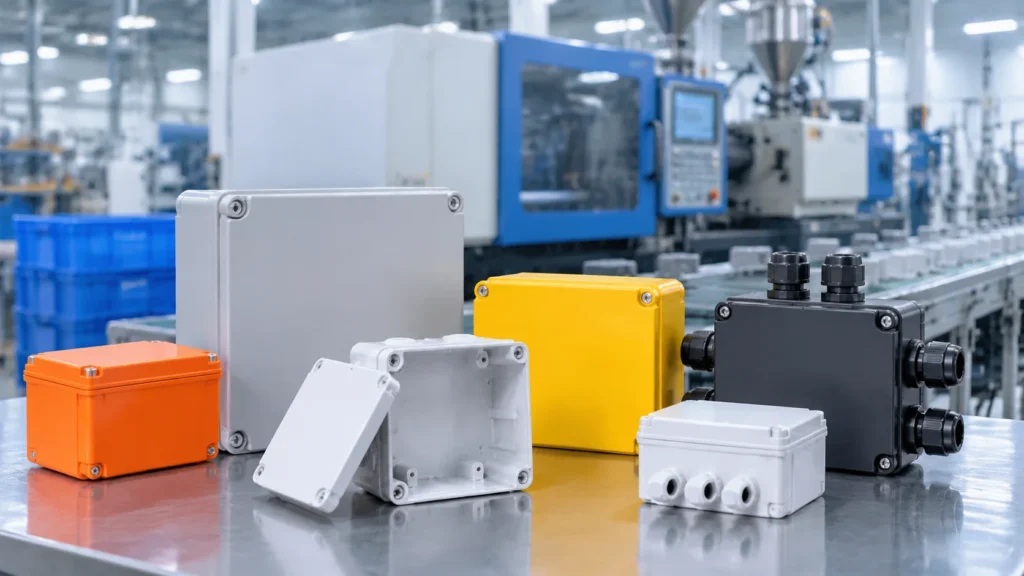
Most suppliers answer a custom enclosure enquiry with one sentence: “we support customisation.” That sentence costs the buyer a week, because it does not separate changes that are mere configuration from changes that need tooling — and those two categories differ by an order of magnitude in cost and lead time. A custom junction box manufacturer that quotes properly splits the work into three tiers before it quotes a price. This guide sets out that split for moulded enclosures, explains why a custom opening can quietly void an IP rating, and lists what belongs in an RFQ. The examples come from the three families we build: ABS bodies with cut outlets, flat-gasket IP67 enclosures, and IP68 mini connectors, all inside the waterproof junction box range.
These are choices the existing tool already produces. No new mould, no setup charge, no minimum beyond the standard one:
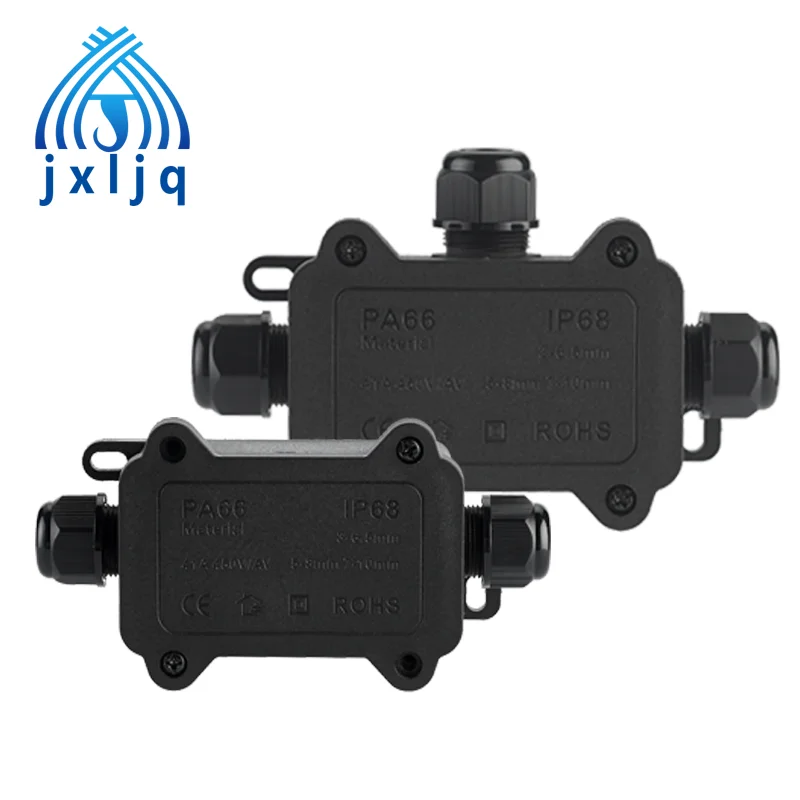
Our F1 series is a family where the configuration is the product: 2-way, 3-way and 4-way bodies, each with 3–6.5 mm, 5–8 mm or 7–10 mm inserts. Picking a combination is a warehouse decision, not an engineering one — the F1 ordering table exists so that decision can be made on paper instead of in a sample cycle.
No new tool, but a run long enough to absorb a setup:
| Change | What sets the floor | What to send |
|---|---|---|
| Custom body colour | Masterbatch batch; the machine runs one colour at a time | RAL or Pantone, plus indoor or outdoor use |
| Logo or marking | Print plate or laser program setup | Vector artwork, position, maximum area |
| Extra or moved holes | Drilling fixture, made per pattern | 2D drawing with a datum and thread callout |
| Printed inner box or label | Print run, not enclosure run | Artwork, barcode data, carton mark |
| Assembled with glands | Kitting labour and a seal check per unit | Gland model, thread, torque instruction |
Colour is the item buyers most often misjudge. A custom colour is not a design change; it is a production batch change, and the floor is set by how much compound must be mixed, not by how many boxes you want. At low volume, ask for the nearest standard shade. On an outdoor ABS body the colour is also a UV decision — a dark custom shade chosen for branding runs hotter in sun than standard light grey.
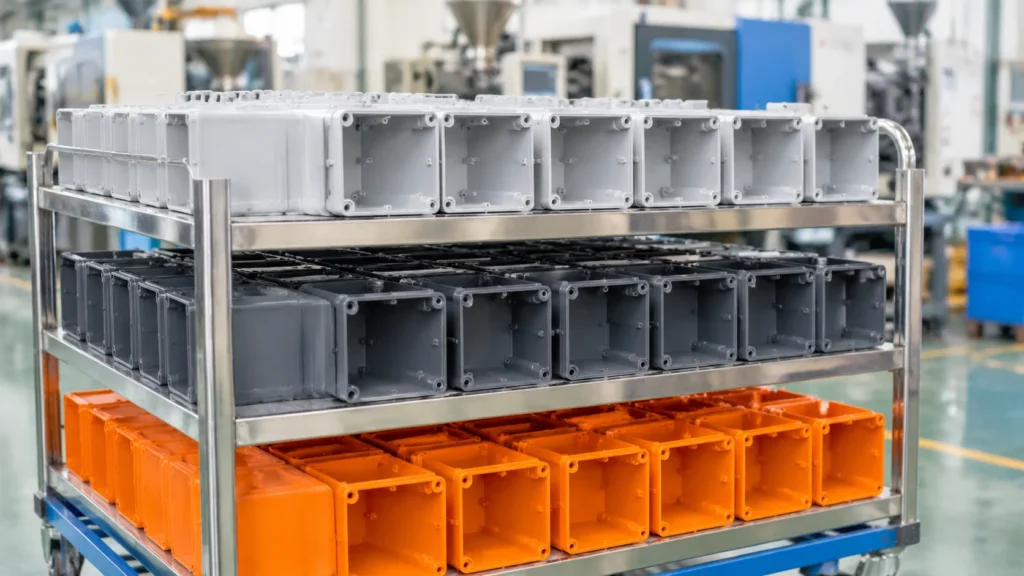
A new body size, new cover geometry, a different gasket channel, or a change to wall thickness all mean a new tool or a major insert modification. Tooling is a capital item with its own lead time and ownership question, and it must never be bundled silently into a unit price. Before approving it, settle three things in writing: who owns the tool, whether it is exclusive to your part, and what happens to it if the programme ends.
Most “custom box” projects never reach this tier. They need a different combination of openings, a colour and a printed logo on a body that already exists — which is why the first question a competent factory asks is not “what size do you want” but “which of our existing bodies is closest”.
An IP rating describes a tested configuration, not a plastic shape. The enclosure was verified as a specific assembly — this body, this gasket, these openings, with these plugs and glands fitted. Change the opening pattern and you have built a different assembly, and the original certificate no longer describes it.
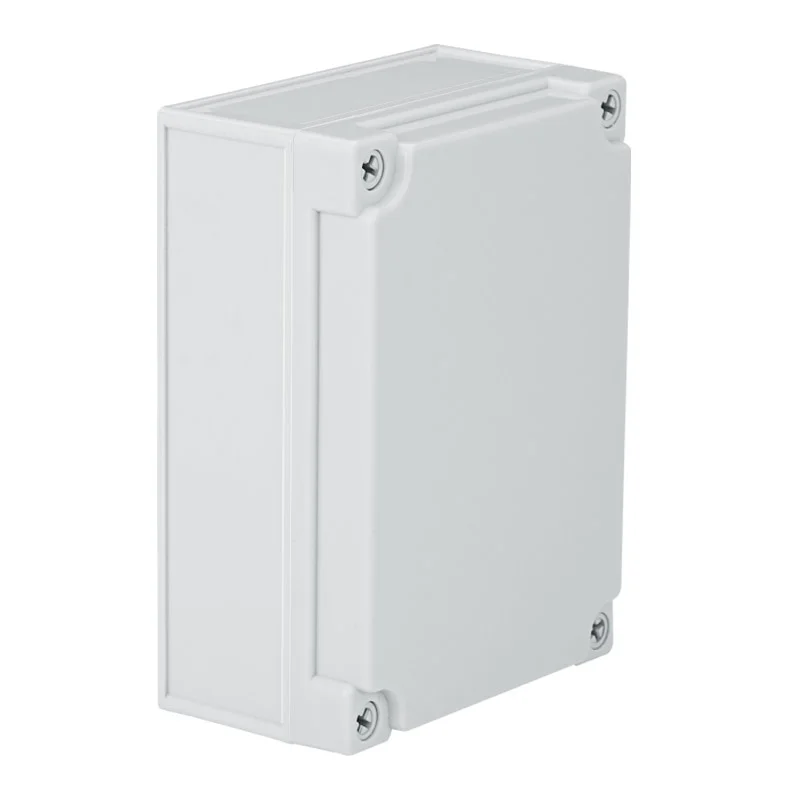
Two consequences follow. Extra openings should be declared at order so they can be part of the tested sample rather than drilled on site afterwards. And every opening must be closed with a component rated at least as high as the box: an IP68 body fitted with an IP54 gland is an IP54 assembly. The same logic applies to the lid — a flat-gasket enclosure such as the JX-AG series depends entirely on that one face seal, so a warped lid from a bad mould change turns IP67 into a drip tray.
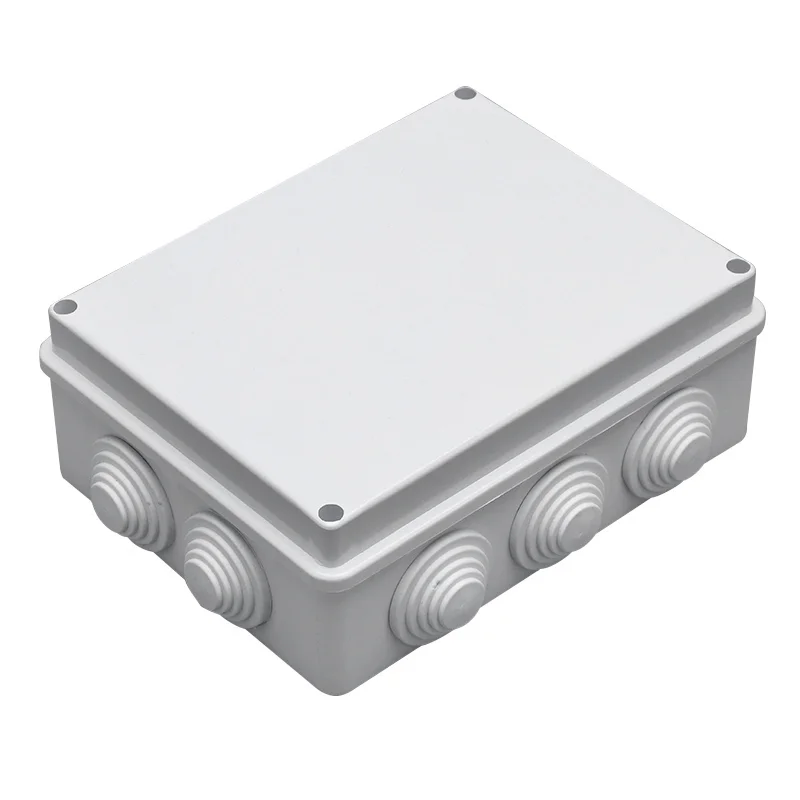
Where openings are cut after moulding, wall thickness becomes the limit. An M20 gland tightened into a 2 mm ABS wall with no boss will crack the wall before it compresses the washer. On the JX-RA ABS range, standard outlets are 25 mm and 36 mm across bodies carrying 4 to 16 outlets; larger or additional outlets are a factory operation, not a site one.
MOQ is almost never about the box. It is the sum of the setups in the order: a standard model in a standard colour has the lowest floor we offer, a colour and a print plate move it, a fixture for a new hole pattern moves it again. So “low MOQ” claims are not comparable between suppliers. Ask instead what the MOQ is at each tier, and which tier your change falls into. It is also why samples matter more than the number: two free samples at a 3–7 day lead time let you verify fit and seal before committing to a batch.
Most wrong quotations trace back to a missing datum or an unstated thread. Send these and the quotation stops being a guess.
“Hole on the left side” is not a specification. State the datum — one corner, or the body centreline — and give coordinates from it with a tolerance. Without one, a 1 mm disagreement about where the hole sits becomes a rejected lot, and both sides believe the other made the error.
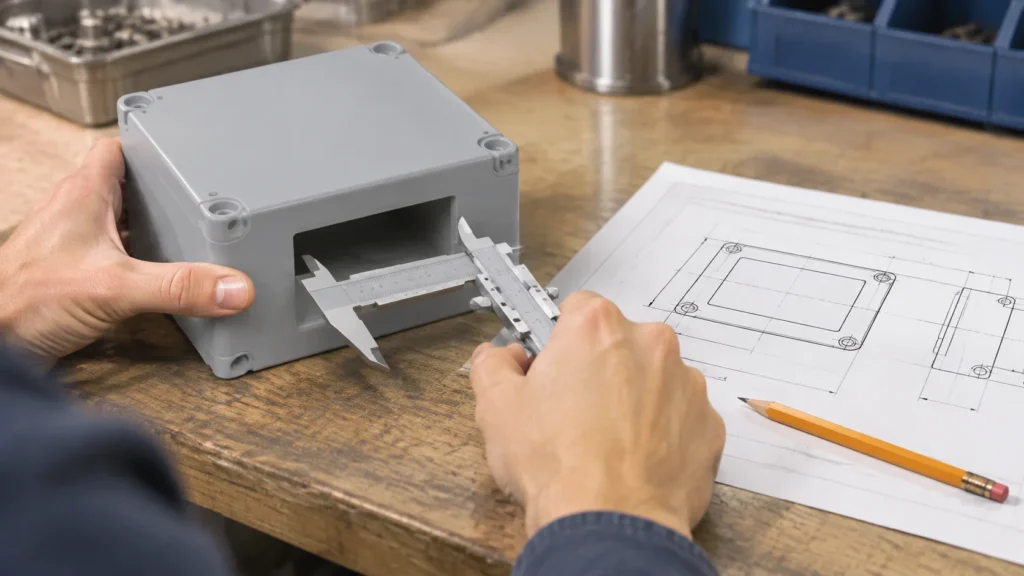
A 20 mm hole is not an M20 thread. Specify M, PG or NPT explicitly; they are different pitches with different drill sizes and they do not interchange. Our conversion table for metric, PG and NPT threads gives the equivalents, but the order must name the standard you need.
“High-quality plastic” is not something a purchase order can enforce. Name the polymer and the flame class. Our own catalogue is the fair warning here: the F1 model page lists PA6 while the series page lists PA66, and both are flame-retardant V0 nylon — but a buyer who needs one grade for a temperature or hydrolysis requirement must write it into the PO rather than read it off a web page. The trade-offs between PA66, ABS, polycarbonate and stainless steel are in our junction box material comparison.
Ask what the sample is meant to prove. One that confirms dimensions does not confirm the seal; one assembled by hand may not represent production. The useful sample comes from a production run, with the intended gland and plug configuration fitted, tested the way the batch will be.
Certification scope is the other item buyers discover late. CE and RoHS declarations attach to a declared configuration and material set, so substituting the polymer for a custom order may leave the declaration describing a part you no longer buy. Ask which certificate covers your exact configuration before ordering, and ask to see inspection records — our quality control process describes what we record at each stage.
Customise at the tier that matches your volume. Choose from the existing pattern where the options already exist, pay a setup when you need a colour, a print or an extra hole, and treat new tooling as a separate capital decision with its own ownership terms. Declare every opening before the box is moulded, name the thread standard and polymer grade in writing, and put a datum and a tolerance on the drawing. Those habits remove most of the cost and nearly all of the rework from an OEM order.
Yes, if the change stays inside tier one or two. A different opening combination, cable range or gland configuration on an existing family has the lowest floor. Colour and logo carry a batch minimum; a new body needs tooling.
Yes. A rating describes a tested assembly, so an opening added afterwards is outside the tested configuration even if a gland is fitted. Have it included in the factory sample.
On standard bodies with a changed configuration we publish 3–7 days, with two free samples. A new colour, print or hole pattern adds setup, and new tooling runs to its own schedule.
Yes. Factory assembly puts the gland, plug and torque under process control rather than leaving them to the installer, and it is the configuration most likely to match how the enclosure was tested.
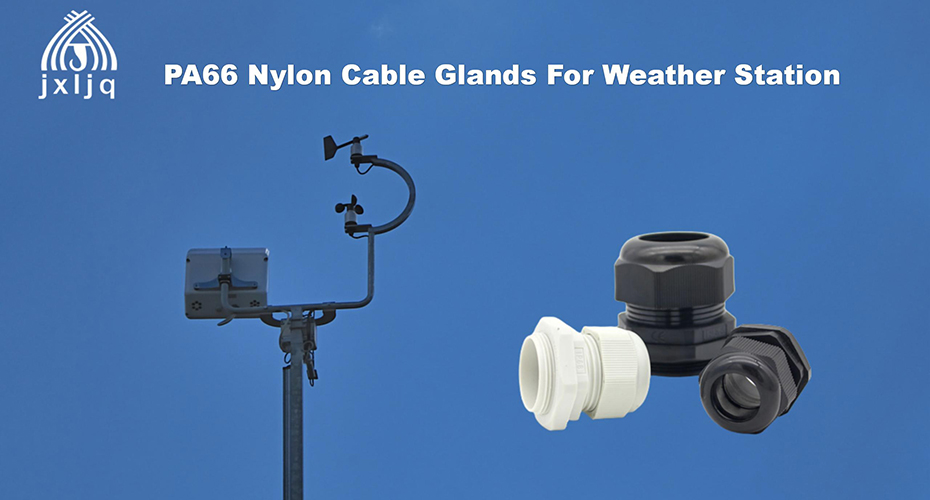
How PA66 nylon cable glands protect weather station sensors, data loggers and control boxes: IP68 sealing, UV and corrosion resistance, and gland selection.
Read More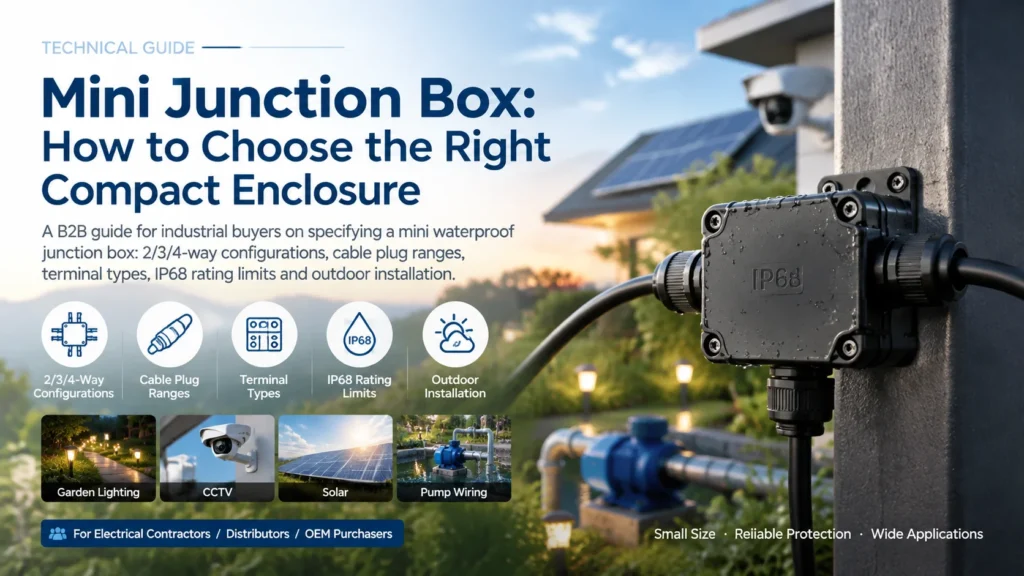
Specify a mini junction box correctly: 2/3/4-way choice, cable plug ranges, terminal types, IP68 limits for burial, and five installation steps that keep the seal.
Read More
BW, CW and A2 are positions in the BS 6121 cable gland type code, not rival models. This guide decodes the letter system and shows how to specify the right armored gland type.
Read More