Blog
What is EMC cable gland?
Learn what an EMC cable gland is and how it keeps a shielded cable’s braid grounded to the enclosure to block electromagnetic interference in automation, telecom, and signal systems.
Read More
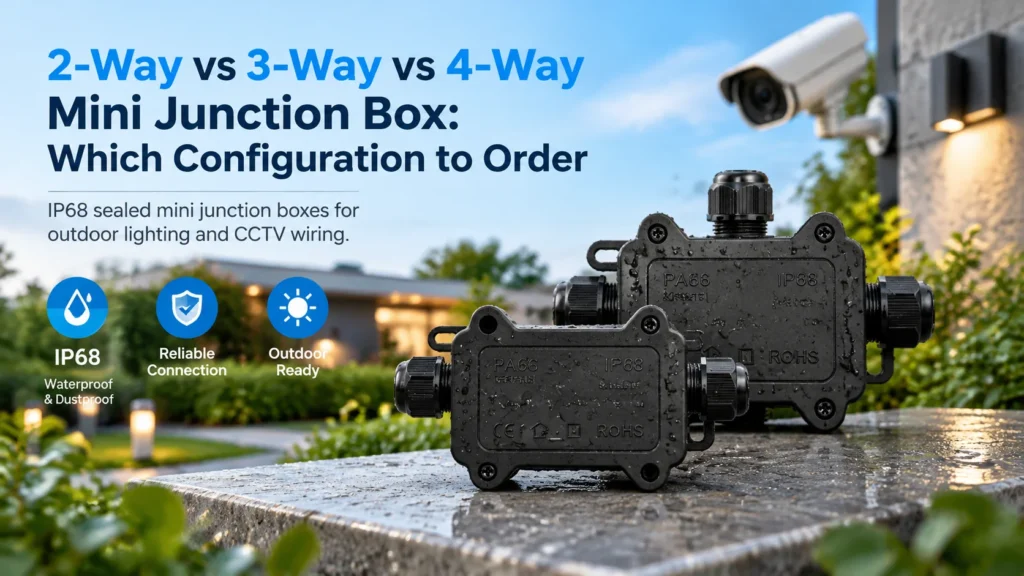
Search for a 3 way junction box and half the results are talking about something else entirely. Some describe a sealed splice enclosure with three cable entries. Others describe the box behind a two-switch lighting circuit. The products are not interchangeable, the wiring rules are different, and the only thing they share is a number.
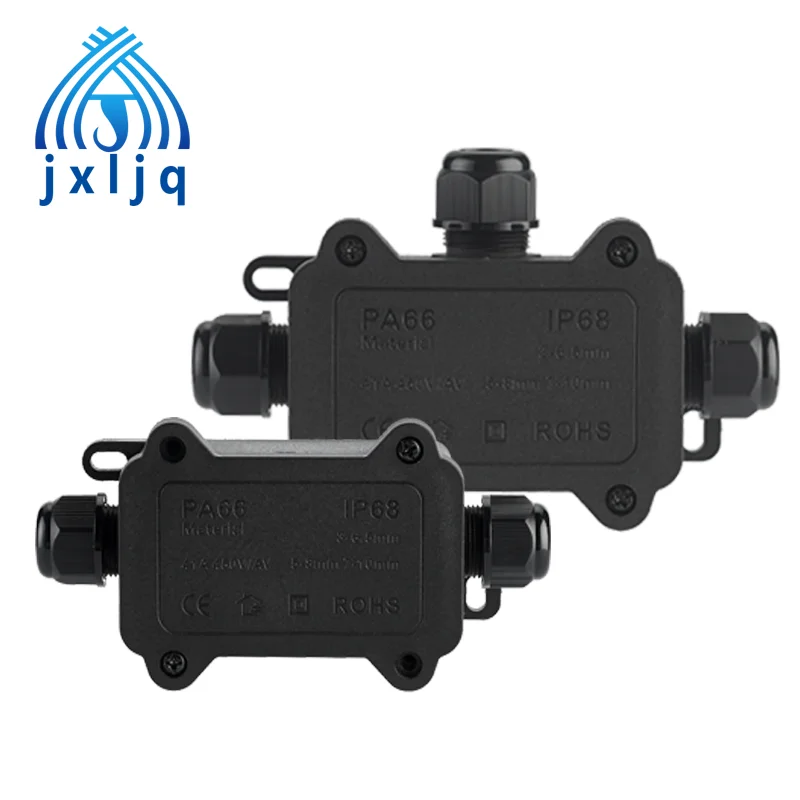
This page separates the two meanings, then does the part most catalogues skip: it walks the real order codes for the F1 mini range — eight stock configurations across 2-way, 3-way and 4-way — and shows which one each wiring layout needs. By the end you should be able to pick a part number for a 3 way junction box from your cable schedule instead of guessing between three and four entries.
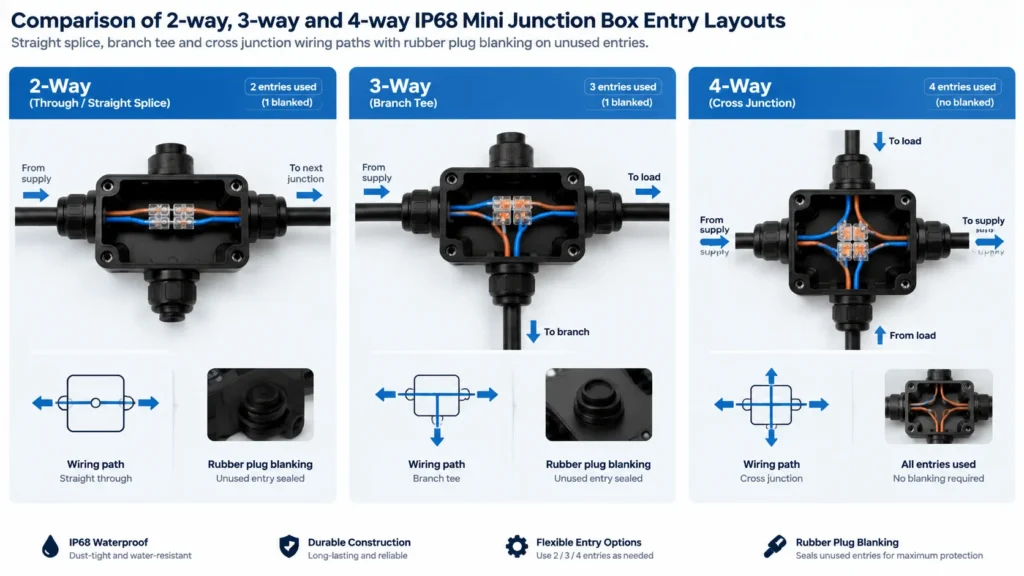
In a moulded IP-rated splice enclosure, the number refers to entry points. A 2-way box joins two cables end to end. A 3-way box accepts three cables at one point, which is what a branch or tee connection needs. A 4-way box accepts four, typically for a cross junction or a four-leg lighting run.
Each entry carries its own seal, and the box is supplied with rubber plugs so unused entries can be blanked. That is the whole design: one body, one O-ring, one set of brass contacts, and a choice of how many cables enter it.
The other meaning comes from switch wiring, where two switches control one load. That circuit needs a box large enough for travellers, and in North American practice it is a wall or ceiling box sized by conductor volume, not an IP-rated splice enclosure. If your job is stair-well lighting, you are buying a different product class — our boxes are for joining outdoor and wet-location cables, not for housing switch mechanisms.
Everything below refers to meaning one: entries, not switches.
The range is IP68 rated, moulded in flame-retardant PA6 nylon with a silicone O-ring, and terminates by screw-crimping onto nickel-plated 59-1 brass contacts. Voltage withstand is 1500 V, working ratings are 16 A/450 V and 24 A/450 V by model, housing is UL94 V0, and the operating range is −40 °C to +105 °C.
| Order code | Configuration | Cable range (mm) | Weight (g/pc) | Conductor size |
|---|---|---|---|---|
| MN-01 | 2-way | 3–6.5 | 71.6 | 0.5–4 mm² |
| MN-02 | 2-way | 5–8 | 72.8 | 0.5–4 mm² |
| MN-03 | 2-way | 7–10 | 70.8 | 0.5–4 mm² |
| MH-05 | 3-way | 3–6.5 | 78.8 | 0.5–2.5 mm² |
| MH-06 | 3-way | 5–8 | 77.4 | 0.5–2.5 mm² |
| MH-07 | 3-way | 7–10 | 76.5 | 0.5–2.5 mm² |
| MN-8 | 4-way | 3–6.5 | 85.0 | 0.5–2.5 mm² |
| MN-9 | 4-way | 5–8 | 79.5 | 0.5–2.5 mm² |
Carton quantities, packing dimensions and the current datasheet sit on the F1-2T/3T/4T mini waterproof junction box page.
Every 2-way and 3-way code covers all three cable ranges. The 4-way does not: MN-8 stops at 6.5 mm and MN-9 at 8 mm. If your design needs four entries and 7–10 mm cable, no F1 code will do it. That is a specification limit, not an ordering oversight, and it is the single most common mismatch we see in RFQs for this range. The workaround is a standard enclosure with four glands, which is a different product and a different installation method.
The 2-way codes accept 0.5–4 mm². The 3-way and 4-way codes accept 0.5–2.5 mm². If a branch circuit carries 4 mm² conductors, a 3-way F1 is not eligible however well the cable diameter fits — check the contact size before the seal size.
Three-way bodies run roughly 7 g heavier than the 2-way of the same cable range; the 4-way adds about 13 g over the 2-way. On a 10,000-piece order that is 130 kg of extra gross weight and a measurable difference in freight and carton count. For a project choosing between a 3-way at every branch and a mix of 2-way plus a single larger enclosure, the arithmetic is worth doing before the PO.
A 3-way box used for a straight splice has one entry that must be blanked. The rubber plug is part of the IP68 claim, not an accessory. Boxes arrive with plugs fitted; if a plug is removed during trial assembly and not refitted, the enclosure is no longer sealed and no test report will save it. Write “confirm all unused entries plugged” onto the installation checklist, because it is the failure mode that returns units.
| Layout | Entries needed | Configuration | Notes |
|---|---|---|---|
| Cable-to-cable splice, in line | 2 | 2-way | Cheapest and smallest; no plug left open |
| Main run with one branch tap | 3 | 3-way | The standard branch box; one entry per leg |
| Two runs crossing, all joined | 4 | 4-way | Check cable diameter first — 4-way ends at 8 mm |
| Run passing through with a service loop | 2 | 2-way | No joint, so no fill question; seal quality is the only criterion |
| Two branches plus a spare leg for future | 4 | 4-way | If the spare leg stays unused, plug it and re-test |
| Branch with 4 mm² conductors | 3 | None — use a standard box | F1 3-way stops at 2.5 mm² |
The layout question is genuinely three questions stacked: how many cables leave this point, how big is the largest one, and does anything have to pass through without being cut. Answer those three and the row picks itself.
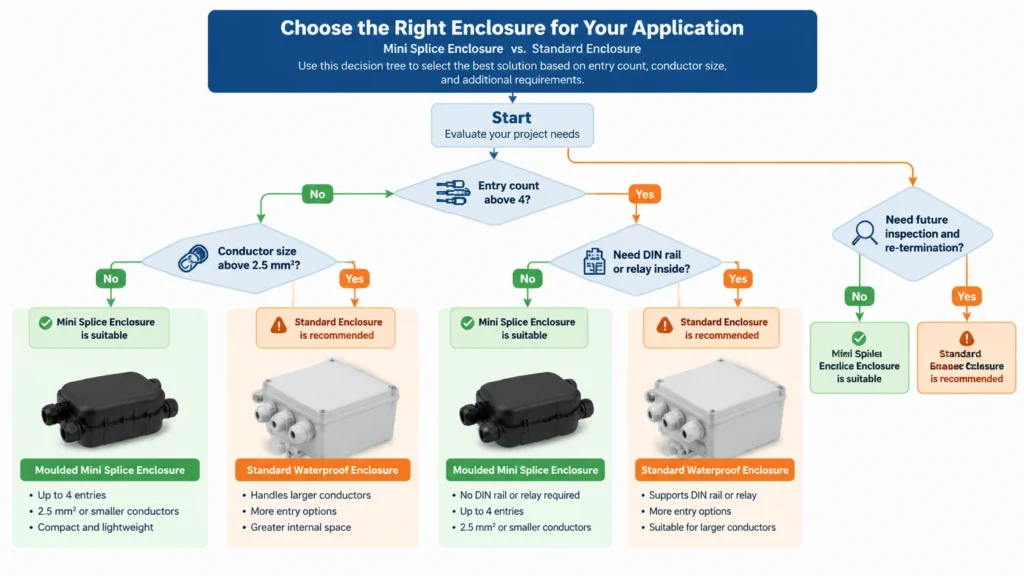
The F1 range is designed around cable sealing, not around internal working space. There is no room for a DIN rail, no flat mounting face inside, and no capacity for a terminal block beyond the moulded brass contacts. That is a feature for landscape lighting, CCTV drops, pump feeds and solar strings, where the joint is two or three cables and nothing else.
It stops being the right answer when any of the following is true:
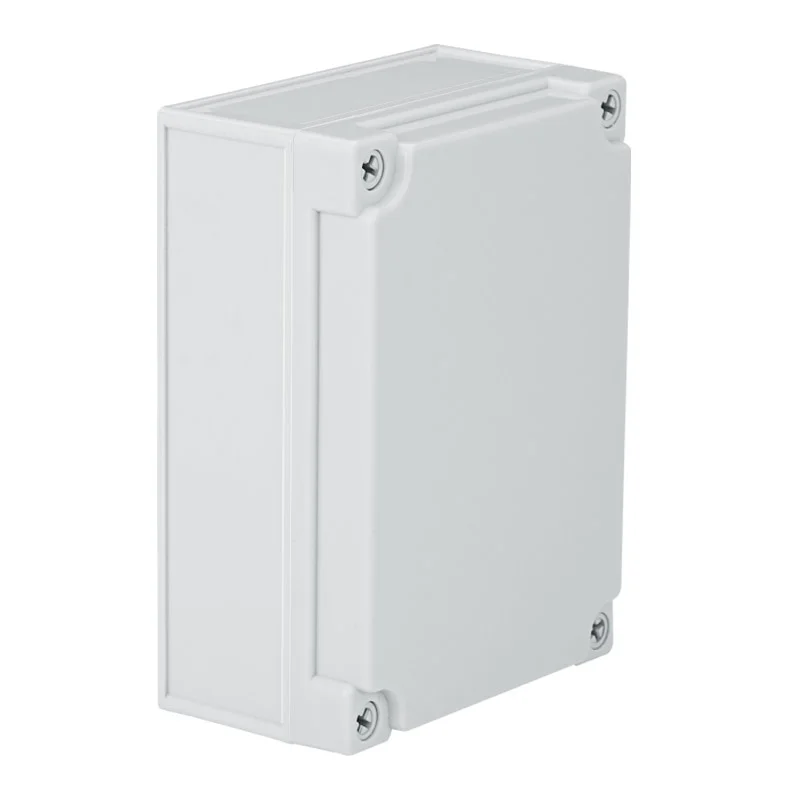
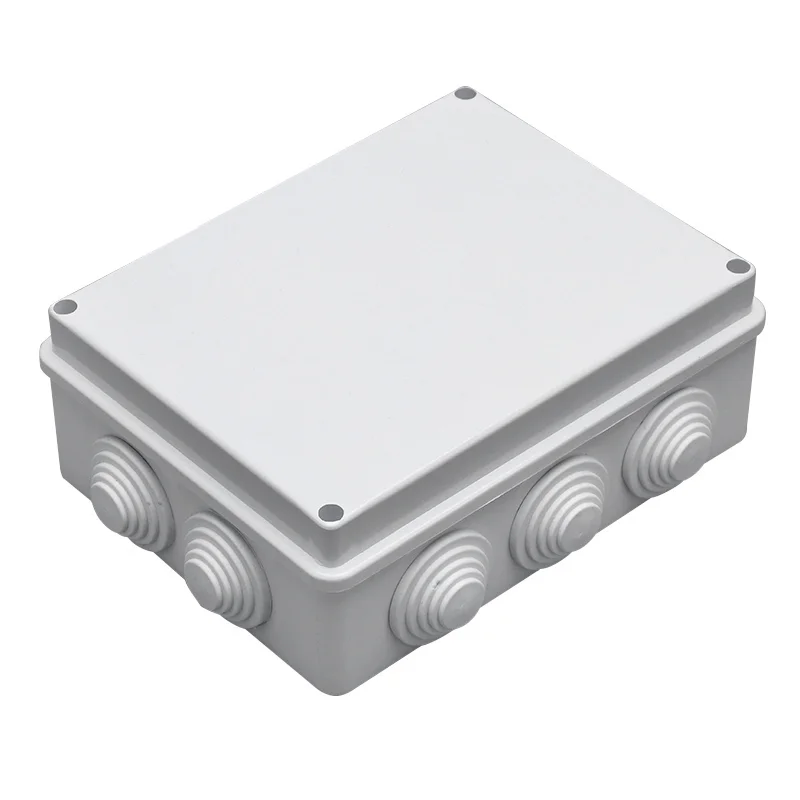
At that point the decision moves to a standard enclosure: an IP-rated junction box with drilled entries, or a moulded-hole body such as JX-RA plastic waterproof junction box, which offers up to sixteen pre-moulded 36 mm entries on the largest size and internal mounting points for PCB or DIN rail. The trade is straightforward: you gain space and serviceability, and you take on gland selection and drilling.
If the cable count is still the open question, the sizing logic in our waterproof junction box selection guide works from conductor count rather than entry count and will tell you when a mini enclosure is already too small. And if the answer is a mini box but the cable range is open, the cable gland size chart covers the metric, PG and NPT equivalents.
Pick the configuration from the cable schedule, not from the product name. Count the cables leaving the joint, note the largest diameter and the largest conductor, then read across the table. If the numbers land on a 2-way, order the 2-way — the extra entries on a 3-way are a sealing risk you do not need to carry.
Send us the joint layout and cable diameters and we will return the exact order codes and quantity, with the plug count and a packing list for the shipment. Send your cable schedule to our team and we will confirm against current stock.
On a sealed splice enclosure it means three cable entries — three cables meet at that point. It does not refer to three-way switching, which is a lighting control circuit housed in a different class of box.
You can, but two entries would be blanked with rubber plugs. That adds two potential leak paths and costs more for no benefit. Use a 2-way unless the spare entries are genuinely reserved for future circuits.
Yes. The plugs are part of the IP68 seal. An open entry breaks the rating regardless of how well the glanded entries are made, and no immersion test on a fully populated sample proves anything about your partially populated installation.
8 mm outside diameter in the current F1 range. The 4-way codes are offered for 3–6.5 mm and 5–8 mm cable only; the 7–10 mm option exists on the 2-way and 3-way codes.
The range is rated 450 V with a 1500 V withstand, so it suits common single-phase mains circuits within its current rating. Confirm the working current against the model — the range covers 16 A and 24 A versions — and confirm local wiring rules for the location.
Custom configurations are possible through OEM tooling, but the standard eight codes cover most layouts and ship from stock. Tooling changes affect lead time, so specify early if your project depends on a non-standard count.

Learn what an EMC cable gland is and how it keeps a shielded cable’s braid grounded to the enclosure to block electromagnetic interference in automation, telecom, and signal systems.
Read More
Why nylon cable glands are used in solar and wind systems: IP68 sealing, UV and corrosion resistance, and how to specify the right gland.
Read More
How PA66 nylon cable glands protect weather station sensors, data loggers and control boxes: IP68 sealing, UV and corrosion resistance, and gland selection.
Read More