Blog
Application of Strain Relief Cable Glands in Robotic Industry
Why robot cables fail at entry points, how strain relief cable glands protect them, where they matter in a robotic cell, and how to choose and install them.
Read More
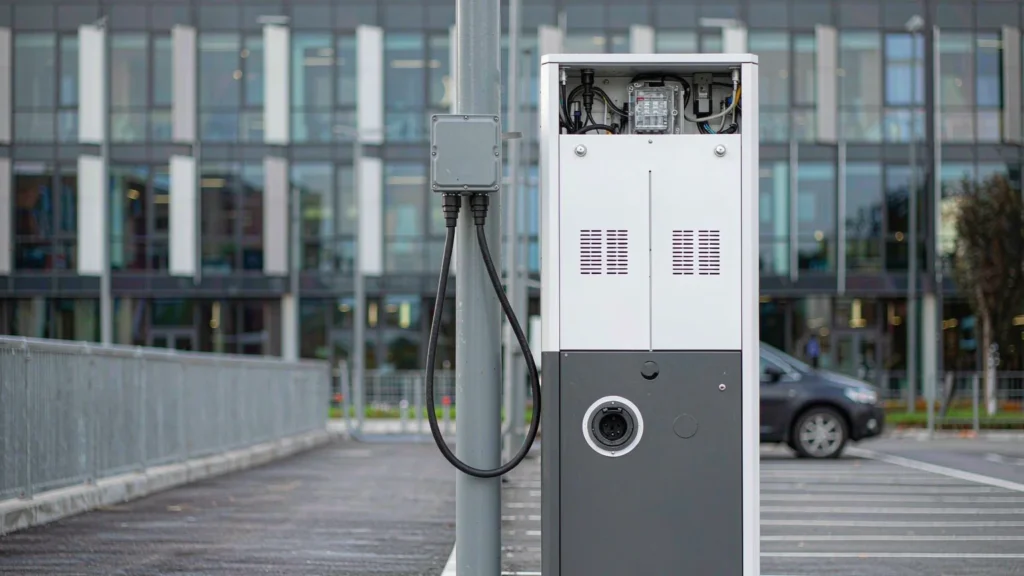
Nothing on an EV charging installation gets specified more loosely than the ev charger junction box. On one site it means the small plastic enclosure where a 6 mm² supply cable is jointed to the charger; on another it means the box holding the current transformers for load management; on a third it turns out to mean the charger itself. Those are three different products with three different jobs, and only the first two are junction boxes. Getting the naming right matters because the failure modes are not shared: a box carrying 32 A continuously has a heat problem, and a box carrying a 0.5 mm² control pair has a corrosion problem. This guide separates the three, sizes each one honestly, and lists the values worth writing into a purchase order.
Separate them before choosing anything. The materials, the IP class and the terminals differ by an order of magnitude.
| What it is | What it carries | Typical enclosure |
|---|---|---|
| Supply transition box | 230/400 V AC, 16–32 A | IP65 box with gland plate and terminal block |
| Control and metering box | CP/PP pilot, RS485, CT leads | IP65–IP68 compact box |
| The charger cabinet | Everything, including the contactor | Rated EVSE assembly, not a junction box |
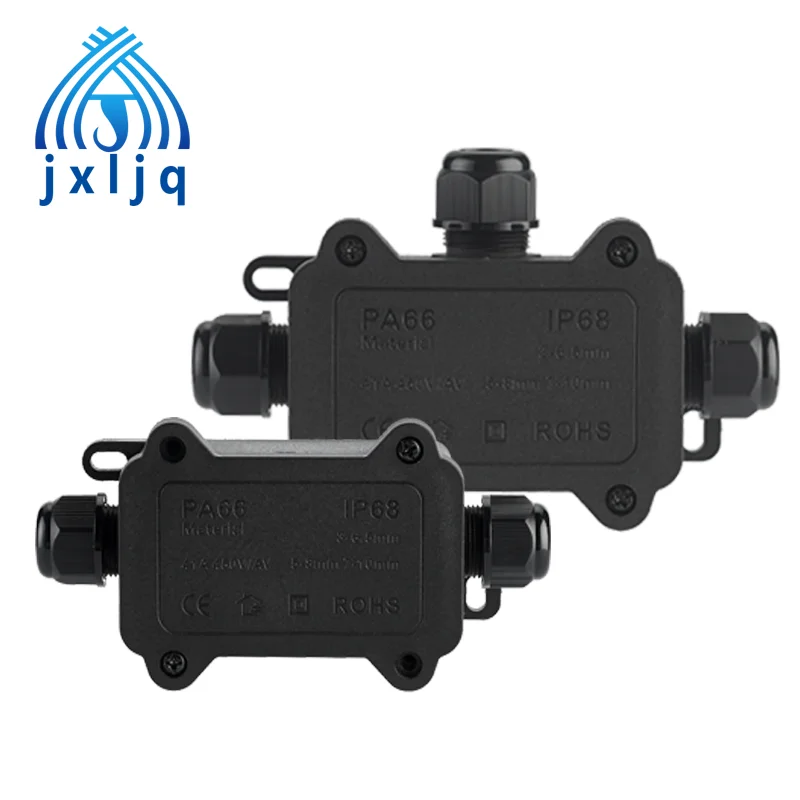
A mini IP68 box from a waterproof junction box range belongs in the second row. Putting it in the first is the most common specification error we see here.
National adoptions of the EV supply equipment safety rules generally set IP54 outdoors and something near IP32 indoors, because that is what a device exposed to rain needs. Treat it as a floor, not a target. Once you add cable entries, the assembly rarely holds its nominal class: an unused entry blanked with tape, or a gland whose seal range misses the jacket by a millimetre, pulls the effective protection down to the weakest component. For an outdoor pedestal in a car park, IP65 is a sensible working number, and IP66 or IP67 where jets or flooding are realistic. The number always describes an assembly, not a moulding — the difference between the classes is worth ten minutes before you write the line.
A 7.4 kW single-phase charger draws about 32 A and needs roughly 6 mm² conductors. A 22 kW three-phase unit draws 32 A per phase and needs five 6 mm² cores. Mini boxes in the F1 class carry 0.5–4 mm² on the two-way version and 0.5–2.5 mm² on the three- and four-way versions, with terminals rated 16 A or 24 A at 450 V, and the cable entries accept 3–6.5 mm, 5–8 mm or 7–10 mm jackets. That is a fine envelope for control wiring and a hard no for a 32 A feeder.
| Circuit | Current | Conductor | Fits a mini box? |
|---|---|---|---|
| 7.4 kW single phase | 32 A | ~6 mm² | No |
| 22 kW three phase | 32 A per phase | 5 × 6 mm² | No |
| CP / PP pilot pair | <1 A | 0.5–1.5 mm² | Yes |
| RS485 or CT leads | Signal | 0.5–1.5 mm² | Yes |
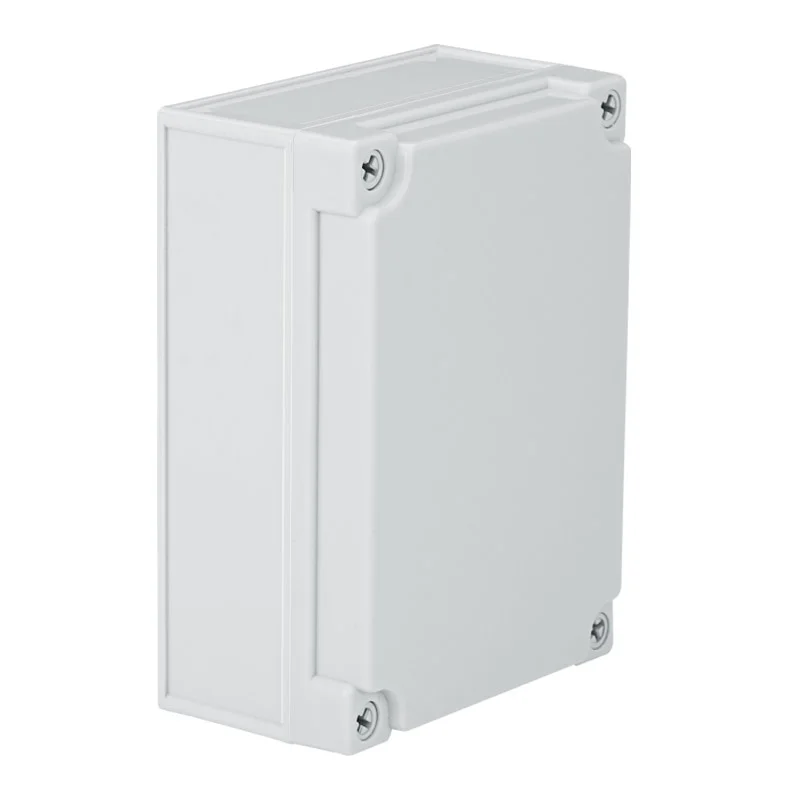
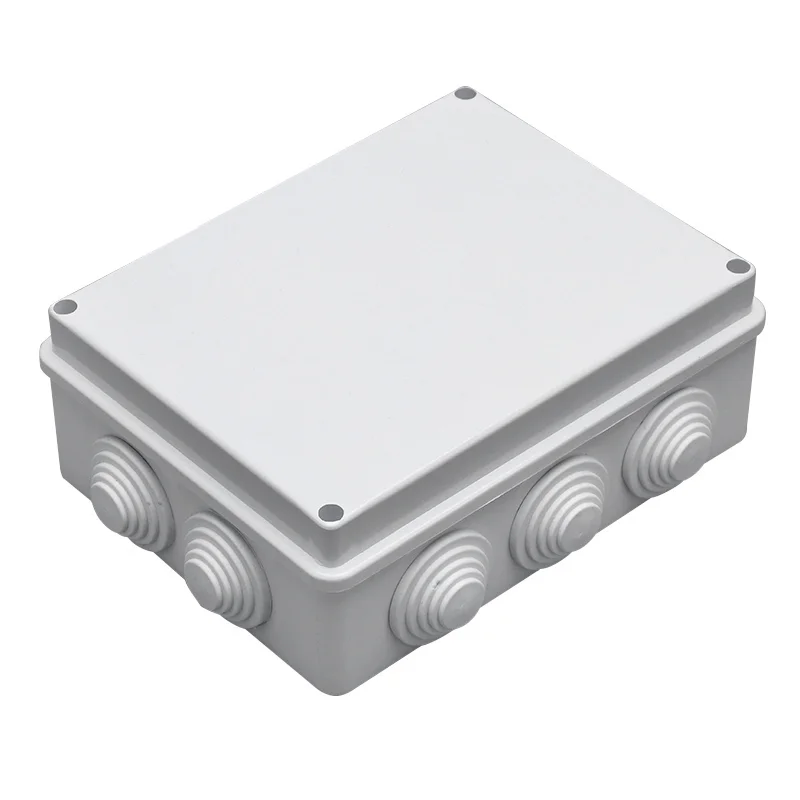
For the feeder, the right product is a larger enclosure with a Din-rail terminal block and a gland plate — the JX-AG series from 95×65×55 mm up to 280×190×180 mm at IP67, or the ABS JX-RA range at IP65 with 25 mm and 36 mm entries. Both give you the volume and wall thickness to land 6 mm² properly.
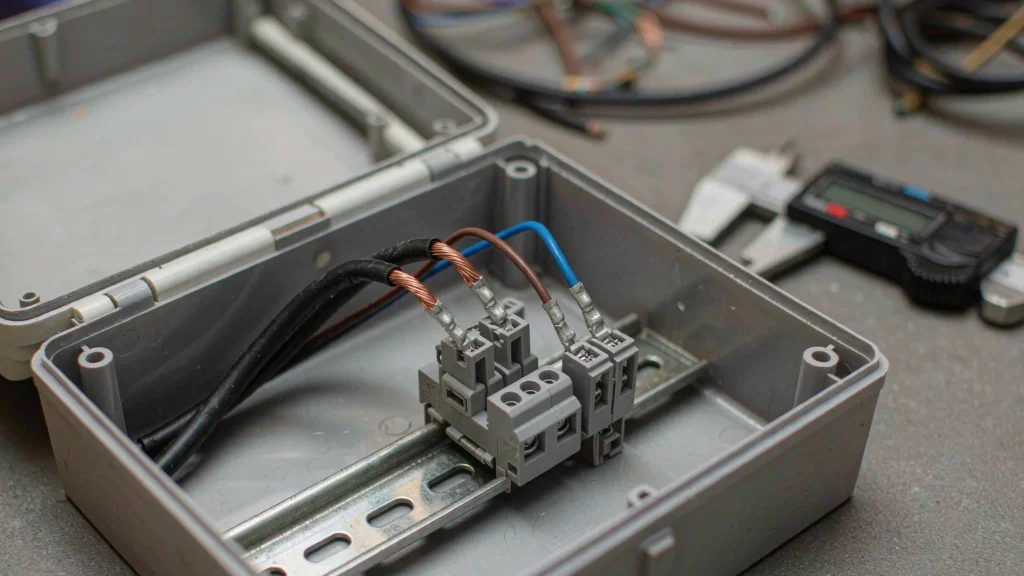
The control pilot, proximity pilot, RS485 link to a load management controller and the CT secondary leads all have to pass from the charger into building wiring somewhere. That is the legitimate job of an ev charger junction box, and it suits a compact IP68 unit with screw-crimp terminals. Keep the low-voltage pair in its own box, separate from the feeder, so a fault on one cannot migrate to the other. Terminate CT leads on their own pair, never shared with the pilot wires.
Two rules catch people out. First, an EV supply point needs residual current protection that reacts to smooth DC leakage — typically a Type B device, or a Type A breaker plus a 6 mA DC detecting module built to IEC 62955. A junction box is not part of that decision, but it can defeat it if the box is used to joint the protective conductor, because that joint sits between the point of protection and the vehicle terminal, in the one place most likely to corrode. Second, never use an enclosure to hide a splice in an earthing conductor. Run the CPC continuous and bond the enclosure separately.
A sealed enclosure at 32 A continuous has no path for heat except its own surface. Polyamide softens progressively above its heat deflection temperature — for an unfilled PA6 at 1.8 MPa that figure sits in the 60–80 °C band and falls as the material absorbs moisture. A terminal reaching 70 °C in a 40 °C plant room is not a failure in year one; it is a creep-and-loosen failure in year four. Oversize the enclosure, keep it out of direct sun, and prefer fewer thick conductors over many thin ones. If the box is genuinely sealed and sees daily temperature swings, condensation is a separate problem — venting beats sealing harder in that case.
The cable glands used in EV charging are covered in more depth separately, including EMC termination for shielded feeders.
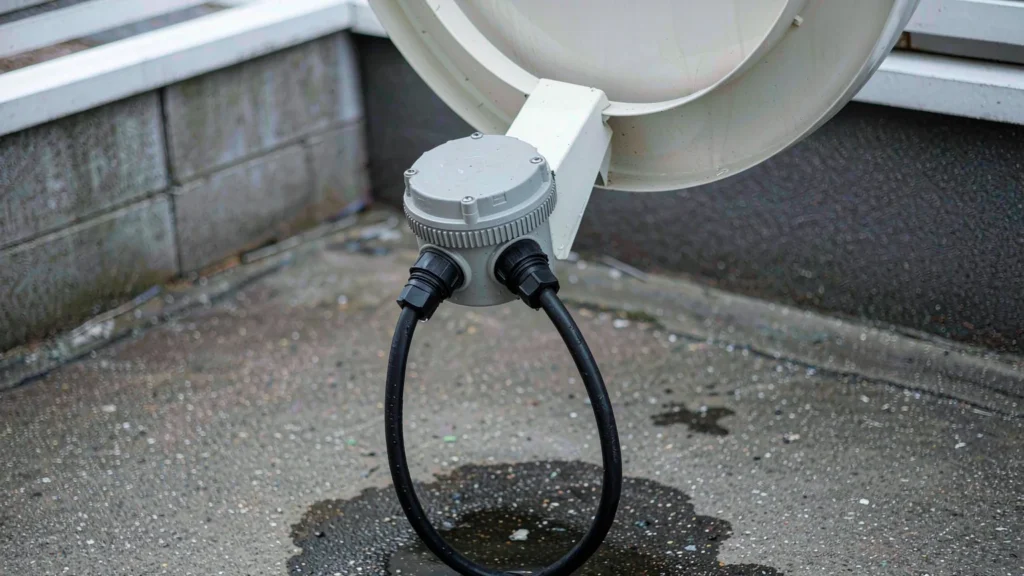
Inside a battery energy storage cabinet, the DC string side should contain no joint you can avoid. A plastic junction box that is ideal for a pilot pair is the wrong home for a DC string termination, because a loose DC joint does not self-extinguish — there is no zero crossing to break the arc. Keep the box for communications and sensing, land DC conductors on terminals rated for the voltage and current with the correct breaking device upstream, and treat arc containment as the cabinet’s job.
| Parameter | Write this | Because |
|---|---|---|
| IP class | IP65 minimum, assembly tested with entries | Floor is IP54, glands decide reality |
| Material | Named grade, UV stabilised, UL 94 V-0 | Outdoor ageing and fire |
| Terminals | Current and voltage rating stated | A 16 A terminal on a 32 A circuit fails slowly |
| Conductor range | mm² per way, per pole count | Three- and four-way boxes accept less |
| Entries | Thread type, size, seal range, long-thread option | Pedestal walls vary |
| Volume | Internal dimensions, not external | Bend radius and heat both need space |
The useful rule is simple: state the current first, then pick the box. Anything at 32 A belongs in an enclosure with a terminal block, a gland plate and enough volume to land 6 mm² without bending it sharply. Pilot wires, CT leads and RS485 pairs belong in a compact IP68 box where a screw-crimp terminal and a silicone O-ring are exactly right. If you are sizing for a specific charger, the size chart settles the volume question before you open a catalogue.
IP54 is the usual regulatory floor for outdoor EV supply equipment. In practice specify IP65 for a wall or pedestal box, and IP66 or IP67 where jets, washdown or standing water are realistic. Remember the rating belongs to the assembled box, including glands and blanks.
Not for a 32 A feeder. The compact boxes in the F1 class accept 0.5–4 mm² at best, with 16 A or 24 A terminals and a 10 mm maximum jacket. Use them for control and metering circuits and take the feeder to a larger enclosure with a terminal block.
Yes. The enclosure material has nothing to do with residual current protection. EV charging needs protection against smooth DC leakage, so a Type B device or a Type A plus a 6 mA DC detection module is required either way.
Because it is a sealed volume carrying continuous current. There is no airflow, so heat leaves only through the surface. Long-duty charging at 32 A on a sunny wall can push terminals past their comfortable range, and sustained heat is what loosens screw terminals over time.
If you are specifying for a charger platform, send the current, the conductor sizes and the entry direction — we will tell you which of the JX-AG sizes covers it, or whether a mini junction box is the better fit for the control side.

Why robot cables fail at entry points, how strain relief cable glands protect them, where they matter in a robotic cell, and how to choose and install them.
Read More
Learn how the IP68 rating on cable glands works: what IEC 60529 actually tests, how the two-seal waterproofing mechanism blocks water, and why installation errors cause most leaks.
Read More
NEMA 4X stops at IP66, while IP68 is a supplier-declared immersion test. See the correct cross-reference, the test methods behind both codes, and the spec line that stops rejections.
Read More