Blog
IP68 Waterproof Junction Box Selection Guide (2026)
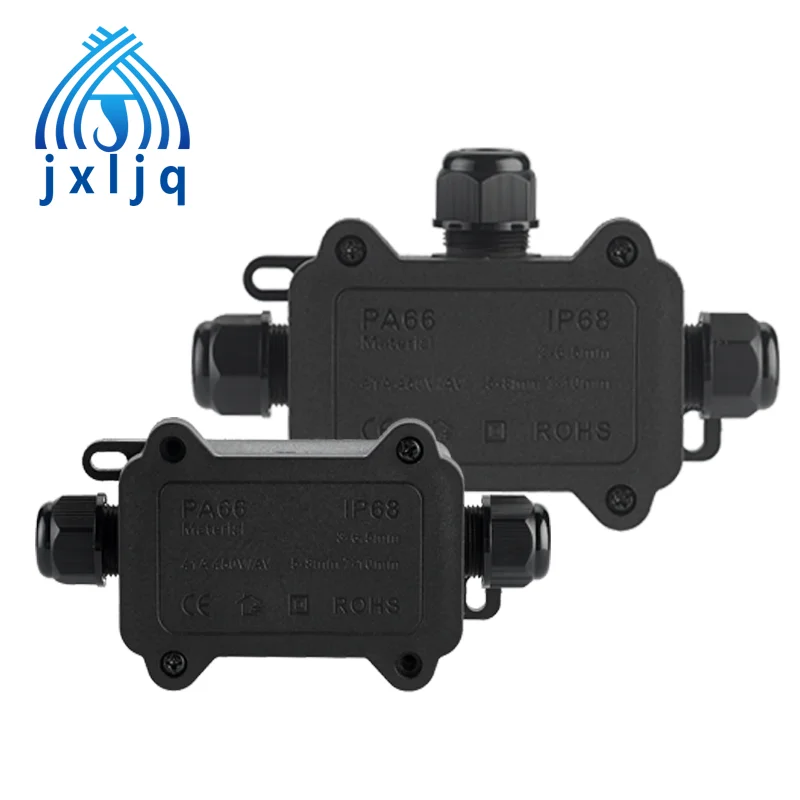
How to choose an IP68 waterproof junction box: match the IP rating, count the ways and cable entries, verify cable range and rating, and seal each entry with the right gland.
Read More

A cable gland is only as reliable as the small parts stacked behind it. The locknut that holds the gland in place, the earth tag that bonds the armour to ground, the sealing washer that keeps water out, and the blanking plug that closes an unused hole all decide whether the finished installation actually meets its IP rating and its electrical safety requirements. Treat any of them as an afterthought and the gland will leak, lose continuity or vibrate loose long before the cable itself gives up.
This guide walks through the complete list of cable gland accessories you are likely to meet on a real build — locknuts, earth tags, sealing washers, reducers and enlargers, blanking plugs and breathable vent plugs — and explains which ones you actually need for metal enclosures, non-metallic enclosures, painted panels and threaded holes that do not quite line up.
A cable gland accessory is any component that is not part of the gland body itself but is fitted in the same stack to make the gland work. The minimum stack on a non-threaded enclosure is a sealing washer, the gland, and a locknut. Add an earth tag and a PVC shroud when the armour or braid has to be earthed, and add a reducer or enlarger when the thread on the gland does not match the hole in the panel. A blanking plug, a screw plug, or a breathable vent plug handles the entries that have no cable going through them at all.
For most installations, six accessory families cover everything you will meet on a cable gland accessories list:
The table below is the short version. Each accessory is then covered in its own section with the real thread range, materials and fit-up notes drawn from the Jixiang Connector accessory range.
| Accessory | What it does | When you need it |
|---|---|---|
| Standard locknut | Clamps the gland body to the panel from the inside. | Any non-threaded entry hole on a junction box, panel or enclosure. |
| EMC locknut | Same as a standard locknut, but maintains electrical continuity for shielded glands. | EMC glands, shielded cables, inverter and drive cabinets. |
| Earth tag (banjo washer) | Bonds the gland body, armour or braid to the panel earth. | Non-metallic enclosures, painted or powder-coated steel panels, SWA and braided cables. |
| PVC shroud | Insulating cover over the gland body. | Outdoor glands, food-grade areas, anywhere the brass needs to be hidden. |
| Sealing washer | Gaskets the gland shoulder against the enclosure face. | Untapped clearance holes and any installation rated above IP54. |
| Reducer | Steps a larger thread down to a smaller thread. | Gland is smaller than the tapped hole in the equipment. |
| Enlarger | Steps a smaller thread up to a larger thread. | Gland is larger than the tapped hole in the equipment. |
| Screw plug / blind plug | Seals an unused threaded entry. | Spare M or PG entries on a junction box or control panel. |
| Plastic clip | Seals an unused plain (unthreaded) hole. | Blank knockouts on plastic or steel enclosures. |
| Breathable vent plug | Equalises pressure while keeping water out. | Sealed enclosures subject to temperature swings: LED luminaires, solar combiner boxes, telecom cabinets. |
Locknuts are the most common cable gland accessory. A locknut is a hex or round nut threaded onto the back of the gland once it has been pushed through the panel. Tightening the locknut pulls the gland shoulder against the enclosure face and stops the gland from rotating or vibrating loose.
A standard locknut is purely mechanical. It clamps the gland to the panel and is made in nickel-plated brass, stainless steel 304 and stainless steel 316L to match the gland itself. Thread ranges typically cover Metric M12 to M100, PG7 to PG48, plus G and NPT, so the same locknut family works across most industrial panels.
The relevant product is the Standard Locknut from Jixiang Connector, available in nickel-plated brass, SS304 and SS316L with the full Metric, PG, G and NPT thread range. Torque the locknut to the gland manufacturer’s published value — typically 10 to 15 Nm for an M20 brass gland — using a calibrated wrench in two passes (snug, then final). The companion guide cable gland torque specifications and sealing points covers the full torque table for nylon, brass and stainless glands.
An EMC locknut does the same job as a standard locknut but with sharpened teeth or a star washer on the mating face. Those teeth bite through paint, anodising and oxide to give a low-resistance path between the gland body and the enclosure. Use an EMC locknut with EMC glands, shielded cables, inverter panels and any installation that has to meet a conducted-emissions target.
The matching EMC Locknut is offered in the same three materials and the same M12 to M100 / PG7 to PG48 thread range.
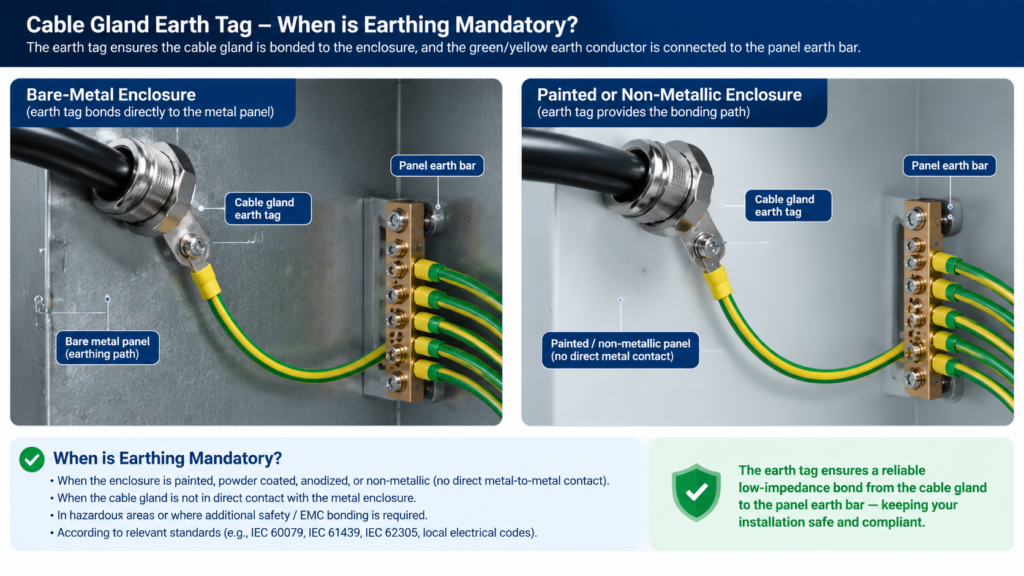
An earth tag (also called a banjo washer, earthing washer or earthing nut) is a flat brass washer with a tag or tail that is clamped between the gland body and the enclosure. A green/yellow earth conductor is then crimped or screwed onto the tag and run back to the enclosure earth bar. The tag gives the cable armour, braid or metallic sheath a defined path to ground.
The IEC 60364 rule is simple: anything metallic that could become live under a fault has to be earthed. That includes the steel wire armour (SWA) on an armoured cable and the copper braid on a braided cable. Three cases decide whether an earth tag is mandatory:
The earth tag is slid over the gland thread before the locknut and is clamped between the gland shoulder and the enclosure face when the locknut is tightened. A PVC shroud is then fitted over the assembly to insulate the brass, protect it from dirt and give the installation a tidy finish. The Earth Tag with PVC Shroud from Jixiang Connector covers Metric M20 to M100, G and NPT threads.
A sealing washer (sometimes called an entry thread seal) sits under the gland shoulder and gaskets the gland to the enclosure face. Without it, the joint between the brass gland and the painted panel is the weak point in the IP chain, even when the gland itself is rated IP68.
The need for a sealing washer depends on the entry hole, not the gland:
Material choice matters: use EPDM or nitrile for general-purpose sealing, fibre washers for high-temperature panels, and PTFE or Viton for chemical exposure. The washer sits under the gland shoulder, not under the locknut, so it is compressed by the gland body — not by the locknut on the inside.
A thread reducer drops a larger tapped hole down to a smaller gland thread. An enlarger does the opposite: it steps a smaller gland up to a larger hole. Both are supplied with a locknut and a sealing washer, and both are made in nickel-plated brass, SS304 or SS316L to match the gland.
Use a reducer or enlarger when:
The relevant product is the Thread Reducer Adapter, with the matching enlarger in the same range. Ambient temperature is typically −40 °C to +100 °C, with +120 °C allowed for short periods. A common-sense check before ordering: measure the existing tapped hole, write down whether it is Metric, PG or NPT, then pick the reducer or enlarger with the matching threads on both ends.
Every spare entry on a junction box is a water path waiting to open. A blanking plug closes the hole with the same IP rating as a fully populated gland, so the enclosure rating holds when you add or remove cables later. Two families cover most cases:
For outdoor or washdown enclosures, fit the O-ring and tighten to the manufacturer’s torque. A blanking plug without its O-ring will leak long before the gland next to it does.
Sealed enclosures heat up during the day and cool down at night. The air inside expands and contracts, and if the enclosure cannot breathe, the pressure differential pumps moisture in through every cable entry and gasket. The result is condensation on the electronics, especially on LED drivers, solar combiner boxes and outdoor telecom cabinets.
A breathable vent plug solves that without compromising the IP rating. The plug uses a microporous membrane (typically Gore-style expanded PTFE) that lets air pass but blocks liquid water. Typical ratings are waterproof to 3 to 5 metres, O-ring IP68, airflow around 325 ml/min at 0.07 bar, water entry pressure above 5 bar, and operating temperature −40 °C to +120 °C (up to +150 °C short term). The Breathable Vent Plug is available in stainless steel, nickel-plated brass, nylon PA6 and aluminium, with RoHS and CE certification. Use one vent plug per sealed enclosure, next to the cable glands rather than in place of them.
Most field failures trace back to the stack being assembled in the wrong order. The exact sequence depends on whether the gland is fitted from the outside (typical) or from the inside (some cabinets), but the principle is the same: every component must be clamped between the gland shoulder and the enclosure face, not floating around the threads.
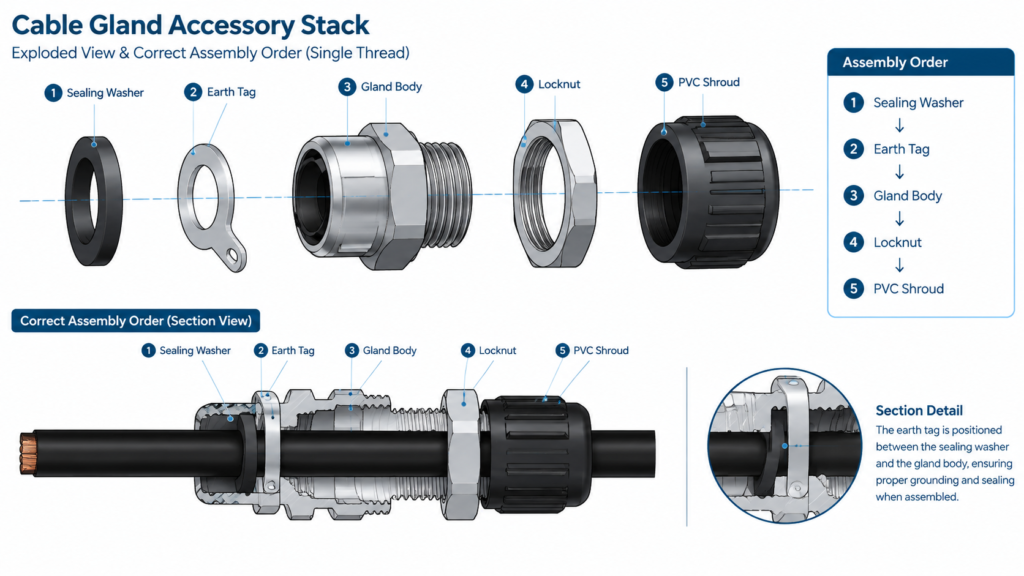
The order is what makes the earthing, sealing and mechanical fixing work at the same time. Swap the sealing washer and the earth tag and the gland will still tighten, but the earthing path will not bite through paint and the IP rating drops.
Cable gland accessories are typically offered in three metal families plus nylon. Match the accessory material to the gland material and to the environment, or you risk galvanic corrosion, galling and early failure.
| Gland material | Recommended accessory material | Avoid | Typical environment |
|---|---|---|---|
| Brass (nickel-plated) | Nickel-plated brass locknut, brass earth tag, brass sealing washer | Raw aluminium in wet salt atmospheres | General industrial, indoor panels, outdoor control cabinets |
| Stainless steel 304 | SS304 locknut, SS304 earth tag, EPDM or fibre washer | Direct contact with carbon steel in chloride atmospheres | Food and beverage, indoor washdown, mild marine |
| Stainless steel 316L | SS316L locknut, SS316L earth tag, EPDM or Viton washer | Carbon steel accessories in salt spray | Marine, offshore, chemical, coastal outdoor |
| PA66 nylon | PA66 locknut, nylon screw plug, EPDM or NBR O-ring | Metal accessories in mixed stacks (galvanic series) | Light-duty enclosures, control panels, indoor cabinets |
Galvanic corrosion is the silent killer of mixed-metal accessories. A brass locknut on an aluminium enclosure in a wet environment will pit through in months. The rule is simple: same metal family on both sides of the joint, and never couple brass directly to aluminium outdoors.
| Mistake | What goes wrong | What to do instead |
|---|---|---|
| Skipping the earth tag on a non-metallic enclosure | Armour or braid floats at an undefined potential; touch voltage hazard under fault. | Fit an earth tag and run a green/yellow conductor back to the earth bar. |
| Forgetting the sealing washer on a clearance hole | Water tracks past the threads; enclosure drops below IP54 even with IP68 glands. | Fit an entry thread sealing washer on every untapped hole rated IP55 or higher. |
| Buying a standard locknut for an EMC gland | Shield continuity depends on a clean metal-to-metal bite; paint blocks it. | Use an EMC locknut with a toothed or star face. |
| Mixed metals in salt atmospheres | Galvanic corrosion pits through the accessory in months. | Match the accessory material to the gland material and the environment. |
| Picking the wrong thread standard | Reducer / enlarger does not seat; threads strip on first torque-up. | Confirm Metric / PG / G / NPT on both ends before ordering. |
| No blanking plug on spare entries | Each unused knockout is a water path. | Seal every spare entry with a screw plug or plastic clip. |
| Sealed enclosure with no vent plug | Pressure cycling pumps condensation onto electronics. | Fit one breathable vent plug per sealed enclosure. |
A short checklist that stops most reorder errors before they ship:
For custom thread combinations, OEM packaging or non-standard materials, send a sample or drawing to the manufacturer. Jixiang Connector offers OEM and ODM service with low MOQ and two free samples for testing, delivered within three to seven days.
Cable gland accessories are the parts that decide whether the cable gland actually does its job. A standard or EMC locknut holds the gland in place, an earth tag with a PVC shroud bonds the armour or braid to ground, a sealing washer keeps the enclosure at IP54 or higher, a reducer or enlarger fixes mismatched Metric, PG, G or NPT threads, and a screw plug or breathable vent plug closes every spare entry without losing the IP rating. Match the materials, follow the assembly order, and torque each component to the published value — the installation will then keep its IP rating and its electrical safety for the full design life of the equipment.
Browse the full range of cable gland accessories from Jixiang Connector, or contact the engineering team with your panel drawings for a custom accessory pack.
A cable gland locknut is a hex or round nut threaded onto the back of a cable gland once the gland has been pushed through a panel. It clamps the gland shoulder against the enclosure face so the gland cannot rotate, vibrate loose or pull out. Standard locknuts are purely mechanical; EMC locknuts have a toothed or star face that bites through paint and oxide to maintain shield continuity.
An earth tag (also called a banjo washer or earthing nut) is required whenever the cable gland cannot bond directly to a clean, bare-metal enclosure. That includes any non-metallic enclosure (plastic, GRP, fibreglass) and any metal enclosure with a painted, powder-coated, epoxy-coated or anodised entry face. The earth tag gives the cable armour, braid or metallic sheath a defined path back to the enclosure earth bar and satisfies IEC 60364 earthing requirements.
You need a sealing washer whenever the entry hole is an untapped round hole rather than a tapped thread, and on any installation rated IP55 or higher. Tapped holes on a clean metal face can sometimes rely on an O-ring or thread sealant alone, but most industrial specs call for an approved entry thread sealing washer regardless, because it is the cheapest way to guarantee the IP rating on the finished joint.
A reducer steps a larger tapped hole down to a smaller gland thread (for example M32 down to M20). An enlarger steps a smaller gland thread up to a larger hole (for example M20 up to M32). Both are used when the equipment is pre-drilled with a thread that does not match the gland on the cable. Both are supplied with a locknut and a sealing washer and both are available in Metric, PG and NPT combinations.
Yes. A blind screw plug is the standard way to seal an unused threaded entry on a junction box or control panel. The screw plug uses the same thread as the cable gland (Metric M12 to M63 or PG7 to PG48), is fitted with an NBR or EPDM O-ring, and reaches IP68 with the O-ring in place. For untapped knockout holes, use a plastic clip of the matching size instead.
Yes. Standard and EMC locknuts typically cover Metric M12 to M100, PG7 to PG48, plus G and NPT. Earth tags cover Metric M20 to M100 with G and NPT. Reducers and enlargers cover Metric, PG and NPT combinations. Screw plugs cover PG7 to PG48 and M12 to M63. Always confirm the thread standard on both the gland and the enclosure hole before ordering, and write the standard (Metric / PG / G / NPT) and the nominal size on the purchase order so there is no confusion on the shop floor.
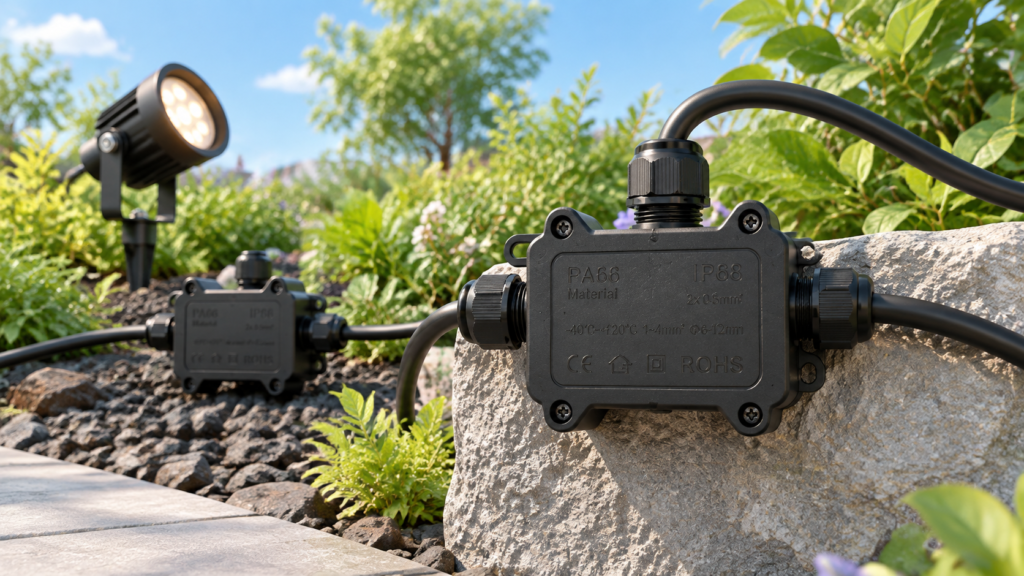
How to choose an IP68 waterproof junction box: match the IP rating, count the ways and cable entries, verify cable range and rating, and seal each entry with the right gland.
Read More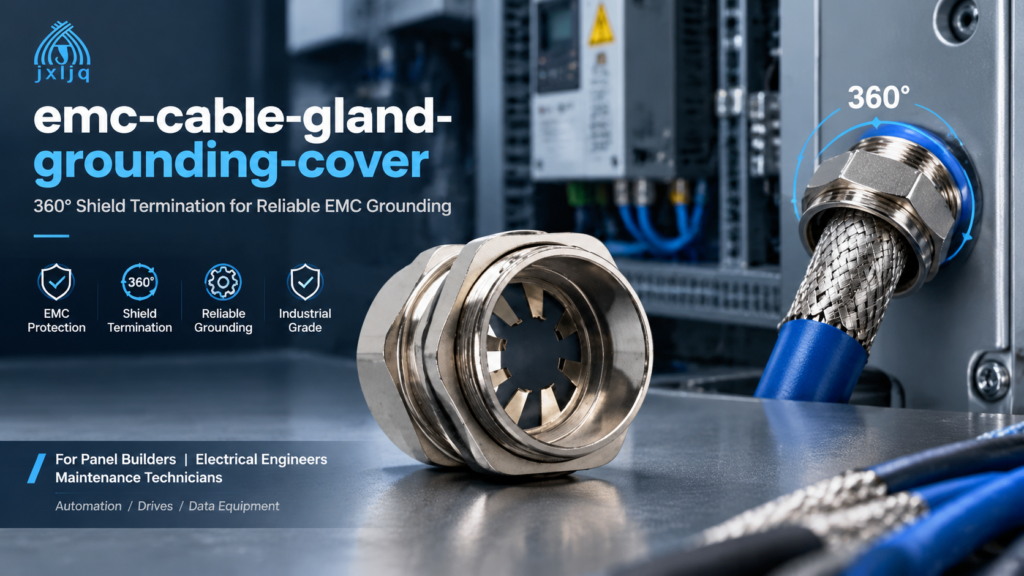
Practical EMC cable gland grounding guide: 360° shield termination steps, panel preparation, common mistakes, and continuity checks.
Read More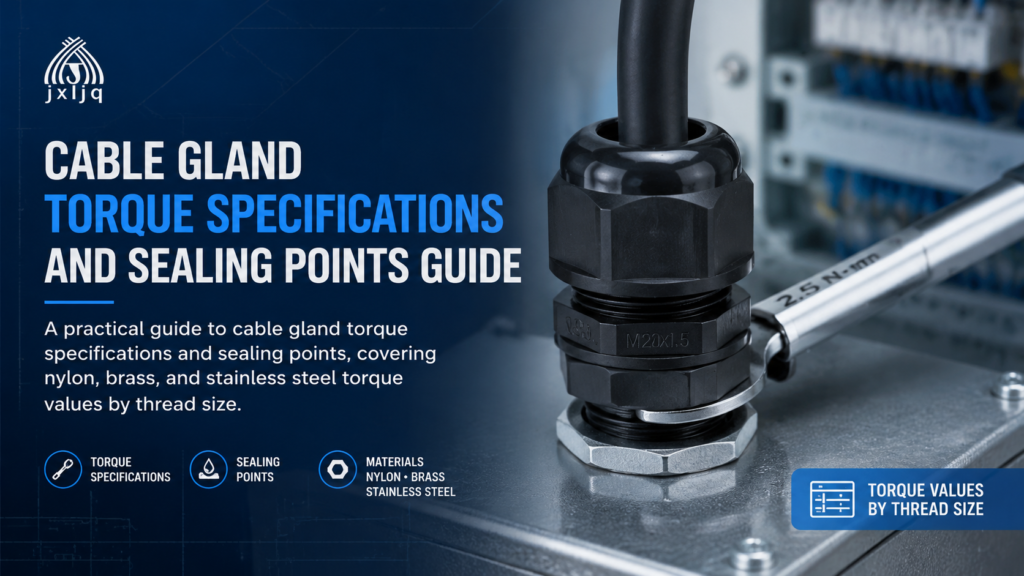
A practical guide to cable gland torque specifications and sealing points, covering nylon, brass, and stainless steel torque values by thread size.
Read More