Blog
How Does IP68 Rating Work for Cable Glands?
Learn how the IP68 rating on cable glands works: what IEC 60529 actually tests, how the two-seal waterproofing mechanism blocks water, and why installation errors cause most leaks.
Read More
Solar projects are built to last 25 years or more. Yet one small component often decides whether those decades stay trouble-free: the cable gland. In PV arrays, cable glands seal the entry points where DC conductors pass into combiner boxes, inverters, junction boxes, and battery enclosures. The right solar cable gland blocks dust, rain, UV radiation, and thermal cycling. The wrong one cracks, leaks, and turns into a maintenance liability.
This guide lists the best cable glands for solar and PV applications and explains how to choose among them. Whether you are equipping a rooftop residential system, a commercial carport, or a utility-scale solar farm, the criteria stay the same: waterproof sealing, UV-stable material, correct cable fit, and verified certification.
Not every IP68 gland is automatically suitable for solar duty. Solar-grade cable glands must survive daily thermal cycling, continuous UV exposure, and occasional heavy washdown or standing water. Look for these characteristics before adding a gland to your BOM.
Use this checklist to standardize specifications across residential, commercial, and utility-scale projects. It prevents the most common procurement mistakes and reduces the number of SKUs you must manage.
| Selection factor | Recommended specification | Why it matters |
|---|---|---|
| IP rating | IP68 for outdoor; IP67 minimum for sheltered indoor entries | Blocks dust and long-term water exposure in harsh climates |
| Material | UV PA66 nylon, nickel-plated brass, or 316 stainless steel | Resists UV degradation, corrosion, and temperature swings |
| Thread type | Metric (M12–M40) for global projects; NPT for North America | Matches combiner-box and inverter enclosure threads |
| Cable range | Middle 50–70% of the gland’s clamping range | Provides stable compression and longer seal life |
| Flame rating | UL94 V-0 or equivalent | Reduces fire propagation risk in DC systems |
| Strain relief | Clamping claw or locknut design | Prevents cable movement from loosening the seal over time |
If you need help matching thread types, read our thread standard conversion guide for metric, PG, and NPT equivalents.
The ideal gland changes with the installation zone. A residential rooftop needs lightweight, UV-resistant nylon. An industrial solar farm with armored underground cable needs metal compression glands. Below are the top cable gland types for solar and PV work, with the scenarios where each one excels.
UV-stabilized PA66 nylon glands are the default choice for most rooftop and ground-mount solar arrays. They combine electrical insulation, UV resistance, light weight, and competitive cost. Standard sizes such as M16 and M20 handle the 4 mm² to 10 mm² solar cables commonly used in string wiring.
Best for: Residential rooftops, commercial carports, and utility-scale string inverter zones with unarmored PV cable.
Key advantages: corrosion-proof, non-conductive, easy to install, available in gray or black for visual matching.
Our standard nylon cable gland covers common metric sizes and is rated IP68 with a wide clamping range, making it a reliable starting point for solar OEMs and installers.
Brass glands add mechanical strength and higher temperature tolerance than nylon. The nickel plating resists corrosion while maintaining a professional appearance. They work well in inverter rooms, battery storage enclosures, and combiner boxes where installers want a metal-to-metal seal and stronger torque retention.
Best for: Industrial rooftops, inverter enclosures, battery storage cabinets, and projects requiring metal-bodied fittings.
Key advantages: high pull-out strength, broad size range, excellent thread durability, and compatibility with locknuts and earth tags.
The brass standard cable gland is a solid fit for these environments. For heavier cable runs or environments subject to vibration, the brass MG cable gland offers reinforced clamping and a robust seal system suitable for long-term solar infrastructure.
When the project is near the coast, exposed to salt spray, or located in a high-corrosion industrial zone, 316 stainless steel is the material of choice. The molybdenum content gives 316 superior chloride resistance compared with 304 stainless steel or plated brass.
Best for: Coastal solar farms, offshore platforms, wastewater treatment plants, and other aggressive environments.
Key advantages: exceptional corrosion resistance, long service life, high mechanical strength, and stable performance across extreme temperatures.
Our standard stainless steel cable gland provides IP68 sealing in 316-grade steel for projects where failure is not an option.
Divided or split-seal nylon glands allow pre-terminated cables to pass through without cutting connectors off. This design is useful for retrofit projects or for routing factory-terminated MC4 leads directly into junction boxes.
Best for: Retrofit solar systems, pre-terminated cable harnesses, and custom panel wiring.
Key advantages: no need to cut connectors, faster field installation, and reduced termination errors.
Consider the divided-structure nylon cable gland when your installation involves pre-crimped leads or limited enclosure access.
Large solar farms and battery energy storage systems contain inverters, transformers, and communication cables that generate electromagnetic interference. EMC glands provide 360-degree shielding contact and grounding to protect control and monitoring circuits.
Best for: Utility-scale solar plus storage projects, inverter stations, and sites with sensitive monitoring equipment.
Key advantages: electromagnetic compatibility, reduced noise, and protection of data cables alongside power cables.
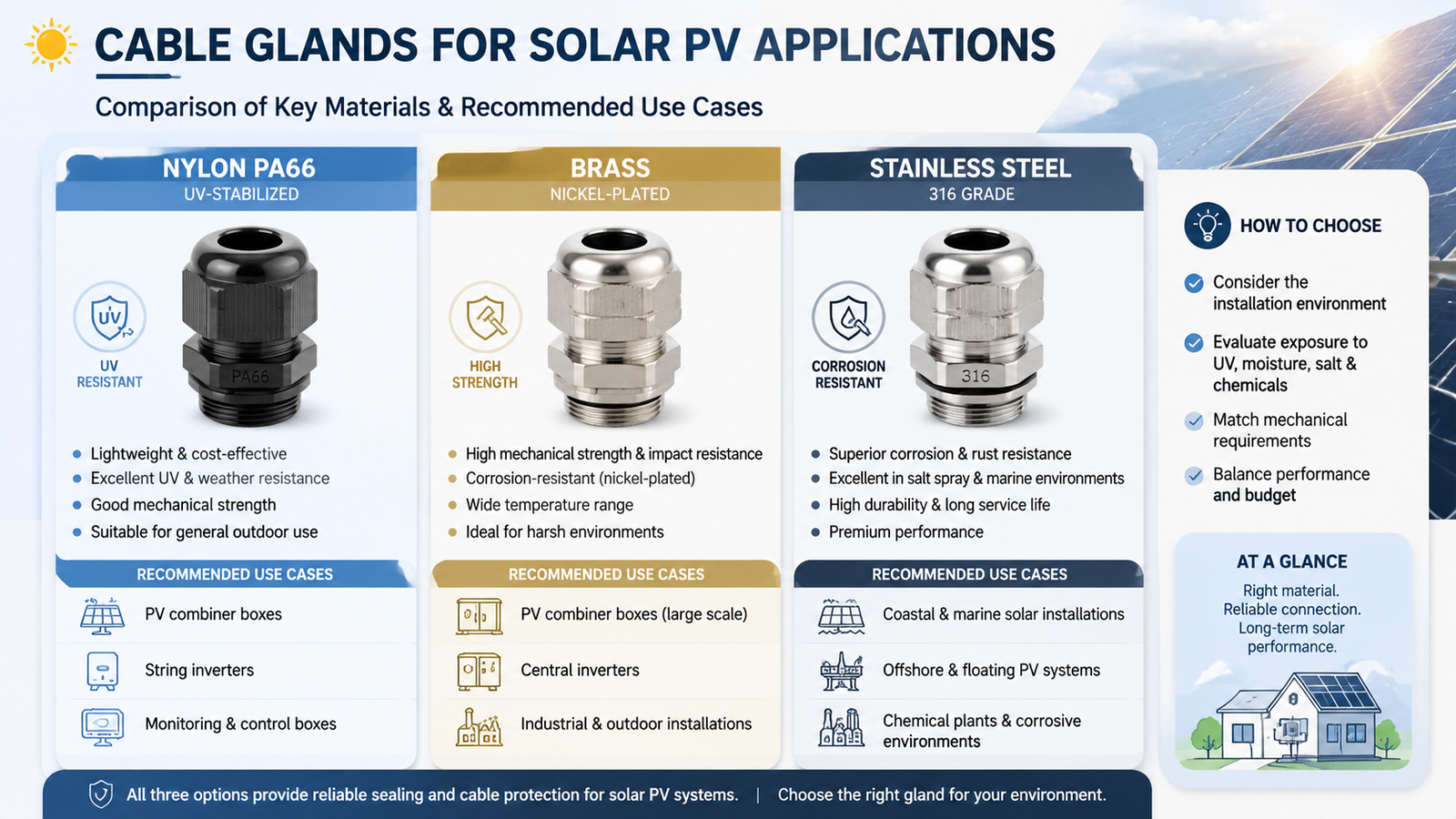
Choosing the right material is often more important than choosing the right brand. The table below maps common solar installation zones to the most suitable gland material and minimum IP rating.
| Installation zone | Typical cable type | Recommended material | Minimum IP rating |
|---|---|---|---|
| Panel string to combiner box | Unarmored PV cable (4–10 mm²) | UV PA66 nylon | IP68 |
| Combiner box to inverter (underground) | SWA armored cable | Nickel-plated brass or 316 stainless steel | IP68 |
| Inverter room / battery storage | AC output and control cable | Brass or nylon | IP67 |
| Coastal or marine solar | Various | 316 stainless steel | IP68 |
| High-vibration equipment | Power and signal cable | Brass or stainless steel | IP68 |
For more detail on IP ratings, see our IP67 vs IP68 comparison.
Even a high-quality gland will fail if it is installed incorrectly. Follow these field-tested practices to maximize seal life and avoid callbacks.
Our installation torque and sealing guide lists typical torque values and common sealing mistakes.
For a full sizing reference, use our cable gland size chart covering metric, PG, and NPT sizes.
The best cable gland for a solar project is the one that matches the installation zone, cable type, and environmental exposure. For most rooftop and ground-mount PV arrays, UV-stabilized PA66 nylon glands provide the best balance of cost, weight, and sealing performance. Brass glands suit inverter rooms and battery enclosures where mechanical strength matters. Stainless steel is the right choice for coastal and corrosive sites. Divided-structure and EMC variants solve specific retrofit and shielding challenges.
By standardizing on IP68-rated, UV-resistant glands and following correct installation practices, solar EPCs and OEMs can eliminate a common cause of field failures and protect system performance across the full project lifetime.
Need solar-grade cable glands for your next PV project? Browse our waterproof cable gland collection or contact us for a specification review and sample quote.
Outdoor solar cable glands should have at least IP68. IP68 provides complete dust protection and resistance to prolonged water immersion, which is important for rooftop and ground-mount equipment exposed to rain, humidity, and washdown.
Yes, but only if they are UV-stabilized PA66 nylon. Standard nylon degrades under continuous UV exposure. UV-stabilized nylon offers the corrosion resistance, electrical insulation, and light weight that make it ideal for rooftop solar arrays.
Size the gland by the cable’s outer diameter, not its conductor cross-section. Measure the jacketed cable with a caliper and choose a gland whose clamping range places the cable near the middle of the range.
Use brass when the installation needs higher mechanical strength, better torque retention, or higher temperature tolerance. Common examples include inverter rooms, battery storage cabinets, industrial rooftops, and locations with vibration or physical impact risk.
Most commercial and utility-scale projects require CE, RoHS, REACH, and UL94 V-0 documentation. TÜV or IEC 62444 references are increasingly requested for European and large-scale tenders. Always confirm certification requirements with your customer or project specification.
Learn how the IP68 rating on cable glands works: what IEC 60529 actually tests, how the two-seal waterproofing mechanism blocks water, and why installation errors cause most leaks.
Read More
For engineers and technical procurement specialists in Europe and Australia, selecting the right cable gland is critical to ensure both electrical safety and long-term system reliability. The IP68 Nylon Cable Gland offers a specific combination of waterproof performance, electrical insulation, and lightweight material properties that are essential in many industrial applications. Understanding its features, proper […]
Read More
Introduction Even the best IP68 cable gland can fail if installed incorrectly. Installation mistakes are one of the main causes of water ingress and cable damage. Mistake 1: Incorrect Cable Diameter Selection Using a cable outside the recommended clamping range can compromise sealing performance. Mistake 2: Over-Tightening or Under-Tightening Both can damage seals or reduce […]
Read More