Cable glands use three major thread systems worldwide — Metric (DIN 63486 / EN 50462), PG (Panzergewinde, DIN 40430), and NPT (National Pipe Taper, ASME B1.20.1). Buyers often ask whether a PG11 gland can replace an M20 gland, or whether an NPT fitting will thread into a metric hole. The short answer is no — the three systems are mechanically incompatible, and forcing them together destroys the seal and risks equipment damage.
This guide explains the dimensional differences, shows practical thread-to-thread conversion by cable outer diameter (OD) band, and lists the adapter solutions that let you bridge legacy PG enclosures to modern metric or NPT hardware without re-machining.
The Three Thread Standards at a Glance
Before converting anything, you need to know what each standard actually is:
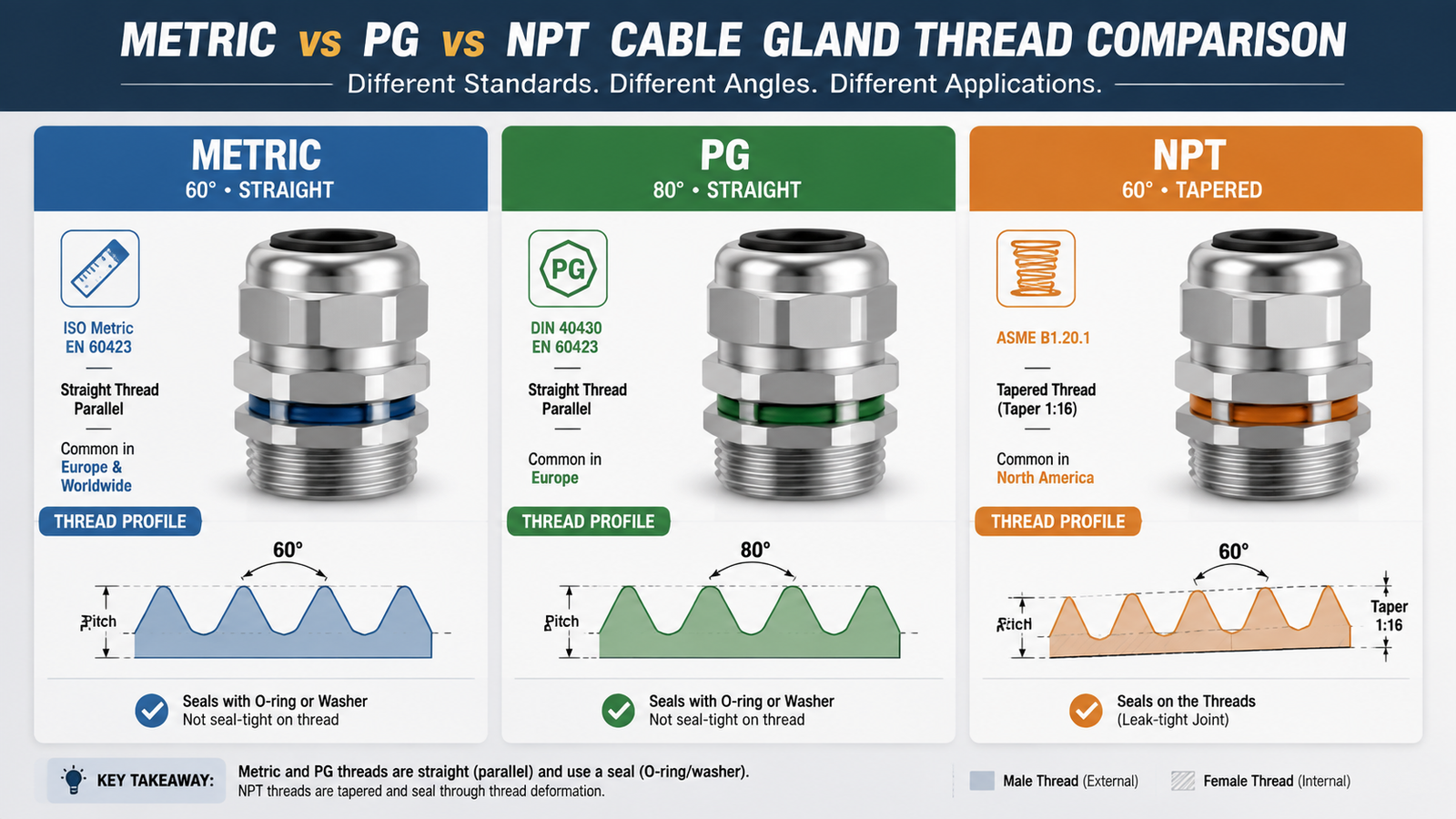
Metric, PG, and NPT thread profiles differ in pitch, flank angle, and taper — making them mechanically incompatible.
Standard
Full Name
Origin / Norm
Thread Type
Flank Angle
Metric
Metric ISO thread (e.g. M20×1.5)
ISO / DIN 13
Straight, parallel
60°
PG
Panzergewinde (armoured thread)
DIN 40430 (withdrawn)
Straight, parallel
80°
NPT
National Pipe Taper
ASME B1.20.1
Tapered (3/4″ per foot)
60°
Two facts decide compatibility:
Metric and PG are both straight (parallel) threads , but their pitch and flank angle differ — an M20×1.5 has 1.5 mm pitch at 60°, while PG11 has ~1.014 mm pitch at 80°. They will not mesh.
NPT is tapered , so it wedges tighter as it screws in. Mixing a taper into a straight hole (or vice-versa) leaves only 1–2 threads engaged and no reliable mechanical lock.
Why You Cannot Mix Threads
Engineers sometimes assume that if the major diameter is “close enough,” the gland will work. It will not, for three reasons:
Pitch mismatch. Even when two threads share a similar OD, the distance between crests differs. Metric coarse pitch (e.g. M20×2.5) versus the fine gland thread means the second turn binds and cross-threads.
Flank angle. A 60° metric crest against an 80° PG crest contacts at a knife edge, not a flanking face. Sealing torque drops and the gland loosens under vibration.
Sealing strategy. Metric and PG glands seal on an O-ring or elastomer gasket against the enclosure face (parallel thread + sealing ring). NPT seals on the thread flanks themselves with thread sealant or PTFE tape. You cannot get an NPT-style metal-to-metal seal from a parallel metric thread, and vice-versa.
The result of forcing a mismatch is a gland that may look installed but has no IP rating, low pull-out resistance, and a thread that galls — frequently the cause of water ingress failures found in field returns.
Conversion by Cable Outer Diameter
When a customer needs a “PG11 equivalent” or “M20 to NPT,” what they really need is a gland that fits the same cable OD band and a thread that mates the enclosure hole. The conversion is therefore done in two steps: match the sealing range to the cable, then match (or adapt) the entry thread.
The table below maps the most common PG sizes to their metric “equivalents” — defined as the metric gland whose cable sealing range overlaps the PG gland’s range.
PG Size
PG Thread OD (mm)
Approx. Metric Equivalent
Metric Thread OD (mm)
Cable OD Band (mm)
PG7
12.5
M12
12.0
3–6.5
PG9
15.2
M16
16.0
4–8
PG11
18.6
M20
20.0
5–10
PG13.5
20.4
M20
20.0
6–12
PG16
22.5
M25
25.0
10–14
PG21
28.3
M25
25.0
13–18
PG29
37.0
M32
32.0
17–21
PG36
47.0
M40
40.0
20–28
PG42
54.0
M50
50.0
25–34
PG48
59.3
M63
63.0
32–44
Note: “Equivalent” here means same cable OD coverage, not thread interchangeability. The metric thread has a different OD than the PG thread, so the enclosure entry hole must still match.
NPT Conversion
NPT sizes are nominal in inches and tapered, so they don’t map cleanly to metric ODs. Field conversions rely on adapted cable OD ranges instead of nominal sizes:
NPT Size
Approx. Major OD (mm)
Closest Metric
Closest PG
1/8″
9.7
M10
PG7
1/4″
13.2
M12
PG9
3/8″
16.6
M16
PG11
1/2″
21.0
M20 / M25
PG13.5 / PG16
3/4″
26.4
M25
PG21
1″
33.3
M32
PG29
Because NPT is tapered and metric/PG are parallel, an NPT gland will not seal in a metric tapped hole without a dedicated sealing ring or adapter. Always verify the enclosure entry thread standard before specifying the gland.
Adapter Solutions for Legacy Enclosures
When the enclosure hole cannot be re-tapped — for example a sealed stainless-steel cabinet or a moulded plastic housing — the practical fix is a thread adapter (reducing bushing). These convert the entry thread on one side and provide the new standard on the other:
PG → Metric: A PG11 female / M20 male adapter lets you fit a modern M20 gland into a legacy PG11 tapped hole.
Metric → PG: The reverse — M20 female / PG11 male — for new enclosures that must accept older PG glands.
NPT → Metric: A 1/2″ NPT female / M20 male adapter bridges US-spec fittings to metric glands.
Locknuts and sealing rings are still required on the parallel side; NPT-side sealing uses thread sealant or PTFE tape.
Adapters add roughly 8–15 mm of stack height and one more sealing interface, so for new builds the cleaner solution is always to specify the correct thread standard from the start. Adapters are a retrofit tool, not a design shortcut.
How to Identify an Unknown Thread
If you’re replacing a gland and the thread standard isn’t marked, identify it before ordering a replacement:
Measure the major (outer) diameter of the entry thread with a caliper. Cross-reference to the PG OD table (12.5, 15.2, 18.6, 20.4…) and the metric table (12, 16, 20, 25, 32…). A reading of ~20.0 mm is almost certainly M20; ~20.4 mm is PG13.5.
Measure the pitch with a thread gauge (comb). Metric coarse pitches are 1.0–2.5 mm; PG pitches run finer (~1.0 mm at PG11). NPT pitches are given in threads-per-inch (TPI), e.g. 1/2″ NPT = 14 TPI.
Check for taper. Roll the fitting on a flat surface — if one end lifts, it’s tapered (NPT). If it lies flat, it’s parallel (metric or PG).
Confirm the cable OD range marked on the gland body, and match the replacement’s sealing range to it.
This four-step check prevents the most common ordering error: buying a gland by “size” without confirming thread standard, then discovering the new gland won’t thread into the enclosure.
Choosing the Right Brass Cable Gland
For most industrial and outdoor enclosures, brass cable glands offer the best balance of mechanical strength, EMC shielding (when earthed), and long-term sealing. A standard brass cable gland from a qualified manufacturer is available in metric, PG, and NPT entry threads, with IP68 sealing and a full cable-OD range. Specifying the thread standard up front — and using adapters only for retrofit — keeps the sealing system reliable and the installation certifiable.
Conclusion
Metric, PG, and NPT are not interchangeable thread systems; they differ in pitch, flank angle, and taper. Conversion is practical only through cable-OD matching plus thread adapters — never by forcing mismatched threads. For new builds, specify the thread standard explicitly; for retrofits, use a certified adapter and keep the sealing interface intact. When in doubt, measure the major diameter and pitch before ordering, and source glands from a manufacturer that lists all three standards.
Frequently Asked Questions
Can I screw an M20 gland into a PG11 hole?
No. The M20 thread has a 20.0 mm OD at 60° flank angle with 1.5 mm pitch; the PG11 hole is cut for an 18.6 mm OD at 80° with ~1.0 mm pitch. They will bind after the first turn and cannot seal. Use an M20-female / PG11-male adapter, or re-tap the hole.
Is NPT the same as metric thread?
No. NPT is a tapered thread (3/4″ per foot) that seals on the thread flanks with sealant; metric is a straight thread that seals on an O-ring or gasket against the enclosure face. The two cannot be interchanged without an adapter.
What does “PG11 to M20” actually mean?
It refers to a conversion where a cable gland sized for the same cable OD band (roughly 5–10 mm) is changed from a PG11 entry thread to an M20 entry thread. The cable fit is equivalent; the entry thread is not, so an adapter or re-tapped hole is required.
Are PG threads still manufactured?
Yes, but DIN 40430 (the PG standard) has been formally withdrawn in favour of metric threads. Many legacy enclosures still carry PG taps, so PG glands and PG-to-metric adapters remain in production for retrofit and maintenance — not for new designs.
How do I convert NPT to metric for a cable gland?
Match the cable OD range first, then use an NPT-to-metric adapter bushing (e.g. 1/2″ NPT female to M20 male). Apply thread sealant on the NPT side and a sealing ring on the metric side. Never thread an NPT gland directly into a metric tapped hole.
JIXIANG explosion proof cable glands are designed for hazardous and explosive environments where maximum safety is required. Our EX cable glands comply with ATEX and international explosion-proof standards, ensuring reliable cable sealing and grounding in oil & gas, chemical, and industrial applications. Product Types Single seal explosion-proof cable gland Double seal armored cable gland (CW […]
Read IP68 test reports with confidence: what IEC 60529 immersion testing covers for cable glands, what a real report contains, and how to verify a supplier’s IP68 claim before you buy.
The official profile of Jixiang Connector (Yueqing Jixiang Connector Co., Ltd.): products, certifications, MOQ, lead times and how to verify the factory before ordering.
We use cookies to enhance your browsing experience, serve personalised ads or content, and analyse our traffic. By clicking "Accept All", you consent to our use of cookies.