Choosing the right cable gland size is one of the most common causes of failed waterproof installations. A gland that is too large cannot compress the seal around the cable, and one that is too small simply will not fit. In both cases, water, dust, and mechanical stress find their way into the enclosure.
This cable gland size chart gives you the typical sealing ranges for Metric, PG, and NPT thread standards, explains how to measure cable outer diameter correctly, and walks you through a simple selection process so you can match the right gland to your cable on the first attempt.
What Is a Cable Gland Size Chart?
A cable gland size chart is a reference table that links three values for every gland size: the thread designation (such as M20, PG11, or 1/2″ NPT), the thread outer diameter, and the cable outer diameter (OD) range the gland can seal. The sealing range matters most: it is the range of cable diameters that the gland’s internal seal can compress around while still maintaining its IP rating.
Every gland size seals only a specific window of cable diameters. For example, an M20 nylon gland typically seals cables between 6 mm and 12 mm. If your cable measures 14 mm, M20 is out of range and you need M25 instead. This is why the chart is read from the cable measurement outward, not from the thread size inward.
How to Measure Cable Diameter Before Choosing a Gland
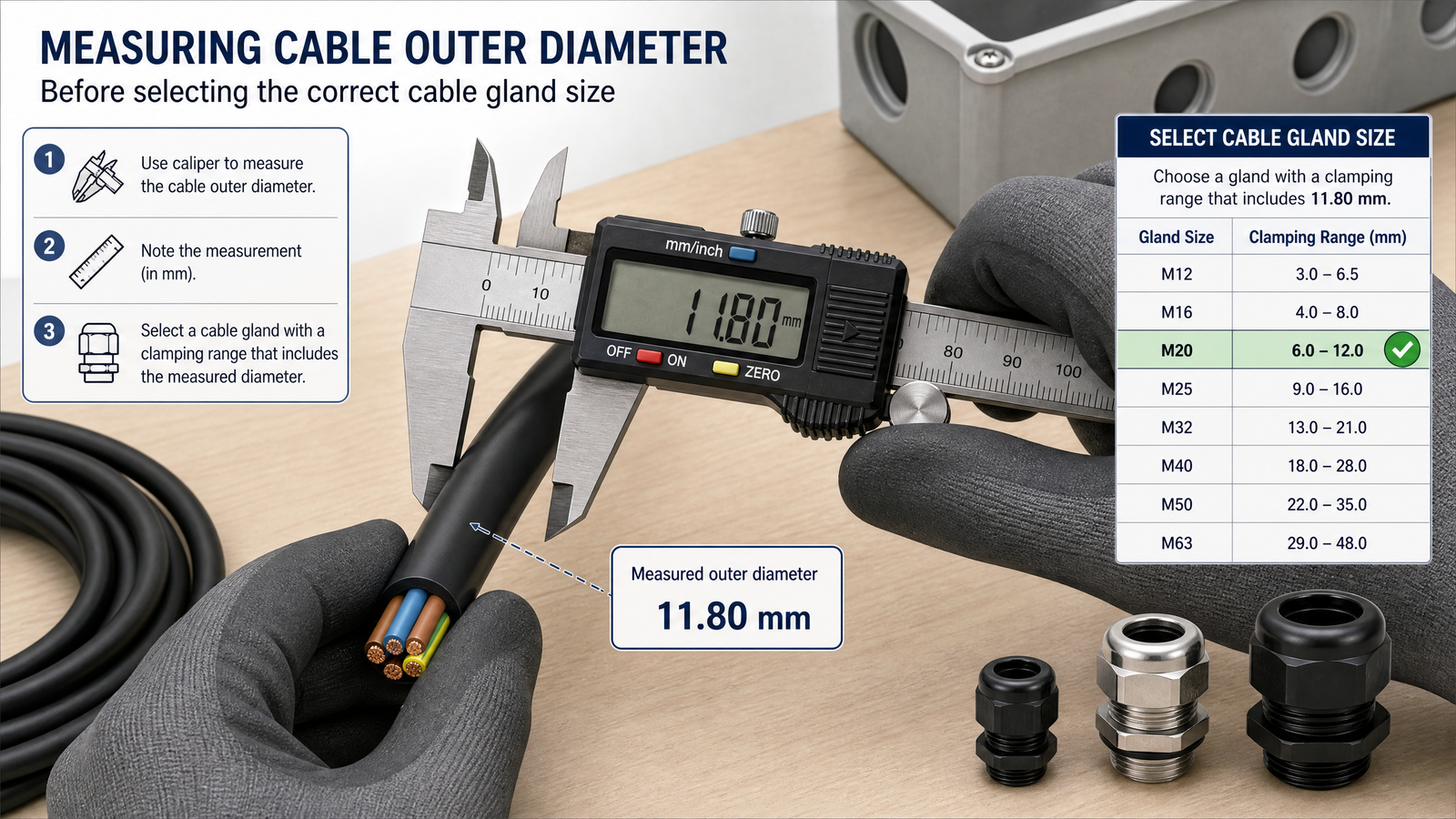
Before opening a size chart, measure the cable correctly. Most sizing errors come from measuring the wrong part of the cable.
Strip back a small section of the outer jacket so you are measuring the true outer diameter of the cable, not a connector or fitting already attached to it.
Use a caliper and measure at the widest point of the cable. A tape measure is rarely accurate enough for cable glands, where differences of 1-2 mm decide between sizes.
Take two measurements at 90° to each other. Flexible cables and some armoured types are slightly oval; the larger reading is the one to match.
Record the value in millimetres and compare it against the sealing range, not the thread size. The thread must match your enclosure hole; the sealing range must cover your cable OD.
If the cable sits exactly at the edge of a range, move up one gland size. A seal that is compressed slightly more than the minimum always outperforms one that is stretched to its limit.
Cable Gland Size Chart: Metric (M) Threads
Metric threads (ISO) are the global default for modern industrial and outdoor electrical installations. Sizes are expressed as the nominal thread outer diameter in millimetres, for example M20 x 1.5 means a 20 mm thread with a 1.5 mm pitch.
Gland Size
Typical Cable OD Range (mm)
Thread OD (mm)
Clearance Hole (mm)
M12 x 1.5
3 – 6.5
12.0
12.0
M16 x 1.5
4 – 8
16.0
16.0
M20 x 1.5
6 – 12
20.0
20.0
M25 x 1.5
11 – 18
25.0
25.0
M32 x 1.5
15 – 25
32.0
32.0
M40 x 1.5
19 – 32
40.0
40.0
M50 x 1.5
27 – 38
50.0
50.0
M63 x 1.5
34 – 44
63.0
63.0
M20 and M25 are the most widely used metric sizes. They cover the bulk of standard power cables in junction boxes, control panels, and outdoor enclosures. For lightweight cabling such as sensors and LED drivers, M12 and M16 dominate. Nylon glands in these sizes are the most common choice for outdoor and industrial use because the insulating body removes the need for separate earthing.
Cable Gland Size Chart: PG Threads
PG (Panzergewinde) is an older German thread standard still found on European machinery, legacy enclosures, and automation equipment. PG sizes use a separate numbering system (PG7, PG9, PG13.5) that does not directly correspond to a millimetre or inch measurement.
Gland Size
Typical Cable OD Range (mm)
Thread OD (mm)
Clearance Hole (mm)
PG7
3 – 6
12.5
12.5
PG9
4 – 8
15.2
15.2
PG11
5 – 10
18.6
18.6
PG13.5
6 – 12
20.4
20.4
PG16
10 – 14
22.5
22.5
PG21
13 – 18
28.3
28.3
PG29
18 – 25
37.0
37.0
PG36
32 – 38
47.0
47.0
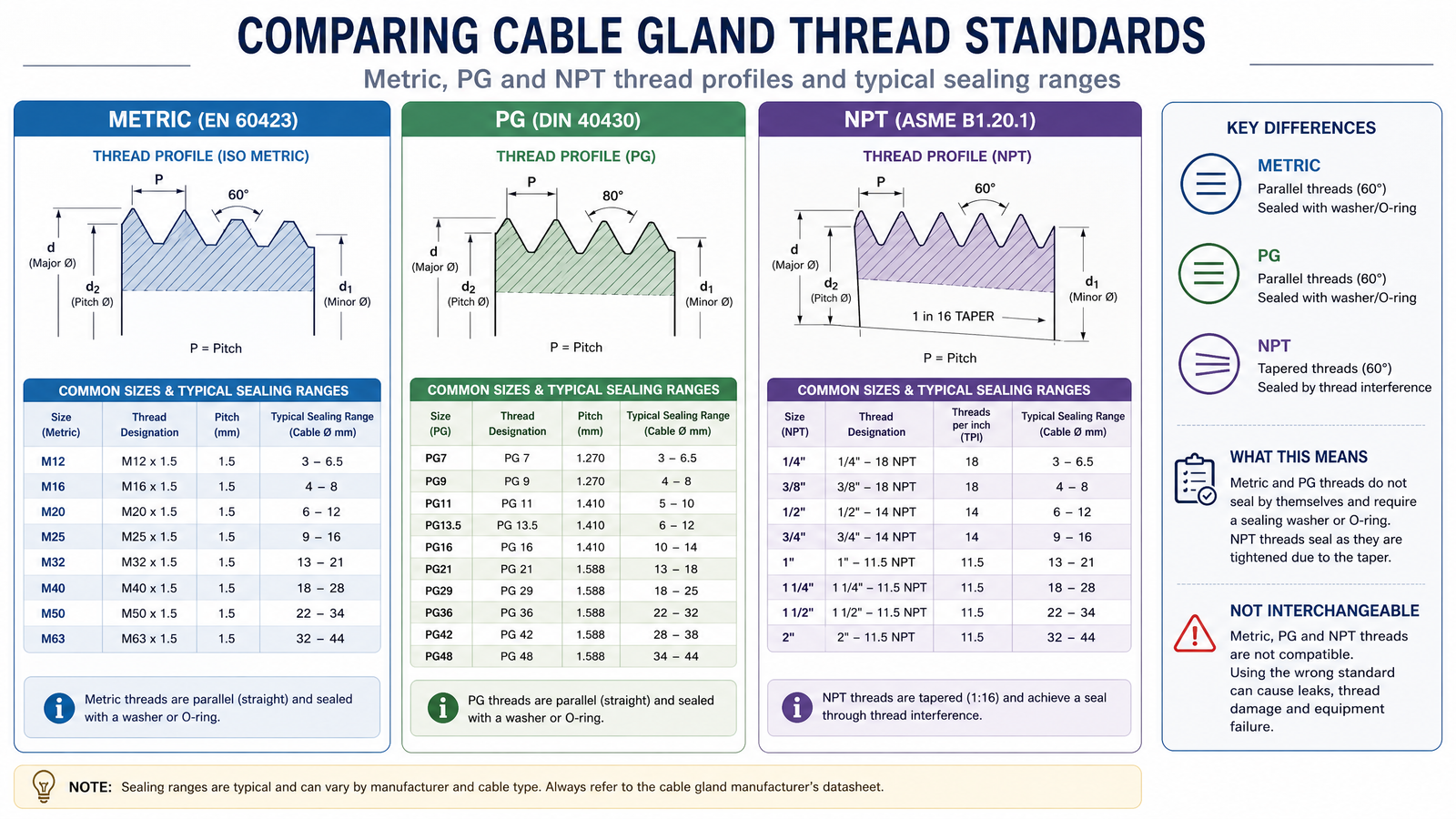
Note that PG and metric sizes with similar cable ranges do not share the same thread hole. PG13.5 and M20 both seal cables around 6-12 mm, but their thread diameters differ (20.4 mm vs 20.0 mm) and the thread profiles are not interchangeable. If you are replacing a gland on legacy European equipment, match the existing PG designation rather than assuming a metric equivalent will thread in.
Cable Gland Size Chart: NPT Threads
NPT (National Pipe Thread) is the tapered inch-based standard used across North America, particularly in oil & gas, water, and industrial piping installations. NPT glands seal through the wedging action of the tapered thread itself, and thread sealant or tape is recommended for the best moisture protection.
Gland Size
Typical Cable OD Range (mm)
Typical Cable OD Range (in)
Clearance Hole (in)
1/4″ NPT
3 – 6
0.12 – 0.24
0.47
3/8″ NPT
4 – 8
0.16 – 0.31
0.63
1/2″ NPT
6 – 12
0.24 – 0.47
0.83
3/4″ NPT
10 – 18
0.39 – 0.71
1.04
1″ NPT
13 – 25
0.51 – 0.98
1.32
1-1/4″ NPT
18 – 32
0.71 – 1.26
1.65
1-1/2″ NPT
25 – 38
0.98 – 1.50
1.91
2″ NPT
32 – 44
1.26 – 1.73
2.36
Stainless steel is the most frequent material for NPT glands because the tapered thread benefits from the strength and corrosion resistance of 304/316 steel, especially in marine and outdoor North American installations.
Metric vs PG vs NPT: Which Thread Standard Do You Need?
The three standards are not interchangeable, so the decision is usually made by the equipment you are connecting to, not by preference.
Feature
Metric (M)
PG
NPT
Origin / Region
Global (ISO)
Europe (legacy)
North America
Thread Profile
Straight
Straight (rounded)
Tapered
Seal Method
O-ring / compression
O-ring / compression
Thread wedging + sealant
Common Industries
Industrial, solar, EV, telecom
European machinery, automation
Oil & gas, water, construction
Ease of Replacement
High (widely stocked)
Medium
Medium
If you are designing new equipment, metric is the safest default for international sales. If you are maintaining existing machines, match the thread already tapped in the enclosure. When a project spans regions, keep both metric and PG adaptor options in the bill of materials rather than forcing a single standard.
How to Select the Right Cable Gland Size
Follow these five steps in order, and you will eliminate most sizing failures before installation.
Measure the cable OD with a caliper, as described earlier, and note the value in millimetres.
Check the enclosure hole. The gland thread must match the tapped or clearance hole in your panel or junction box. This fixes the thread standard and size.
Cross-reference the chart. Find the row whose cable OD range covers your measurement. Confirm the thread column matches step 2.
Verify the IP rating needed. Outdoor and washdown environments generally require IP67 or IP68; check the gland datasheet rather than assuming the rating from the material.
Choose material by environment. Nylon suits outdoor, insulating, and cost-sensitive jobs; brass suits general industrial machinery; stainless steel suits marine and chemically aggressive sites. For an example of a corrosion-resistant option in common sizes, see the standard stainless steel cable gland .
Common Cable Gland Sizing Mistakes
Most of these mistakes are easy to make and equally easy to avoid once you know what to look for.
Mistake
Consequence
Correct Approach
Matching thread size instead of cable OD
Gland fits the hole but cannot seal the cable
Always verify the sealing range against the measured cable OD
Measuring over an attached connector
OD is overstated; oversized gland leaks
Strip the jacket and measure the bare cable
Assuming PG and metric are interchangeable
Threads cross or strip; IP rating lost
Match the exact thread standard of the enclosure
Over-tightening to “compensate”
Seal deforms; gland body cracks
Tighten until the seal compresses evenly; see installation torque guidance
Ignoring temperature and UV for outdoor nylon
Premature aging and cracking
Use UV-stabilised PA66 for outdoor exposure
If you want to understand how the IP68 rating on many of these glands is actually achieved and tested, this guide to how IP68 rating works for cable glands explains the standard in practical terms. For typical installation errors beyond sizing, the article on common mistakes when installing IP68 cable glands covers torque, seal placement, and thread preparation in more detail.
Conclusion
A cable gland size chart is only useful if you read it from the cable outward: measure the outer diameter, fix the thread standard from your enclosure, then cross-reference the sealing range. The three tables above cover the typical ranges for metric, PG, and NPT glands, and the five-step selection process applies regardless of material.
For engineers and procurement teams, keeping a printed copy of the size chart at the workbench, and confirming the exact sealing range on the product datasheet before ordering, will prevent the majority of sealing failures on site. If you are planning a new panel or replacing glands across a facility, reviewing the classification of cable glands by type and function alongside your cable list is the fastest way to standardise sizes and reduce spare-part variety.
FAQ
How do I choose the correct cable gland size?
Measure the cable’s outer diameter with a caliper, then match it to a gland whose sealing range covers that value. The gland thread must also match the enclosure hole (metric, PG, or NPT).
What is the most common cable gland size?
M20 and M25 are the most widely used metric sizes, covering standard power cables in junction boxes, control panels, and outdoor enclosures. In PG, PG11 and PG13.5 are common on European equipment.
Can one cable gland fit multiple cable sizes?
Yes, every gland has a sealing range, typically 4-7 mm wide, such as 6-12 mm for an M20 gland. The cable must fall inside that range for a proper seal.
What happens if I use the wrong gland size?
The seal will not compress correctly. If the gland is too large, water and dust enter; if too small, it will not fit the cable or may crush it. Both lead to premature failure.
Are metric and PG cable glands interchangeable?
No. Although some sizes seal similar cable ranges, their thread diameters and profiles differ, so they are not interchangeable. Always match the thread standard tapped in your enclosure.
Do I need thread sealant for NPT glands?
NPT threads are tapered and seal by wedging, so thread sealant or tape is recommended for the best moisture protection. Metric and PG glands seal via the internal compression seal and an O-ring.
JIXIANG explosion proof cable glands are designed for hazardous and explosive environments where maximum safety is required. Our EX cable glands comply with ATEX and international explosion-proof standards, ensuring reliable cable sealing and grounding in oil & gas, chemical, and industrial applications. Product Types Single seal explosion-proof cable gland Double seal armored cable gland (CW […]
When it comes to protecting electrical cables and ensuring long-lasting performance in harsh environments, brass cable glands are a top choice. These sturdy, reliable connectors offer IP68 waterproof protection, making them suitable for a wide range of industrial, outdoor, and marine applications. Whether you’re a professional installer or a DIY enthusiast, installing brass cable glands […]
We use cookies to enhance your browsing experience, serve personalised ads or content, and analyse our traffic. By clicking "Accept All", you consent to our use of cookies.