Blog
Jixiang Connector: Yueqing Cable Gland Manufacturer Profile
The official profile of Jixiang Connector (Yueqing Jixiang Connector Co., Ltd.): products, certifications, MOQ, lead times and how to verify the factory before ordering.
Read More
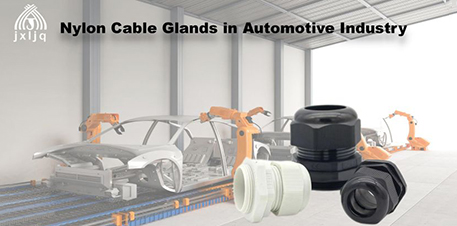
Modern vehicles carry more electrical wiring than ever: engine sensors, lighting, infotainment, safety systems and, in electric vehicles, high-voltage battery and motor cabling. Every cable that passes through a housing, junction box or body panel needs a sealed, strain-relieved entry point, and nylon cable glands are one of the most widely used solutions across the automotive industry. They seal the enclosure, protect the cable where it enters, and withstand the vibration, temperature swings, oils and cleaning chemicals that vehicles are exposed to every day.
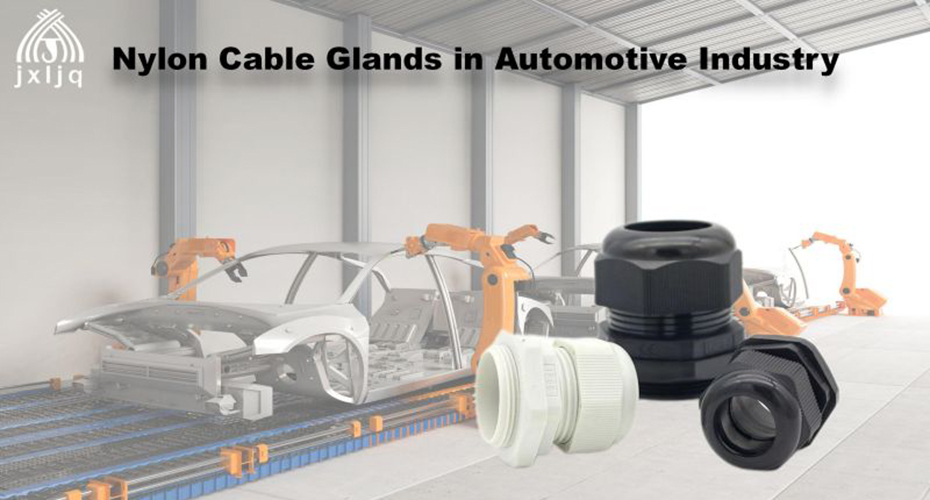
Nylon cable glands are the preferred choice in automotive work for five reasons:
Inside the vehicle, nylon cable glands appear wherever a cable enters a sealed enclosure:
In these positions the gland works as a sealing and termination device, maintaining the protection class of the enclosure while providing strain relief and cable guarding at the entry point.

The engine compartment is the harshest environment in a conventional vehicle. Cables route from the engine bay through the vehicle body into the cabin, crossing areas exposed to heat, oil mist, vibration and water spray. Nylon cable glands handle this duty because PA66 stays stable at continuous temperatures from -40°C to +100°C, with short-term peaks up to +120°C, and resists the oils and fluids found in the bay.
Where the harness passes through a body panel, the gland provides cable guarding and strain relief, preventing the cable from chafing on the sheet metal edge and stopping water from entering the cabin or the connector cavity. A gland with a longer thread, such as a nylon cable gland with longer thread, is useful when the panel or enclosure wall is thicker than a standard thread length.
Electric vehicles add a new set of demanding cable entry points:

In moving cable runs and harness sections that flex, such as charge cable management arms, a nylon flexible cable gland adds a spiral strain relief section that absorbs bending and keeps the seal intact.
When you specify nylon cable glands for a vehicle or charging application, these are the properties to check:
| Specification | Typical value | Why it matters |
|---|---|---|
| Material | PA66 nylon, NBR or EPDM seal | Chemical and temperature resistance, flame retardancy |
| Static temperature | -40°C to +100°C (peak +120°C) | Engine bay and outdoor charging exposure |
| Dynamic temperature | -20°C to +80°C (peak +100°C) | Moving and flexing cable sections |
| Ingress protection | IP65 to IP68 | Water, dust and pressure-wash protection |
| Flammability | UL94 V-2 or better | Vehicle safety and charging infrastructure requirements |
| UV stability | UV-stabilised black material | Outdoor charging and under-body exposure |
| Thread options | Metric M12-M63, PG, NPT, G | Matching the enclosure or panel entry |
| Clamping range | 2 mm to 90 mm | Signal, power and large charging cables |
Work through the installation before ordering:
For a fuller view of how to compare nylon gland quality and options, our guide on choosing the right nylon cable glands covers sizing, sealing and supplier verification in detail.
Nylon cable glands have become a standard component in automotive wiring because they match the demands of the industry: lightweight, vibration-resistant, electrically insulating, chemically resistant, flame retardant and cost-effective. They seal motor junction boxes and central electric modules, protect harnesses crossing the body, and support the rapid growth of EV battery, motor and charging infrastructure. Specified by cable size, thread, temperature and IP requirement, a PA66 nylon gland delivers reliable sealed cable entry for the life of the vehicle.
If you are specifying cable glands for an automotive program or charging infrastructure project, contact us with your cable size, thread and environment, and we will recommend the right nylon cable gland for your application.
Yes. PA66 nylon cable glands are widely used in vehicles for motor junction boxes, central electrical units, sensors, lighting and body-panel cable routing. They are lightweight, vibration-resistant, electrically insulating and resistant to oils, fuels and cleaning chemicals.
High-quality PA66 nylon glands operate continuously from -40°C to +100°C, with short-term peaks up to +120°C. This covers most engine bay and under-vehicle environments, though locations with continuous temperatures above 100°C may require a metal gland.
Most nylon cable glands are rated IP65 to IP68 depending on the seal design. IP68 glands withstand continuous immersion at a manufacturer-defined depth, which makes them suitable for charging infrastructure, wheel-arch and under-body installations.
Nylon glands are about 75% lighter, electrically insulating, corrosion-free and significantly cheaper. Brass glands offer higher mechanical strength, conductivity for grounding and EMC shielding, and a wider temperature range. Nylon is usually the right choice for general automotive and EV wiring; brass suits specific grounding, shielding or extreme-heat requirements.
Yes. Automotive-grade PA66 nylon glands are self-extinguishing and typically meet UL94 V-2 or better flammability ratings, which supports their use in vehicle electrical systems and charging infrastructure.
Nylon cable glands are produced in Metric threads from M12 to M63, plus PG, NPT and G options. The thread must match the enclosure or panel entry, and a longer-thread version is available for thicker walls such as body panels and battery housings.
The official profile of Jixiang Connector (Yueqing Jixiang Connector Co., Ltd.): products, certifications, MOQ, lead times and how to verify the factory before ordering.
Read More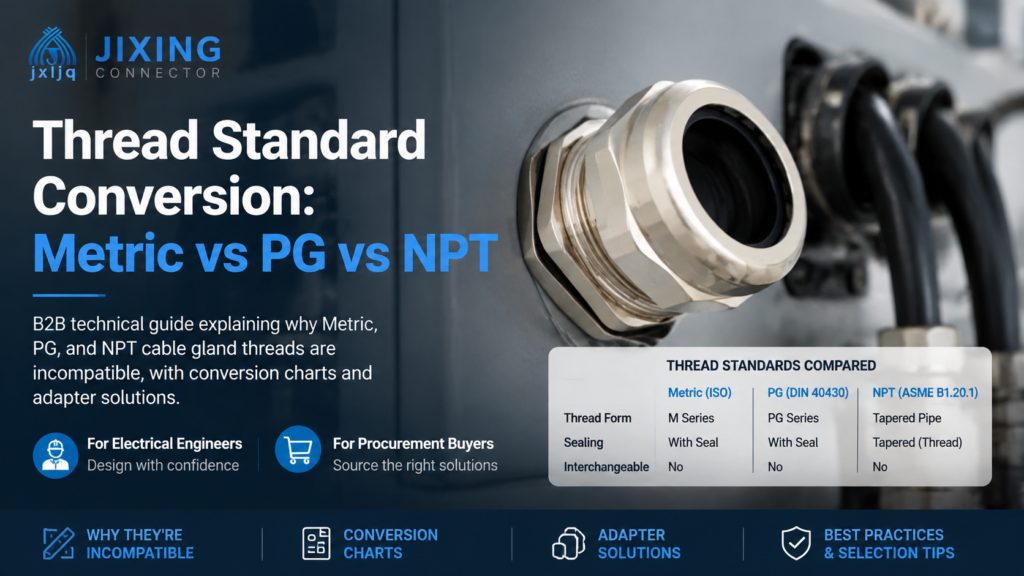
Metric, PG, and NPT cable gland threads are mechanically incompatible. This guide explains the dimensional differences, shows conversion by cable OD band, and lists adapter solutions for legacy enclosures.
Read More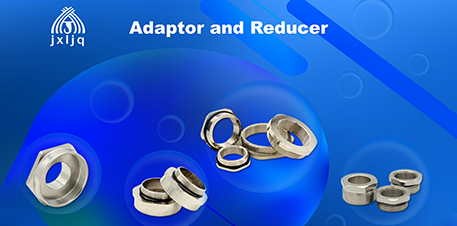
When to use a cable gland adaptor, reducer or enlarger: the difference between them, common thread combinations, and how to keep the IP rating when threads do not match.
Read More