Blog
What Is an IP69K Cable Gland? Washdown Rating Guide
IP69K cable glands explained: the high-pressure hot-water washdown rating, how it is tested, and how to choose cable entry for food, pharma and outdoor plants.
Read More

A flexible spiral cable gland, also called a spring cable gland, is a cable entry fitting built with a spiral flexible protector that surrounds the cable where it leaves the gland. Instead of a rigid exit that forces the cable into a sharp bend, the spiral section bends progressively along its length, absorbing movement and preventing over-bending, kinking and twisting at the entry point. It is a liquid-tight strain relief solution that protects the cable, minimises repairs and reduces downtime maintenance costs in applications where cables move.
These glands are widely used in dynamic applications where a standard rigid gland would shorten cable life: robotics, automation, handheld devices, lighting and sound equipment, automobiles and renewable energy. This guide covers what to confirm before you buy, how to choose the size and material, and the final checklist that prevents ordering the wrong part.
Cables for electrical appliances and machinery that move during normal use must be protected against excessive bending. A standard gland holds the cable at one rigid point, so every flex concentrates stress at that point and the cable jacket eventually cracks. A flexible spiral gland spreads the bending force along the spiral section, which:
Typical installations include robotic arms and end effectors, automation cells and AGVs, handheld power tools, stage lighting and sound systems, vehicle wiring and harnesses, and solar or energy storage equipment. In every case the cable moves, bends or vibrates, and the gland must protect both the cable and the enclosure entry.
To save time and complete the project smoothly, confirm these points before ordering flexible spiral cable glands:
Sizing is the step that causes the most ordering errors. Flexible spiral cable glands are sized by the cable clamping range, not by the thread size alone. A typical range covers cables from about 3 mm to 18 mm across the standard thread sizes, for example a smaller gland clamping 3-6.5 mm cable, a medium gland clamping 6-12 mm, and a larger gland clamping 13-18 mm. Always:
The material choice comes down to environment and budget.
| Factor | Nylon flexible spiral gland | Brass flexible spiral gland |
|---|---|---|
| Cost | Economical, first choice for most buyers | Higher |
| Durability | Good, PA66 is strong and durable | Excellent for industrial duty |
| Corrosion | Non-corrosive | Nickel plating resists corrosion, friction and contamination |
| EMI shielding | None | Conductive body offers shielding and grounding |
| Colour options | Black, white and custom colours | Metallic finish |
| Best fit | General automation, indoor, budget projects | Industrial, outdoor, harsh environments |
A nylon flexible cable gland is the practical first choice for most projects: economical, durable PA66 material, IP68 protection, available in black, white or custom colours to match equipment or colour-code cable use, and it forms a safe, reliable electrical connection while sealing out dust and water and allowing cable flexibility. A brass flexible cable gland is the choice for demanding industrial applications: nickel-plated brass gives excellent durability and performance, reliable bending and anti-kink protection, and a clamping system that protects against the cable being pulled out.
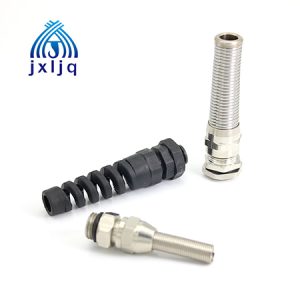
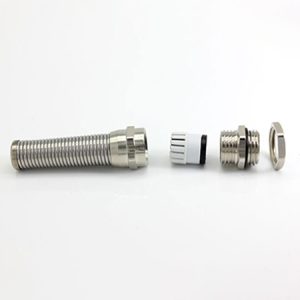
Before you place the order, run through this checklist:
For a deeper look at how these glands behave in moving machinery, our guide on strain relief cable glands for dynamic applications and the article on strain relief cable glands in robotics cover installation and selection in moving systems.
Flexible spiral cable glands are a cost-effective solution for any cable that moves, bends or vibrates in service. They protect against excessive bending, keep the enclosure sealed, and reduce repairs, damage and downtime. Ordering the right gland comes down to a short list of decisions: measure the cable, match the thread, choose nylon or brass for the environment, and confirm the IP rating, temperature range and certifications. Work through that list and the gland will perform for the life of the equipment.
If you have questions about sizing or selecting a flexible spiral cable gland for your application, contact us with your cable size, thread and environment, and our team will recommend the right product.
A flexible spiral cable gland protects cables that move, bend or vibrate in service, such as robotic arms, automation equipment, handheld devices, lighting and vehicles. Its spiral strain relief prevents over-bending and kinking at the cable entry point and keeps the enclosure sealed.
Measure the finished cable outer diameter, including the jacket, and select a gland whose clamping range brackets that diameter. Then match the thread type and size to the enclosure entry. Do not size by thread alone; the clamping range decides whether the seal works.
Nylon glands are more economical, lightweight and available in custom colours, and suit most indoor and general applications. Brass glands are stronger, nickel-plated for corrosion resistance, and offer EMI shielding and grounding, making them the choice for harsh industrial and outdoor duty.
Most flexible spiral cable glands achieve IP68 when the O-ring is fitted and the cable is inside the declared clamping range, meaning dust-tight and protected against continuous immersion. Check the datasheet for the exact rating and test condition.
Yes. UV-stabilised nylon and nickel-plated brass versions are suitable for outdoor use, with an IP68 rating sealing against rain, dust and washdown. Confirm the UV stabilisation and temperature range for the specific climate.
Flexible spiral cable glands are produced in Metric, PG and NPT threads. Metric is the most common worldwide, PG is an older European standard, and NPT is used for North American installations. Choose the thread that matches your enclosure entry.
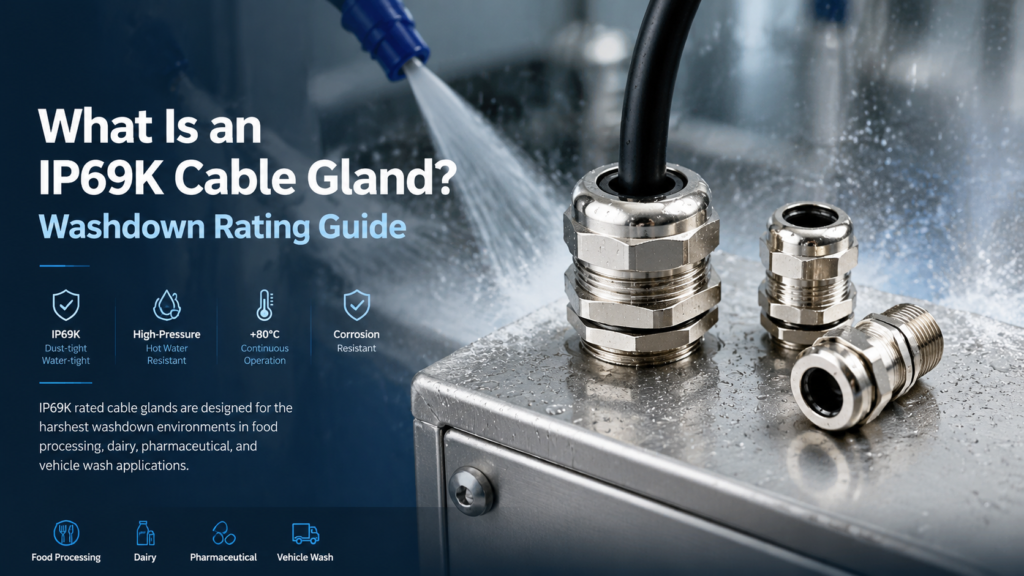
IP69K cable glands explained: the high-pressure hot-water washdown rating, how it is tested, and how to choose cable entry for food, pharma and outdoor plants.
Read More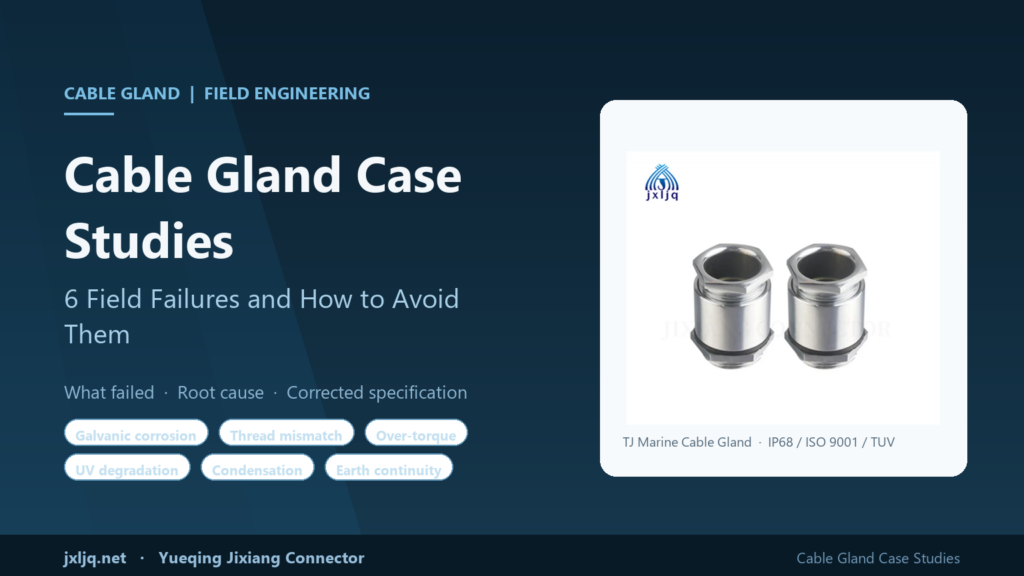
Six cable gland case studies from real installations: the failure, the root cause, and the corrected specification — plus five tests for verifying project claims.
Read More
Why robot cables fail at entry points, how strain relief cable glands protect them, where they matter in a robotic cell, and how to choose and install them.
Read More