Blog
ATEX Zones Explained: Ex d vs Ex e Cable Glands
ATEX zones explained in plain terms: Zone 0-2 and 20-22, equipment categories and EPLs, plus how Ex d and Ex e cable glands differ and when a barrier gland is required.
Read More
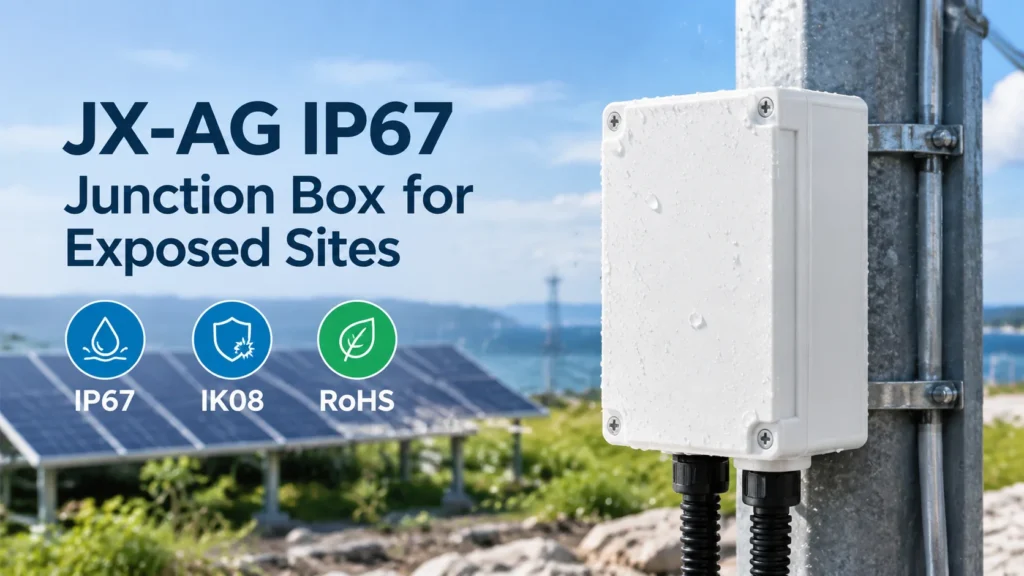
An ip67 junction box is the default answer for outdoor wiring that gets rained on, hosed down and occasionally sits in a puddle. It is also one of the most over-claimed specifications in the category, because IP67 means something much narrower than most buyers assume: temporary immersion, one metre deep, thirty minutes. Nothing more.
This page sets out what an IP67 enclosure is actually certified to do, why the IK08 impact rating matters more than most buyers expect on an exposed wall, and where an IP67 box stops being the right choice — the semi-submerged case, where water stands around the enclosure for hours or days rather than minutes. Then it lists the range and dimensions we build it in, and the five installation habits that decide whether the rating survives first contact with site conditions.
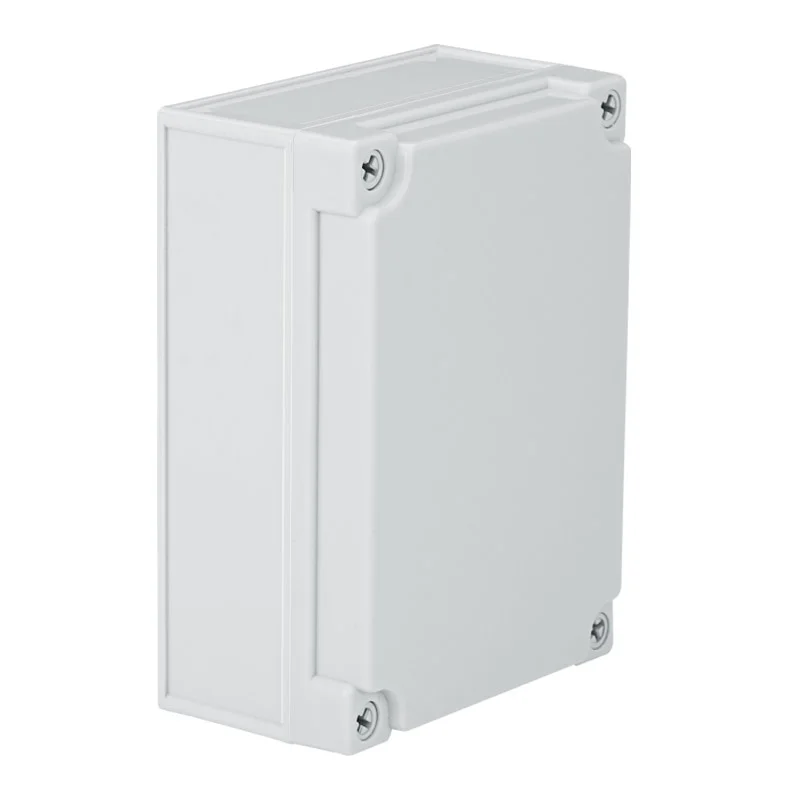
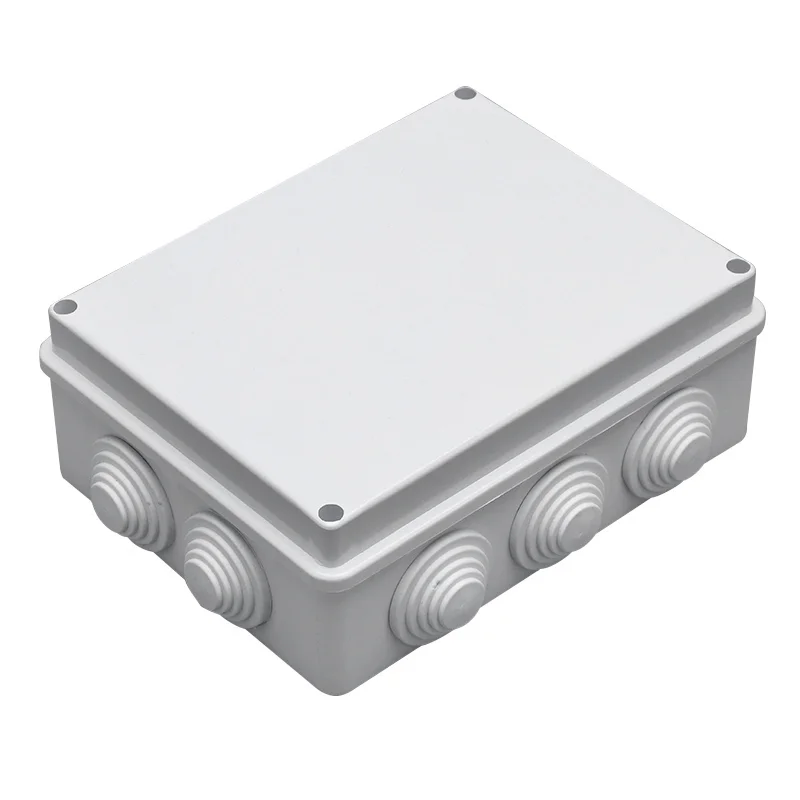
The JX-AG series is the enclosure this page is about: an IP67, IK08 plastic box from 95×65×55 mm up to 280×190×180 mm, RoHS compliant, in a waterproof junction box family that also covers larger moulded-entry bodies.
The second digit codes immersion. IPX7 is tested with the lowest point of the enclosure 1,000 mm below the water surface for 30 minutes, with the top of the enclosure at least 150 mm below the surface, and the water no more than 5 K warmer than the box. After the test the enclosure is opened and inspected for water that has reached live parts or that could impair operation.
Three implications follow directly from that sentence, and they matter more than the number itself:
A box in moving rain sheds water. A box in standing water does not. The moment an enclosure is partly submerged for hours, two things change: the pressure head is constant rather than transient, and any weakness in the gasket path has time to wick. A seal that passes a 30-minute test because the gasket is merely compressed can still pass water over a weekend through capillary action along a cable jacket.
This is why an IP67 box in a semi-submerged location should be treated as an installation problem rather than a rating problem. Either the box is raised above the standing water line, or the enclosure class changes. Our IP67 vs IP68 comparison covers the second route: X8 has no fixed depth or duration at all — those numbers are declared by the manufacturer and must appear on the datasheet, which is exactly the point buyers should be asking about when a supplier says “IP68”.
Impact protection is the second number almost nobody checks, and the one that fails first on a wall-mounted box. IK08 means 5 joules of impact energy under IEC 62262. In field terms that is roughly a 2 kg mass dropped from 25 cm onto the lid, or a strimmer, a ladder foot or a wheelbarrow handle catching the enclosure.
| IK rating | Impact energy | Rough field equivalent |
|---|---|---|
| IK06 | 1 J | Hand tool knock, light contact |
| IK07 | 2 J | Dropped hand tool from waist height |
| IK08 | 5 J | 2 kg mass from 25 cm; ladder or barrow strike |
| IK10 | 20 J | Deliberate heavy strike; vandal-resistant specification |
The reason IK08 is worth specifying on exposed sites is not the impact itself — it is what an impact does to the seal. A cracked lid or a deformed gasket channel turns a certified IP67 enclosure into an unrated one, and the failure shows up months later as corrosion on a terminal rather than as a visible break. If the box is on a wall at knee height in a yard, IK08 is a minimum, not a luxury.
The range is designed for locations that are wet but drain. That covers more of the real world than the IP68 marketing suggests:
In each case the box gets wet and then dries. The immersion allowance covers the hose, the burst pipe, the blocked drain and the storm surge that lasts an hour — which is what the standard was written for.
Semi-submerged means water stands around part of the enclosure. Before ordering, answer three questions:
| Question | If the answer is yes | What to do |
|---|---|---|
| Can the standing water exceed 1 m at the lowest point? | IP67 is out of scope | Raise the box, or specify an IP68 enclosure with declared depth and duration |
| Can water stand for more than 30 minutes at a time? | IP67 is out of scope | Raise above the flood line, or use a potted / gel-filled joint |
| Is the water saline, silty or chemically loaded? | IP testing does not cover it | Confirm material compatibility separately; add a maintenance interval |
The most common real failure we see is not a wrong IP number — it is a correctly rated box installed at ground level in a pit that fills. Raising the enclosure 300 mm on a bracket costs almost nothing and solves the problem that no rating can solve.
Sixteen stock sizes from 95×65×55 mm to 280×190×180 mm. The same series is sold regionally as a splash-proof box, a sealed box, an electrical sealed box or a waterproof power box, which is why the same product can be hard to find under one name.
| Model | L×W×H (mm) | Weight (kg/pc) | Pcs/ctn | Carton (cm) |
|---|---|---|---|---|
| JX-090605 | 95×65×55 | 0.12 | 160 | 41×34×45.5 |
| JX-110805 | 110×80×50 | 0.14 | 135 | 41×34×45.5 |
| JX-110808 | 110×80×85 | 0.19 | 75 | 41×34×45.5 |
| JX-101007 | 100×100×75 | 0.18 | 140 | 52×42×52 |
| JX-121207 | 125×125×75 | 0.25 | 72 | 51×38.5×47.5 |
| JX-171207 | 175×125×75 | 0.32 | 60 | 53.5×52.5×39.5 |
| JX-202010 | 200×200×100 | 0.59 | 24 | 62×41×53 |
| JX281913 | 280×190×180 | 0.94 | 12 | 57×39×55.5 |
The full 16-model table, with carton weights and gross volume, sits on the JX-AG high-end waterproof junction box page. If you are choosing between two adjacent sizes, the sizing arithmetic — conductor count, box fill, then bend radius — is in the junction box size chart.
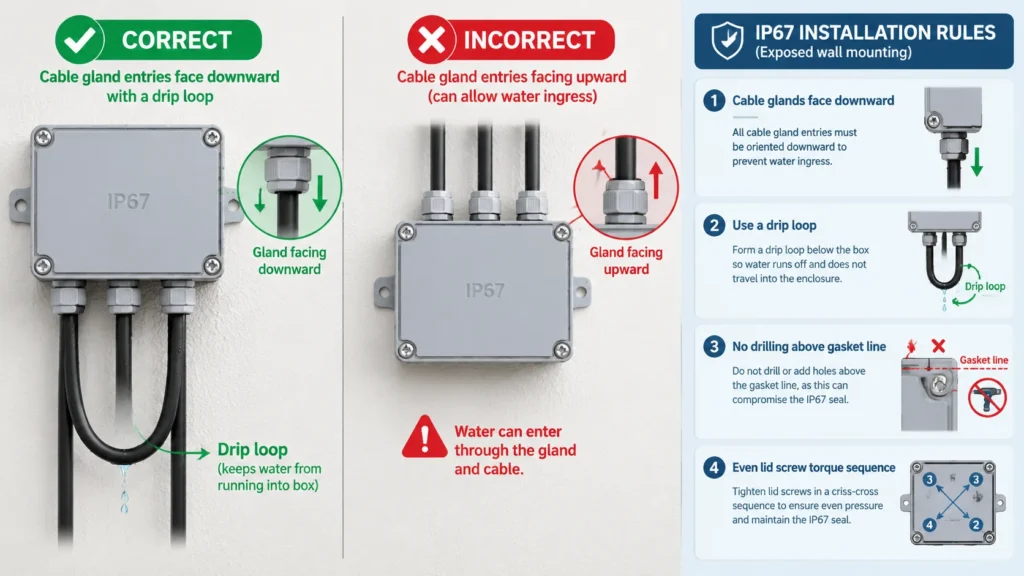
IP67 is the right specification for boxes that get wet and drain, and the wrong one for boxes that sit in water. Pair it with IK08 on any exposed wall, install the entries facing down, and treat the semi-submerged case as a mounting problem: raise the box, or move to an enclosure whose depth and duration are declared on the datasheet.
Send us the mounting position, cable diameters and expected water exposure and we will confirm the model and the entry layout that matches. Send the details to our engineering team and we will reply with a dimensioned drawing and available stock.
Dust-tight, plus protection against temporary immersion with the lowest point one metre below the surface for thirty minutes. It is not a rating for continuous or long-duration submersion.
No. Burying or permanent submersion exceeds both the depth and the duration of the X7 test. Use an IP68 enclosure with a declared depth and time, or a potted joint, and confirm the requirement with the manufacturer in writing.
For a box at height in a domestic or commercial yard, yes. IK08 equals 5 joules, roughly a 2 kg mass from 25 cm. For public areas, car parks or anywhere deliberate damage is plausible, specify IK10.
The standard test uses fresh water. Salt spray, chlorides and process chemicals need a separate material-compatibility assessment — the enclosure material and the gasket compound matter more than the IP number in those locations.
Both are dust-tight. X7 has fixed test conditions; X8 is stronger but declared by the manufacturer, so the depth and duration must be stated on the datasheet. An IP68 claim without numbers is not a specification.
Almost always an entry problem, not a gasket problem: an upward-facing gland, a cable jacket that is undersized for the seal, a lid screw missing, or condensation from thermal cycling. Check the entries first, then add ventilation.
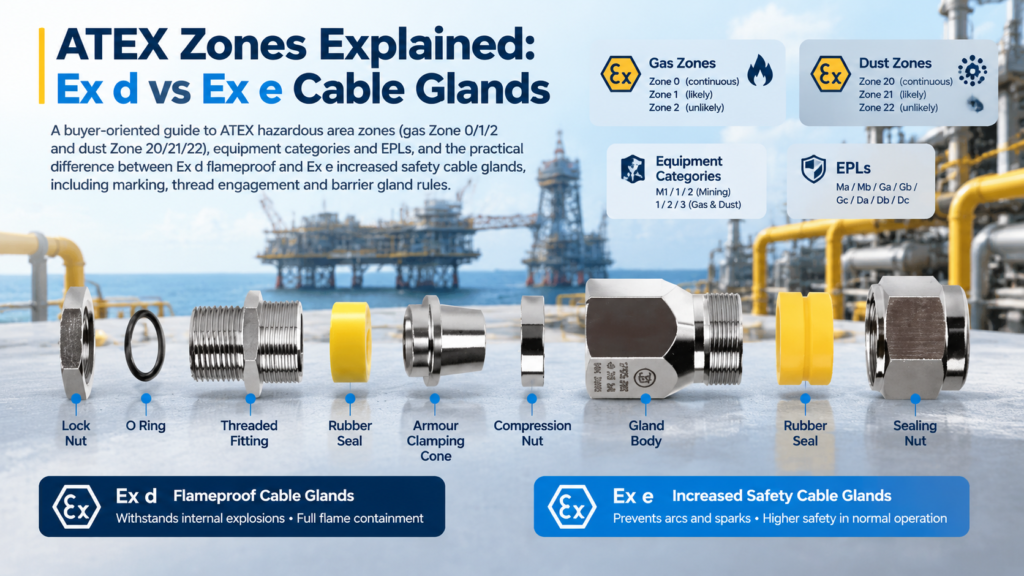
ATEX zones explained in plain terms: Zone 0-2 and 20-22, equipment categories and EPLs, plus how Ex d and Ex e cable glands differ and when a barrier gland is required.
Read More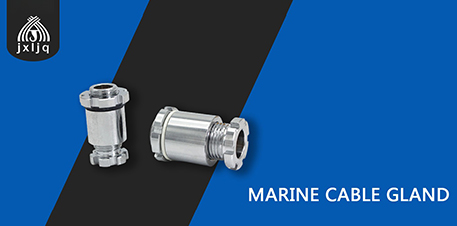
A marine cable gland is a sealing device used for cable entry in industrial electrical installations, shaped like a sleeve. When a cable passes through the gland, epoxy glue or a compression seal is used to achieve explosion-proof, waterproof, and dust-proof sealing at the enclosure entry point. On a ship, every cable that passes through […]
Read More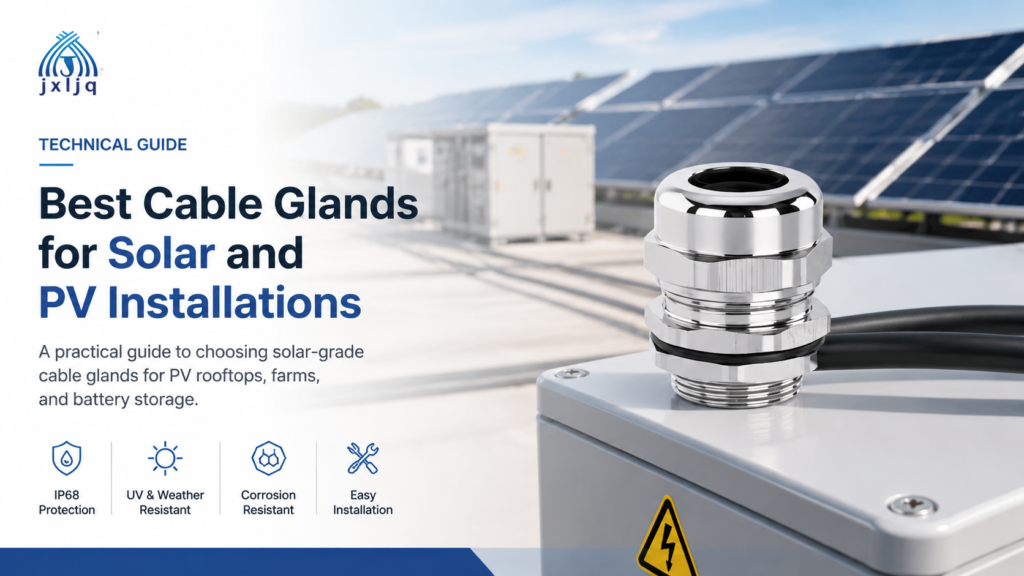
A practical guide to choosing solar-grade cable glands for PV rooftops, farms, and battery storage. Compare materials, IP ratings, and installation tips.
Read More