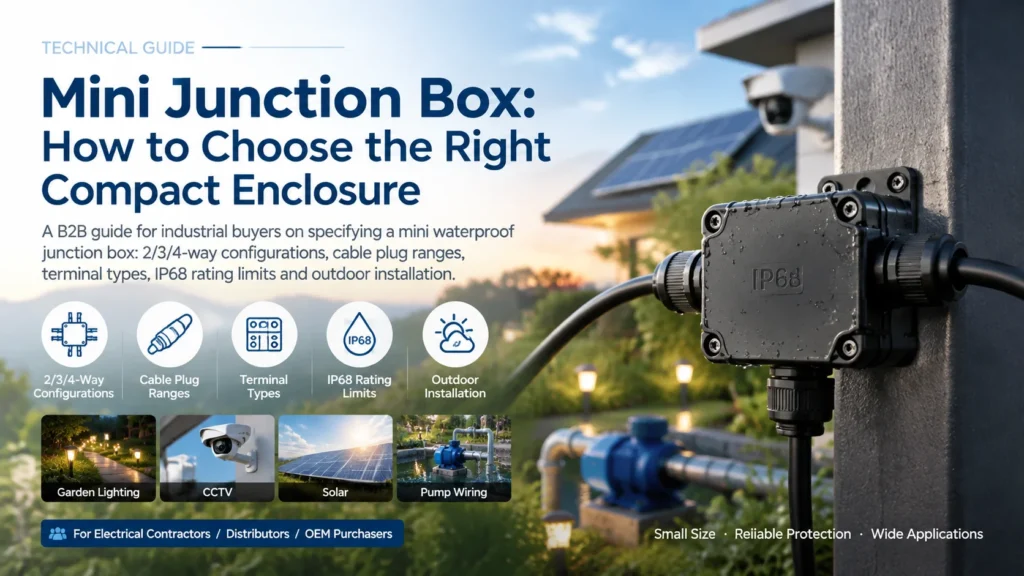
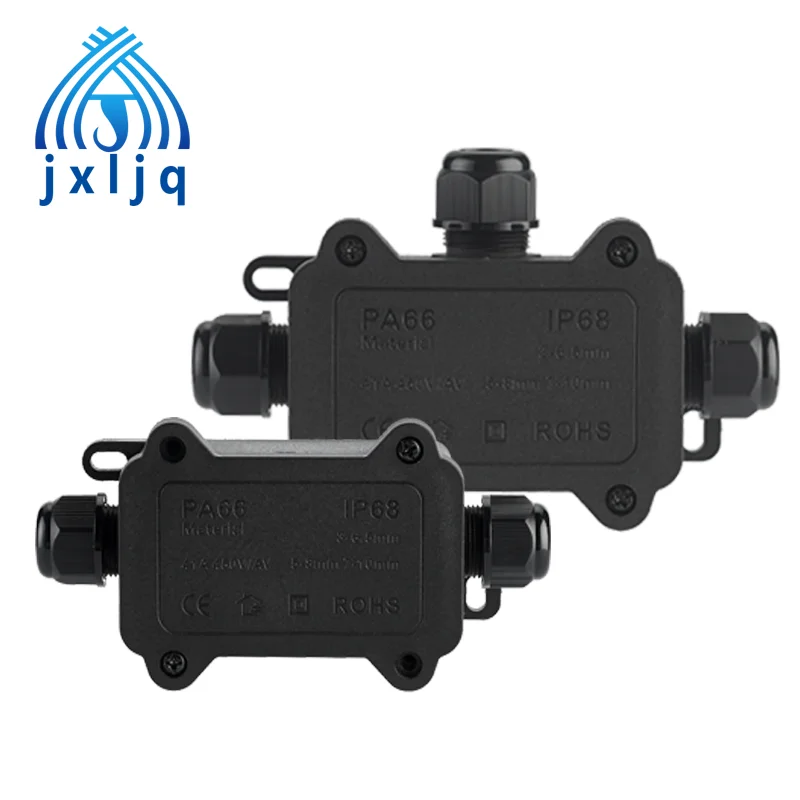
A mini junction box is a compact, sealed enclosure used to join two, three, or four cable runs where a full-size box will not fit — behind a light fixture, inside a soffit, under a deck, or at the base of a garden post. The category sits between a gel-filled splice kit and a standard wall box: bigger than a connector, smaller than anything that takes a DIN rail.
Most buyers get it wrong the same way. They pick a way count first, order on price, and discover at installation that the cable jacket does not fit the rubber plug, or that the box has no room for the bend radius the cable needs. This guide covers the three decisions that actually define the part — ways, cable range, and terminal type — then the ratings, the installation steps that preserve the seal, and the points worth confirming before you order. The mini junction box category lists current models by way count and cable range if you want to compare while reading.
What Makes a Junction Box “Mini”?
There is no standard that defines the term. In practice, a mini box is moulded as a single compact body with cable entries built into the housing rather than knocked out of a wall, and it terminates cables directly on a small internal block instead of a separate terminal strip you install yourself. That construction keeps the footprint palm-sized — typically under 100 grams for a 2-way unit. The trade-off is fixed capacity: a mini box cannot be expanded, cannot take a DIN rail, and cannot accept a cable entry that was not moulded into it. That is the right compromise for a lighting spur and the wrong one for a control panel.
The Three Decisions That Define the Part
1. How many ways — 2, 3, or 4
“Ways” counts the cable directions the box accepts, not the number of wires inside.
2-way — a straight in-line join. One cable in, one cable out. This is the default for extending a run.
3-way — a T-branch. The feed continues past the box while a spur leaves at the side. Standard for lighting circuits where one feed serves several fixtures.
4-way — a cross junction. Two runs pass through and both can branch, or four cables meet at one point.
The mistake here is buying by way count alone. A 4-way box does not help if the fourth entry is a moulded size that will not take the cable you have.
2. Cable outside diameter and rubber plug range
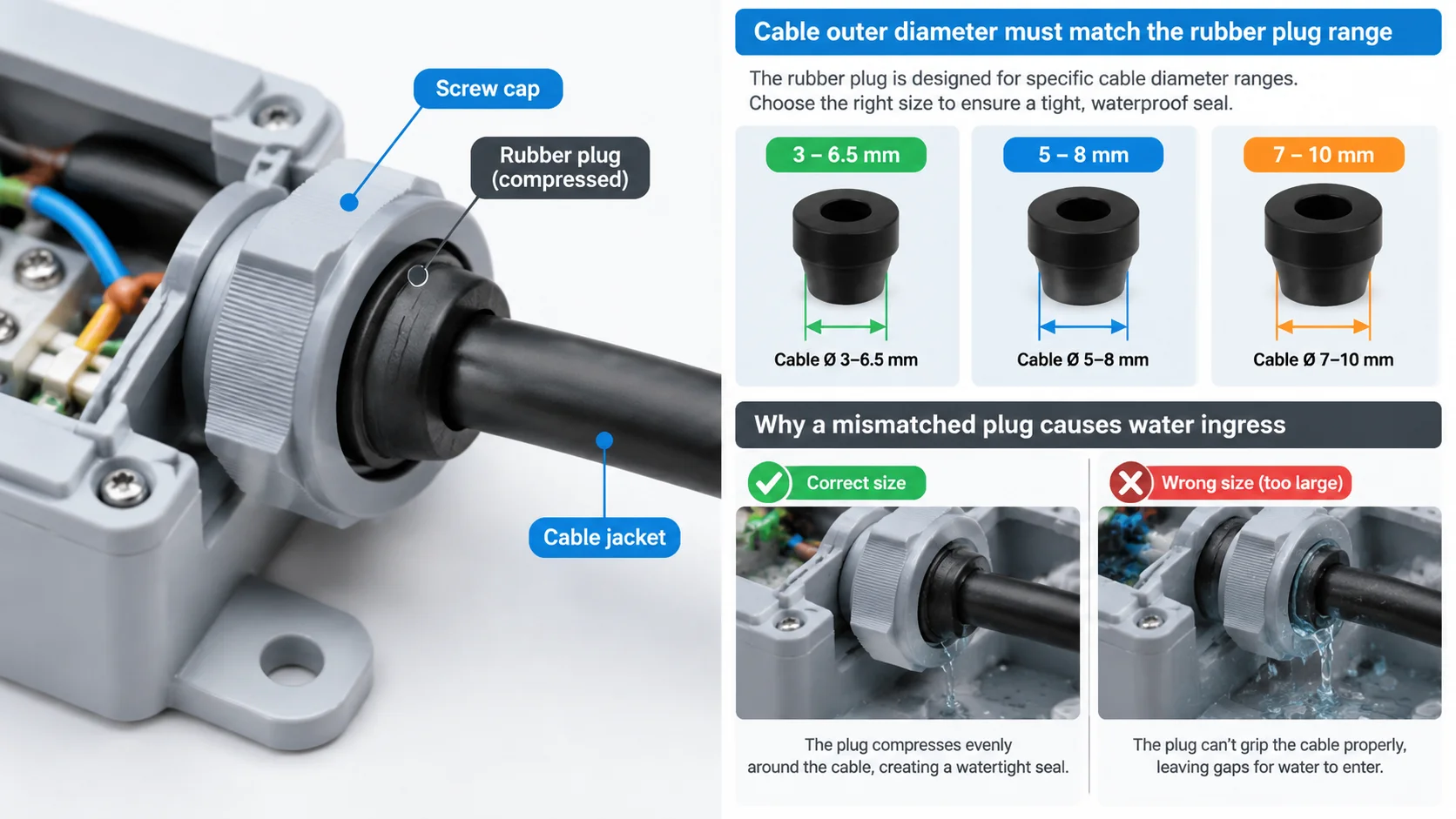
This is the specification that fails in the field. Mini boxes seal on the cable jacket with a rubber plug compressed by a screw cap. Each box ships with a plug sized for a specific diameter band, and the band is narrow: on the F1 series the three options are 3–6.5 mm, 5–8 mm, and 7–10 mm.
Measure the actual jacket with a caliper, not from a datasheet. A 6 mm cable sits inside the 5–8 mm plug with room to compress; the same cable in a 3–6.5 mm plug is already at the top of its range and will not seal reliably after a season of thermal cycling. One box size, three plug options, three different part numbers — that is normal for this category.
3. Terminal type — screw-crimp, push-in, or lever
Screw-crimp terminals are the most common and the most serviceable: strip, insert, tighten. Push-in and lever terminals are faster on site and better where the installer cannot reach the terminal with a screwdriver. Lever terminals are also easier to re-open during testing.
None of these changes the IP rating. The rating belongs to the housing, the plug, and the lid seal combined — the terminal block sits inside a sealed volume and its type has no effect on ingress protection.
Mini vs Standard Junction Box
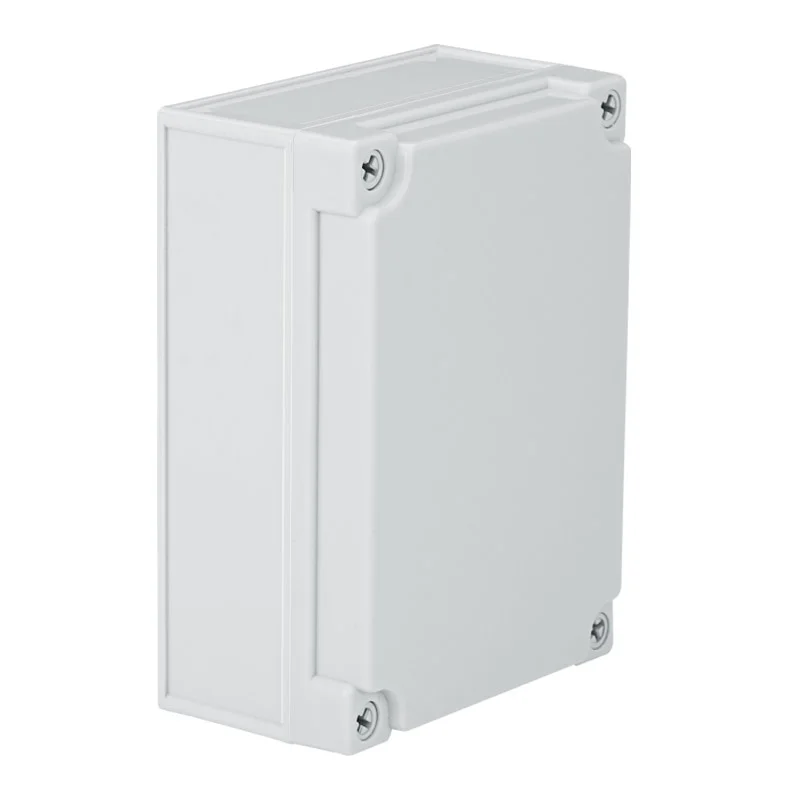
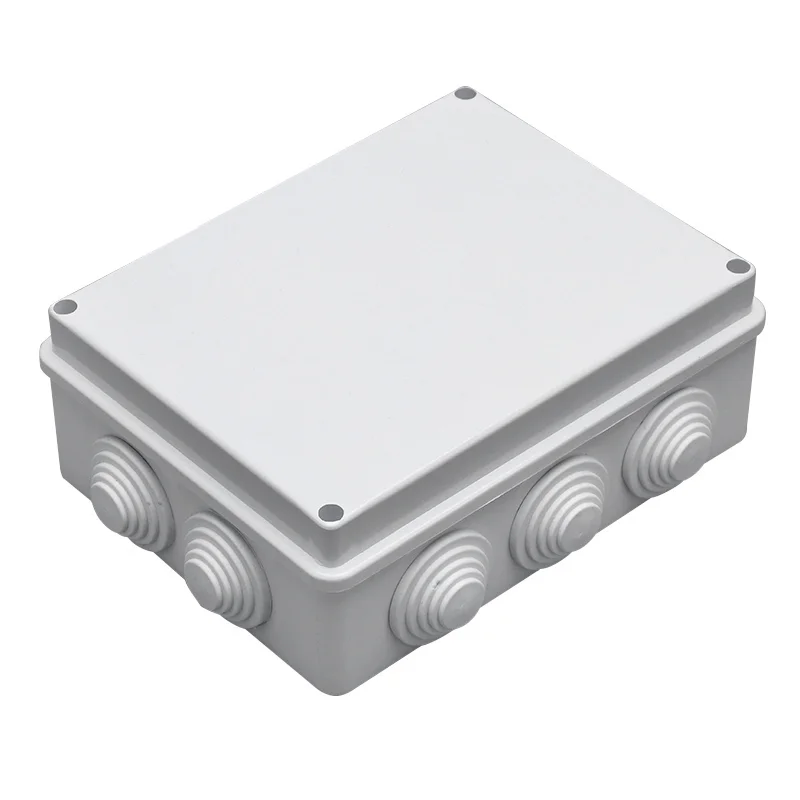
The decision is about internal volume and serviceability, not protection. A mini box can carry the same IP68 rating as a large enclosure; what it cannot do is give you space. Rule of thumb: if the connection is a splice that gets closed and left alone, a mini box is enough. If someone will open it to add a circuit, or the cable is stiff armoured stock, move up to a standard enclosure such as the JX-AG high-end waterproof junction box (95 × 65 × 55 mm to 280 × 190 × 180 mm), or the JX-RA plastic waterproof junction box if internal mounting for a PCB or DIN rail is required.
Factor
Mini junction box
Standard junction box
Typical footprint
Palm-sized, 70–115 mm long
From 95 × 65 mm upward
Cable entries
Moulded, fixed count and size
Knockouts or threaded entries, selectable
Termination
Integral small block
Separate terminal strip or DIN rail
Expandability
None
Add terminals, rail, PCB
Bend radius room
Limited — check before ordering
Generous
Best fit
Lighting, CCTV, pumps, sensors
Power distribution, control, DIN-rail devices
IP Ratings on a Small Enclosure
Mini boxes in this category are commonly rated IP68. Before treating that as equivalent between suppliers, confirm two things:
The test depth and duration. IP68 is open-ended — the manufacturer states the conditions. A box tested at 1 m for 30 minutes and one tested at 4 m for 120 hours carry the same code.
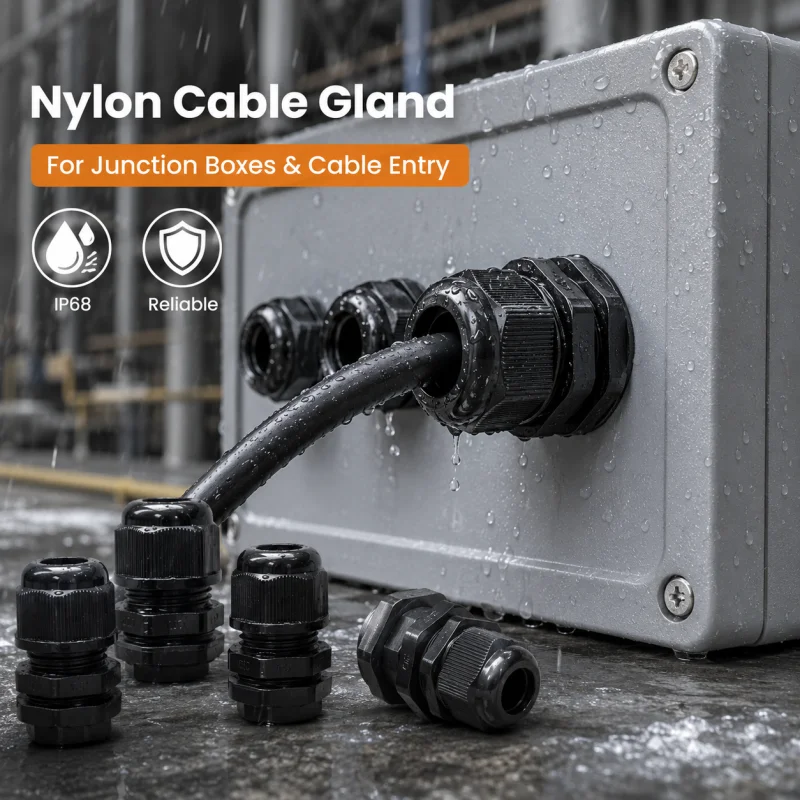
Whether the rating covers the assembled unit. A housing rated IP68 with the plugs supplied is not the same as the same housing with a gland fitted on site. If your installation needs a threaded gland instead of the moulded plug, the seal is only as good as that interface.
For above-ground outdoor work — a wall, a post, a soffit — IP65 or IP67 is usually sufficient. Reserve IP68 for buried joints, pits, fountains, and anything that can sit in standing water. The difference between the two codes in practice is smaller than the numbering suggests, and worth reading separately before you specify burial.
Where Mini Junction Boxes Are Used
Application
Typical configuration
Watch out for
Garden and landscape lighting
2-way in-line, 5–8 mm cable, buried or at fixture base
Burial requires genuine IP68 and a drain-free joint
CCTV and security cameras
2-way, behind the mount or in the soffit
PoE cable is fragile — do not over-compress the plug
Solar and renewable wiring
3-way branch, UV-stabilised housing
Continuous sun exposure accelerates plug hardening
Pumps and irrigation
2- or 3-way, wet location
Valve boxes cycle through condensation daily
Signage and facade lighting
2-way, short runs
Access for service is often forgotten
Installation: Five Steps That Keep the Seal
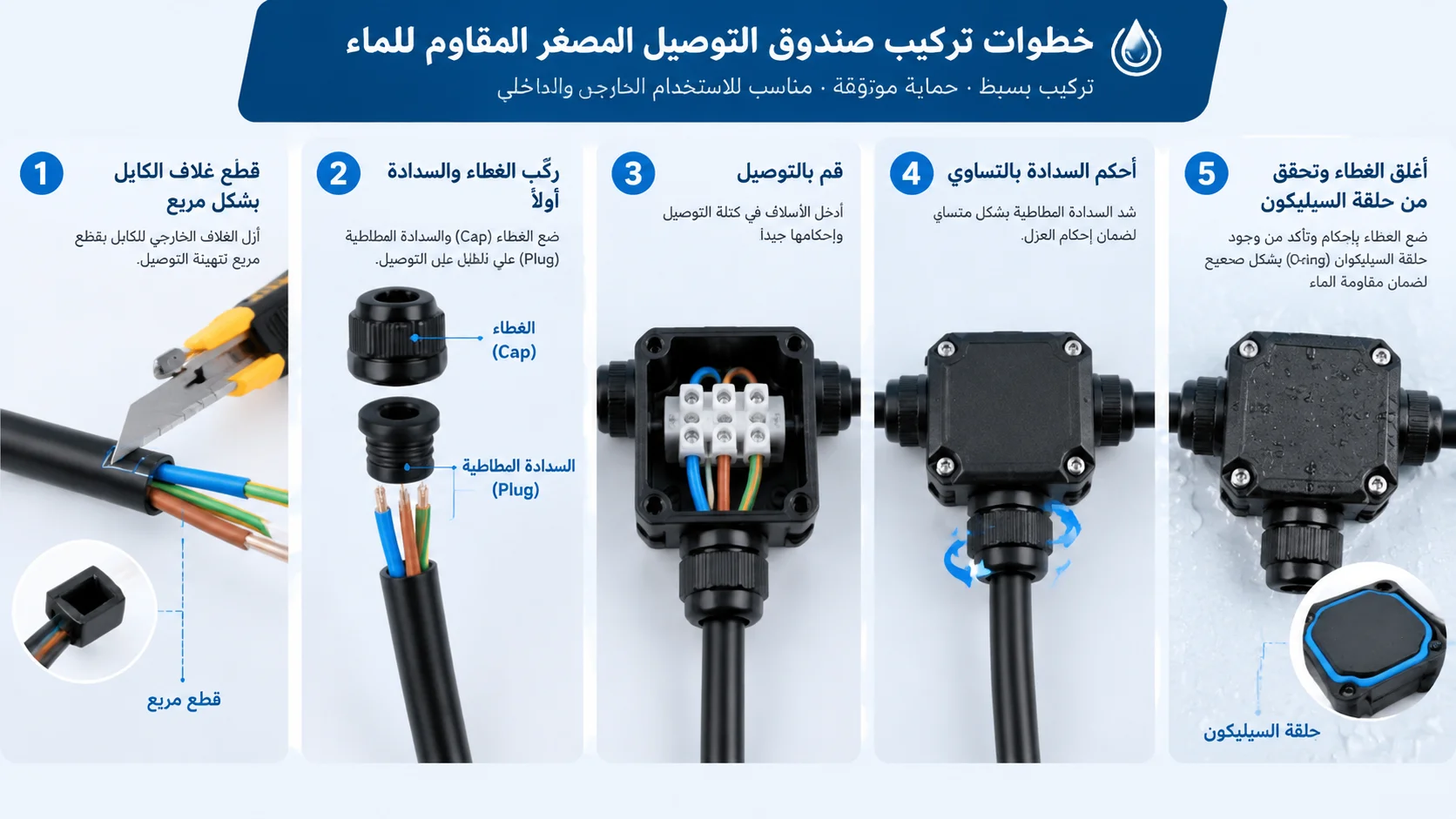
Cut the jacket square. A ragged cut leaves a path for water to track under the plug. Strip only the length the terminal block needs.
Fit the cap and plug first. The screw cap and rubber plug must slide onto the cable before the conductors go into the block — they cannot be added afterwards.
Terminate and check. Tighten each screw, then pull each conductor lightly. A conductor that moves will heat under load.
Seat the plug and tighten evenly. Compress the plug until it grips the jacket without deforming it. Overtightening splits the plug or pinches the insulation.
Close the lid and confirm the O-ring. The silicone O-ring must sit in its groove with no twist and no grit. Tighten lid screws in a cross pattern, not around the perimeter.
Five Mistakes That Cause Failures
Mismatched plug range. The cable measures outside the plug band, so the cap cannot compress anything. Water tracks along the jacket.
Unused entries left open. Every entry must be closed with its plug, not tape and not silicone alone.
Condensation ignored. A sealed box with a daily temperature swing builds internal moisture even with a perfect seal. In non-submerged installations, a breathable vent plug equalises pressure without admitting water.
Buying on price and ignoring the rating. An indoor-rated box used outdoors fails within a season, and the labour cost of the return visit exceeds the price difference many times over.
Assuming a mini box can be buried because it is IP68. Burial also depends on mechanical protection, soil movement, and local wiring rules — the rating alone does not authorise it.
Ordering: What to Confirm With the Supplier
For project quantities, five items should be fixed in writing before production:
Way count and the exact plug range per entry
Rated voltage and current, and the wire cross-section accepted
Housing material and flame-retardant grade
IP rating with its test conditions
Whether custom housing colour, laser marking, or packaging is available, and at what minimum order quantity
The F1-2T/3T/4T series, for example, covers 2-way, 3-way, and 4-way bodies with cable ranges of 3–6.5 mm, 5–8 mm, and 7–10 mm, PA6 flame-retardant housing, silicone O-ring, nickel-plated brass conductors, and 16 A or 24 A at 450 V — and is available with OEM cable ranges and packaging. Full dimensions and model numbers are on the F1-2T/3T/4T product page.
Conclusion
A mini junction box is a fixed-configuration part, so the specification has to be right before the order, not after. Get the way count from the wiring layout, the plug range from a caliper reading of the actual jacket, and the terminal type from how the joint will be serviced. Then confirm the IP rating’s test conditions and whether the seal depends on a gland you supply yourself.
Comparing compact against standard enclosures for the same project? The IP68 waterproof junction box selection guide walks through the full enclosure decision, and junction box vs distribution box clarifies where a box stops being a junction point. Send us the jacket diameters and way count and we will confirm the matching part number.
FAQ
What is a mini junction box used for?
It joins two to four cable runs in a space too small for a standard enclosure — typically behind light fixtures, in soffits, at post bases, and on irrigation or CCTV runs. It is a splice enclosure, not a distribution point.
What is the difference between a 2-way, 3-way, and 4-way mini junction box?
The number of cable directions the body accepts. A 2-way makes a straight in-line join, a 3-way makes a T-branch while the feed continues, and a 4-way makes a cross junction. It does not refer to the number of conductors inside.
Can a mini junction box be buried underground?
Only if it is rated for the conditions and local wiring rules permit it. IP68 indicates the housing survived a defined submersion test; it does not by itself approve direct burial, which also depends on mechanical protection and soil movement.
How do I know which rubber plug size to order?
Measure the cable outside diameter with a caliper at the point where it enters the box, then choose the plug band that contains that figure with margin on both sides. Do not size from a nominal cable description.
Do I need cable glands with a mini junction box?
Usually no. Mini boxes seal with moulded entries and rubber plugs. Glands are used when the enclosure has threaded entries, or when the cable needs strain relief and armour clamping that a plug cannot provide.
Can a mini junction box carry the same current as a standard box?
Current capacity comes from the terminal block and conductor size, not the housing. Compact boxes are commonly rated around 16–24 A at 450 V; check the terminal rating for the specific model rather than assuming it matches a larger enclosure.
Outdoor electrical systems are constantly exposed to rain, humidity, dust, UV radiation, and temperature changes. When wiring protection is not properly designed, water ingress and connection failure often occur at the cable entry points rather than inside the equipment itself. Understanding how waterproof cable glands and IP68 junction boxes for outdoor wiring systems work together […]
JIXIANG explosion proof cable glands are designed for hazardous and explosive environments where maximum safety is required. Our EX cable glands comply with ATEX and international explosion-proof standards, ensuring reliable cable sealing and grounding in oil & gas, chemical, and industrial applications. Product Types Single seal explosion-proof cable gland Double seal armored cable gland (CW […]
Learn how the IP68 rating on cable glands works: what IEC 60529 actually tests, how the two-seal waterproofing mechanism blocks water, and why installation errors cause most leaks.
We use cookies to enhance your browsing experience, serve personalised ads or content, and analyse our traffic. By clicking "Accept All", you consent to our use of cookies.