Blog
EMC Cable Gland Grounding: 360° Shield Termination Guide
Practical EMC cable gland grounding guide: 360° shield termination steps, panel preparation, common mistakes, and continuity checks.
Read More

Industrial robots run cables through nearly every moving part of the machine: up the arm, across the wrist, into the end effector, and back into the control cabinet. Every movement, from a welding torch reposition to a pick-and-place cycle, bends and twists those cables. The cable entry point, where the cable leaves the gland and enters the enclosure, is where that movement concentrates, and it is the most common place for robot wiring to fail in the field.
Standard cable glands grip the cable at one rigid point. When a robot arm flexes repeatedly, that single clamp point becomes a stress concentration, and the cable jacket cracks, the internal conductors fatigue, and the IP seal loosens over time. Bend tests on typical gland designs show first jacket failure after roughly 3,000 to 8,000 bend cycles with a standard gland, while a strain relief design keeps the same cable intact through 10,000 to 50,000 or more cycles. For a robot that moves several times a minute, that difference is the difference between planned maintenance and unplanned downtime.
This guide explains how strain relief cable glands solve this problem, where they matter most in a robotic cell, how to choose between brass and nylon versions, and how to install them so the protection actually lasts.
A strain relief cable gland, also called a spring cable gland or flexible cable gland, is a cable entry fitting built with a spiral flexible protector instead of a rigid exit. The spiral section surrounds the cable where it leaves the gland, supporting a longer length of cable and spreading bending force gradually instead of concentrating it at one sharp edge. Combined with the compression seal at the entry, a strain relief gland leads the cable into the housing in a sealed, strain-relieved way and typically achieves IP68 water protection when the sealing elements are correctly fitted.
Because the flexible section absorbs the movement, very little bending or pulling force transfers to the clamp and seal inside the gland. That is what keeps the seal compressed and the IP rating intact after millions of cycles. If you are not yet familiar with the general design, materials and mounting options of these fittings, our guide to strain relief cable glands for dynamic applications covers the fundamentals; this article focuses specifically on how they behave in robotic systems.
The protection works through three mechanisms that matter directly to robot uptime:


The result is a cable system that survives 5 to 10 times more flex cycles than the same cable in a standard gland, which translates directly into fewer cable replacements, less maintenance labour and fewer production stoppages.
Cable entry points appear in several places in a typical robotic installation, and each one stresses the fitting differently:
Strain relief cable glands are commonly manufactured in nickel-plated brass and nylon, and the material choice depends on the environment around the robot.
| Factor | Nylon strain relief gland | Brass strain relief gland |
|---|---|---|
| Best fit | General automation, cobots, indoor cells | Washdown, welding, chemical and heavy-duty areas |
| Corrosion resistance | Good, non-corrosive | Very good with nickel plating |
| Mechanical strength | Good | Higher, handles impact and vibration |
| Electrical continuity | Insulating | Conductive, supports bonding/grounding |
| Cost | Economical | Higher |
A nylon flexible cable gland is the economical, lightweight choice for clean indoor automation, collaborative robots and general machine wiring. A brass flexible cable gland suits washdown zones, welding cells with spatter, chemical exposure and areas where the gland itself takes mechanical abuse, and its conductive body helps maintain a bonded metallic conduit system.
A strain relief gland only performs if the cable route around it is designed correctly:
Work through the application before ordering:
For a structured buying process, our guide on buying flexible spiral cable glands covers the specification checklist, and the article on how IP68 ratings work for cable glands explains the sealing claims behind the datasheet.
Robots put cables under a kind of stress that standard cable glands were never designed to handle: continuous bending, twisting, vibration and acceleration at every entry point. Strain relief cable glands answer that problem with a spiral flexible section that spreads stress, absorbs torsion and keeps the IP seal intact for millions of cycles. Chosen by movement type and environment, sized to the actual cable, and installed with the correct bend radius and torque, they turn the weakest point of a robot wiring system into one of its most reliable parts.
If you are specifying cable glands for a robotic cell or automation line, contact us with your cable size, movement profile and environment, and we will recommend the right strain relief cable gland for your application.
A strain relief cable gland is a cable entry fitting with a spiral flexible protector around the cable where it exits the gland. It supports the cable over a longer length, spreads bending force gradually and absorbs torsion, preventing the sharp stress concentration that breaks cables in moving applications.
Robot arms and end effectors bend and twist their cables continuously. A standard gland concentrates that movement at one rigid point, cracking the jacket and fatiguing the conductors after a few thousand cycles. A strain relief gland distributes the stress and survives 5 to 10 times more flex cycles.
A standard gland grips the cable at one fixed point with a rigid exit, which creates a stress concentration under movement. A strain relief gland adds a spiral flexible section that bends progressively and absorbs torsion, protecting the cable and keeping the IP seal intact during flexing.
Yes. Nylon and brass strain relief glands are available with IP65, IP67 or IP68 ratings depending on the seal design. For food, beverage and washdown robot cells, choose a brass or suitably rated gland and confirm the seal material withstands the cleaning chemicals.
Nylon is the economical, lightweight choice for clean indoor automation and collaborative robots. Brass is stronger, conductive and more resistant to washdown, welding spatter and chemical exposure, making it the choice for harsh robot environments where the gland itself takes abuse.
Strain relief cable glands are typically rated IP65, IP67 or IP68 depending on the sealing design. With the seal and O-ring correctly fitted and the cable inside the declared clamping range, the gland maintains its rated protection even while the cable flexes.
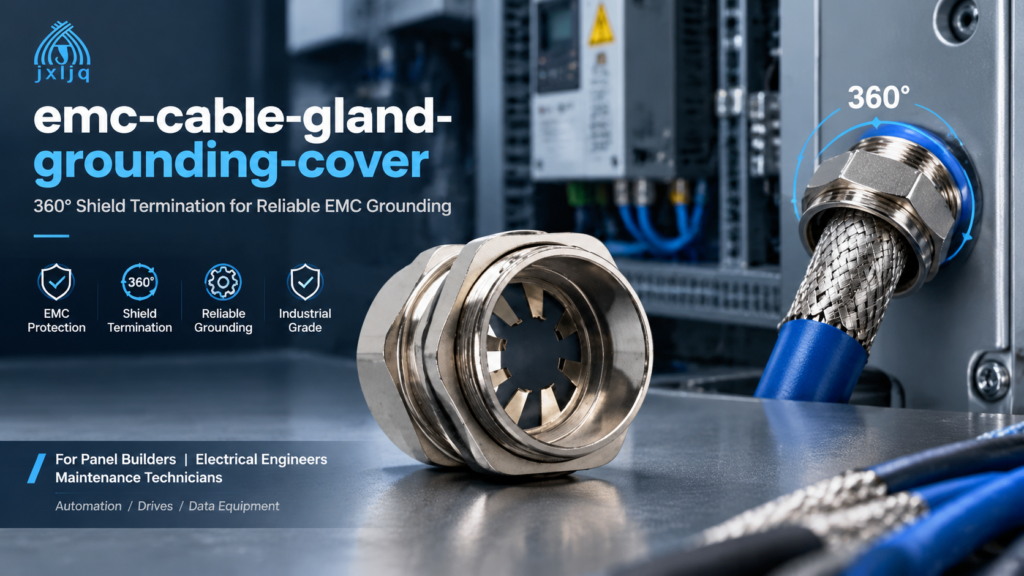
Practical EMC cable gland grounding guide: 360° shield termination steps, panel preparation, common mistakes, and continuity checks.
Read More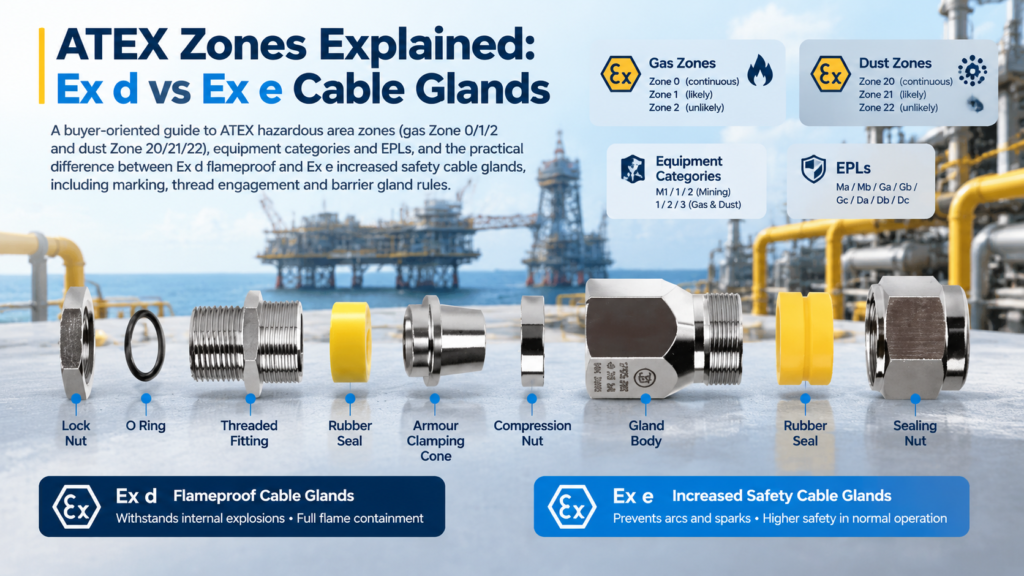
ATEX zones explained in plain terms: Zone 0-2 and 20-22, equipment categories and EPLs, plus how Ex d and Ex e cable glands differ and when a barrier gland is required.
Read More
Compare metric, PG, and NPT cable gland sizes in one chart. Learn how to measure cable diameter, match sealing ranges, and avoid sizing mistakes.
Read More